New to this edition: * Learn how many Hollywood techniques--previously impractical on video--can help solve problems on smaller productions * Expanded cookbook recipes section * Technically updated throughout
Make your soundtracks as good as your pictures with this compendium of professional audio techniques that can be adapted to desktop post. Specializing in sound after the shoot, this book features many practical examples, cookbook recipes, and tutorials. Audio theory, when necessary, is presented in plain English with plenty of visual analogies.
FAQs, full explanations, and from-the-trenches tips address the complete range of processes from wiring and hardware to testing the final mix. Novices will learn how to improve their soundtrack--even after the actors have gone home. Experienced producers will learn how to solve technical and creative problems quickly.
You'll get recipes and step-by-step instructions on how to: * build an efficient and reliable audio post setup * plan and budget a good soundtrack * get sound into your NLE without losing quality or sync * edit voices and music * record Foley and ADR * find music and use it effectively * find and create your own sound effects * shape sounds with equalization, reverb, noise reduction, and more * produce the final mix * test the final product for various media
We hear the world as ratios between sounds, not as absolute values. Volume and pitch differences—expressed as decibels and musical steps—are always comparisons between two values, like “twice as big” or “one-eighth.” Don’t think of these measurements as fixed units like ounces or inches.
Sound exists only in time, and there is no such thing as an “audio stillframe.” This affects everything you do with a track.
Although sound itself is analog, there are good reasons to keep a soundtrack in the digital domain. Some of the rules for digital audio are different from those for analog.
A TREE FALLS IN A FOREST …
Jokes and koans aside, we’ll assume it makes a sound. We’ll also assume you’re doing a film about logging, and the sound is part of a title sequence. You need to record the crash. You need to edit, process, and mix it for maximum impact. And you need to do this in a way that assures the viewer hears what you intended.
You probably bought this book to help accomplish goals like that. If you’re impatient, you can open the Table of Contents, find the tasks you want to accomplish, and turn to those chapters. Or, if you have issues with an existing track, flip to the gray-tinted pages at the end of this book: They’re a list of common problems and what to do about them.
But I honestly believe you’ll get a far better track—and ultimately be a better filmmaker—if you read this chapter first. It tells how a sound gets started, how it travels through the air, and how it turns into analog and then digital signals that are linked to pictures. When you understand this process, good sound becomes intuitive and creative. Then the rest of this book can serve as guidance, inspiration, and professional tips—things to build on, rather than steps to blindly follow.
This isn’t rocket science, just grade-school math and intuitive physics. But because it isn’t visual, many filmmakers surround the process with myth and hype. Take a few minutes now to think about how sound works; it’ll save you time and money later.
So: To the tree.
Gotcha
In this book, you’ll find a bunch ofGotchas. They straighten out audio myths, correct mis-applied principles, and fix other audio mistakes that can affect your track. They’re based on real-world confusions I hear from filmmakers, read on Internet forums, or even find in software tutorials.
HOW SOUND WORKS
If our tree fell on the moon, no one would hear it. Sound requires air,1 whose tiny molecules surround us. Anything that moves in the air reacts with those molecules.
As our earthbound tree’s leaves pass by, they scatter air molecules aside (a softwhoosh).
As branches and limbs break, they vibrate. The vibration is transferred to nearby molecules (crackle).
When the thick trunk gets close to the ground, it squeezes a lot of molecules in a hurry (bang).
When the trunk lands, the ground vibrates and moves molecules next to it (thud).
These movements eventually transfer to our ears, and we hear the tree come down. Let’s concentrate on just one aspect of that sound: the tree approaching the ground.
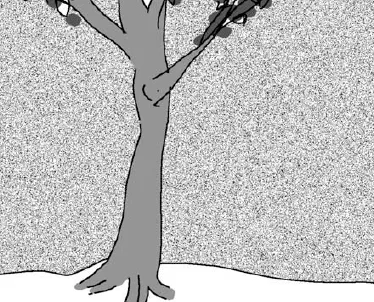
Before the tree starts to fall, air molecules surround it evenly. Their insectionidual positions may be random, but the overall density is the same on both sides of the trunk. If we could enlarge and see these molecules, they’d look like the black specks all aroundFigure 1.1.
_____________
1 Unless you’re making a science-fiction film. It’s an accepted movie convention that explosions, rocket fly-bys, and other events make noise in the vacuum of space. Sci-fi filmmakers also generally ignore another fundamental rule of physics, as you’ll learn in a couple of pages.
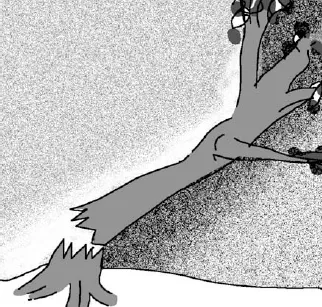
As the tree falls, it pushes molecules directly in front of it and squeezes them together (lower right in Figure 1.2). At the same time, it forms a partial vacuum behind it—where there was tree, now there’s nothing. This vacuum pulls nearby molecules into it, spreading them out (upper left).
The squeezed air molecules in front of the tree have to go somewhere, so they push against those farther out. Those newly-pushed molecules push others even farther, and so on. This creates a wave ofcompression, or higher air pressure, moving out from the tree. Meanwhile, the partial vacuum behind the tree forms a wave of low pressure, orrarefaction. It also moves out from the tree and draws nearby molecules toward it.
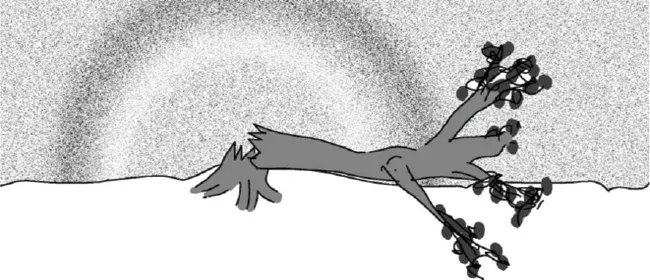
Trees aren’t two-dimensional blobs like my drawing. In the real world, molecules flow around a three-dimensional trunk and branches. So as our waves spread out, other molecules rush in to equalize the pressure behind them. The result is a growing bubble of compression and rarefaction that constantly spreads out from the tree. If you could freeze it, it would look like Figure 1.3.
FIGURE 1.1 Air molecules distributed evenly around a standing tree.
The Speed of Sound
Push one end of a piece of wood, and the other end immediately moves. But molecules in air aren’t connected that way. Push an air molecule, and it takes a moment for pressure to build up enough to move its neighbor.This is a vitally important concept: The farther sound has to travel, the longer it takes. Our pressure bubble spreads from the tree at about 1,100 feet per second. 2 It might seem pretty fast, but sound is a slowpoke compared to light.
When a sound is being picked up by two mics, differences in the length of time it takes to reach each can affect sound quality. We’ll deal with that in Chapter 7.
FIGURE 1.2 The falling tree squeezes molecules in front, and spreads out those behind.
_____________
2 Actually, sound travels 1,087 feet per second at 32° Fahrenheit, gaining about 1.1 foot per second per degree, with minor variations based on pressure and humidity. We round it to 1,100 feet per second. That’s close enough for filmmaking.
FIGURE 1.3 A growing bubble of compression and rarefaction spreads out from the tree.
Gotcha
Twelve yards is a frame! A video frame is roughly 1/30th second, and sound travels only about 36 feet in that time. 3 If you have a shouted conversation with someone across the street, their voice arrives about one frame after you see their lips move. If you see someone shoot a gun on the other side of a football field, the bang reaches you five frames after you see the barrel flash!
In other words, the real world is frequently out of sync. It affects the film world as well: In a very large theater, people in the back rows will hear dialog a few frames after it leaves the speaker mounted behind the screen.
Frequency
A tree falls just once, so our example creates a single pressure wave—something you’re as likely to feel as to hear. But most things that make sound tend to vibrate for a while. Consider the imaginary guitar string in Figure 1.4. When it’s pulled back (1.4a), it stores energy. When it’s let go, it snaps forward quickly and creates a pressure wave. But since it snaps past its resting position (1.4b),tension draws it back, creating rarefaction. The process repeats (1.4c) until all the energy from the pull is absorbed b...
Table of contents
Cover
Half Title
Title Page
Copyright Page
Table of Contents
Acknowledgments
Introduction
Chapter 1 Vibrations to Volts to Bits
Chapter 2 The Studio: Acoustics and Monitoring
Chapter 3 The Studio: Equipment and Wiring
Chapter 4 The Studio: Audio Software
Chapter 5 Planning the Track
Chapter 6 Getting Audio into the Computer
Chapter 7 Voiceover Recording a Dialog Replacement
Chapter 8 Editing Dialog
Chapter 9 Finding and Editing Music
Chapter 10 Working with Sound Effects
Chapter 11 Equalization
Chapter 12 Dynamics Control
Chapter 13 Time-Domain Effects
Chapter 14 Time and Pitch Manipulation
Chapter 15 Noise Reduction
Chapter 16 Other Effects
Chapter 17 The Mix
Chapter 18 After the Mix
Chapter 19 Help!
Appendix A: Glossary
Appendix B: About the CD
Index
Trusted by 375,005 students
Access to over 1.5 million titles for a fair monthly price.
Study more efficiently using our study tools.
Frequently asked questions
Yes, you can cancel anytime from the Subscription tab in your account settings on the Perlego website. Your subscription will stay active until the end of your current billing period. Learn how to cancel your subscription
No, books cannot be downloaded as external files, such as PDFs, for use outside of Perlego. However, you can download books within the Perlego app for offline reading on mobile or tablet. Learn how to download books offline
Perlego offers two plans: Essential and Complete
Essential is ideal for learners and professionals who enjoy exploring a wide range of subjects. Access the Essential Library with 800,000+ trusted titles and best-sellers across business, personal growth, and the humanities. Includes unlimited reading time and Standard Read Aloud voice.
Complete: Perfect for advanced learners and researchers needing full, unrestricted access. Unlock 1.5M+ books across hundreds of subjects, including academic and specialized titles. The Complete Plan also includes advanced features like Premium Read Aloud and Research Assistant.
Both plans are available with monthly, semester, or annual billing cycles.
We are an online textbook subscription service, where you can get access to an entire online library for less than the price of a single book per month. With over 1.5 million books across 990+ topics, we’ve got you covered! Learn about our mission
Look out for the read-aloud symbol on your next book to see if you can listen to it. The read-aloud tool reads text aloud for you, highlighting the text as it is being read. You can pause it, speed it up and slow it down. Learn more about Read Aloud
Yes! You can use the Perlego app on both iOS and Android devices to read anytime, anywhere — even offline. Perfect for commutes or when you’re on the go. Please note we cannot support devices running on iOS 13 and Android 7 or earlier. Learn more about using the app
Yes, you can access Audio Postproduction for Film and Video by Jay Rose in PDF and/or ePUB format, as well as other popular books in Media & Performing Arts & Film & Video. We have over 1.5 million books available in our catalogue for you to explore.