
- 148 pages
- English
- ePUB (mobile friendly)
- Available on iOS & Android
eBook - ePub
500 Tips for Primary School Teachers
About this book
This manual provides practical advice and tips on dealing with aspects of the primary teacher's role, from classroom organization to professional development.
Information
Chapter 1 Classroom Management and Organisation
When working with young children the way that you set up and run a teaching space is crucial. Young children need to be clear about what is expected of them and how they are supposed to go about their work. A disorganised classroom or constantly changing routines make for chaotic lessons. This chapter contains some ideas on how to help ensure that your classroom and classroom make life as easy and stress free as possible, for you and the children in your class. This section covers:
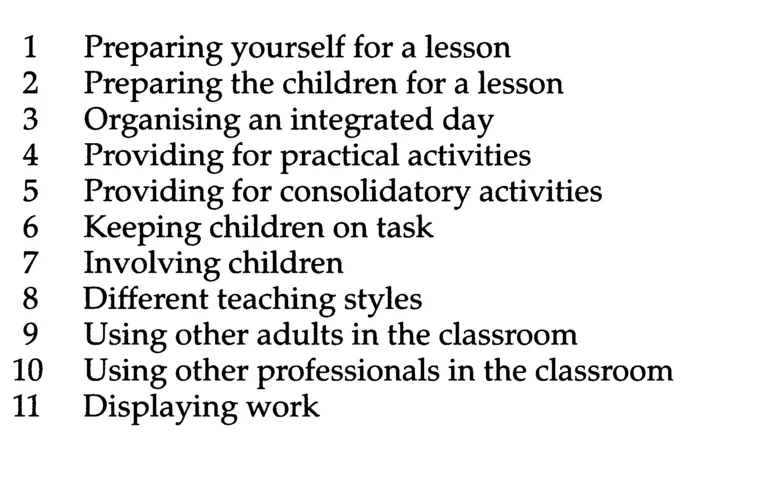
1
Preparing yourself for a lesson
To ensure that you use the time you have with the children in school as efficiently as possible, you have to be sure that you are properly prepared. This chapter looks at a range of issues you may need to consider and gives some practical ideas for helping you to do this quickly and effectively.
- Always start positively. In all aspects of your work, try to approach everything as cheerfully as possible. It usually has a positive effect on those around you too. Children are quick to pick up on a negative atmosphere and often react badly to it.
- Know where you are starting from. This helps to ensure that activities and questions can be pitched at the right level. Once you have had a class for a short time you will quickly develop a good idea of your class's abilities and knowledge. Experience of a year group also counts for a lot, but in the meantime it may help to ask regular class teachers (if you are on teaching practice) or previous class teachers for background data. Also, refer to previous work and records of the children involved. Of course you could also start by asking the children!
- Know where you are going. In your long-term planning you will have identified your long-term aims for a topic or term, but it is also essential to identify very short-term objectives for each activity or lesson. Know in advance exactly what you are hoping the children will have learned by the end of the lesson. This helps you to focus on the sorts of questions, resources and support you may need to build into the activity
- Know what resources you will need. Consider what resources will make the activity you are working on easier to manage and give appropriate structure so that the children can work independently, if necessary, helping to keep them on task.
- Know where to find these resources. Much of what you will need for your lesson will be readily available in school. Ask subject coordinators where possible about specific resources. Sometimes your own ideas can be adapted to fit the resources available, but if not, you will need to either produce some resources yourself or delegate the task to auxiliaries or trainees, if you have them in school. (Ensure that you give precise instructions.)
- Allow plenty of time to set up. Having all activities fully prepared and the resources readily available for the children before you begin the lesson will mean that they can settle to their work quickly. Even sharpening the pencils before the lesson means less fuss when the lesson starts. This is not always appropriate because children do need to learn how to organise themselves too, and this should be planned for.
- Make a list of the main points to be included in the lesson. A list of the main points you wish to cover in discussions with the children, or instructions you need to give, can help you put your original intentions into practice, even though this is not always that easy.
- Decide who will work where. Know where you will be working (your focus task). If you have nursery nurses, auxiliaries or parents helping in class, make sure you know what they are going to be doing too. You will need to give them clear and explicit instructions to make the best of their assistance.
- Have backup activities to hand. Consider what those children who might finish their work early will do. Try to build extension activities into the normal routines of the day. Having role-play areas, structured work in sand and water or free writing areas, reading or number games, fiction and non-fiction books applicable to the class you are teaching readily available, will ensure that children are engaged in worthwhile activities while others finish off.
- Have a checklist that shows the activities individual children or groups of children will be working on. It can also show when they start and whether they have finished or not. It will help you keep track and is especially useful if you are running an integrated day.
2
Preparing the children for a lesson
Getting the children in your class prepared for work is essential to get the best from them in the time available. The following ideas might help you to get the children settled and paying attention with the minimum of fuss.
- Welcome the children in to the class. This gives you a chance to set the tone of the day. You will be able to welcome them properly but also to establish control and reinforce your expectations of them from the first moment.
- Settle the children down. Many classrooms have a collecting or carpeted area, a place to gather the children together for whole class work and administration. Make clear to the class the rules that apply to the use of these areas. Having story or non-fiction books, puzzles, puppets or toys and some simple games available for the children in these areas gives them something to do and helps prevent disruptive behaviour.
- Manage things they might bring from home. Matters that the children are likely to want to talk about, or items they may wish to play with, will cause disruption if they keep hold of things they have brought with them into class. If you want to encourage children to bring things into class for 'show and tell' sessions, have a space where they might leave their belongings or ask them to leave them in drawers.
- Establish the rules for registration. Be imaginative: registration times can be fun and educational, but you will need to be clear and consistent about the rules. Try allowing children to respond in different languages or accents, quietly or loudly, time how long the register takes, or even sing responses, and so on.
- Set the scene for an activity. Start with what the children already know. Sometimes an activity will build on previous work, so remind the children of this work. Introducing new ideas will require more discussion, so allow time for this and consider how best to introduce the idea. Often stories, books or artefacts can be used, but asking children what they already know about a concept also establishes a context well.
- Ensure the children know why they are doing what they are doing. Making sure that children know what they are supposed to learn helps them to focus on the real point of the activity. Leaving them unsure of what they are trying to achieve means they might get the wrong end of the stick.
- Recap on the instructions you have given. It is worth recapping on the main points of the activity the children will be tackling just before they start. With young children, try to keep the number of different instructions to a minimum.
- Give the children the chance to ask questions. It's a good idea to let the children have the opportunity to check things out if they do not understand what is required of them. You can use this to reinforce the need for them to pay attention. Making it clear that you will not repeat your instructions once the lesson has started encourages good listening skills.
- Send the children to their jobs. Getting the children to settle to their work quickly sets the right tone for the lesson. Sending them off in small groups, or even one by one, helps prevent a crush or arguments over who might sit where. It is worth spending the first few minutes ensuring the children make a good start on their work before getting on with your main focus activity.
- Consider the environmental needs of the children. If the classroom is too warm or too cold, it makes it harder for them to concentrate. Try to get this sorted out before the lesson starts. Every so often, remind the children about others' needs and how important it is to let everyone get on with their work in peace.
3
Organising an integrated day
An integrated approach to classroom management is valuable because it can help children to balance independent learning with a more structured approach. Usually running an integrated day means tackling three or four activities, covering different areas of the curriculum at the same time. If you are going to use this integrated approach it is usually best to do it on a regular basis so that children get into the routines involved. The following tips offer some routines that might be useful.
- Have one focus activity for each work session. One of the main advantages of integrated activities is that you can structure each work session so that you can work with a small group on a specific task — the thing that you are actually going to teach. Let the children know where you are going to be working too.
- Prepare other work for the rest of the class. On the whole, these activities should be consolidatory tasks. Try to plan activities that the children will be able to tackle independently. Consider what resources you will be able to give the children to support them.
- Organise your classroom for integrated activities. If you are going to work on integrated activities, your classroom will probably need to be set up in areas where resources that support work in each curriculum area can be collected and made available for the children. You might also want to try to separate potentially noisy or active areas from areas for quieter and more settled activities.
- Help the children to help you. To allow you to get on with your focus activity, it is a good idea to instruct in advance those working on other tasks where they should put finished work and what they should do when they have finished, so as to avoid disturbing you. To help them manage their time it is also a good idea, now and then, to let them know how long they have got left.
- Remember that not every area of the curriculum has to be tackled each day or even each week. Trying to squeeze everything into a space where it doesn't comfortably fit might result in a waste of time for all concerned. A half-term plan should allow a balance of learning across the curriculum.
- Be aware that administration of integrated days can be complex. This is because you have to keep track of a range of different activities at the same time. Having a tick list that tables each child against each activity is virtually essential, as is a key that shows when they do what and how far they have progressed.
- Think about group sizes. Generally it is easier to split up your class according to broad ability bands, but some activities are inappropriate for (say) ten children to do at once. Practical activities, scientific investigations, art work, technology and so on may need to be done in smaller groups, so consider what the others might be doing at the same time.
- Keep instructions simple. Some children will need to work fairly independently. It is easy to bombard them with too much information. Often there will be points during work on your focus task where you can leave the children in your group to carry on independently. With careful management, you can use these times to give new briefings or reinforce previously delivered instructions or guidance to the other groups or mark work.
- Remember that setting up for integrated days can be time consuming. This is because there are more activities to set up than when all of the children are working on one task. Try taking some of the pressure off and getting the children to set up the more practical tasks for you. If they have just done a particular activity they will have a fair idea of what is required and, besides, they love doing it.
- Make sure you finish the session as carefully as you started it. At the end of the session you will probably want to get the children to start tidying up while you try to get round and check work. Having containers and spaces for storage of the equipment they have been using is really useful because it takes away a lot of the pressure of continually giving instructions about where things should go.
4
Providing for practical activities
The sorts of practical activity that you will want to tackle in your class obviously depend on the age of the children, the number in the class and how settled they tend to be, but there are still some basic, underlying ideas that might help you to organise and manage practical work. For ease they have been arranged into the three sections that practical activities tend to fall, but there is some overlap. It may also be useful to consider the ideas outlined in 'Organising an Integrated Day' too, (see page 8).
Scientific Investigation
- Provide unstructured opportunities for investigation. Giving the children the materials that they will be investigating as a 'choosing' activity some time before setting a more structured one gives them a good head start when it comes to trying to answer a specific question. (For instance, leave out a range of batteries, wires and bulbs for a week or so, then ask them to try to make a circuit.)
- Try to make sure that there is an adult to help. Left to their own devices, children tend to stray from an intended path during investigations. This may be part of the point, but if you or another adult can be on hand to ask questions and listen to the children's responses you will be able to keep the children focused on the original question.
- Consider whether you really need a written record from children. Getting children to record an experiment (what the children observe and appear to find out) does not necessarily demonstrate understanding and can disrupt the children's concentration. A verbal report to the class, group recording using an adult as a scribe, a concept keyboard overlay on a computer, diagrams, Cloze procedures, cut and stick activities, and so on, can be effective too.
- Manage investigations to keep children on task. You may want a small number of them to experiment as a group and without adult support. Keeping them on task will need structuring. This could be achieved by the use of work sheets, prompt cards, peer tutoring or something even more imaginative, such as displays or games.
Mathematical Investigation
- 5 Remember, you can never have too much practical equipment for maths. This is especially true when working with very young children, and having this equipment on display and accessible to the children is also important. Small children may well find waiting their turn for equipment detrimental to attention and behaviour,
- 6 Try to make practical activities relevant to children's lives. If you want to tackle non-standard measures, comparing the height of the children, their hand spans, foot sizes, reach and so on, or comparing spoons, chairs, beds or even eating porridge from different bowls after reading Goldilocks and the Three Bears is more relevant and memorable than 'colouring the biggest bowl in the picture'.
Art and Technology
- 7 Give the children ready access to materials that are available. If they are able to get at what they need when they need it, they will not have to bother you so often. Set up your areas with as wide a range of materials on show as possible. In the long term this will also give them more confidence in choosing appropriate materials.
- 8 For specific artistic activities, you will need to prepare the materials in advance. If the table is ready for them to get on w...
Table of contents
- Cover
- Title
- Copyright
- Dedication
- Contents
- Acknowledgements
- Introduction
- Chapter 1 Classroom Management and Organisation
- Chapter 2 Curricular Responsibilities
- Chapter 3 Pastoral Care
- Chapter 4 Making and Managing Resources
- Chapter 5 Assessment and Record Keeping
- Chapter 6 Your Professional Life
- Some Helpful Books
- Index
Trusted by 375,005 students
Access to over 1.5 million titles for a fair monthly price.
Study more efficiently using our study tools.
Frequently asked questions
Yes, you can cancel anytime from the Subscription tab in your account settings on the Perlego website. Your subscription will stay active until the end of your current billing period. Learn how to cancel your subscription
No, books cannot be downloaded as external files, such as PDFs, for use outside of Perlego. However, you can download books within the Perlego app for offline reading on mobile or tablet. Learn how to download books offline
Perlego offers two plans: Essential and Complete
- Essential is ideal for learners and professionals who enjoy exploring a wide range of subjects. Access the Essential Library with 800,000+ trusted titles and best-sellers across business, personal growth, and the humanities. Includes unlimited reading time and Standard Read Aloud voice.
- Complete: Perfect for advanced learners and researchers needing full, unrestricted access. Unlock 1.5M+ books across hundreds of subjects, including academic and specialized titles. The Complete Plan also includes advanced features like Premium Read Aloud and Research Assistant.
We are an online textbook subscription service, where you can get access to an entire online library for less than the price of a single book per month. With over 1.5 million books across 990+ topics, we’ve got you covered! Learn about our mission
Look out for the read-aloud symbol on your next book to see if you can listen to it. The read-aloud tool reads text aloud for you, highlighting the text as it is being read. You can pause it, speed it up and slow it down. Learn more about Read Aloud
Yes! You can use the Perlego app on both iOS and Android devices to read anytime, anywhere — even offline. Perfect for commutes or when you’re on the go.
Please note we cannot support devices running on iOS 13 and Android 7 or earlier. Learn more about using the app
Please note we cannot support devices running on iOS 13 and Android 7 or earlier. Learn more about using the app
Yes, you can access 500 Tips for Primary School Teachers by Sally Brown,Emma Packard,Nick Packard in PDF and/or ePUB format, as well as other popular books in Education & Classroom Management. We have over 1.5 million books available in our catalogue for you to explore.