- 344 pages
- English
- ePUB (mobile friendly)
- Available on iOS & Android
eBook - ePub
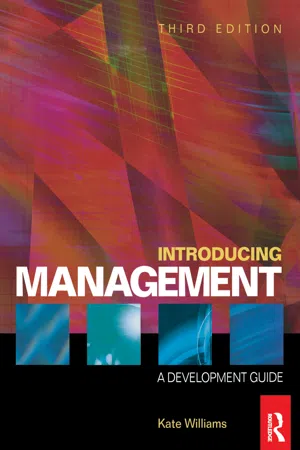
Introducing Management
About this book
Now fully revised and in its third edition, this comprehensive best-selling text, Introducing Management: A Development Guide, explains the principles and practice of management and is ideal for both new and existing managers to assist them in their role. The text incorporates the latest innovations in management thinking and reflects the changes within the management standards. This is an essential resource for those undertaking qualifications at S/NVQ at Level 3.
The learning development is clearly structured in each chapter to include:-
Objectives, Insights, Case Studies, Examples, Review Your Learning, Back to Work, allowing the user to check their understanding and apply the concepts and principles to their own work situation.
Section 1 Managing in Context
• What is management?
• What do managers do?
• What resources do managers have?
• Where do resources come from?
• Who are our customers?
• What do they buy?
• How does culture affect an organization's performance?
• What is the significance of organizational culture to you as a manager?
• What affects an organization's success or failure?
1 Achieving results
Chapter Objectives | • What is management? • What do managers do? |
We begin this book by examining the role of the manager; this will help you to have a better understanding of management, what managers do and the impact effective management has on an organization. You may not necessarily have ‘manager’ in your job title. In fact many organizations avoid the term, particularly for jobs that have a management element at a junior level. For example, the Civil Service typically uses the titles ‘Administrative Officer’ and ‘Executive Officer’ for such positions. Many companies call their junior managers ‘supervisors’ or ‘team leaders’. On the other hand, in some small firms, the Directors are also responsible for day-today management.
That's all very well but not particularly helpful without some understanding of what the management role involves. There are many differing views amongst writers on management, which help towards an overall understanding.
Many of the early writers on management have significantly influenced the way we view the management role. For example, in the first European book on management, Henri Fayol (1916) stated that management involved:
• Forecasting and planning
• Organization
• Command
• Control
• Co-ordination.
E. F. L. Brech (1953) described management as:
A social process entailing responsibility for the effective and economical planning and regulation of the operations of an enterprise, in fulfillment of a given purpose or task.
Koontz (1914), on the other hand, in his book Towards a Unified Theory of Management, argued that management was:
… the art of getting things done through and with people in formally organized groups.
More recent definitions include:
Management is … the organ of society specifically charged with making resources productive.
Drucker (1954)
Drucker (1954)
Deciding what should be done and then getting other people to do it.
Stewart (1999)
Stewart (1999)
Management is fundamental to the effective operation of work organizations.
Mullins (2002)
Mullins (2002)
As you can see, there is a common thread that links these views:
• Management involves making plans and decisions about the future needs of the business
• Management is about making cost-effective use of resources through efficient organization and control
• Management is about getting the best out of people to achieve objectives.
Your role as a manager
It is the content of your job which makes you a manager not simply your job title. Regardless of the title, a genuine management job involves:
• Forecasting the future nature of the business and of your operation and the challenges (environmental factors) affecting it
• Planning the targets and objectives your operation will deliver either in the short term (day-to-day) or in the medium to long term, or both
• Ensuring you have the resources (people, equipment, budget, materials) to meet your objectives
• Making cost-effective use of those resources
• Giving clear and relevant instructions to your staff
• Gaining and maintaining staff commitment to the organization and to their work.
These activities reflect the content of a manager's job whatever the level. However, the balance of activities varies according to whether we are considering a junior, middle or senior manager. Research in America, by Rosemary Stewart, shows that junior managers are much more involved in short-term, relatively simple, day-to-day decisions. At higher levels, decisions take longer to make and put into practice.
Decisions at the lower levels are often more clear cut. They usually have to be done quickly and there is less uncertainty about the result than at higher levels. Downsizing and streamlining across a number of different industry sectors has led to a reduction in the number of management levels and has pushed decision-making responsibility and leadership roles further down the organization. Nevertheless it is still the case that:
• First-line managers are mainly responsible for day-to-day and hour-by-hour decisions
• Their decisions tend to be followed by immediate action which allows an early chance to see if they have worked
• First-line management decisions usually deal with fairly straightforward issues where the results and effects of the decision are obvious.
At the same time, not all decisions at a junior level are of this short-term, straightforward nature. Increasingly, managers at this level are being expected to make or suggest improvements to working practices, the use of resources and the quality of their output and to take responsibility for longer-term issues like staff recruitment and customer satisfaction.
However, not all the work a manager does is truly management work. Consider this situation:
Insight | Ranjit Khan is the manager of a small neighbourhood supermarket. Each morning he comes in early to open the shop and serves at the checkout until his staff arrive. He then gives them their duties for the day. During the day, he meets sales representatives and places orders for next week. When the shop is busy, he refills the shelves. In quiet moments he prepares wage packets, checks stock levels and pays bills. |
Which of Ranjit's jobs are management jobs?
The following are the management elements we see in Ranjit's job:
• Using Resources
This involves opening the shop, checking stock levels and placing orders.
• Working with People
This involves giving his staff their duties and presumably supervising them during the day.
• Providing Direction
Ranjit's presence in the shop enables him to assess the extent to which it is providing customer satisfaction and to make improvements.
• Managing Information
The jobs of preparing wage packets and paying bills are not management jobs. However, they may encourage him to seek more effective ways of managing the payroll or keeping accounts.
In a small operation like this it would be unrealistic to expect that the manager will manage all the time. Ranjit is not managing when he serves at the checkout or refills the shelves. But those activities do keep him close to customers and aware of the issues and problems facing his staff when they do the same jobs. This is one of the main considerations which have led to the delegation of decision-making – decisions should be taken by the people affected by them and who will understand the consequences.
For many junior managers the jobs they do are an uncomfortable mix of managerial and ‘hands-on’ work. It is important to be aware of the difference. Managerial work involves the activities of forecasting, planning, managing resources and managing people that have already been described. ‘Hands-on’ work involves the basic tasks that keep the operation running.
Review your learning | Check your understanding of this chapter by completing the following: 1 Henri Fayol listed five elements of management. What words did he use to describe the following activities? (a) Look to the future and deciding what to do about it ........... (b) Get together the necessary resources... |
Table of contents
- Front Cover
- Half Title
- Title Page
- Copyright
- Contents
- Preface
- Learning structure
- Section 1 Managing in Context
- Section 2 Providing Direction
- Section 3 People and Performance
- Section 4 Effective Resource Management
- Section 5 Focusing on Results
- Answers to ‘review your learning’ questions
- Index
Trusted by 375,005 students
Access to over 1.5 million titles for a fair monthly price.
Study more efficiently using our study tools.
Frequently asked questions
Yes, you can cancel anytime from the Subscription tab in your account settings on the Perlego website. Your subscription will stay active until the end of your current billing period. Learn how to cancel your subscription
No, books cannot be downloaded as external files, such as PDFs, for use outside of Perlego. However, you can download books within the Perlego app for offline reading on mobile or tablet. Learn how to download books offline
Perlego offers two plans: Essential and Complete
- Essential is ideal for learners and professionals who enjoy exploring a wide range of subjects. Access the Essential Library with 800,000+ trusted titles and best-sellers across business, personal growth, and the humanities. Includes unlimited reading time and Standard Read Aloud voice.
- Complete: Perfect for advanced learners and researchers needing full, unrestricted access. Unlock 1.5M+ books across hundreds of subjects, including academic and specialized titles. The Complete Plan also includes advanced features like Premium Read Aloud and Research Assistant.
We are an online textbook subscription service, where you can get access to an entire online library for less than the price of a single book per month. With over 1.5 million books across 990+ topics, we’ve got you covered! Learn about our mission
Look out for the read-aloud symbol on your next book to see if you can listen to it. The read-aloud tool reads text aloud for you, highlighting the text as it is being read. You can pause it, speed it up and slow it down. Learn more about Read Aloud
Yes! You can use the Perlego app on both iOS and Android devices to read anytime, anywhere — even offline. Perfect for commutes or when you’re on the go.
Please note we cannot support devices running on iOS 13 and Android 7 or earlier. Learn more about using the app
Please note we cannot support devices running on iOS 13 and Android 7 or earlier. Learn more about using the app
Yes, you can access Introducing Management by Kate Williams in PDF and/or ePUB format, as well as other popular books in Business & Business General. We have over 1.5 million books available in our catalogue for you to explore.