- 360 pages
- English
- ePUB (mobile friendly)
- Available on iOS & Android
eBook - ePub
About this book
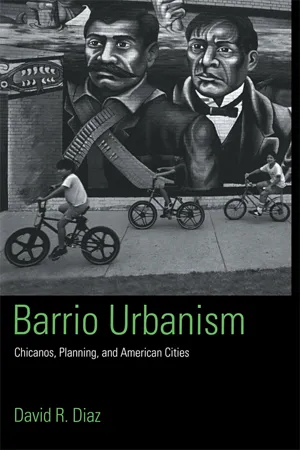
This, the first book on Latinos in America from an urban planning/policy perspective, covers the last century, and includes a substantial historical overview the subject. The authors trace the movement of Latinos (primarily Chicanos) into American cities from Mexico and then describe the problems facing them in those cities. They then show how the planning profession and developers consistently failed to meet their needs due to both poverty and racism. Attention is also paid to the most pressing concerns in Latino barrios during recent times, including environmental degradation and justice, land use policy, and others. The book closes with a consideration of the issues that will face Latinos as they become the nation's largest minority in the 21st century.
Information
PART I
History of Chicana/o Residential Patterns
1
Introduction: The Structural Influence of Chicanas/os on Spatial Relations in the Cities of the Southwest
El barrio—the central space, culture, conflict, and resistance of and within—is the foundation of Chicana/o urbanism throughout the United States. Both as a reality and a representation, it encompasses myriad interpretations. In terms of spatial relations, it is historically a zone of segregation and repression. Uneven development, inflated rents, low wage labor, lack of housing, and the worst abuses of urban renewal best characterize barrios in the arena of urban policy. Conversely, within the context of everyday life, el barrio is the reaffirmation of culture, a defense of space, an ethnically bounded sanctuary, and the spiritual zone of Chicana/o and Mexicana/o identity. It is a powerful, intense space that has defined the independence and resistance of a culture that predates Euro-American influences on city life and urban form. El barrio, then, relates to key themes in United States urbanism in many ways—in terms of physical locale, economic inequality, cultural solidarity, racial injustice, and political mobilization.
In relation to the history of the Southwest, the development of el barrio was the second form of urbanism, following the settlement patterns of Pueblo nations. With regard to modern urbanism, first nations created the system of cities that are now the most prominent in the Southwest. In a period of virtually no attention from the national government in Mexico City, barrios were formed by relationships based on a mutualista social structure (Hernandez 1983). The community established collective forms of civic administration, construction, agriculture, social welfare, and local defense. Survival depended on the self-reliance and resources of the social network in barrios. In fact, prior to Euro-American migration, the barrio culture incorporated features of the modern welfare state: health and death insurance, community loan funds, collective labor in agriculture, infrastructure for storm runoff, and subsistence provision for families who suffered the loss of economically productive members (Hernandez 1983). Culturally, religion, history, and language shaped socialization patterns beginning in the late 1500s. During the mid- to late 1800s, these cultural forces became essential to the survival of Chicana/o Mexicana/o identity when this culture was confronted with the new Euro- American trinity of repression, political marginalization, and economic exploitation.
Resistance to discrimination, in all of its forms, was interwoven into an oppositional logic that characterized social relations in this region following the invasion of northern Coahuila. Conflict with powerful state and economic forces stemmed initially from police vigilantism and bitter labor struggles (Barrera 1979). The confiscation of land titles and land rights following the Mexican-American War also generated conflict. Indeed, it permanently and dramatically restructured economic and political relations into the current era. Property, a key force for empowerment and self-determination, both collectively in the form of communal land grants or individual land titles, was systematically stolen from Chicana/o owners through the 1890s. This substantial loss of wealth and power was the foundation of marginalization, uneven development, and racism that characterized Chicana/o urbanism for more than a century.
In the mid-1900s, resistance and politicization, while continuing to center on labor issues and land issues, expanded to include education, political access, and civil rights (Reisler 1976, 39). Throughout, el barrio served as the organizing platform to create networks of solidarity, support, and self-determination. Concurrently, Euro-Americans condescendingly viewed the culture of the barrio as seditious, threatening, and rebellious. These enclaves, in the perspective of racist America, were “untamed, revolutionary, conflictive and inferior,” typical terms used in the language of ethnic repression of internal minorities in the United States (Doob 1999). The logic of social repression requires a functional rationale to legitimate a civil society in which segregation (in reality ethnic cleansing) and brutality are normative social constructions. This racist Eurocentric vision of el barrio influenced the totality of urban public policy—streets, infrastructure, parks, housing conditions, politics, economics, the condition of labor, locational barriers, and, eventually, redistributive strategies. Later, during the Civil Rights era reforms, when the streets of America were the center of a broad civil and civic war to end the logic of American apartheid, the resistance of el barrio initiated a transition into a new arena of conflict and controversy, a battle against mainstream planning, urban renewal, and modern urban restructuring. It is this period and its aftermath that forms the main focus of this analysis and the critique of planning in relation to Chicana/o urbanism.
The conflict between Chicanas/os and planning, in the broadest urban context, has its basis in Euro-America’s absolute control over spatial relations and public policy dating to the early 1900s. It was in that period that barrio underdevelopment began to produce numerous urban crises, the most prominent of which were unpaved streets, no infrastructure (for instance, sewer systems, water or gas lines), undermaintained urban amenities, lack of park facilities, lenient and/or unethical land use policy in relation to incompatible uses (for example, industry or landfills), and minimal sanctions against land speculators. Some of these problems persisted into the 1990s. Inattention to these problems led directly to lower property appreciation rates among minority land owners, constant urban deterioration, private sector manipulation of a limited housing supply, and weak commercial districts. The result was virtually permanent uneven development in the barrios of the Southwest.
The relationship between planning and the real estate industry, the first true public/private sector partnership, began in the 1920s and 1930s and fostered residential segregation and blatant discrimination against Chicanas/ os in the housing market. While the real estate and banking industries were at the vanguard of establishing systemic residential apartheid (Denton and Massey 1993), planning assumed a structural role by ignoring the gross deterioration of the urban condition of minority communities. This period of systemic administrative neglect, based on ethnic and class privilege, “trained” the profession in relation to future policy initiatives oriented toward revitalization and sponsored by the federal government. El barrio would remain an arena of structural neglect, if not abandonment, by the local state for most of the twentieth century. One side effect has been an absolute lack of planning literature on the Chicana/o urban experience. Addressing the influence of Chicanas/os on urban spatial relations is essential because of their significant impact on urban form, particularly in the Southwest. In many instances, they drove the demand for urban revitalization and policy reform to reverse the history of uneven development of the barrios.
The two oldest urban forms of settlement in North America are pueblos of first nations and, subsequently, the formation of colonias. The evolution of cities in the Southwest is directly linked to Chicana/o urbanism from its earliest histories. In the twentieth century, barrios assumed a structural role in the production and reproduction of cities, in terms of both spatial and labor relations. With a few notable exceptions, in particular El Paso and San Antonio, these enclaves were numerically overwhelmed by Euro-American in-migration into the Southwest. But despite this, they have maintained an essential role in the evolution of the city. The shift in demographic characteristics during the past three decades has fundamentally changed urbanization patterns and reinvigorated the centrality of el barrio in the culture of the region. In fact, in a few major cities, especially Chicago and Kansas City, it is one of the most dynamic factors in the changing ethnic composition of this society.
The changing class location of Chicanas/os has also had an important impact on Southwest urbanization patterns. The economic reforms of the Civil Rights movement have changed the locus of Chicana/o urbanism from a barrio-centered reality into a regionally situated influence. Challenges to restrictive housing policies, regressive banking practices, and affirmative action have transformed Chicana/o urban culture and society in the Southwest. Chicanas/os now reside in almost all zones of the city. No longer structurally “contained” in the barrio, Southwest Chicana/o urbanism has evolved into a three-tiered system: working-class barrios, working- and middle-class suburbs where Chicanas/os are a demographic majority, and suburbs where Chicanas/os are not a majority.
The growth of cities is directly related to a massive demographic expansion in the past quarter century. The cities of the Southwest are collectively the fastest growth zones in the United States. Other than Florida, no region has experienced greater changes in urban form than the major cities in this region. Sprawl, inner city deterioration, urban renewal, low-wage labor, housing crises, transportation gridlock, and environmental problems were integral to this period of expansion. In numerous cities, Chicanas/os are either the largest or second largest ethnic group. (This ethnic transition is accelerating due mainly to the growth in numbers of native-born Chicanas/os and to immigration policies [or lack thereof] related to regional labor demands.) The future portends a continuation of this trend, and Chicana/o urbanism will increasingly characterize the region.
The Civil Rights movement had another impact on urbanism. The emergence of Chicana/o social movements, some of which opposed traditional planning, ushered in a new period of contention and conflict over redistributive policy. In particular, they incorporated a critique of the failure of planning to address urban crises in barrios. These social movements addressed not simply the focus of urban policy but also engaged in struggles over representation, empowerment, and inclusion with regard to the urban redevelopment and land planning process. Opposition to irrational planning proposals and the acute lack of benefits from federal revitalization programs regulated by the Department of Housing and Urban Development (HUD) signaled a change in the political relationship between the local state and the barrio. This history, which remains undocumented, begs the question: when will planning place el barrio and its impact on Southwest urbanism at the center of urban policy?
The Critique of Planning Literature in Relation to Chicana/o Urbanism
Historically, the planning profession has exhibited an eastern bias in relation to the focus of the “official” minority subject. Academia, including West coast universities, appeared to be “region locked” intellectually in terms of which ethnic community served as the universal subject. Latinas/os were afforded a second-tier status in relation to the documentation of urban policy and conflicts. The first major book on a Latina/o community, Patricia Cayo-Sexton’s pioneering project Spanish Harlem (1965), was an early model of how planning addressed Latinas/os and spatial relations. But in the aftermath of Sexton’s publication, the planning literature focused almost exclusively on Afro-Americans, and this one minority group served as the explanatory model for all minority urbanism. The exclusion of Chicanas/os in the Southwest—with intermittent exceptions—characterized planning literature into the late 1980s.
The literature on the Southwest and its explosive expansion would have appeared to indicate a potentially new period of attention to Chicana/o urbanism and the central logic of the barrio, particularly in the literature. One book, Minorities in the Sunbelt (James et al. 1984), did so. While it did not specifically address the barrio in terms of urban policy and uneven development, this project did focus specifically on urbanization patterns of minorities in a few key Southwestern cities (Denver, Phoenix, and Albuquerque). However, most of the literature was devoid of a specific analysis of the impact of redevelopment, transportation, housing, economic policy, urban renewal, eminent domain, or a range of other conventional urban policy fields on Chicanas/os. No publication even remotely attempted to address the totality of Chicana/o urbanism.
The literature does address uneven development, social justice, discrimination in urban policy, racism in planning, the affordability housing crisis, residential discrimination, immigration policy, economic restructuring, environmental justice, and other topics critical of planning. The problem is that Chicanas/os are rarely the focus in this planning literature. There is a definite intellectual hierarchy that has historically devalued Chicana/o urbanism. An exception is Nestor Rodriguez, who offered a productive analysis of Tejana/o urban crises in Houston and central Texas. He is one of the few leading voices focused on this arena of urbanism in planning. He links demographic transformations, urban politics, the decomposition of the barrio, the failure of urban policy, and uneven development.
The studies that have addressed aspects of Chicana/o urban form and policy are either historical, social, cultural, political, or economic (mainly focusing on poverty and low wage labor) in forms. They lack a specificity to the urban that is normal in the planning literature. Mainstream literature within Chicana/o and Latina/o Studies addresses a range of social policy, including education, gangs, social welfare, public health, and political representation in which references to urban form or crises are a subplot in the analysis. Rudy Acuna’s editions of Occupied America documents a number of urban political struggles in conjunction with structural racism in public policy against Chicanas/os. Ricardo Romo’s and George Sanchez’s historical analysis of East Los Angeles presents a demographic, economic, and urban assessment of the cultural transition of this zone into the second largest Chicana/o Mexicana/o zone in North America by 1940. This type of historical analysis characterizes a number of books that address the history of a particular community in which urban topics are addressed to varying degrees. However, these publications are oriented toward historical analysis, not urban planning.
In the 1990s, three key books initiated a shift into Chicana/o urbanism. Victor Valle and Rudolfo Torres’ Latino Metropolis (2000) developed three sections on urban policy. This book analyzed two important urban issues: open space and redevelopment. It also contained sections that reinterpreted the culture of Mexican cuisine, the Los Angeles (L.A.) riots, and minority politics in Los Angeles (among other topics). Mike Davis’ Magical Urbanism (2000) is devoted to Latina/o urbanism. In typical fashion, Davis merges social commentary, urban culture, a smattering of demographics, immigration, the border, luchas (or struggles) of low-wage labor movements, and political representation. He tends to venture in and out of urban policy without a specific analysis of how planning should change. His eclectic political economy, while progressive, often fails to provide specific policy prescriptions, and instead offers only a tantalizing discontent with the present and projections of a disheartening Eurocentric future.
Devon Pena’s academic project is on social justice and environmental movements in Chicana/o communities. In The Terror of the Machine (1997) and Chicano Culture, Ecology, Politics (1998, editor) Pena presents both the contradictions of planning and resistance in defense of barrio spatial relations. He is a leading voice in a wilderness within urban literature, in which Chicana/o urban, environmental, and planning issues have emerged at a glacial pace. Another publication, Quest for the Golden Circle (Gomez 2000), addressed regional urban expansion in mid-size cities in the four corners zone of the Southwest. Nora Hamilton and Norma Chinchilla expanded the Latina/ o urban literature with Seeking Community in a Global City (2001), which analyzes the significant impact of Los Angeles’ Central American community on urban policy and neighborhood transition. Collectively, these recent projects offer a framework for the future that is yet to be fully explored within planning.
In relation to social policy and the urban, two other researchers, Joan Moore and Joe Feagin, have contributed to significantly enhancing a social and historical comprehension of Chicana/o urbanism. Moore’s early career focused on the intense gang culture of East Los Angeles, which was inherently an underclass. Her pioneering field projects, centered on gangs and socialization patterns, led directly to the social construction of the barrio’s everyday life. She focused on the urban context: inadequate housing, a lack of infrastructure, scant open space and recreational amenities, as well as other social crises, including poor education, public health problems, and constant police harassment. Since 1990, she has expanded her scope to incorporate the totality of the urban question in relation to social alienation and dysfunctional behavioral patterns—the intersection of planning and social policy. Joe Feagin, based in Texas, is one of the few prominent urbanists in this society who has consistently incorporated Chicanas/os into his analysis of the corporate dominance of urban systems; housing decomposition in minority communities; the high level of poverty in barrios; the relationship between labor control, structural deterioration, and the regional economy; and demographics of such communities. His theoretical perspective places Chicanas/os in the center of Southwest urbanization and economic relations. Although this ethnic group is often neither the main focus nor central theme of his productive research, it constitutes an essential urban reality within his worldview that has not been replicated by most urban literature centered on this region.
What has been developed in the past decade does not constitute a substantive literature. A number of publications address some aspect of urban or planning policy in conjunction with politics, social welfare, public health, youth crime, and/or education. But the planning literature is devoid of adequate attention to, for instance, the structural underdevelopment of the barrio or the failure of affordable housing policy in barrios. In addition, there is a failure to document the initial history of urban social movements against the urban cartels of the 1970s. Works that address housing, urban renewal, open space, transportation, and economic development in barrios—whether using the term Chicana/o, Latina/o, or Mexican American—are missing in action.
A review of the literature would seem to indicate that the nation’s second largest ethnic community has only limited relevance to urban public policy and city planning.
What Is Missing from Planning Literature on Los Angeles...
Table of contents
- Cover Page
- Title Page
- Copyright Page
- Preface
- Part I: History of Chicana/o Residential Patterns
- Part II Major Urban Issues and the Chicana/o Community
- Part III: Land Use and Politics Arena in the Post-World War II Suburban Expansion
- Part IV: The Future of Urban Policy in the Southwest
- Appendix
- Bibliography
Trusted by 375,005 students
Access to over 1.5 million titles for a fair monthly price.
Study more efficiently using our study tools.
Frequently asked questions
Yes, you can cancel anytime from the Subscription tab in your account settings on the Perlego website. Your subscription will stay active until the end of your current billing period. Learn how to cancel your subscription
No, books cannot be downloaded as external files, such as PDFs, for use outside of Perlego. However, you can download books within the Perlego app for offline reading on mobile or tablet. Learn how to download books offline
Perlego offers two plans: Essential and Complete
- Essential is ideal for learners and professionals who enjoy exploring a wide range of subjects. Access the Essential Library with 800,000+ trusted titles and best-sellers across business, personal growth, and the humanities. Includes unlimited reading time and Standard Read Aloud voice.
- Complete: Perfect for advanced learners and researchers needing full, unrestricted access. Unlock 1.5M+ books across hundreds of subjects, including academic and specialized titles. The Complete Plan also includes advanced features like Premium Read Aloud and Research Assistant.
We are an online textbook subscription service, where you can get access to an entire online library for less than the price of a single book per month. With over 1.5 million books across 990+ topics, we’ve got you covered! Learn about our mission
Look out for the read-aloud symbol on your next book to see if you can listen to it. The read-aloud tool reads text aloud for you, highlighting the text as it is being read. You can pause it, speed it up and slow it down. Learn more about Read Aloud
Yes! You can use the Perlego app on both iOS and Android devices to read anytime, anywhere — even offline. Perfect for commutes or when you’re on the go.
Please note we cannot support devices running on iOS 13 and Android 7 or earlier. Learn more about using the app
Please note we cannot support devices running on iOS 13 and Android 7 or earlier. Learn more about using the app
Yes, you can access Barrio Urbanism by David R. Diaz in PDF and/or ePUB format, as well as other popular books in Architecture & Urban Planning & Landscaping. We have over 1.5 million books available in our catalogue for you to explore.