- 256 pages
- English
- ePUB (mobile friendly)
- Available on iOS & Android
eBook - ePub
Influencer Marketing
About this book
Influencer Marketing is the most important new approach to marketing in a decade for those professionals at the leading edge of purchasing decision making. It shows that key decision makers in all major markets operate within communities of influencers- because major decisions are too complex and risky to taken in isolation.
The 'ecosystems' this creates are full of these critically important people, whose impact on purchasing decisions is both pivotal and misunderstood. This new book demonstrates that-
• As mass media impact wanes so the role of influencers grows - marketers need to know why and how to use this knowledge
• The impact of blogs, wikis and other social media is that they enable new influencers to emerge, and disperse traditional sources of influence.
• Large and small businesses worldwide pour billions of pounds each year into influencing what they think are their influencers. This book shows you that most of that money is being spent on the wrong people, leaving the real influencers all too often untouched.
• Influencers do not do the buying, are not obvious, cannot be bought, and start off neutral - which is why their potential to affect sales is so great
• Influencers are not all equal - they can be assessed, ranked and prioritised to be used effectively
• Influencers can be influenced – the question is how to get to them to generate market awareness, leads and address sales barriers
Influencer marketing is closely related to the relentless rise and success of word of mouth (WOM) and relationship marketing, and is now established as one of the armoury of new techniques professionals must use. For all those involved in marketing and sales this book will be an essential analysis of how to identify who has influence, how they apply it, and how you can turn it to your advantage.
1
Marketing is broken
In this first chapter we look at the evidence for declaring that ‘marketing is broken’ and how marketing today rarely helps your sales force.
You know the scene
It's painfully familiar. You've just heard that a competitor has won a deal that you were banking on. You'd been marketing to that account for months. Your sales rep had a good relationship with the decision-maker, felt in control of the sales process and you'd submitted a strong proposal. Nothing left to chance. So what happened?
The rep calls the prospect to try and save the deal but it's too late. When you ask why you lost the sale, your prospect says that his team didn't believe your pitch, was unconvinced by your ability to deliver and was unimpressed by your service capability. But didn't they read the proposal? You don't know how or when, but your competitor managed to turn the prospect away from you and towards them. The decision was made before you wrote your proposal.
This is news that you didn't want to hear. You're finding it harder to get prospects’ attention. You miss out on tenders because you just didn't hear about them in time. But somehow your competitor did. You're invited to tender on bids but you feel you're just making up the numbers. You find out about deals your competitor closed that you didn't even know about. Your lead generation numbers are flagging, and your leads-to-sale conversion rate is down.
You want to apply more science to marketing, because you know much of your spend must be wasted. But you don't know what marketing works and what doesn't. You're doing this year what you've always done, but now it doesn't seem to work.
And the sales director is looking for you. A bad sign.
Look at the situation from the prospect's viewpoint. They are being bombarded by marketing messages from you and your competitors, pitching similar products with similar features at similar prices. Your attempts at differentiation are just adding to the noise. Your prospects are confused and they need someone to help filter the useful information from the background chatter. Who do they turn to? Who do they listen to? Who do they trust?
Marketing is broken. This shouldn't come as news to you. The fact that you're reading this book means that you're interested in marketing, you're curious to discover new marketing approaches and, we assume, you're aware that all is not well.
In the background research for this book, we examined the opinions of a range of experts in marketing, from academics to gurus and practitioners. It is depressingly easy to build a list of statements that confirm that marketing is failing. Here's our list, but you should try making your own:

Marketing no longer sells anything
Our starting point for this book is not to reveal that marketing doesn't work very well, but to try and articulate how we think it can be fixed. Our research has shown that, while everybody seems to be aware of the decline in marketing, few do anything about it. The lack of innovation in marketing is ironic, given its supposed creative core.
When we say ‘marketing is broken’ what do we mean? Simply, that it no longer does its job. Marketing is orientated around sales. If it doesn't initiate, assist or close a sale then it is failing. And failing it is. The largest single item on most firms’ marketing spend is advertising, accounting for between a quarter and three-quarters of budgets. In some industries, marketing accounts for a third of revenues. Yet the link between marketing and consequential revenues is rarely demonstrable. Astonishing.
Marketing is based on notions that are 20 years out of date. The notion that if you put enough messages out there some of them will be heard. The notion that ‘building the brand’ is money well spent. The notion that people believe what they see and read. Recent initiatives to take advantage of Web 2.0 technologies are merely reactions that apply old techniques to new media. Marketing needs to rethink the messages it is communicating, to whom it's communicated and the methods being used. Many companies are disappointed at the lack of tangible return on their multi-million pounds marketing activities. Advertising remains the largest budget item on most firms’ marketing plans. Advertising may be a fixture in a company's annual spend, but management boards are increasingly questioning why this is. The most recent Brandchannel survey in 2007 illustrates this point well. Four of the world's five largest brands have never conducted any advertising, and the same is true for seven out of the 10 fastest growing brands. There is no proven causal relationship between advertising and financial performance. And advertising is just the tip of the melting marketing iceberg.
There is no strong evidence to suggest that advertising has any effect on sales. The academic research on marketing and return on investment (ROI) is paltry in number and unconvincing in conclusion. There is an awful lot of assertion from the profession itself, and several claims to the link between brand and revenues or stock price. It is true that firms with big revenues and profits usually have well-known brands. Yet brand awareness could equally be an outcome of high sales, rather than a driver of it. Google has never advertised, yet it has become the world's most powerful brand.
There exists in most companies a disconnect between sales and marketing. This manifests itself at an operational level in departmental warfare where, according to marketing guru Philip Kotler, ‘sales forces and marketers feud like Capulets and Montagues - with disastrous results’. If you haven't heard Philip's 30-min audio download of Ending the War between Sales and Marketing then we'd suggest you do.
Inside almost every company there lies a gulf between marketing and sales. Rarely is there harmony, at best just an agreement to silently walk past on opposite sides of the corridor. At worst, it can totally paralyse an organisation. Separate territories, with neither able to see the other's viewpoint.
Recent trends in marketing - the move online, campaign management systems, the creation of brand personalities - have done nothing to bring the two divisions closer.
Continuing disillusionment with traditional marketing and its dubious returns are leading many organisations to question how, or if, to continue with their current marketing levels. Marketing executives are under pressure to show results, ones that will impress the management team. There has never been so much interest and activity in marketing performance metrics and dashboards. While this focus on measurement is encouraging, most metrics concentrate on monitoring the effectiveness of the marketing operation, how well it does what it does, rather than the marketing execution. Does marketing result in more leads, more sales? The answer, across industries and geographies, is typically ‘We have no idea’.
Is anybody there?
If the paucity of tangible and reliable ROI metrics from marketing, across all industries and geographies, suggests how marketing is broken, it begs the question: why is it broken? Why does marketing not deliver higher sales or better lead generation?
The answer is that nobody is listening anymore. By the time you go to bed tonight you'll have seen roughly 1000 commercial messages. There are just too many to remember, so they're all ignored. TV advertisers reckon they need to show an advert between 7 and 10 times before the audience can recall seeing it, and even then they don't necessarily remember what it was advertising - ‘Yes I remember the house with the rubber floor but no, I can't remember which beer it was advertising’.
Besides the sheer volume of messages bombarding us everyday, have you noticed that they all sound the same? A consistent theme in marketing literature is the blandness of messages. Advertising is the price for being dull - you have to pay to get people to listen to you.
There is a chronic lack of marketing innovation in the technology industry. Compare your core message with that of your competitors’. Your product is easy-to-use, fast, leading-edge, proven, customisable, flexible, scalable and available in mauve. Welcome to the club. Part of the problem is the unsustainability of competitive advantage, due to the rapid transmission of ideas and technical capability. Your competitors can deliver a similar product 6 months after you innovate. If you work in a service-based industry your competitors can clone your offer by tomorrow.
There's also a problem in the way that marketers talk. Imagine you're at a party. A man comes up to you, but instead of introducing himself, he yanks your head back, pulls your jaw down and looks at your teeth. ‘I'M A DENTIST!’ he explains.
That how marketing sounds. It's one way. It's abrupt. It has no concept that the listener may not want to hear the message. It lacks social graces. It intrudes, by demanding your attention. There are no pleasantries. There's no engagement with the listener. It's what Seth Godin aptly calls interruption marketing.
In fact, it doesn't really matter if you're heard above the noise or if your message is innovative and relevant. Because your prospects don't believe you. You're selling something, which means you're biased. Prospects may like your message but they want to hear it from someone they trust.
We've decided to decide in a different way
A decade ago decision-makers used two types of sources to influence their opinions and agenda. The first was the printed media, either the general business press or industry-specific trade press. These covered current trends, macro-economic reports and experiences from the field. The second source was industry analysts, used heavily in the technology and telecoms sectors, but also appearing in retail, banking, manufacturing, pharmaceuticals and others. Together journalists and analysts made up the bulk of influencers on business decision-makers.
Our own research has tracked the continued decline in share of influence amongst journalists and analysts between 2003 and 2007 ( Figure 1.1). The research begs a key question: if journalists and analysts are diminishing in their share of influence, who is replacing them?
The answer is that decision-makers use a wide variety of influencers to inform their judgments, from inception to implementation. We've identified over 20 different categories of influencer and they may play a number of different roles throughout a decision process. For any one decision, there could be a dozen or more individual influencers involved at some level. In a market there are typically hundreds of people exerting their influence.
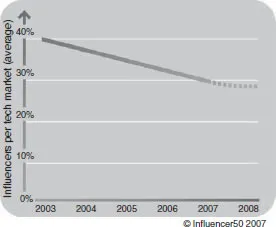
Figure 1.1 Journalist and analyst share of influence is declining
But marketing has not kept in line with this trend. The vast majority of marketing activity with influencers is still founded on PR (public relations) and AR (analyst relations). Our research suggests that, instead of devising programmes that target journalists and analysts and ignoring the remaining 15 per cent or so of miscellaneous influencers, as you could have done 10 years ago, you would now be missing out...
Table of contents
- Front Cover
- Half Title
- Title Page
- Copyright
- Contents
- Foreword
- Preface
- Introduction
- 1 Marketing is broken
- 2 What’s wrong with traditional marketing today?
- 3 How buyers buy
- 4 Decision-maker ecosystems
- 5 How influence works
- 6 Who are your influencers?
- 7 Identifying and ranking influencers
- 8 Who should evaluate the influencers in your market?
- 9 Marketing to influencers
- 10 Good, bad and ugly influencers
- 11 Marketing through influencers
- 12 Marketing with influencers
- 13 Evaluating influencer marketing
- 14 Influencer marketing and word of mouth
- 15 Social media – the new influence enablers
- 16 Influencing through social media
- 17 Influencing consumers
- 18 Influencers in consumer markets
- 19 How to structure influencer marketing in your organisation
- 20 Making influencer marketing work for your company
- 21 The future of influencer marketing
- Index
Trusted by 375,005 students
Access to over 1.5 million titles for a fair monthly price.
Study more efficiently using our study tools.
Frequently asked questions
Yes, you can cancel anytime from the Subscription tab in your account settings on the Perlego website. Your subscription will stay active until the end of your current billing period. Learn how to cancel your subscription
No, books cannot be downloaded as external files, such as PDFs, for use outside of Perlego. However, you can download books within the Perlego app for offline reading on mobile or tablet. Learn how to download books offline
Perlego offers two plans: Essential and Complete
- Essential is ideal for learners and professionals who enjoy exploring a wide range of subjects. Access the Essential Library with 800,000+ trusted titles and best-sellers across business, personal growth, and the humanities. Includes unlimited reading time and Standard Read Aloud voice.
- Complete: Perfect for advanced learners and researchers needing full, unrestricted access. Unlock 1.5M+ books across hundreds of subjects, including academic and specialized titles. The Complete Plan also includes advanced features like Premium Read Aloud and Research Assistant.
We are an online textbook subscription service, where you can get access to an entire online library for less than the price of a single book per month. With over 1.5 million books across 990+ topics, we’ve got you covered! Learn about our mission
Look out for the read-aloud symbol on your next book to see if you can listen to it. The read-aloud tool reads text aloud for you, highlighting the text as it is being read. You can pause it, speed it up and slow it down. Learn more about Read Aloud
Yes! You can use the Perlego app on both iOS and Android devices to read anytime, anywhere — even offline. Perfect for commutes or when you’re on the go.
Please note we cannot support devices running on iOS 13 and Android 7 or earlier. Learn more about using the app
Please note we cannot support devices running on iOS 13 and Android 7 or earlier. Learn more about using the app
Yes, you can access Influencer Marketing by Duncan Brown,Nick Hayes in PDF and/or ePUB format, as well as other popular books in Business & Digital Marketing. We have over 1.5 million books available in our catalogue for you to explore.