As global capitalism expands and reaches ever-further corners of the world, practical problems continue to escalate and repercussions become increasingly serious and irreversible. These practical problems carry with them equally important and ethical issues.
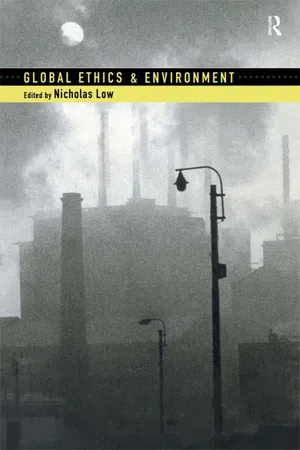
Global Ethics and Environment explores these ethical issues from a range of perspectives and using a wide range of case studies. Chapters focus on: the impact of development in new industrial regions; the ethical relationship between human and non-human nature; the application of ethics in different cultural and institutional contexts; environmental injustice in the location of hazardous materials and processes; the ethics of the impact of a single event (Chernobyl) on the global community; the ethics of transitional institutions.
This collection will both stimulate debate and provide an excellent resource for wide-ranging case study material and solid academic context.
- 336 pages
- English
- ePUB (mobile friendly)
- Available on iOS & Android
eBook - ePub
Global Ethics and Environment
About this book
Information
1 Introduction
Towards global ethics
Nicholas Low
Introduction
‘Global ecology’ and ‘global economy’ are frameworks for describing what is happening in our world. But we have no guide to public action without ‘global ethics’. Ethics tells us what we should do, how we should act. When we act together as a community or a society, then we need political ethics, as Aristotle explained (1976 edn). Since the 1970s our growing consciousness of the ecological crisis has confronted us with the need for global as well as local political action at the intersection between ecology and economy. This kind of action demands an ethic of the public sphere—the political, as well as the personal.1
The dominant ecopolitical ideas which emerged from environmentalism in the latter part of the twentieth century need to be expanded. The quest for ‘ecologically sustainable development’ has revealed a host of conflicting interests and demands whose resolution requires a conception of environmental justice—not least among them the conflict between human interests and those of the rest of nature. The slogan ‘think globally, act locally’ suggests that action can be mounted effectively without changing our global institutions, yet those institutions are already in transformation as a result of global ecology and global economy. They must be changed, and will be changed in the twenty-first century.
The Rio Declaration which came out of the United Nations Conference on Environment and Development in 1992 provided a broad set of political principles which are intended to guide the world towards ecological sustainability and social justice. The accompanying ‘Agenda 21’ identified, in general terms, policies which could implement those principles. However, to move beyond mere rhetoric means deciding between those industries and activities that are sustainable and those that are not. Such a decision cannot be left to individual transactions and personal morality. In a world of uneven consumption patterns, sustainable development raises major questions of international distribution. Deciding such matters inevitably raises the prospect of changing both the use and the allocation of social and ecological resources. Any fundamental change to resource allocation will have social distributional consequences, and the issue of justice therefore becomes a critical element of any formulation of sustainability. If ecological sustainability demands among other things the altering of human social development in order to secure its ecological footing, then this change will impinge upon the social distribution of environmental well-being both within and between nations.
There has been criticism of Western-style ‘modernity’—of the social relations of the family, of the objectivity of science, of the emancipatory potential of the democratic state, of the idea of progress, and the universality of ethics (see Lyotard, 1984; Jänicke, 1990; Feyerabend, 1993; Jagger, 1980; Fraser, 1987; Bauman, 1993,1995). Some critiques challenge not only existing institutions but also the basis for their social transformation. Yet not to intervene in a continuing process of transformation, to retreat from whatever is going on politically, is itself a political act. The existing system of competing national states and multinational corporations organized on the basis of market competition is patently inadequate to the purposes of conservation, sustainability and, ultimately, species survival.
A conference entitled ‘Environmental Justice: Global Ethics for the 21st Century’ was convened in 1997 at the University of Melbourne to explore these matters. The aim was to discuss the questions which arise from the idea of global ethics and to stimulate what Hannah Arendt (1977) called ‘enlarged thought’ on the subject. The agenda of the conference was to bring together people thinking about ‘environmental ethics’—a vast field—with those thinking about political economy and society: global ecology and global economy; and also to attempt some integration of the urban and the non-urban dimensions of the ecological problem. We set out to attract scholars who were already making forays across these categorical boundaries. For all sorts of obvious and unavoidable reasons, given the limited capacity of a three-day event and the limited knowledge of its organizers, it has become unhappily obvious since the conference that many who could have made an important contribution did not attend. This book is published in the hope that further connections may be made and the debate advanced. The conference could not be, nor did it aim to be, definitive. Nevertheless, it marked a small step forward along what Arne Naess calls the ‘long frontier’—the diversity of conceptions, knowledge and perspectives among those who seem to be heading in broadly the same direction.
This book is a record of the ideas offered by speakers at plenary sessions of the conference. The chapters which follow are based on their papers. The original papers have been revised and edited in the light of discussions which took place during the conference and subsequently. The order of presentation has been reshaped for an edited collection of essays for a wide readership, rather than being simply a conference ‘proceedings’ (more output from the conference can be found on the ‘proceedings’ website (http://www.arbld.unimelb.edu.au/envjust/papers/papers.html), in Low et al., 1999, and in Gleeson and Low, forthcoming).
This book is structured as follows. Following this chapter is Arne Naess’s introduction to the conference and overview of the field (Chapter 2). Nothing further needs to be said here by way of introduction about this essay from one of the world’s leading philosophers of ecology, as ever not shrinking from the moral dilemmas and conflicts which lie ahead of us. Naess vividly confronts us with the problem of dealing fairly with our non-human neighbours on the planet. There follows a group of chapters which consider specific issues in which the idea of environmental justice is confronted: prima facie cases of environmental injustice. Next come a group of chapters which examine some of the underlying ‘issues of principle’ in environmental ethics. Finally there are four chapters reflecting on aspects of our global institutions and the ethical system they embody.
Environmental justice challenges
Part I of the book, ‘Environmental Justice Challenges’, contains two pairs of chapters, each with a distinctly different emphasis but each discussing actual events, issues and political struggles in which the question of justice arises through the experience of injustice. The first pair, the chapters of Bullard and Shiva respectively, is primarily about the (unjust) distribution of good and bad local environments. Both authors are activists and leaders in environmental struggles. The second pair, by Shrader-Frechette and Hamilton from a slightly less politically engaged vantage point, concerns justice issues of transnational and global scope.
Environmental justice, as such, was first articulated politically in the United States in both a creative leap and a challenge to the environment movement–which was also an invitation to make common cause. As Robert Bullard observes (Chapter 3), ‘hazardous wastes and dirty industries follow the path of least resistance’. Such paths are constructed in societies by economic relations and the not-necessarily-intended and cumulative effects of political decisions. The path almost always leads to the neighbourhoods of the poor, the disenfranchised and excluded who, in the United States, are often also people of colour: Native Americans, African Americans and Latinos. The struggle for environmental justice developed out of the struggle for civil rights and against all forms of racism, and thus against environmental racism.
The idea of ‘racism’ gains meaning from the liberal ideal that every person is intrinsically of equal worth. This is a universal aspiration of the dominant political-economic culture, which also powers many different political movements, including socialism and feminism (as a movement) as well as the civil rights movement, in opposition to that culture. These movements insist that the dominant culture fails to live up to its own ideals. Here, then, we encounter in a concrete sense one of the major themes discussed in this book: the relationship between the universal and the particular in the ethics of the environment. Vandana Shiva (Chapter 4) argues that what is currently portrayed as the universal interest in the rhetoric of globalization is not: ‘The global’, she says, ‘in this sense does not represent the universal human interest; it represents a particular local and parochial interest and culture, which has been globalized through its reach and control, its irresponsibility and lack of reciprocity’ (p. 48). The global interest in the free-market economy and its institutional paraphernalia, the particular interpretation of freedom and equality is what Shiva targets here, not the basic idea of human freedom and equality.
The chapter by Shiva contains some interesting similarities to that of Bullard, as well as some important differences. Both describe ‘situated’ struggles-though arising within quite different political-cultural contexts: India and the United States. Both describe ‘bottom-up’ processes and local mobilization. Both look to local cultural and political traditions to find rhetorical ammunition for the fight. Both report successes through court action, and from that perhaps we may conclude that the idea of justice is still central to an independent judiciary. Both describe how action initiated at grassroots level has resulted in change at the institutional level, as it must in order to be effective. Both also invoke a range of broader ethical ideas connecting humans and the rest of nature, though these are not fully worked through in more abstract and rigorous terms.
As to the differences, the American ‘environmental justice’ movement contains an immanent critique of environmentalism as well as of American democracy as practised. The argument is that environmental laws have been used unfairly to create those ‘paths of least resistance’ and, implicitly I think, that the pluralist politics of the environment unfairly advantages the well off (environmentally as in other material ways). However, the system, which could be a fair one, is, according to Bullard, ‘broken and needs to be fixed’. ‘Human rights’ is perhaps the dominant key in which the American ethical score is written.
Shiva, from a vantage point at the receiving end of environmental risks, is much less sanguine about the system. The system here is not just a national political economy, but a global one. And, for Shiva, this system needs to be radically changed, not just fixed, and changed in a way demanded by environmentalism. Perhaps the actual ethical aspirations to justice of a global economy centring on the United States are much less clear and explicit than those that Bullard supposes to hold within that nation. Indeed, this imbalance, or ‘global apartheid’, has been noted elsewhere (see, for example, Falk, 1995). Here it is precisely the lack of universality (of equal freedom) that is the problem. The ethical standards applied, albeit imperfectly, within North America do not apply to the rest of the world. On a more trivial level, Bullard describes a predominantly urban politics whereas Shiva spans the urban and rural, but this distinction is less important, I suspect, than their shared primary concern with ‘the human’, rather than with ‘nature’. Nature is certainly invoked but as one with the exploited and oppressed. The possibility of the interests of humans and non-human nature diverging is not addressed.
The second pair of essays deal with a different kind of environmental problem, the sort of problem that does not create ‘paths of least resistance’or, if there are pathways, they are not directly affected by political-economic resistances. They are the environmental risks without frontiers that Ulrich Beck (1992) believed to be increasingly typical of our modern world. In fact, even these risks are not so undiscriminating. The primary impact of Chernobyl was felt by a nation afflicted by poverty. Global warming will impinge most drastically and soonest upon the poorest peoples of the Earth. But still, the impacts are indeed vastly widespread. Kristin Shrader-Frechette (Chapter 5) points out, with well-supported arguments, that half a million people—half of them outside the former Soviet Union—can be expected to die a premature death from cancer as a result of the single nuclear accident at Chernobyl. Clive Hamilton (Chapter 6) observes that some countries whose economies can best afford to adapt to a regime of reduced output of greenhouse gases are doing the least to induce adaptation. Of course, the small apparent adaptation (apparent because we do not know if even that will be complied with) currently agreed under the Climate Convention falls far short of what the vast consensus among disinterested climatologists insists is necessary to avert major climate change with all its terrible consequences.
These are injustices of a different order. It is not that these events have no distributional effects, nor even that they do not discriminate in the usual way between rich and poor, white and non-white, but that both the temporal and the spatial reach of the effects are massively greater. They bring into sharp focus the question of intergenerational justice: why should we be allowed to burden our successors with genetic damage, and with the all-encompassing environmental damage of climate change? This is a political question, a question of governance, on which the current dogma of rule by the deregulated, market has little of moral value to contribute.
What is problematized in both Shrader-Frechette’s and Hamilton’s chapters is the distortion which occurs when utilitarianism is shorn of the ethical underpinnings of rights and needs. Shrader-Frechette points out that the ‘justification principle’ (adopted by the main international agency responsible for radiation protection) allows for damage to individuals by radiation to be offset by benefits to society in general. This appears to violate the right of the individual to environmental safety. It is not at all clear where the dividing line exists between the violation of a person’s body by radiation ‘in the public interest’ and violation by imprisonment or torture, ‘in the public interest’— or indeed whether there is or should be such a dividing line at all. Hamilton questions the adequacy of international scrutiny of arguments about the justice of distribution of costs of compliance with the global climate regime. Such little public scrutiny as there is appears to be subordinated to political considerations, as evidenced by the ease with which Australia was able to back its ‘special case’ at Kyoto with what appear to be spurious and tendentious arguments.
All that utilitarian microeconomics can say about such questions is that these are matters which have to be decided by political choice. But at the same time the neo-liberal ideology, which usually comes in the same package with microeconomics, expresses profound distrust of political choice and seeks to restrict it wherever possible, or to reduce it to an economic logic, and to shrink the public sphere and its ethics. Thus Hamilton notes the comments of the Australian government’s chief economic adviser on climate change that it may be more efficient to evacuate small island states subject to inundation than to require industrialized countries like Australia to reduce their emissions. Evidently there are issues of global governance here whose resolution requires some kind of global ethic.
The chapters in the first part of the book raise the questions of environmental justice and global ethics in a concrete and practical sense. Conceptions of justice, however, are complex structures of ideas involving different ways of recognizing rights, deserts and needs, in which varying emphasis is given to each. On the face of it there seems to be a multiplicity of ways of conceiving of justice. The second part contains chapters which deepen the debates conceptually and explore this multiplicity.
Issues of principle
David Harvey (Chapter 7) captures something of the urgency and difficulty of our ethical predicament. On the one hand there is some evidence, he says, that the environmental justice movement in the United States is failing to realize its political potential;2 on the other, there is more and more academic talk about the meaning of environmental justice. All the talk discloses a vast range of conceptual interpretations of environmental ethics and justice, but the words do not lead to more and better action: the need for action seems to require a focus around a single universally applicable interpretation. Thus Harvey says, ‘Of course a universal environmental ethic is impossible—and of course it is desirable!’ (p. 109).
To reinforce his first point, Harvey sets out some of the conceptual dimensions of environmental justice and their axes of difference: ecocentric versus anthropocentric, individualist versus communitarian, culturally embedded or universal, ma...
Table of contents
- Front Cover
- Half Title
- Title Page
- Copyright
- Dedication
- Contents
- List of figures and tables
- List of contributors
- 1 Introduction: Towards global ethics
- 2 An outline of the problems ahead
- Part I Environmental justice challenges
- Part II Environmental justice: issues of principle
- Part III Global political justice
- Index
Trusted by 375,005 students
Access to over 1.5 million titles for a fair monthly price.
Study more efficiently using our study tools.
Frequently asked questions
Yes, you can cancel anytime from the Subscription tab in your account settings on the Perlego website. Your subscription will stay active until the end of your current billing period. Learn how to cancel your subscription
No, books cannot be downloaded as external files, such as PDFs, for use outside of Perlego. However, you can download books within the Perlego app for offline reading on mobile or tablet. Learn how to download books offline
Perlego offers two plans: Essential and Complete
- Essential is ideal for learners and professionals who enjoy exploring a wide range of subjects. Access the Essential Library with 800,000+ trusted titles and best-sellers across business, personal growth, and the humanities. Includes unlimited reading time and Standard Read Aloud voice.
- Complete: Perfect for advanced learners and researchers needing full, unrestricted access. Unlock 1.5M+ books across hundreds of subjects, including academic and specialized titles. The Complete Plan also includes advanced features like Premium Read Aloud and Research Assistant.
We are an online textbook subscription service, where you can get access to an entire online library for less than the price of a single book per month. With over 1.5 million books across 990+ topics, we’ve got you covered! Learn about our mission
Look out for the read-aloud symbol on your next book to see if you can listen to it. The read-aloud tool reads text aloud for you, highlighting the text as it is being read. You can pause it, speed it up and slow it down. Learn more about Read Aloud
Yes! You can use the Perlego app on both iOS and Android devices to read anytime, anywhere — even offline. Perfect for commutes or when you’re on the go.
Please note we cannot support devices running on iOS 13 and Android 7 or earlier. Learn more about using the app
Please note we cannot support devices running on iOS 13 and Android 7 or earlier. Learn more about using the app
Yes, you can access Global Ethics and Environment by Nicholas Low in PDF and/or ePUB format, as well as other popular books in Biological Sciences & Environment & Energy Policy. We have over 1.5 million books available in our catalogue for you to explore.