Understand how to integrate management accounting into your TQM and JIT systems * Learn how to use Value Added Accounting to make better strategic decisions * Find out how to use advanced costing techniques to correctly price products and services * Trace the development of modern best practice back to the breakthrough insights of the field's leading experts
Every modern company now has to compete in a market environment that is becoming ever faster, more complex and competitive. Management accounting must respond to these changes, otherwise its risks becoming irrelevant to real business needs.
This book demonstrates how the discipline can raise itself up to a new level of performance, allowing it to cope with challenges such as flexible manufacturing systems, flatter and leaner organisations, strategic alliances and globalisation. It explains how cutting edge management accounting techniques can transform a firm's operations and prospects, enabling it to become the best of the best.
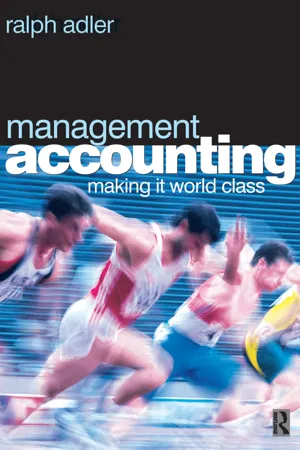
- 196 pages
- English
- ePUB (mobile friendly)
- Available on iOS & Android
eBook - ePub
Management Accounting
About this book
1
Introduction
The management accounting function, and in particular the information it produces, has often been criticized for lacking timeliness, accuracy and relevance. Prominent among the critics have been Thomas Johnson and Robert Kaplan. Their criticisms, contained in two highly influential books, Relevance Lost and Relevance Regained, reveal the tremendous disarray and great need for change that faces management accounting today.
The reasons why management accounting has fallen into such a state of disarray are well captured by Johnson and Kaplan. In particular, they suggest that the management accounting function has been shunted aside by what has become an increasingly bigger and more dominant organizational brother: the financial accounting function. The rise of the multinational behemoth requires complex internal systems for planning, controlling and co-ordinating its globe-spanning activities. Additionally, the company is required to maintain a substantial network of internal and administrative control systems to ensure it meets the multiple and often non-complementary regulatory reporting requirements of the various countries within which it operates. Not surprisingly, and as is the case with most squeaky wheel situations, the rigid and unbending deadlines that are imposed by banks, stock markets, and taxing authorities means that financial accounting issues are generally deemed more urgent than management accounting issues. Alas, financial accounting is given the lion’s share of the resources, and management accounting dries into an insignificant tributary.
While some people might interpret today’s imbalance in the resources devoted to financial and management accounting as a case in which the tail (i.e. the relatively few but very powerful external parties) is wagging the dog, the decline in management accounting can also be attributed to senior managers themselves. This situation is most ironic in light of the fact that management accounting’s aim has always been to provide information that is relevant and useful to the operational and strategic decisions that senior managers make. Nevertheless, focused as they are on the stock options for which they have become increasingly dependent, these individuals are often more interested in the financial accounting information, with its predominantly external decision-maker focus, than they are with the strategic and operational insights that the management accounting function is meant to provide. As a consequence, instead of decisions being based on forward- and outward-looking information, decisions are increasingly made on information that is backward and inward looking. The folly of such an approach should be obvious. Senior managers who rely on financial accounting information to direct and guide their company are similar to the ship’s captain who navigates his course by looking at the wake his vessel makes.
At this point the reader might be wondering, ‘How, if firms are making decisions on such misguided information, can they be as successful as they are?’ The answer to this question lies partly in the universal and ubiquitous nature of failed accounting systems and partly in what is still a relatively munificent and forgiving environment.
Very few firms have yet awoken to the outdated and outmoded state of their accounting systems. As a result, there is a general lack of awareness that appropriately devised and operated management accounting systems can endow a firm with a competitive advantage. Until a sufficient number of firms grasp this important point, firms will be allowed to operate their management accounting systems within a wide range of tolerance and not jeopardize the firm’s survival.
Of course, this range of tolerance is continually narrowing. As trade and language barriers decrease, the idea of a fully integrated competitive environment, where all organizations operate on a level playing field, becomes more of a reality. Being unable to hide behind tariffs, import duties and quota systems, firms will face an increasingly competitive and unforgiving economic environment. While some people may rightfully note that today’s firms have already entered this new economic order, it should be recognized that what we are now seeing and experiencing is but the tip of the iceberg. We are presently perched at the verge of the much heralded information revolution. Aided by this revolution, firms will be able to produce and market products and services in an increasingly customized and flexible manner anywhere throughout the world. As a result, such conventional ideas as operating as a generalist producer/provider or being a specialist who occupies a niche market will be overthrown. If managers believe that today’s world is highly competitive, they should remember one fact: tomorrow’s will be even more.
Far from taking a doomsday or apocalyptic perspective, this book is meant to help managers (and the students who will assume managerial roles) to anticipate and relish the forthcoming opportunities that will accompany these economic changes. Before managers will be able to reach this plateau, however, they will need to have some minimum understanding of the various management and accounting philosophies, practices and techniques that have recently been developed under the mantra of world class organizations. While many of these management approaches have featured prominently in the management literature, for example, total quality management, readers will be shortly introduced to the fact that these management approaches alone are not sufficient. Today’s advanced management techniques need to be incorporated and integrated with the advanced management accounting practices.
Plan of the book
The book is divided into four main parts. The first part, consisting of Chapters 2 and 3, discusses the traditional definitions of world class organizations and proposes why such definitions insufficiently capture the concept. A revised conceptualization is proposed and serves as the book’s pedagogical road map.
The second part of the book is devoted to a discussion of the advanced costing techniques that have been promoted over the past 15 years. Activity-based costing is discussed in Chapter 4. The ideas of Robin Cooper and Robert Kaplan, two of the more notable proponents of this technique, are examined at length. Also included, however, is a discussion of some of the concept’s recent refinements and enhancements, including the innovative ideas of Mike Walker.
Chapter 5 discusses the concept of cost of quality. The chapter begins with a summary of the various quality gurus’ approaches to total quality management. The ideas of Deming, Juran, Crosby and Taguchi are discussed in detail. The chapter then proceeds to explore past and present attempts to account for quality.
Target costing is discussed in Chapter 6. The chapter highlights the distinguishing features of target costing and, in the process, reveals how it is such an all-pervasive technique for Japanese manufacturers. The two-phase process of genka kikaku and genka kaizen is used to structure much of the discussion. Also, the interrelationships between life-cycle costing, cost of modelling, and target costing are unveiled.
Part Three of the book explores the various performance measures that are typically relied upon, as well as those that have only most recently appeared in the business and academic literature. Chapter 7 discusses financial performance measures. It begins by examining the problems of using such traditional financial measures of performance as return on investment (ROI) and residual income (RI). Next the chapter focuses on two of the newer financial performance measures: shareholder value analysis (SVA) and economic value added (EVA).
Chapter 8 explores the use of non-financial measures. This chapter starts by highlighting the increased popularity and use of non-financial measures. The chapter then shows how this upsurge in the use of non-financial measures parallels the evolution of firms from being cost efficient to becoming quality conscious, then capable of meeting customers’ demands for variety, and now capable of meeting customers’ demands for product novelty.
The topic of benchmarking is discussed in Chapter 9. This chapter seeks to inform the reader of both the virtues and pitfalls of benchmarking. The chapter begins by linking benchmarking with a firm’s TQM initiative. The discussion then moves to a more detailed description of benchmarking, including examples of various firms’ benchmarking practices. The chapter concludes with a discussion of the situational determinants that are most conducive to the use of benchmarking. The hope is for the reader to develop an appreciation for the types of environments in which benchmarking is both well and ill suited.
The fourth part of the book examines what are (or at least what should be) the strategic dimensions of management accounting. Chapter 10 discusses the issue of strategic cost management. Particular attention is paid to such topics as value chain analysis, cost driver analysis, and competitive advantage analysis.
The evaluation of strategic investment decisions is discussed in Chapter 11. The chapter begins by examining some of the difficulties and problems with using traditional analytical methods as the basis for choosing between strategic investment decisions. Because the basis of competition has changed from being cost efficient to being cost efficient and quality conscious and flexible and innovative, many of the traditional methods are ill suited for today’s environment. The chapter will discuss some of the alternatives that can be used.
Chapter 12 examines how transfer pricing can (and should) be used to promote the firm’s strategic objectives. Surprisingly, while many firms have begun adopting various management practices to achieve world-class status, few of these firms understand the important role that transfer pricing plays. Too often firms base sourcing decisions on narrowly framed cost/benefit analyses. The purpose of this chapter is to help the reader understand how a firm’s chosen transfer pricing method can add to or detract from its strategic initiative.
The book’s conclusion is presented in Chapter 13. This chapter is entitled ‘A destiny for management accounting’. The chapter begins by exploring the past and present role of the management accounting function, noting how the accountant has evolved from being a rather passive historian of events to assuming a more active role in daily operating decisions. The chapter then proceeds to discuss how the role of the accountant must evolve further to the point where he or she assumes a proactive role and strategic focus. The purpose of this chapter is to provoke and stimulate debate on the role and future direction of management accounting.
References
Cooper, R. (1995). When Lean Organizations Collide: Competing Through Confrontation. Cambridge, MA: Harvard Business School Press.
Johnson, T. and Kaplan, R. (1987). Relevance Lost: The Rise and Fall of Management Accounting. Boston, MA: Harvard Business School Press.
Johnson, T. (1992). Relevance Regained: From Top-Down Control to Bottom-Up Empowerment. The Free Press.
Kaplan, R. (1984). The Evolution of Management Accounting. Accounting Review, 59(3), 390–418.
Kaplan, R. (1994). Management Accounting Practice (1984–1994): Development of New Practice and Theory. Management Accounting Research, 5, 247–260.
Laverty, K. (1996). Economic ‘Short-Termism’: The Debate, the Unresolved Issues, and the Implications for Management Practice and Research. Academy of Management Review, 21(3), 825–860.
Simons, R. (1990). The Role of Management Accounting Systems in Creating Competitive Advantage. Accounting, Organizations and Society, 15(1/2), 127–143.
Part One
Becoming a World Class Organization
2
World class organizations: conventional wisdom
Chapter objectives
- Discuss how today’s organizations must compete across a wide range of business activities.
- Identify various exemplary organizations and the approaches they are taking to maintain their competitiveness.
- Define and describe the term world class organization (WCO).
- Explore the concepts of JIT and TQM.
- Examine recent attempts to include advanced manufacturing technology as a further WCO component.
Today’s organizations face ever-rising customer demands and expectations. Over the past four decades the performance that separates successful from unsuccessful firms has risen dramatically. To be successful in today’s economic environment, organizations must excel on a wide range of business activities, including cost, quality, delivery, flexibility, and innovation.
The challenge of excelling across such a wide array of business activities, and sustaining this excellence, is substantial. Only a small number of organizations, even on a world-wide basis, have accomplished this feat. A handful of examples that spring to mind are Vanguard (the American mutual fund company), IKEA (the Swedish furniture retailer), Motorola (the American communications equipment manufacturer), Harley-Davidson (the American motorcycle manufacturer), and Bic (the ubiquitous pen maker). These firms have been able to successfully design their structures, systems, and processes in a way that ultimately endows their end customers with a set of advantages that competitors are unable to replicate.
IKEA, for example, has found a way to sell low-priced furniture without skimping on various other product attributes that customers typically value. For instance, by maintaining a warehouse adjacent to its furniture showrooms IKEA is able to achieve same-day-as-purchase deliveries. IKEA’s competitors, by contrast, generally require six to eight weeks to make their deliveries. In addition to its fast deliveries, IKEA provides extended shopping hours and in-store childcare facilities. These latter two features help IKEA to meet the needs of its customer base — many of whom are juggling professional work lives with raising children — and to further differentiate itself as an innovative furniture retailer.
Vanguard represents a second example of a firm that excels across a variety of customer-cherished service attributes. Vanguard is a low-cost, high-performing stock and bond investment brokerage house. Its customers pay no entry or exit fees upon the purchase or sale of funds (i.e. funds are no-loads) and its management expense to assets managed ratio is one of the lowest in the industry at three per cent. Vanguard’s low-cost nature has not, however, prevented it from excelling on a variety of other service dimensions that investors generally seek. In fact, its low-cost...
Table of contents
- Cover Page
- Half-Title Page
- Dedication
- Title Page
- Copyright Page
- Table of Contents
- List of figures
- List of tables
- Preface
- Acknowledgements
- Part One Becoming a World Class Organization
- Part Two Advanced Costing Methods
- Part Three Advanced Performance Measures
- Part Four Strategic Management Issues
- List of abbreviations
- Glossary
- Name index
- Company index
- Subject index
Trusted by 375,005 students
Access to over 1.5 million titles for a fair monthly price.
Study more efficiently using our study tools.
Frequently asked questions
Yes, you can cancel anytime from the Subscription tab in your account settings on the Perlego website. Your subscription will stay active until the end of your current billing period. Learn how to cancel your subscription
No, books cannot be downloaded as external files, such as PDFs, for use outside of Perlego. However, you can download books within the Perlego app for offline reading on mobile or tablet. Learn how to download books offline
Perlego offers two plans: Essential and Complete
- Essential is ideal for learners and professionals who enjoy exploring a wide range of subjects. Access the Essential Library with 800,000+ trusted titles and best-sellers across business, personal growth, and the humanities. Includes unlimited reading time and Standard Read Aloud voice.
- Complete: Perfect for advanced learners and researchers needing full, unrestricted access. Unlock 1.5M+ books across hundreds of subjects, including academic and specialized titles. The Complete Plan also includes advanced features like Premium Read Aloud and Research Assistant.
We are an online textbook subscription service, where you can get access to an entire online library for less than the price of a single book per month. With over 1.5 million books across 990+ topics, we’ve got you covered! Learn about our mission
Look out for the read-aloud symbol on your next book to see if you can listen to it. The read-aloud tool reads text aloud for you, highlighting the text as it is being read. You can pause it, speed it up and slow it down. Learn more about Read Aloud
Yes! You can use the Perlego app on both iOS and Android devices to read anytime, anywhere — even offline. Perfect for commutes or when you’re on the go.
Please note we cannot support devices running on iOS 13 and Android 7 or earlier. Learn more about using the app
Please note we cannot support devices running on iOS 13 and Android 7 or earlier. Learn more about using the app
Yes, you can access Management Accounting by Ralph Adler in PDF and/or ePUB format, as well as other popular books in Business & Accounting. We have over 1.5 million books available in our catalogue for you to explore.