Rūzbihān establishes ribat in Shiraz in 560/1165 ’
2a. Shihāb al-Dīn Muhammad ibn Rūzbihān (d. 605/1209)
2b. Fakhr al-DTn Ahmad ibn Rūzbihān (ca. 570/1174-645/1247)
3a. Abū Bakr ibn Muhammad ibn Rūzbihān (d. 640/1242)
3b. Sadr al-Dīn Ibrahīm ibn Fakhr al- Dīn Ahmad Rūzbihān Tharii (615/1218 or 603/1206-685/1286)
4a. Sharaf al-Dīn Ibrahim ibn Sadr al-Dīn Rūzbihān Tharii, author of Tuhfat ahl al-’irfan (700/1300)
4b. Shams al-Dīn ‘Abd al-Latif ibn Sadr al-Dīn Rūzbihān Tharnī, author of Rūh al-jirix0101.webpn (705/1305)
4c. Jalāl al-Dīn Yahya ibn Sadr al-Dīn Rūzbihān Tharii
5a. Sadr al-Dīn ibn Sharaf al-Dīn Ibrahim Rūzbihān Thalith
5b. ‘Izz al-Dīn Mas’ud ibn Sharaf al- Dīn Ibrahim
Contemporary Political Figures in Fars1
Salghurid At a begs
Muzaffar al-Dīn Sonqur (r. 543/1148-556/1161)
[Muzaffar al-Dīn Zangi (r. 556/1161-570/1175)]
Sa’id Degele (Takla) ibn Zangi (r. 570/1175-590/1194)
[Toghril (r. 590/1194-601/1203)]
Sa’d ibn Zangi (r. 601/1203-628/1231)
Abū Bakr ibn Sa’d Qutlugh Khan (r. 628/1231-658/1260)
[four other Atabegs]
Jalal al-Dīn Abū Bakr ibn Khwaja (former caliphal official?)
Direct Mongol Rule after 668/1270
Amir Bulughān (Mongol governor who converts to Islam, ca. 680/1281- 681/1282)
Nusrat al-Dīn Ahmad, ruler of Lur-i Buzurg (r. 696/1296-733/1333)
1. Names in brackets are not mentioned in the hagiographies dedicated to Ruzhiban and his successors
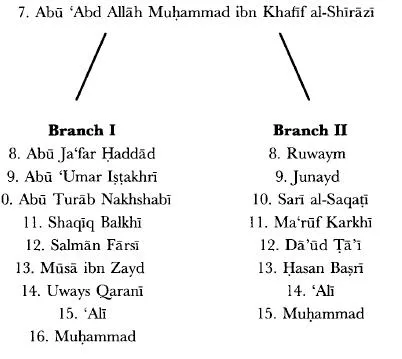
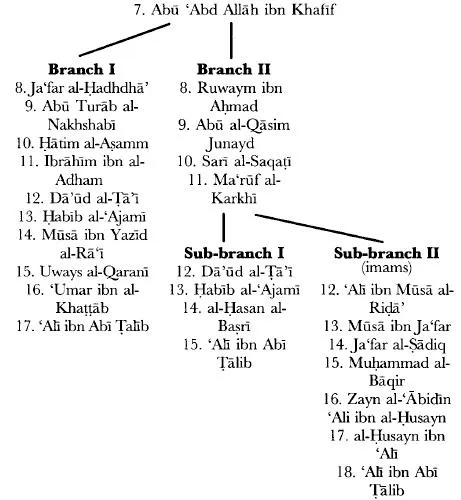
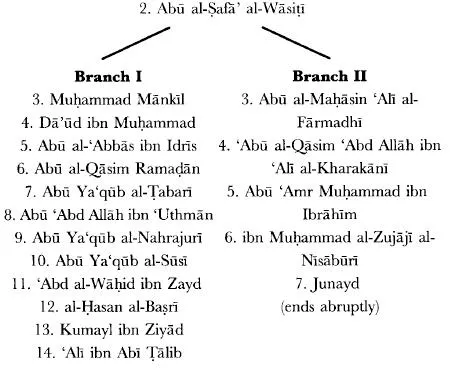
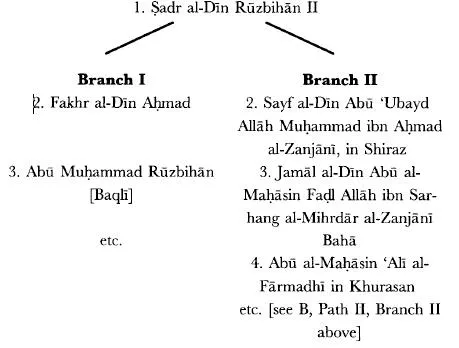
Chart 2
Rūzbihān’s Initiatic Genealogy according to his Descendants
A. According to Tuhfat ahl al-‘irfān, pp. 16–17.
1. Rūzbihān
2. Sirarāj-Dīn Khalifa
3. Abū al-Qāsim Muhammad ibn Ahmad ibn ‘Abd al-Karīm
4. Khatib Abū Bakr ibn Muhammad
5. Abū Ishāq Ibrāhim ibn Shahriyār al-Kāzarūnl
6.
usayn Akkar Firūzabadī
B. According to Rūh al-jinān, pp. 184-86.
Path I
1. Rūzbihān
2. Sirāj al-Dīn Mahmūd ibn al-Khallfa
3. Abū al-Qasim Mahmud ibn Ahmad ibn ‘Abd al-Karim [KazarunI]
4. Abū Bakr ibn [sic] Muhammad ibn Khatib Abu al-Qasim ibn ‘Abī al-Karīm
5. Abū Ishaq Ibrahim ibn Shahryār al-Kazaruni
6. Husayn al-Akkār
Path II
1. Rūzbihān
C. The Initiatic Genealogy of Sadr al-Dīn Rūzbihān II (Rūh aljinān, pp. 186–87)
I
The Tradition of Rūzbihān Baqlī
A. A Sufi’s Life
The conventional story of the life of Rūzbihān Baqlī has been preserved in a number of biographical reports. Here I would like simply to present a summary, noting in every case the source of our information and indicating where the shaykh’s own writings bear out or conflict with the data of later writers, since these divergences will be explored later on. It will be helpful to the reader to digest this account before going on to the raptures and the inner landscapes of The Unveiling of Secrets, which are analyzed in the Chapter II. The contrasting literary perspectives of the later biographies will be discussed in Chapter III.
Rūzbihān’s life took place in Persia during the period that Marshal Hodgson calls the “earlier middle period” of Islamic history. The ‘Abbāsid caliphate in Baghdad declined precipitously after the middle of the fourth/tenth century. New waves of nomadic confederations were drawn from the steppes of Central Asia to the cultured cities of Iran and Iraq. The Seljuk Turks became Muslims and quickly were drawn to support the Sunni caliphate and to make alliances with religious scholars and Sufis. They established domination over Iran, controlling the area where Rūzbihān would be born as early as 441/1049–50.1 Shiraz, where Rūzbihān is buried, became the capital of the Salghurids, one of several semi-independent dynasties of Atābegs — nominal regents for Seljuk princes who seized effective power for themselves, at first as vassals for the Seljuks, then for the Khwarazmshahs, and finally for the Mongols. The Salghurids remained independent for over 120 years, from 543/1148 to 668/1270, when the Mongols finally took direct control over Fars. Political turmoil and the contest for power made it a turbulent time, though there were also periods of years of tranquillity.
Nearly all our biographers agree that Rūzbihān Baqlī was born in 522/1128 in the Persian town of Pasā (Arabicized as Fasā). The lone ...
Table of contents
Cover
Half Title
Routledge Sufi Series
Full Title
Copyright
Contents
Figures
Preface
Chart 1
Chart 2
I. The Tradition of Ruzbihan Baqli
II. The Inner Structure of Sainthood
III. Institutionalizing a Sufi Order
IV. Conclusion
Appendix A. The Writings of Ruzbihan Baqli
Appendix B. Ruzbihan's Two Commentaries on the "Ascension" of Abu Yazid al-Bistami
Select Bibliography
Index of Names
Glossary and Index of Terms and Subjects
Trusted by 375,005 students
Access to over 1.5 million titles for a fair monthly price.
Study more efficiently using our study tools.
Frequently asked questions
Yes, you can cancel anytime from the Subscription tab in your account settings on the Perlego website. Your subscription will stay active until the end of your current billing period. Learn how to cancel your subscription
No, books cannot be downloaded as external files, such as PDFs, for use outside of Perlego. However, you can download books within the Perlego app for offline reading on mobile or tablet. Learn how to download books offline
Perlego offers two plans: Essential and Complete
Essential is ideal for learners and professionals who enjoy exploring a wide range of subjects. Access the Essential Library with 800,000+ trusted titles and best-sellers across business, personal growth, and the humanities. Includes unlimited reading time and Standard Read Aloud voice.
Complete: Perfect for advanced learners and researchers needing full, unrestricted access. Unlock 1.5M+ books across hundreds of subjects, including academic and specialized titles. The Complete Plan also includes advanced features like Premium Read Aloud and Research Assistant.
Both plans are available with monthly, semester, or annual billing cycles.
We are an online textbook subscription service, where you can get access to an entire online library for less than the price of a single book per month. With over 1.5 million books across 990+ topics, we’ve got you covered! Learn about our mission
Look out for the read-aloud symbol on your next book to see if you can listen to it. The read-aloud tool reads text aloud for you, highlighting the text as it is being read. You can pause it, speed it up and slow it down. Learn more about Read Aloud
Yes! You can use the Perlego app on both iOS and Android devices to read anytime, anywhere — even offline. Perfect for commutes or when you’re on the go. Please note we cannot support devices running on iOS 13 and Android 7 or earlier. Learn more about using the app
Yes, you can access Ruzbihan Baqli by Carl W. Ernst in PDF and/or ePUB format, as well as other popular books in Teología y religión & Biografías religiosas. We have over 1.5 million books available in our catalogue for you to explore.