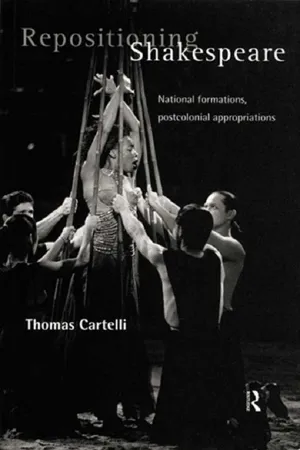
Repositioning Shakespeare offers an original assessment of a broad range of texts and cultural events that appropriate Shakespeare. Examining these materials within the context of 'the nation' in a postcolonial era, Thomas Cartelli considers:
* essays by Walt Whitman
* the nineteenth-century play, 'Jack Cade'
* novels by Aphra Behn, Ngugi Wa Thiong'o, Michelle Cliff, Tayeb Salih, Nadine Gordimer and Robert Stone
* the 1849 Astor Place Riot
Cartelli places particular emphasis on redefining the 'postcolonial' in order to find a place for America. In doing so, Repositioning Shakespeare makes a considerable contribution to the continuing debate about the uses we make of Shakespeare.
eBook - ePub
Repositioning Shakespeare
National Formations, Postcolonial Appropriations
- 248 pages
- English
- ePUB (mobile friendly)
- Available on iOS & Android
eBook - ePub
About this book
Information
Part I
DEMOCRATIC VISTAS
1
NATIVISM, NATIONALISM, AND THE COMMON MAN IN AMERICAN CONSTRUCTIONS OF SHAKESPEARE
1.
Gus Van Sant's 1991 film My Own Private Idaho boldly appropriates the Boar's Head subplot of Shakespeare's Henriad in the process of dramatizing the one-sided romance of two male hustlers and the rejection by one of them of his Falstaffian father-surrogate in the contemporary American Northwest. Van Sant's injection of mannered Shakespearean dramaturgy into a film that is more generally responsive to the edgier, inarticulate rhythms of contemporary urban life arguably imposes an inflated style and pattern of significance on a narrative that neither requires, nor is able to sustain, the effort. But by focusing its appropriative energies on the rejection of “Falstaff” by the film's Prince Hal figure—Scott Favor, the attractively prodigal son of the officious Mayor of Portland, Oregon—and by linking its sympathies and point of view with the narcoleptic hustler, Mike Waters, who is also cast off by Scott, the film makes Shakespeare function in the interests of its socially and sexually marginalized protagonists.1 In the end, Van Sant offers a pointedly democratized—and homoeroticized—rewriting of Prince Hal's interactions with his criminal companions in the Henriad, one that conspicuously departs from Kenneth Branagh's conservative reworking of some of the same material in his own recent film, Henry V2
As in the case of Prince Hal in '1 & 2 Henry IV, Scott's belated reconciliation with his father is directly connected to his summary rejection of an array of transgressive practices, an act which the film, unlike the play, presents as an unambiguous indication of social and sexual betrayal. Having privileged throughout the interactions of the homeless hustlers, and having favorably presented Scott's sensitive and protective relationships with them, the film casts a critical eye on his concluding transformation—which eventuates in Scott's emergence as a born-again heterosexual, Mike's wholesale abandonment and return to the streets, and—as in the Henriad—in “Falstaff's” death from the failed heart “Prince Hal” has killed.,3
Probably the most significant aspect of Van Sant's appropriation of the Henriad is its clearly positioned critique of Hal's transformation. All manner of critics have had difficulty accepting Hal's reconciliation with his father, rejection of Falstaff, and assumption of the Lord Chief Justice as his father-figure. Yet most have been persuaded to accept the transformation as both morally and politically constructive.4 My Own Private Idaho rejects this recuperative gesture because its social and sexual positionings stand opposed to the normative moral and political imperatives even revisionist critics have endorsed in the face of Falstaff's carnivalesque challenge to order and responsibility. Bringing to this material a sensibility that is at once romantic, individualist, and egalitarian, Van Sant revives a dissident strain in U.S. constructions of Shakespeare that has largely gone silent since the death of Walt Whitman. By restaging scenes whose resolution, both in criticism and in production, almost always privileges what Michael Bristol terms “the pathos of kingship,” and having them instead record a shift of sympathetic identification from ruling class to underclass, Van Sant effectively repositions Shakespeare in terms that Whitman might well consider more “consistent with the institution of these States” (Whitman 1907: 249).
By effecting this departure from standard interpretations of Hal's transformation, Idaho brings back into focus one of the long-term “anomalies” of the American romance with Shakespeare. As Bristol writes:
Shakespeare's centrality in American culture might be construed as a kind of anomaly in that it entails respect and admiration for an archaic world-consciousness deep inside the American project of renovatio. Why should a society whose founding actions entail radical separation from all institutions of hereditary privilege be devoted to a writer whose primary themes are the pathos of kingship and the decline of the great feudal classes?(Bristol 1990: 2)
Shakespeare's “centrality in American culture” has been convincingly demonstrated both by Bristol himself in his recent book on the institutions that have evolved to sponsor “the Shakespearizing of America” and by Lawrence Levine who, in his study of Shakespeare and American popular culture, concludes that “Nineteenth-century America swallowed Shakespeare, digested him and his plays, and made them part of the cultural body” (Levine 1988: 24). Neither Bristol nor Levine, however, address at any length the anomalous nature of the American romance with Shakespeare as Bristol describes it. Nor do they consider the admittedly exceptional, but recurring, voices that have dissented from the American consensus on the very grounds outlined by Bristol.
These voices may be heard with some consistency in the “national penchant for parodying Shakespeare” in the first half of the nineteenth century that Levine takes to be indicative of a widespread familiarity with Shakespeare in America (Levine 1988: 14–16) but that may also indicate Shakespeare's perceived irrelevance to American experience.5 Like My Own Private Idaho, some of these parodies take a decidedly revisionist position toward Shakespeare, rewriting him in terms that are not only irreverent but consistent with the increasingly pluralistic nature of American society and die development of anti-authoritarian strains within it. In John Brougham's Much Ado About a Merchant of Venice (1868), for example, we find Shylock described as “a shamefully ill-used and persecuted old Hebrew gendeman,” whose “character was darkened by his Christian contemporaries simply to conceal their own nefarious transactions” (Wells 1978: 5:78) and Portia represented as a Philadelphia lawyer who caustically derides the corruption of the contemporary judicial system (Wells 1978: 5:113).6 Of course, the penchant for parody also embraced less savory aspects of American national interests, as the series of blackface travesties produced throughout the century demonstrate. One of these, John F. Poole's Ye Comedie of Errours (1858), includes several unflattering references to fugitive slaves, the underground railroad, and Harriet Beecher Stowe.7
In this chapter, I would like to re-examine the similarly qualified, but more seriously intentioned, dissent against the Shakespearizing of America that is recorded in the writings of Whitman and to explore in a more sustained manner the efforts on behalf of a national drama undertaken some time earlier in the nineteenth century by William Leggett, Edwin Forrest, and Robert Taylor Conrad that eventuated in their collaborative production, Aylmere, or Jack Cade. My intention is less to contest Levine's or Bristol's respective accounts of Shakespeare's naturalization and institutionalization than to provide a supplementary account of “American contestatory discourses and practices” (Murray 1994: 268) that may be productively connected to contemporary efforts to reposition Shakespeare both in America and in other former colonies of Great Britain.8 As I will demonstrate, the defense of the common man advanced by Whitman and the collaborative “authors” of Jack Cade was qualified by a rhetoric of proud individualism and democratic self-congratulation modeled, in many respects, on the same kind of immersion in purported Shakespearean ideals that Levine and Bristol describe. Their efforts to defend the claims of American democratic subjectivity against foreign contamination were further qualified by a strident nationalism that often betrayed a marked nativist bias. The very mounting of this defense, and the record of dissent it supplies, however, indicate that for many nineteenth-century Americans Shakespeare was more “a site of cultural contest” (Sinfield 1992: 264) than of cultural consensus or accord, and functioned as a privileged medium through which a self-consciously postcolonial society could both address and construct its differences from the society that had produced it.
2.
While bardolatry generally prevailed on both sides of the Atlantic in the nineteenth century, Whitman, invested as he was in promoting a national literature freed from the grip of European feudalism, brought a contentiously critical approach to bear on his assessments of Shakespeare. Whitman's contentiousness was no doubt rooted in his close affiliation with the Young America movement of the 1830s whose “members sought to make a case for literary nationalism” (Bender 1987: 142) and called for the development of an “American Shakespeare” who would “condemn conventional distinctions of rank and wealth” and “affirm the brotherhood and equality of man” (Bender 1987: 150). This movement reached its productive zenith in the early 1840s in the pages of the Democratic Review, which Thomas Bender called “the most brilliant periodical of its time” (1987: 145), and to which Whitman began contributing in 1841. Whitman was drawn to the Review as much for its affiliation with the radical Locofoco wing of the Democratic Party, as for its literary aspirations. Whitman's artisan father was himself “a Locofoco Democrat, and like the son an admirer of William Leggett” (Bender 1987: 153) who was “the ideological patron saint of die Democratic Review and of radical Locofoco Democracy in New York” (Bender 1987: 147). Leggett, in turn, was the longtime friend and associate of the celebrated actor and radical democrat, Edwin Forrest, whose sustained attempt to establish a national drama would anticipate and influence Whitman's own commitment to literary nationalism.
Like Leggett's and Forrest's, Whitman's quarrel with Shakespeare— which may be more precisely construed as his objection to Shakespeare's operation as a model for American writers—almost exclusively focuses on Shakespeare's alleged degradation of the common people in his plays. As Whitman writes in Democratic Vistas (1871):
The great poems, Shakspere included, are poisonous to the idea of the pride and dignity of the common people, the life-blood of democracy. The models of our literature, as we get it from other lands,…have had their birth in courts, and bask'd and grown in castle sunshine; all smells of princes' favors.(Whitman 1907:218)
In the later November Boughs (1888), after contending that Shakespeare “stands entirely for the mighty esthetic sceptres of the past, not for the spiritual and democratic, the sceptres of the future,” Whitman observes that:
The low characters, mechanics, even the loyal henchmen—all in themselves nothing—serve as capital foils to die aristocracy. The comedies (exquisite as they certainly are), bringing in admirably portray'd common characters, have the unmistakable hue of plays, portraits, made for the divertisement only of the elite of the castle, and from its point of view. The comedies are altogether non-acceptable for America and Democracy.(Whitman 1907: 393–4)
No one familiar with Whitman's poetry will be surprised to learn that these decisive assertions do not represent his “last word” on Shakespeare.9 Indeed, in the very same pages of the essay in which he declares the comedies “non-acceptable for America and Democracy,” Whitman offers the following comparison of the avowedly “popular” poet, Robert Burns, with the allegedly elitist Shakespeare:
[Burns] has been applauded as democratic, and with some warrant; while Shakspere, and with the greatest warrant, has been called monarchical or aristocratic (which he certainly is). But the splendid personalizations of Shakspere, formulated on the largest, freest, most heroic, most artistic mould, are to me far dearer as lessons, and more precious even as models for Democracy, than the humdrum samples Burns presents.(Whitman 1907: 399–400)
Rather than consider this merely another of Whitman's many celebrated contradictions, one would do well to notice that Whitman's distinction pivots less on express political principles than on the relative capacity for freedom and breadth of expression of Shakespeare and Burns. Shakespeare is preferred to Burns largely because his alleged positioning in the camp of the English aristocracy gave him imaginative access to the freest, most powerful, and fully realized “personalizations” of his age, on whom he modeled his own. Enjoying the same individual freedoms the American common man of the nineteenth-century could, presumably, claim as his birthright, Shakespeare's heroic princes provide “dearer lessons” or “models for Democracy” than do Burns's countrymen, who are still bent under their feudal, “old world” yokes.10
Whitman moves in a similar direction in Democratic Vistas. After claiming that such master spirits as Shakespeare, Kant, and Hegel were “grown not for America, but rather for her foes, the feudal and the old,” he asks them:
but to breathe your breath of life into our New World's nostrils—not to enslave us, as now, but, for our needs, to breed a spirit like your own—perhaps, (dare we say it?) to dominate, even destroy, what you yourselves have left!(Whitman 1907: 233)
Specifically at stake here is the negotiation of an American shortcut to greatness that might be achieved without payment of the “proportionate price” which Whitman, in a more sober moment, knows that “as for all lands” greatness should exact (Whitman 1907: 247). In the end—at least at the end of Democratic Vistas—Whitman concludes that the negotiation of greatness must finally involve neither the servile mimicry nor the empowering absorption of ancient models, but, instead, their appropriation and critical transformation:
We see that almost everything that has been written, sung, or stated, of old, with reference to humanity under the feudal and oriental institutes…needs to be re-written, re-stated, in terms consistent with the institution of these States, and to come in range and obedient uniformity with them.(Whitman 1907: 249)
As citizens of a former “settler colony” still “tributary” to the parent-stream of language and culture, American writers were at once compelled to register the falseness of New World experience conveyed in “Old World terms” and their continued dependence on the Old World for a defining sense of literary standards and values (see Ashcroft et al. 1989: 16–17, 133”8). Whitman and h...
Table of contents
- Cover
- Half Title
- Full Title
- Copyright
- Dedication
- Contents
- Acknowledgments
- Introduction
- PART I Democratic vistas
- PART II Prospero's books
- PART III The Othello complex
- Conclusion—Decolonizing Shakespeare: My Son's Story, Children of Light, and late imperial romance
- Notes
- Works cited
- Index
Trusted by 375,005 students
Access to over 1.5 million titles for a fair monthly price.
Study more efficiently using our study tools.
Frequently asked questions
Yes, you can cancel anytime from the Subscription tab in your account settings on the Perlego website. Your subscription will stay active until the end of your current billing period. Learn how to cancel your subscription
No, books cannot be downloaded as external files, such as PDFs, for use outside of Perlego. However, you can download books within the Perlego app for offline reading on mobile or tablet. Learn how to download books offline
Perlego offers two plans: Essential and Complete
- Essential is ideal for learners and professionals who enjoy exploring a wide range of subjects. Access the Essential Library with 800,000+ trusted titles and best-sellers across business, personal growth, and the humanities. Includes unlimited reading time and Standard Read Aloud voice.
- Complete: Perfect for advanced learners and researchers needing full, unrestricted access. Unlock 1.5M+ books across hundreds of subjects, including academic and specialized titles. The Complete Plan also includes advanced features like Premium Read Aloud and Research Assistant.
We are an online textbook subscription service, where you can get access to an entire online library for less than the price of a single book per month. With over 1.5 million books across 990+ topics, we’ve got you covered! Learn about our mission
Look out for the read-aloud symbol on your next book to see if you can listen to it. The read-aloud tool reads text aloud for you, highlighting the text as it is being read. You can pause it, speed it up and slow it down. Learn more about Read Aloud
Yes! You can use the Perlego app on both iOS and Android devices to read anytime, anywhere — even offline. Perfect for commutes or when you’re on the go.
Please note we cannot support devices running on iOS 13 and Android 7 or earlier. Learn more about using the app
Please note we cannot support devices running on iOS 13 and Android 7 or earlier. Learn more about using the app
Yes, you can access Repositioning Shakespeare by Thomas Cartelli in PDF and/or ePUB format, as well as other popular books in Literature & Literary Collections. We have over 1.5 million books available in our catalogue for you to explore.