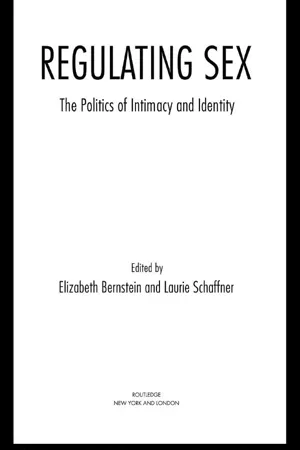
Regulating Sex is an anthology that presents debates over the role of the state in constructing and controlling erotic practice, intimacy, and identity. The purpose of this edited volume is to address sexual dilemmas in law and the state in substantive areas such as same-sex domestic partnerships, sexual economies, and childhood sexuality via a series of spirited dialogues between socio-legal scholars from diverse disciplinary, national, and political perspectives.
eBook - ePub
Regulating Sex
The Politics of Intimacy and Identity
- 344 pages
- English
- ePUB (mobile friendly)
- Available on iOS & Android
eBook - ePub
About this book
Information
1
The Regulation of Queer
Identities and Intimacies
CHAPTER 1
Liberalism and Social Movement Success:
The Case of United States Sodomy Statutes
MARY BERNSTEIN1
In 1960, every state in the United States had a sodomy law that banned certain consensual sex acts between adults in private. In addition to statutes regarding anal sex, the sodomy statutes, either by express statutory language or judicial interpretation, prohibited any oral-genital contact. In some states, these laws applied to opposite-sex as well as same-sex couples, and to married as well as single people (Apasu-Gbotsu et al. 1986). During the last half-century, however, these laws have primarily been used to control lesbians and gay men, despite the fact that they were originally enacted to prohibit any nonprocreative sex (Halley 1994; Greenberg 1988; M. Bernstein 2004). Lesbians and gay men have been arrested in undercover sting operations in gay bars, cruising places, and hotel rooms, as well as in their own bedrooms as recently as the 1980s and 1990s (Robson 1992). Sodomy laws have also signified support for a heteronormative order that posits distinct gender and sexual roles for men and women (M. Bernstein 2001).
How should social movement theorists assess the success of movements that seek to profoundly alter dominant cultural values as well as achieve concrete legal change? Political opportunity theory along with much of the social movement literature tells us that changing laws or policies, in this case the sodomy statutes, constitutes movement success. But should we count these legal victories as successes when, rather than challenging the symbolic dimensions of these laws that discursively mark lesbian and gay sexuality and identity as inferior to heterosexuality, activists appeal to a right to privacy that leaves the symbolic meaning of these laws intact? Or do we need an alternative way to understand movement success?
Elsewhere (M. Bernstein 2003), I argue for a multidimensional approach to understanding movement outcomes (see also Staggenborg 1995), which identifies three categories of movement impact: political and policy outcomes, which include changes in laws and policies, as well as new benefits for a constituency; mobilization outcomes that correspond to organizational successes that result in the ongoing ability of movement organizations to engage in collective action; and cultural outcomes that, among other things, include discursive impact. In this chapter, I argue that liberal notions of success underlie political opportunity and political process theory and inhibit an understanding of movement impact. I examine the relationship between lesbian and gay movement strategies and outcomes along with a particular discursive frame: the right to privacy. I show both the strength of hegemonic discourse on privacy and illustrate the potential to challenge this discourse. The impact of social movements is varied, and liberal notions of success only partially capture their impact.
Political Opportunity, Liberalism, and Social Movement Success
Political opportunity theory focuses on the external political environment in order to explain the emergence of social movements, their strategies, and their outcomes. As political access opens, influential allies seek new constituents, and divisions among elites magnify, activists have better opportunities for mobilization and success.2
Implicit in political opportunity theory is a notion of success derived from liberal political theory. Movement success is generally defined as new benefits for a constituency and/or recognition by elites (Gamson 1990). Thus, an alliance with elites’ lobbying strategies may result in policy change. In this view, legal or policy change should be considered the end of collective action and the mark of a successful movement. But a liberal conceptualization of success does not take into account a movement’s cultural and mobilization goals. Divisions among which types of goals to seek are apparent in many social movements, including civil rights and Black Power movements, liberal and radical feminism movements, and gay liberation and gay rights movements. Although alliances with elites may lead to legal change, they may also demobilize a movement and promulgate a conservative discourse. Therefore, the effects of “opportunity” are contradictory, so that political change, mobilization, and other movement goals may be inversely related, suggesting the importance of a multidimensional approach to movement success that does not assume that political, cultural, and mobilization goals line up in a one-to-one fashion (M. Bernstein 2003).
Sociolegal scholars ask to what extent the courts can serve as a vehicle for meaningful social reform by examining the discursive and ideological effects of the law. According to McCann (1998), studies of the impact of legal reform begin with legal norms or actions and examine their impact on target populations. With few exceptions, such studies are critical of the promise of legal justice (76). For example, critical legal theorists argue that formulating claims in terms of rights is problematic because such claims can, in turn, generate competing rights claims (for example, the rights of the woman versus the rights of the fetus; see Hunt 1990). Queer legal theory stresses that the legal categories dictated by the law inadequately describe lesbian, gay, bisexual, transgendered (LGBT) or queer people, and contribute to the suppression of differences within queer communities (Bower 1997). Put simply, legal change generally fails to alter existing power relations.
Skepticism by sociolegal theorists about the benefits of legal change is matched by social movement scholars who question the passage of legislation as an adequate gauge of success. If we assume policy or legal change is an instrumental good, we also assume that these policies are materially meaningful. But Paul Burstein (1985) argues that the implementation of equal employment opportunity legislation was as important as its passage. Entman and Rojecki (1993) find that nuclear-freeze legislation was passed to quell protest, but due to lack of enforcement was ultimately an impotent measure. Often policy reform is symbolic in nature, having little impact in the real world. In fact, most recent studies of movement outcomes focus strictly on explaining why policy changes occur (e.g.,Amenta, Dunleavy, and M. Bernstein 1994; Gamson 1990).While this remains a critical question, the achievement of new policies should be considered one aspect of success—a starting point, not an endpoint. Thus, even within a liberal political framework, a multidimensional approach to movement success is justified.
New Social Movement (NSM) theory, like critical legal studies, conceptualizes the goals of collective action in a fundamentally different way from resource mobilization and political opportunity theories, thus offering an alternative way to understand movement success. NSM theory views the generation of social movements that emerged in the 1960s and 1970s as challenges to dominant cultural patterns. Recent work argues that the ontological role of NSMs is to challenge the way markets and regulations “threaten, destroy, or manipulate self-identity” (Touraine 1997, 765). In this view, the challenges presented by collective action to dominant beliefs and the new identities created by political action are more significant than instrumental political change. Despite the many problems with the distinction between “new” and “old” social movements (e.g., Calhoun 1993; M. Bernstein 1997; Pichardo 1997), it makes sense for social movement actors to challenge both the fact of, as well as the stigma embodied by, the sodomy statutes.
The extent to which the courts can produce meaningful social change depends on whether movement outcomes are conceptualized as narrowly defined legal change and policy reform or by their impact on culture, including the development or deployment of identities, discourse, and community-building. Although NSM theory has not underscored the importance of law to social movements, it shows a concern with the impact of NSMs on transforming broad cultural patterns and norms.
Therefore, I argue that theorists must understand not only a movement’s political impact, but its mobilization and cultural effects, including the creation of alternative discourse, community-building, and empowerment as well. Political campaigns are often as important for their effect on communities, organizations, and identities as for the laws they change. For example, despite the fact that abortion is still legal in the United States, the antichoice movement has made safe abortions unattainable for many American women. The antichoice movement has also had a tremendous discursive impact. For example, the terms “unborn children” and “partial birth abortion” are now routinely used by the media and the culture more broadly. I am not arguing that changing laws and policies is unimportant, but rather that certain goals are often privileged at the expense of others. Because shifts in the political environment privilege some forms of collective action over others, the state and the law influence which types of goals movements seek.
Political opportunity theorists argue that access to the structure of political bargaining leads activists to constrain or limit their claims, but the underlying assumption is that such censoring is the price to be paid for policy change. In contrast, I argue that when legal and political elites share movement goals, rather than being an unequivocal good for social movements, such openings may sometimes limit mobilization efforts, that is, dampen the development of a more progressive discourse and slow community-building. Similarly, the price of admission to the courts can be framing arguments in ways that often prevent the cultural challenge of social movements. “Opportunities”may privilege a liberal political agenda, but activists often have other goals, leading them to act in ways not envisioned by political opportunity theory. By understanding movement agendas,we can better understand movement responses to their environment and how the environment shapes those agendas.
Following both NSM and critical legal theory, I advocate caution when viewing legal or political change as the end of collective action. A movement may not achieve legal change, but it may build lasting organizations that can influence dominant cultural values or produce a new generation of activists. Alternatively, legal change may be a catalyst for increased movement and opposing movement activism. In this chapter, I adopt a multidimensional approach to movement success and de-center the focus on legal and policy change as the primary marker of movement impact. This does not mean that I dismiss the importance of legal change. Instead, I suggest that legal decisions and policy outcomes must be analyzed according to their impact on movement and opposing movement mobilization, as well as on dominant cultural values.
In the following section, I draw on two examples from a larger research project that examines the lesbian and gay movement and the decriminalization of sodomy.3 I explore the impact of activists’ strategic choices on agenda-setting, the production of discourse, movement- and community-building, and legal and legislative change. I then consider the Lawrence v. Texas (2003) decision (which occurred after my period of data collection), its cultural meaning, and its possible impact on mobilization and on future legal and policy decisions.
The Alliance of Elites and Social Movements
In return for removing the formal threat of severe criminal sanctions for hidden and discreet acts (which society had rarely enforced in any case), dominant heterosexual society has sought the quiescence of sexual nonconformists—their tacit agreement to hide themselves from view and spare the beneficent dominant culture the disgust of any type of public presence. (Backer 1993, 759)
From 1961 to 1977, elite and movement interests in sodomy law reform coincided. In 1955, the American Law Institute (ALI) set out to rationalize this country’s laws, publishing a Model Penal Code (MPC) as a blueprint for states to follow when revising their laws. Although maintaining penalties for the solicitation of sexual acts, the MPC removed sodomy from its list of crimes and misdemeanors.
The ALI’s rationale for decriminalization (American Law Institute 1980; American Law Institute 1955) rested on the divided opinions of medical elites and contemporary debates over whether or not crimes without victims should be considered crimes. Medical elites were uncertain about whether homosexuality was genetic or psychological, and even less sure about the prospects for a cure. As a medical condition, homosexuality was better treated by medical authorities than by the criminal justice system. Alternatively, if homosexuality were genetic, then punishment would be pointless. The ALI also wanted to eliminate victimless crimes, that is, crimes that lacked a complainant and from which no quantifiable harm resulted. Because of the mostly private nature of the offense, the ALI reasoned that sodomy laws were unenforceable.
The fledgling National Gay Task Force (NGTF), later the National Lesbian and Gay Task Force (NGLTF), ceded initiatives to state legislators. The reigning wisdom was to avoid drawing public attention to the reform. For example, Jean O’Leary, then co-executive director of the NGTF, recommended that the best strategy for success was to work quietly, behind the scenes, and to assist states in recodifying their penal codes (O’Leary 1978). If the code had already been revised, then a more “frontal” strategy could be necessary. During this time period, the NGTF newsletter rarely mentioned sodomy law reform.
The ALI’s commentary provided a number of scripts that lesbian and gay activists could adopt to advocate for change, most notably, the right to privacy. Each script played on dominant political and cultural themes that simultaneously allowed for the moral condemnation of homosexuality and sodomy, but argued that the state need not be a moral arbiter. The normative status of homosexuality could remain intact and, above all, homosexuality would remain in the “private sphere.”By the 1970s, the feminist claim that “the personal is political” directly conflicted with privacy arguments, which did little to challenge dominant cultural norms about homosexuality.
Today, the negative ramifications of privacy arguments are apparent in the military’s “don’t ask, don’t tell” policy, where one is allowed to be gay as long as that “fact” is not made public. Similar reasoning about organizational rights to privacy allowed the Supreme Court to rule that the Ancient Order of Hibernians as well as the Boy Scouts of America had the right to keep identified lesbians and gay men out of their parades and organizations (Currah 1997), despite the apparent “public” nature of these groups.
What effects did leaving the decision making to elites have on discourse, organizing, and legal change? A survey of legislative reference librarians (Apasu- Gbotsu et al. 1986) shows that when legislators first considered decriminalizing private, consensual, sexual conduct between adults in the early 1970s, they either felt law and morality should be separated or they chose to equate legal sanctions with moral disapproval. Even when states voted to decriminalize, their arguments rested on an absence of harm, and the fact that the behavior in question took place behind closed doors.
Penal review committees and state legislatures adopted one of two views about the relationship between law and morality. Those who saw law as a symbolic tool equated decriminalization with condoning sexual conduct they found morally offensive. By 1977, one legislator equated decriminalization with a “gay rights bill.” Others cited reasons to separate the spheres of law and morality. Testimony in favor of decriminalization claimed that issues of morality should be left to spiritual or other authorities, that the law did not signify moral countenance or approval of sexual conduct, that immorality was not the same as criminality, and that the law should not be used to enforce purely religious or moral standards, or, finally, that these laws had no relationship to “family values.” Thus, although the moral status of ...
Table of contents
- Cover Page
- Title Page
- Copyright Page
- Acknowledgments
- Regulating Sex: An Introduction
- 1. The Regulation of Queer Identities and Intimacies
- 2. The Regulation of Sexual Commerce
- 3. The Regulation of Childhood and Gendered “Innocence”
- 4. Beyond Regulation: Towards Sexual Justice
- References
- About the Contributors
Trusted by 375,005 students
Access to over 1.5 million titles for a fair monthly price.
Study more efficiently using our study tools.
Frequently asked questions
Yes, you can cancel anytime from the Subscription tab in your account settings on the Perlego website. Your subscription will stay active until the end of your current billing period. Learn how to cancel your subscription
No, books cannot be downloaded as external files, such as PDFs, for use outside of Perlego. However, you can download books within the Perlego app for offline reading on mobile or tablet. Learn how to download books offline
Perlego offers two plans: Essential and Complete
- Essential is ideal for learners and professionals who enjoy exploring a wide range of subjects. Access the Essential Library with 800,000+ trusted titles and best-sellers across business, personal growth, and the humanities. Includes unlimited reading time and Standard Read Aloud voice.
- Complete: Perfect for advanced learners and researchers needing full, unrestricted access. Unlock 1.5M+ books across hundreds of subjects, including academic and specialized titles. The Complete Plan also includes advanced features like Premium Read Aloud and Research Assistant.
We are an online textbook subscription service, where you can get access to an entire online library for less than the price of a single book per month. With over 1.5 million books across 990+ topics, we’ve got you covered! Learn about our mission
Look out for the read-aloud symbol on your next book to see if you can listen to it. The read-aloud tool reads text aloud for you, highlighting the text as it is being read. You can pause it, speed it up and slow it down. Learn more about Read Aloud
Yes! You can use the Perlego app on both iOS and Android devices to read anytime, anywhere — even offline. Perfect for commutes or when you’re on the go.
Please note we cannot support devices running on iOS 13 and Android 7 or earlier. Learn more about using the app
Please note we cannot support devices running on iOS 13 and Android 7 or earlier. Learn more about using the app
Yes, you can access Regulating Sex by Elizabeth Bernstein,Laurie Schaffner in PDF and/or ePUB format, as well as other popular books in Politics & International Relations & Civil Rights in Politics. We have over 1.5 million books available in our catalogue for you to explore.