Skilful lighting involves a subtle blend of systematic mechanics and a sensitive visual imagination. It requires anticipation, perceptiveness, patience and know-how. But learning through practice alone can take a great deal of time. This book is a distillation of many years' experience, with advice and guidance that will bring successful results right from the start.
Whether you are a student studying lighting techniques in the television, video and film media, or a professional lighting for the camera, this book will be an invaluable aid. Other members of the production team, including camera crews, designers and directors, will also find the information here interesting and useful.
The book concentrates primarily on the fundamental principles of lighting in studios, on location and display, as well as single-camera, small unit production, improvised and economy lighting, and working with limited facilities. Emphasis is also placed on the safety aspects of working with lighting equipment.
Lighting for Television and Film reflects the author's considerable experience of lighting techniques in BBC studios, his teaching and consultancy work.
Gerald Millerson's analytical writings spring from a lifetime's personal experience in the medium, and from his teaching and engineering background. During his career with the BBC, he was primarily associated with studio operations in the Television Service. His lecturing background included courses in TV production at a number of American universities.
His other books for Focal Press are Television Production, TV Scenic Design, Video Production Handbook and, in the Media Manuals series, Effective TV Production, Lighting for Video and Video Camera Techniques.
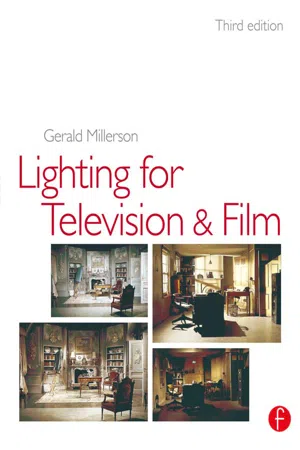
- 448 pages
- English
- ePUB (mobile friendly)
- Available on iOS & Android
eBook - ePub
Lighting for TV and Film
About this book
Information
1 An introduction
Why bother?
Of course we take light for granted. It is part of our everyday world; a phenomenon so familiar that we cease to think about it.
When shooting on location there is usually light of some sort around. It may not be ideal, but at least it allows the camera to see what is going on. If whatever you are looking at happens to be in shadow, move it into the light; if the surroundings are insufficiently bright, add illumination of some kind. In the studio, surely all you need is overall lighting from a large bank of lamps. So why all this mystique about lighting techniques? Why does one need to study the obvious?
Most of us start with questions like these. It is certainly puzzling when you find that a straightforward interview has needed a dozen lamps, and then see a particularly impressive lighting effect which was achieved with just a single lamp!
Why do we need lighting techniques?
There are a number of reasons why carefully arranged lighting is desirable. Some are self-evident, others are less obvious:

What can lighting do?
From what we have already seen it is clear that lighting in television and film is about much more than just making things visible. Skillful lighting allows you to adjust and manipulate the impression conveyed on the screen. You do this by carefully controlling the strength and quality of the light, by arranging its angle and coverage.
A magical property of light is its flexibility – the ease with which it can be controlled. You can totally transform a situation in an instant at the touch of a switch. Or you can alter it gradually and imperceptibly, without your audience realizing how subtly it is changing. Simply by adjusting the relative intensities of the s...
Table of contents
- Cover
- Half Title
- Title Page
- Copyright Page
- Table of Contents
- Preface to the Third Edition
- Acknowledgements
- 1 An introduction
- 2 The nature of light
- 3 The eye and perception
- 4 The principles of lighting
- 5 Lighting people
- 6 The production process
- 7 Lighting on location
- 8 Atmospheric lighting
- 9 Light sources
- 10 Lighting equipment
- 11 Color temperature
- 12 Filters
- 13 Picture control
- 14 Scenery
- 15 Visual effects
- 16 Safety!
- Appendix
- Further reading
- Index
Trusted by 375,005 students
Access to over 1.5 million titles for a fair monthly price.
Study more efficiently using our study tools.
Frequently asked questions
Yes, you can cancel anytime from the Subscription tab in your account settings on the Perlego website. Your subscription will stay active until the end of your current billing period. Learn how to cancel your subscription
No, books cannot be downloaded as external files, such as PDFs, for use outside of Perlego. However, you can download books within the Perlego app for offline reading on mobile or tablet. Learn how to download books offline
Perlego offers two plans: Essential and Complete
- Essential is ideal for learners and professionals who enjoy exploring a wide range of subjects. Access the Essential Library with 800,000+ trusted titles and best-sellers across business, personal growth, and the humanities. Includes unlimited reading time and Standard Read Aloud voice.
- Complete: Perfect for advanced learners and researchers needing full, unrestricted access. Unlock 1.5M+ books across hundreds of subjects, including academic and specialized titles. The Complete Plan also includes advanced features like Premium Read Aloud and Research Assistant.
We are an online textbook subscription service, where you can get access to an entire online library for less than the price of a single book per month. With over 1.5 million books across 990+ topics, we’ve got you covered! Learn about our mission
Look out for the read-aloud symbol on your next book to see if you can listen to it. The read-aloud tool reads text aloud for you, highlighting the text as it is being read. You can pause it, speed it up and slow it down. Learn more about Read Aloud
Yes! You can use the Perlego app on both iOS and Android devices to read anytime, anywhere — even offline. Perfect for commutes or when you’re on the go.
Please note we cannot support devices running on iOS 13 and Android 7 or earlier. Learn more about using the app
Please note we cannot support devices running on iOS 13 and Android 7 or earlier. Learn more about using the app
Yes, you can access Lighting for TV and Film by Gerald Millerson in PDF and/or ePUB format, as well as other popular books in Media & Performing Arts & Film & Video. We have over 1.5 million books available in our catalogue for you to explore.