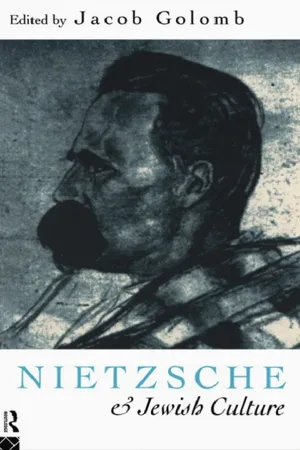
Friedrich Nietzsche occupies a contradictory position in the history of ideas: he came up with the concept of a master race, yet an eminent Jewish scholar like Martin Buber translated his Also sprach Zarathustra into Polish and remained in a lifelong intellectual dialogue with Nietzsche. Sigmund Freud admired his intellectual courage and was not at all reluctant to admit that Nietzsche had anticipated many of his basic ideas.
This unique collection of essays explores the reciprocal relationship between Nietzsche and Jewish culture. It is organized in two parts: the first examines Nietzsche's attitudes towards Jews and Judaism; the second Nietzsche's influence on Jewish intellectuals as diverse and as famous as Franz Kafka, Martin Buber, Franz Rosenzweig and Sigmund Freud. Each carefully selected essay explores one aspect of Nietzsche's relation to Judaism and German intellectual history, from Heinrich Heine to Nazism.
- 296 pages
- English
- ePUB (mobile friendly)
- Available on iOS & Android
eBook - ePub
Nietzsche and Jewish Culture
About this book
Information
Part I
NIETZSCHE’S RELATIONS TO JEWS, JUDAISM AND JEWISH CULTURE
1
NIETZSCHE, ANTI-SEMITISM AND THE HOLOCAUST
Steven E. Aschheim
Each generation, I suggest, constructs its own, most appropriate Nietzsche – or Nietzsches. During the years of the Third Reich (and immediately after) Nietzsche appeared to be paradigmatically Nazi (while National Socialism seemed best understood as a kind of Nietzschean project).1 Both National Socialists and their opponents tended to agree that Nietzsche was the movement’s most formative and influential thinker, visionary of a biologized Lebensphilosophie society, fuelled by regenerationist, postdemocratic, post-Christian impulses in which the weak, decrepit and useless were to be legislated out of existence. For those interested in making the case any number of prophetic themes and uncannily appropriate quotes were available. “From now on”, Nietzsche wrote in The Will to Power,
there will be more favourable preconditions for more comprehensive forms of dominion, whose like has never yet existed. And even this is not the most important thing; the possibility has been established for the production of international racial union whose task it will be to rear a master-race, the future “masters of the earth.” The time is coming when politics will have a different meaning.2
The paradigmatic Nietzsche of the 1930s, 1940s and early 1950s was then the Nietzsche who was regarded as the thinker most crucially and intimately definitive of the Nazi order. To be sure there were always dissenting voices (both within and without the Nazi camp) but the prevailing wisdom held that Nietzsche was proto-Nazi, that he uncannily prefigured and, indeed, in some way even “caused” National Socialism and that in fundamental ways the movement itself had to be regarded as “Nietzschen”.3 This perception began to shift in about the mid-1950s and, although there have always been counterchallenges, it has so proceeded apace that, for many younger people educated from about the 1970s on, the identification seems virtually incomprehensible. Nietzsche’s de-Nazification – and the de-Nietzscheanism of Nazism, I would argue, has become close to a fait accompli within western culture (at least in English-speaking countries and France). This, in the main, has been the product of two, quite different, intellectual forces that – in consonance with wider political changes – have rendered the only other early major competitor and counterinterpretation, Georg Lukács’s Destruction of Reason with its guiding thesis that “Hitler . . . was the executor of Nietzsche’s spiritual testament and of the philosophical development coming after Nietzsche and from him”,4 if not downright quaint, then certainly a little anachronistic.
I am not sure if it is an exaggeration to claim that the basic aim of Nietzsche’s most insistent and influential post-war expositor, translator and popularizer, Walter Kaufmann, was casuistically to rid Nietzsche of these sullied associations and to provide him with the kind of liberalhumanist face consistent with American academic values of the time. His 1950 masterwork portrayed the Nazified Nietzsche as a pure, virtually inexplicable distortion. Essentially a good European, he was a thinker who had to be grasped in terms of his emphases on creativity, culture and critical individualism and whose dismissal of nationalism, racism and anti-Semitism could not have been more apparent.5
Kaufmann was, of course, a more or less systematic philosopher who insisted upon pressing Nietzsche’s thought into a comprehensible and comprehensive system. Such systematization is, of course, anathema to those who since, in a different, less liberally certain and determinate age, have most dominantly colonized Nietzsche (and at the same time been crucially shaped by him!) – those various exponents of what, for lack of a better name, we call post-modernism and deconstructionism (Foucault, Deleuze, de Man, Derrida and so on). For them – as distinct from Kaufmann – the issue by and large goes quite unmentioned, unnoticed; the very need to refute the putative Nietzsche–Nazi link has been obliterated! Theirs is a Nietzsche that is quite dissimilar to Kaufmann’s. Here he is the radically sceptical perspectivist, the anti-totalizing prophet of heterogeneity, différance, fragmentation and discontinuity.6 But like Kaufmann, they have also fashioned a rather sterilized Nietzsche7 whose project appears as the diametrical opposite, even therapeutic answer to, National Socialism. With one exception (to be dealt with a little later) they usually elide the more compromising aspects of his thought, those that sit less comfortably with their hero of ironic indeterminacy.
It may not be at all surprising that the post-war de-Nazification of Nietzsche occurred above all in France and the USA, where, given not only the brilliance but the remarkable elasticity of Nietzsche’s ouvre, he could be harnessed to new cultural and political agendas. In Germany, of course, loosening him from these moorings was a different matter. In the land where Nazism had arisen and flourished and where Nietzsche had become so identified with the regime, it should perhaps not surprise us that, for upholders of the new liberal-democratic regime, resistance to his renewed influence was perhaps the greatest. It is no coincidence therefore that the most vociferous contemporary critic of Nietzsche – as well as post-modernism and what he considers to be its parallel irrationalist, anti-Enlightenment thrust – is Jürgen Habermas.8 There are signs, I believe, that – perhaps with the slow demise of deconstructionist thinking – not only in Germany but elsewhere there has begun to occur another shift, or a rethinking, that, on a more sophisticated, qualified basis, will be able seriously to grapple with this question. The present chapter is an attempt to contribute to this renewed conversation.
Of course, particular readings and judgements of Nietzsche will determine whether we believe him to be implicated in Nazism. And, on the other hand, particular interpretations of National Socialism will influence our readiness to include him within its contours. But the very range and complexity of opinion is also related to the exceedingly charged nature of the issue. After all, both Nietzsche and National Socialism remain central to the twentieth-century experience and our own defining cultural and ideological landscape and sense of self.9 And this chapter, of course, deals with the entwinement in its most explosive dimension: not the general question of the interrelationship of Nietzsche and the Third Reich (this I have done in detail elsewhere10) but the connections between the philosopher and radical Jew-hatred as well as the possible connections between his thought and the genocidal project (and the other major mass murderers) that stood at the dark heart of the Third Reich.
How may the historian deal with such vexed questions and what are the assumptions and materials that must be brought to bear? Anyone even vaguely acquainted with the history of Nietzsche’s political and cultural influence and reception will know how manifold, pervasive and contradictory it has been. It is clear that no “unmediated”, causally direct relationship can be inferred or demonstrated. It would be an error to reduce Nietzsche’s – exceedingly ambiguous, protean, elastic – work to an essence possessed of a single, clear and authoritative meaning and operating in a linearly determined historical direction. There should be no set portrait of the “authentic” Nietzsche, nor dogmatic certainty as to his original intent. Clearly the essentialist representations of both Kaufmann and Lukács – Nietzsche’s thought as either inherently antithetical to or the prototypical reflection, the ideational incarnation, of the Nazi project – prejudge precisely the question at hand. What needs to be sifted out, and analysed as precisely as possible, are the concrete mediating links, the transmission belts that demonstrate conscious appropriation, explicit acknowledgments of affiliation and influence, the recognized thematic parallels and (more speculatively) the preconditions, the creations of states of mind and sensibility that render such events conceivable in the first place.
Let us first turn to the question of Nietzsche and anti-Semitism and, most importantly, his annexation – or, perhaps, rejection – by German anti-Semites from the Second Reich on. As always, Nietzsche’s texts themselves provide a positive goldmine of varied possibilities, filled with ambiguities that his followers – and critics – could scavenge and turn in numerous, very often quite contradictory, directions (this was typical of Nietzsche’s reception in virtually every area). What is clear is that Jews and Judaism are complexly central to Nietzsche’s work; in both his hostile and friendly deliberations, he insisted upon their absolutely fateful historical role within European civilization. Who else could have written in such a simultaneously affirmative and ominous tone: “Among the spectacles to which the coming century invites us is the decision as to the destiny of the Jews of Europe. That their die is cast, that they have crossed their Rubicon, is now palpably obvious: all that is left for them is either to become the masters of Europe or to lose Europe.”11 From our point of view it does not really matter whether Nietzsche’s views on Jews and Judaism are to be regarded as a unified and coherent element of a larger systematic outlook or as disparate and self-contradictory.12 For the historian of culture what is important are the interpretive spaces open to those who selectively read and receive the texts. There are clearly sufficient allusions, hints and themes to satisfy virtually all comers. Jew and anti-Semites alike were aware that both could find Nietzsche’s work useful (and spent much of their time in casuistically explaining away those passages that were not compatible with their own particular outlook). Völkisch anti-Semites interested in annexing Nietzsche had to contend with the knowledge that he was no nationalist, indeed was perhaps the most pronounced critic of his contemporary Germans, and above all the most outspoken opponent of the anti-Semitic “swindle”. Turning around the very basis of his notion of ressentiment he even branded the herd, mass movement of anti-Semitism as itself a kind of slave revolt.13 To make matters worse, more than any other European thinker he lavished extravagant praise on “The Old Testament – all honour to [it]! I find in it great human beings, a heroic landscape, and something of the very rarest quality in the world, the incomparable naïveté of the strong heart; what is more I find a people. In the New one, on the other hand, I find nothing but petty sectarianism, mere rococo of the soul, mere involutions, nooks, queer things”14 – and the comparative virtues of the European Jews of his own time: “Jews among Germans are always the higher race”, he wrote, – “more refined, spiritual, kind. L’adorable Heine, they say in Paris.”15
Those inclined to pick up and disseminate these positive Nietzschean Jewish messages could easily do so (this is precisely what many in the Jewish community consistently did16) and this, indeed, was the reason that many anti-Semites from the Second Reich through the Nazi period either rejected Nietzsche entirely (Theodor Fritsch, Dietrich Eckart and Ernst Krieck are only the best-known of many examples) or, if they did so, appropriated him in qualified, selectively harnessed fashion (for instance Adolf Bartels, Wilhelm Schallmeyer, Heinrich Härtle).17 Even those many anti-Semites and Nazis who were wholeheartedly Nietzschean (Franz Haiser, Ernst Wachler, Alfred Schuler, Ludwig Klages, Alfred Bäumler among others) were aware that casuistic explanation of Nietzsche’s pro-Jewish comments and his biting contempt for political anti-Semitism was needed. Variations on this theme were offered in abundance: the true “Germanic”, indeed, racist, Nietzsche had been consistently hidden by his Jewish mediators who had maliciously transformed him into a libertarian, nihilist internationalist.18 Anyone familiar with Nietzsche, wrote Alfred Bäumler, knew how opposed to the Jews he actually was. His philo-Semitic comments were simply an attention-getting device – playing the Jews against the Germans was part of his strategy to get the Germans to listen to him!19 But the most important claim argued that in recasting the terms of the debate, by infinitely radicalizing the question and going beyond all its conventional forms, Nietzsche was in fact “the most acute anti-Semite that ever was”.20 He had, so the argument went, only opposed its traditional nineteenth-century varieties and its Christian versions because he stood for a newer and more radical form, one whose anti-Christian and biological sources pushed it far beyond the limited confessional, economic and social domains.21
No matter how selective an exercise this was, these anti-Semites were basing themselves upon, and finding inspiration in, particular readings of so...
Table of contents
- Cover Page
- Half Title page
- Title Page
- Copyright Page
- Contents
- Notes on contributors
- Introduction
- Inietzsche's Relations to Jews, Judaism and Jewish Culture
- Nietzsche's Jewish Reception
- Bibliography
- Subject index
- Name index
Trusted by 375,005 students
Access to over 1.5 million titles for a fair monthly price.
Study more efficiently using our study tools.
Frequently asked questions
Yes, you can cancel anytime from the Subscription tab in your account settings on the Perlego website. Your subscription will stay active until the end of your current billing period. Learn how to cancel your subscription
No, books cannot be downloaded as external files, such as PDFs, for use outside of Perlego. However, you can download books within the Perlego app for offline reading on mobile or tablet. Learn how to download books offline
Perlego offers two plans: Essential and Complete
- Essential is ideal for learners and professionals who enjoy exploring a wide range of subjects. Access the Essential Library with 800,000+ trusted titles and best-sellers across business, personal growth, and the humanities. Includes unlimited reading time and Standard Read Aloud voice.
- Complete: Perfect for advanced learners and researchers needing full, unrestricted access. Unlock 1.5M+ books across hundreds of subjects, including academic and specialized titles. The Complete Plan also includes advanced features like Premium Read Aloud and Research Assistant.
We are an online textbook subscription service, where you can get access to an entire online library for less than the price of a single book per month. With over 1.5 million books across 990+ topics, we’ve got you covered! Learn about our mission
Look out for the read-aloud symbol on your next book to see if you can listen to it. The read-aloud tool reads text aloud for you, highlighting the text as it is being read. You can pause it, speed it up and slow it down. Learn more about Read Aloud
Yes! You can use the Perlego app on both iOS and Android devices to read anytime, anywhere — even offline. Perfect for commutes or when you’re on the go.
Please note we cannot support devices running on iOS 13 and Android 7 or earlier. Learn more about using the app
Please note we cannot support devices running on iOS 13 and Android 7 or earlier. Learn more about using the app
Yes, you can access Nietzsche and Jewish Culture by Jacob Golomb in PDF and/or ePUB format, as well as other popular books in Philosophy & Philosophers. We have over 1.5 million books available in our catalogue for you to explore.