- 372 pages
- English
- ePUB (mobile friendly)
- Available on iOS & Android
eBook - ePub
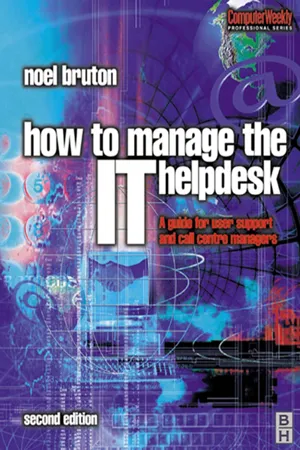
How to Manage the IT Help Desk
About this book
Are you overworked, unappreciated and under-resourced? This book understands you, and provides years and years of User Support experience packed into one volume. The 'How To' book that every IT department needs, it will help turn your helpdesk into a company asset. How to be successful at probably the most stressful job in IT
This book offers tools for measuring productivity and features ten key steps for successful support, while User Support successes and failures are revealed in true life case studies.
This book gives you techniques for:
*Justifying staff and other expenditure
* Gaining senior management support
* Getting the users on your side
* Running a motivated and productive team
* Designing and managing services and service levels
The second edition of this popular book brings updates to several of the author's ideas, strategies and techniques with new material on:
* Customer Relationship Management - definition and the role of the helpdesk
* E-Support and the Internet
* Contrasting the Call Center and the Helpdesk
* first, second and third line support
* Operational Level Agreements
* Strategies for backlog management
* Telephone technologies in user support
In addition there is:
* A new Template for a Service Level Agreement
* An Improved cost justification model for the Internal Helpdesk
* A New cost justification model for the External Helpdesk
Part One What is ‘support’?
1Defining computer user support
DOI: 10.4324/9780080495309-2
What exactly do we mean by ‘user support’? Let us start with a simple definition, based on a common understanding of the role of user support:
User support is the process by which technical knowledge is used by specialists to solve computing problems experienced by lay users.
BEWARE – that is only half the story! Given that simplistic definition, information technology (IT) support is no different from, for example, a motoring organization or any good library. It is just bringing computers into it that complicates matters, as they are perhaps the most technically complex thing we have yet introduced into our everyday lives. And the main reason why they are so complex is because computers, unlike cars or most other electronic appliances, are multifunctional – the user can essentially produce a new and unique problem depending entirely on how he or she uses the machine.
So is support just a reactive bank of specialized knowledge? Essentially, yes; but of course there is rather more to it than that. The quality of the knowledge has to be considered, as do the triggers which start its delivery, let alone the channels along which we pipe our knowledge to our users.
Furthermore, we must consider why we should even bother at all to retain that knowledge in order to deliver it. For instance, why shouldn’t we just give the knowledge to the users and let them get on with it? Surely that alone would reduce the support workload and leave us technical specialists free to get on with the meatier jobs of change management, product evaluation, and solutions research. We can see why we need technical specialists; but why do we need them solely to provide support?
The answer to that is the same as can be applied to so many business problems, namely cost. When we later look at support cost justification, we will see that there comes a point at which the cost of increasing user knowledge outweighs the benefit of having such high levels of IT ability at the users’ fingertips. High technical competence is simply not needed often enough to make spreading it so widely a cost-effective option for many companies. So they elect to retain a few technical specialists who can be consulted as needed.
Immediately we have begun to see that there is not just a set of technical or service reasons why there is a support department; there are invariably strict business reasons why that department should exist. The reasons look very much like the ones which would call any other department, especially a non-revenue department, into existence.
1.1 Support is a business matter
Alas, it is the failing of too many inexperienced support managers that they seem to think their purpose is purely technological; in fact their purpose is, in the end, purely financial. And if support does not recognize how its esoteric function can be made to contribute to the company’s business goals, its usefulness and thus its future come into question. This does not necessarily mean that support has to make a profit directly – but it does mean that it has to contribute to the means by which the company as a whole achieves its business goals. And that means that it must measure itself not in support or technical terms, but in business terms.
For a fuller picture of why support exists, we must look at this business case more deeply. How exactly does the company achieve its business goals, and how can support contribute to that process? The best place to look is at the end result and move back through the effects and causes of the profit-producing machine.
Your company makes a profit by providing a product or service for which customers are willing, for whatever reason, to pay more for than it costs the supplying company to manufacture or obtain. Therefore, what your company’s end customer receives has benefited from the value which has been added to it while the product has been in your company’s hands. Those people who added that value will invariably number among the users of your IT support services.
1.2 User productivity is the key
So it follows that if these users could be made more productive, then theoretically at least, they could be enabled to add more value, thus contributing further profit to the company’s bottom line. One of the most popular ways to increase white-collar productivity in recent times has been to computerize the desktop. IT support services assist that end; therefore, the way support contributes to company profit is to enable the users to increase their productivity through IT.
Support delivers this increased productivity in two main ways: (i) by solving technical problems on the user’s computer, so that the user can resume working; and (ii) by increasing, directly or indirectly, the user’s competence with the technology. It follows, then, that an important way of measuring the success or otherwise of a support service is in terms of user productivity as enhanced by any interaction with the support department.
1.3 Is support just for problem-solving?
The way most users will encounter support is by contacting it for help when the computer fails to do what they expect it to. The reason for the problem is immaterial at this point; it may be due to a hardware or software failure, a user need unanticipated by the existing technology, or ignorance on the user’s part of how to use the systems to achieve his or her business aims. Whatever the cause, it is the ‘computer system’ (a concept that should include the user’s ability to use the technology) which is deemed to have caused the failure. Problems with the computer? Call support!
So support is naturally seen most often as a problem-solving function. But this is only a true picture in support departments which restrict themselves to a purely reactive function; and where that is true for the commonest support function, the ‘helpdesk’, there are many other types of support which provide a range of reactive and proactive services. As mentioned earlier, support may have a research function, identifying new technology needs, and testing various solutions; it may be testing new software in advance of it being installed, so as to anticipate problems before they occur on a user’s desk; support may be involved in applications development, again for reasons of problem prevention; support may be heavily involved in user training, to try to eliminate user ignorance as a major problem cause. All in all, it is too narrow a picture to see support just as a problem-solving service.
1.4 Specialists supporting lay users?
A common image of a technical support department is of a chaotic place, full of half-disassembled electronic equipment, with technical manuals open and strewn over desks typically occupied by a highly specialized guru with a penchant for technical detail, a slender sense of humour, and a distinct lack of sartorial elegance. The ignorant user breaks the rarefied atmosphere with a mere business problem at risk of invoking humiliation at the hands of these masters of the black art of ‘computing’.
Fortunately, this image is now jaded and belongs to the late 1970s before personal computers brought technological literacy to millions. True, the departments may still look like a mad scientist’s laboratory, but disrespect for the users is fast disappearing. This is because users are sophisticated now; the fact is that a user who lives with a spreadsheet package four hours a day will know more about it than the support department can ever hope to. The user is less likely to ring for assistance with the technology and more likely to need an explanation of its unexpected behaviour or guidance towards making a change in his or her use of technology. The image of experts leading the ignorant still exists, but it is a branch, rather than the root of technical support.
In the late 1980s, this raw technical specialization began to gain a new maturity. As professional support tools began to arrive, helpdesks saw these as a way of imposing a shrink-wrapped production process onto what had hitherto been little more than a loose agglomeration of IT skills held by a group of technicians under a technical leader. In the 1990s, this became even more focused. Many corporations now have a defined management structure, headed by an ‘information services manager’, reporting to the chief information officer or IT director. By the end of the decade, the successful helpdesk had two key and inseparable skills – that of technical competence had been augmented by professional service management and service delivery. Nowadays, as a model for IT support, the disorganized group of purely reactive technicians is relatively rare. The organizational imperative now plays an equally central role, and no more so than in the providers of outsourced IT support.
1.5 A new definition needed
We have seen that support cannot be held to be a purely technical function; it has roots in business needs which go as deeply as those to be found in any other department serving the general workforce; that support is a matter of workforce productivity, not just of maintaining the technology. We see that support has a proactive role as well as a reactive one, and can guide the company to new uses of technology. And we have dispelled the outdated myth that support departments are always staffed by isolationist gurus. All of which necessitates a more complete definition of ‘user support’:
User support is a specialist function which retains, on behalf of the company’s user population, technical knowledge about IT and the way the company uses it, in order to deliver that knowledge in a focused form to solve specific technical and business problems on both a reactive and proactive basis, such that user productivity is maintained and enhanced, thereby further enabling the user to contribute to the company’s business goals.
1.6 Defining the business goals
The business goals are a stumbling block; it is here that so many support departments come unstuck, and not necessarily by their own fault. Too often the problem starts higher up the chain, where the business goals should be defined. Business goals are often unclear; either the company, its business, or in these acquisitive days its management is changing too quickly, so the goals move too fast. Another reason might be poor communication channels, rendered that way by accident or deliberately in some misguided attempt to control the workforce as opposed to involving them.
It may be that the business does not actually have any goals beyond sheer survival, in which case the business probably matters rather less than the careers of its participants anyway. A further problem comes from the differing definitions bandied about as to what a ‘goal’ actually is. Differences in understanding of the terms ‘goal’, ‘objective’ and ‘strategy’ are common among managers and directors.
In every helpdesk management training course I conduct, I ask the attendees to put their hands up if their corporation has an ex-helpdesk staff on the board of directors. Over the years I’ve been doing this, the audience response has slowly moved from cynical giggles to a tiny minority raising faltering arms. Progress, of a fashion, I suppose. One can expect that in most companies, the board of directors is made up of staff from sales and accountancy, and perhaps production in the larger manufacturing companies. My contention is this: with no helpdesk people in positions of seniority, from where do the mentors come? Can we be sure that senior management actually understands the issues of delivering user support, the pressures, the needs, the details and the imperatives? And if they do not, can we be sure that the messages we get on the business needs for IT support will be accurate and usable? Even now, in 2002, many companies lack real strategic thinking as regards user support, choosing to leave it to the technicians, who are often too busy putting out fires to think strategically. My additional worry is that while boards are still populated by salespeople and accountants, their ignorance of IT will continue to constrain their ability to offer real managerial guidance to IT support people, while keeping anybody who understands the computers down in the computer room. This is precisely because the company cannot survive without employing somebody who understands the technology upon which the company depends. It means bleak career prospects for aspiring IT support people. And it means that IT support is going to continue to have trouble turning business goals into IT service deliverables for some time yet.
In all these environments, support has to carry on. The failings of the strategists on high can only be a temporary excuse for failing to define support services, because even if the managers cannot agree on the business purposes, the staff who turn in the work will have an idea of what computer support they need. Then the support manager makes an educated guess as to the services needed and implements them through a process of trial and error. (More on designing services in later chapters.)
For the sake of their careers as well as the business, support managers must get out of the computer room and take the screwdrivers out of their breast pockets. If senior management cannot explain business needs...
Table of contents
- Cover Page
- Half Title Page
- Title Page
- Copyright Page
- Table of Contents
- List of case studies
- Butterworth-Heinemann – Computer Weekly Professional Series
- Introduction to the first edition
- Preface to the second edition
- Part One – What is ‘support’?
- Part Two – Client management
- Part Three – Service management
- Part Four – Workload management
- Part Five – Resources management
- Part Six – Staff management
- Index
Trusted by 375,005 students
Access to over 1.5 million titles for a fair monthly price.
Study more efficiently using our study tools.
Frequently asked questions
Yes, you can cancel anytime from the Subscription tab in your account settings on the Perlego website. Your subscription will stay active until the end of your current billing period. Learn how to cancel your subscription
No, books cannot be downloaded as external files, such as PDFs, for use outside of Perlego. However, you can download books within the Perlego app for offline reading on mobile or tablet. Learn how to download books offline
Perlego offers two plans: Essential and Complete
- Essential is ideal for learners and professionals who enjoy exploring a wide range of subjects. Access the Essential Library with 800,000+ trusted titles and best-sellers across business, personal growth, and the humanities. Includes unlimited reading time and Standard Read Aloud voice.
- Complete: Perfect for advanced learners and researchers needing full, unrestricted access. Unlock 1.5M+ books across hundreds of subjects, including academic and specialized titles. The Complete Plan also includes advanced features like Premium Read Aloud and Research Assistant.
We are an online textbook subscription service, where you can get access to an entire online library for less than the price of a single book per month. With over 1.5 million books across 990+ topics, we’ve got you covered! Learn about our mission
Look out for the read-aloud symbol on your next book to see if you can listen to it. The read-aloud tool reads text aloud for you, highlighting the text as it is being read. You can pause it, speed it up and slow it down. Learn more about Read Aloud
Yes! You can use the Perlego app on both iOS and Android devices to read anytime, anywhere — even offline. Perfect for commutes or when you’re on the go.
Please note we cannot support devices running on iOS 13 and Android 7 or earlier. Learn more about using the app
Please note we cannot support devices running on iOS 13 and Android 7 or earlier. Learn more about using the app
Yes, you can access How to Manage the IT Help Desk by Noel Bruton in PDF and/or ePUB format, as well as other popular books in Business & Business General. We have over 1.5 million books available in our catalogue for you to explore.