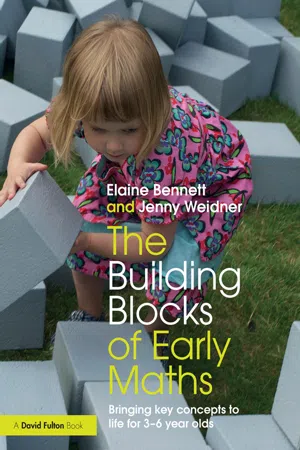
The Building Blocks of Early Maths
eBook - ePub

The Building Blocks of Early Maths

Bringing key concepts to life for 3-6 year olds

  1. 136 pages
  2. English
  3. ePUB (mobile friendly)
  4. Available on iOS & Android
eBook - ePub

The Building Blocks of Early Maths

Bringing key concepts to life for 3-6 year olds

About this book

Young children need to develop and understand the core basic concepts in mathematics before they can move forward in their mathematical learning. Without these solid foundations, they are more likely to have gaps in their knowledge and require intervention in their primary years. This new book provides guidance and resources to help you develop children's key skills and understanding in mathematics.

Written by experienced teachers, the book outlines key mathematical concepts and provides a wide range of exciting, mathematically rich activities that support the development of these concepts. It exposes some of the common misconceptions and errors that practitioners may observe children showing in their settings and offers simple practical strategies to help move children forward in their thinking and understanding.

Covering all areas of mathematics learning – counting and number, calculation, shape and space, pattern, measuring and handling data – the book features:

    • practical ideas for supporting assessment, observation, mathematical vocabulary and building links with home
    • activities that promote a child-led approach, linked to children's everyday lives and experiences
    • guidance on how to extend and challenge children's learning through adult-led, quality teaching and effective practice
    • a clear sense of progression based on children's understanding rather than age.

Written by experienced practitioners, The Building Blocks of Early Maths will help you to ensure that the children in your care have the strong foundations they need to become confident successful mathematician in the future.


Frequently asked questions

Yes, you can cancel anytime from the Subscription tab in your account settings on the Perlego website. Your subscription will stay active until the end of your current billing period. Learn how to cancel your subscription.
No, books cannot be downloaded as external files, such as PDFs, for use outside of Perlego. However, you can download books within the Perlego app for offline reading on mobile or tablet. Learn more here.
Perlego offers two plans: Essential and Complete
  • Essential is ideal for learners and professionals who enjoy exploring a wide range of subjects. Access the Essential Library with 800,000+ trusted titles and best-sellers across business, personal growth, and the humanities. Includes unlimited reading time and Standard Read Aloud voice.
  • Complete: Perfect for advanced learners and researchers needing full, unrestricted access. Unlock 1.4M+ books across hundreds of subjects, including academic and specialized titles. The Complete Plan also includes advanced features like Premium Read Aloud and Research Assistant.
Both plans are available with monthly, semester, or annual billing cycles.
We are an online textbook subscription service, where you can get access to an entire online library for less than the price of a single book per month. With over 1 million books across 1000+ topics, we’ve got you covered! Learn more here.
Look out for the read-aloud symbol on your next book to see if you can listen to it. The read-aloud tool reads text aloud for you, highlighting the text as it is being read. You can pause it, speed it up and slow it down. Learn more here.
Yes! You can use the Perlego app on both iOS or Android devices to read anytime, anywhere — even offline. Perfect for commutes or when you’re on the go.
Please note we cannot support devices running on iOS 13 and Android 7 or earlier. Learn more about using the app.
Yes, you can access The Building Blocks of Early Maths by Elaine Bennett,Jenny Weidner in PDF and/or ePUB format, as well as other popular books in Pedagogía & Educación infantil. We have over one million books available in our catalogue for you to explore.

Information

Publisher
Routledge
Year
2014
eBook ISBN
9781135128708
Edition
1

1 Counting and number

DOI: 10.4324/9780203076972-2

Introduction

Children are surrounded by numbers and this is perhaps the area of maths that children are exposed to from the youngest age. From counting stairs, hearing number rhymes, listening to favourite traditional stories and being out and about whether shopping or at the park. These types of real life experiences can all go some way towards developing a true sense of number and counting. The reason these experiences are so valuable is because they are meaningful and are relevant to children’s lives. They also enable children to begin to make connections, for example the meaning of the number three could be their age, the number of billy goats in a story, how many plates are on their dinner table or the number on their front door. As practitioners working with young children we have lost count of the number of times that children will see a number and excitedly exclaim ‘That’s how old I am!’ or ‘That’s the number on my nanny’s door!’ This clearly demonstrates how children want numbers to be personal to them and are continually searching to make sense of the numbers around them and the connections between them. As children progress through their education a solid sense of number and counting is crucial in order for them to calculate, compare quantities and solve problems. Where children do not have this solid understanding they are simply following mathematical rules or processes without truly understanding them.
Figure 1.1 Provide interesting and unusual objects to spark children's interest in counting

Everyday experiences of number and counting

  • Comparing scores on computer games
  • Door numbers
  • Television channels
  • Ages
  • Telephone numbers
  • Bus numbers
  • Games and jigsaws
  • Getting dressed
  • Shopping
  • Cooking

What are the building blocks?

How many? (Cardinal)

This is about children being able to accurately count objects, knowing that the last number said is the number of objects in the group and that each object is only counted once. They need to understand that it does not affect the total if the group is rearranged or counted in a different order.

Counting out loud

This is about children understanding that when we count aloud there is a set order for the number names, beginning one, two, three, four, five. Even as children begin to count in steps of two, five or ten they are using their knowledge of this number order.

Ordinal

This is about using numbers to describe the place or position of a person or object, for example you would not say someone was three in the line, you would say they were third in the line.

Estimation

This is about using children’s sense of number to make sensible and accurate guesses about quantities and amounts and recognising that an estimate does not need to be exact. Children are often reluctant to make a guess that may not be correct, when in fact a near guess is an essential tool in life, such as checking change in a shop or working out costs.

Place value

This is about the place and value of digits within the number system and, as numbers get bigger, what each digit represents such as ones, tens or hundreds. A solid grasp of place value is essential for the development of calculation skills and for children understanding what is happening to numbers as they add, subtract, multiply and divide.

Reading and writing numbers

This is about children being able to recognise and record numerals to represent amounts such as how many objects in a box, quantities such as how long something is and labels such as a number on a door.

Key vocabulary

  • Number
  • Zero, one, two, three…
  • How many?
  • Count up to
  • Count on
  • Count back
  • More
  • Less
  • Odd
  • Even
  • Estimate
  • Near
  • Fewer
  • Bigger
  • Compare
  • First, second, third…
  • Before
  • After
  • Next
  • Units, ones
  • Tens
  • Teens

Moving on: What does it look like at the three stages of progression?

Laying the foundations
Children at this stage:
  • use numbers in their play;
  • use developing mathematical language in everyday contexts;
  • will probably be able to count up to 10 orally;
  • may be beginning to try and record numbers by making marks or showing numbers on their fingers;
  • enjoy joining in with counting activities such as counting toys, singing songs, etc.
Beginning to build
Children at this stage:
  • count up to 20 orally and can order numbers up to 10, then 20;
  • make simple estimates of how many objects are in a group and check by counting;
  • say one more and one less than a given number to 10 and beyond;
  • record numbers with increasing accuracy in play activities.
Building up
Children at this stage:
  • count at least 20 objects accurately;
  • begin to count to and across 100, forwards and backwards, beginning with 0 or 1, or from any given number;
  • learn to count, read and write numbers to 100 in numerals; initially to 20, with a focus on teens numbers;
  • identify and represent numbers using objects and pictures including the number line;
  • compare and order numbers using the language of: equal to, more than, less than (fewer), most, least;
  • begin to understand what each digit in a number represents, starting with teen numbers;
  • say the number that is one more or less and ten more or less than a multiple of ten;
  • recognise sequences and patterns, including odd and even numbers.

Building together

Out and about
Matching game
Building blocks:
  • How many
  • Counting out loud
  • Reading and writing numbers
Moving on:
Laying the foundations
You will need:
Buckets or bags, sticky labels, washing line, natural ‘treasures’ available in the outdoor area such as coloured leaves, stones, pebbles, sticks, twigs, fir cones, conkers, acorns
Main activity:
Talk to the children about the ‘treasures’ they could find in the outdoor area such as colourful leaves, stones, fir cones, twigs, etc. Hang a selection of buckets or bags on a washing line or wall. Explain to the children that each bucket or bag can only hold a certain number of treasures. Get the children to help you label the buckets or bags using marks, numerals or dots up to five or ten depending on the children’s abilities. Look at the labels on the buckets together and count out loud together until you get to the number that is on the label. Using a range of natural treasures demonstrate how to put the correct number of objects in the bucket. For example, if it is labelled with the number three, then count out loud one count every time you pick up an object until you get to three. Then check by touching each object and counting again. Put the treasures in the bucket. Allow children time to search for and collect a range of treasures and then observe as they count and place them in the buckets. Remind the children to count aloud as they select their objects or to touch each object they have as they count aloud before putting them into the bucket. Once each bucket has treasure inside it gather the children together and check that each bucket has the correct number of objects inside it. Begin by asking the children ‘How many treasures are meant to be in the bucket?’ then check by counting aloud together with the practitioner modelling touching each object, then once the last object has been counted ask again ‘How many treasures do we have?’ Model to the children that the last count represents the number of treasures they have. Children could then repeat the task but labelling the buckets themselves.
Make it easier: Only label buckets with up to three items or provide simple picture cards with two leaves, three stones, one stick, etc. drawn on it so that children can match the objects they find to the cards. Practice counting aloud with the children as they find the objects.
Make it harder: Instead of labelling the buckets with numbers provide each child with a bucket. Explain that they are going to hunt for natural treasures and can fill their buckets but they must only pick one type of natural treasure to collect, such as only leaves or stones. Each child takes their bucket to fill and then returns to the group. Children then respond to the question ‘How many treasures do you think are in your bucket?’ by estimating. Ask the children how they could check whether they are correct. Count the objects together, encouraging the children to count aloud with you, ensuring that they only count each object as it is taken from the bucket.
Out and about
Scavenger hunt
Building blocks:
  • How many
  • Counting out loud
  • Reading and writing numbers
Moving on:
Beginning to build
You will need:
Paper or plastic bags, sticky labels, felt tips/crayons/pencils, sand timer, natural...

Table of contents

  1. Cover Page
  2. Half-Title Page
  3. Title Page
  4. Copyright Page
  5. Table of Contents
  6. Acknowledgements
  7. Introduction
  8. 1 Counting and number
  9. 2 Measuring
  10. 3 Data handling
  11. 4 Calculating
  12. 5 Shape and space
  13. 6 All aboard: Building links and working with families
  14. Bibliography