eBook - ePub
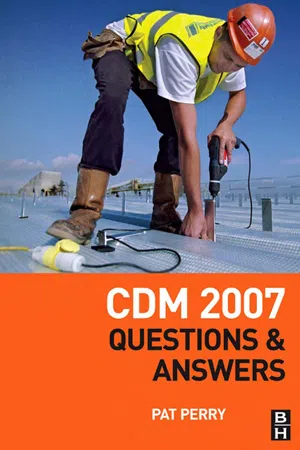
CDM 2007
About this book
The Construction (Design and Management) Regulations 2007 repeal the CDM Regulations 1994 and the Construction (Health, Safety and Welfare) Regulations 1996; containing all the legal duties regarding the design and management of a construction project and the safe operating standards expected on a construction site.
CDM 2007: Questions and Answers by Pat Perry is a pragmatic, common-sense approach to interpreting the many queries which will inevitably arise from the new Regulations, no matter how simplified they purport to be.
The author details practical solutions to a wide range of legal compliance issues and explores answers which go beyond the rather limited information contained in the Approved Code of Practice which supports the Regulations.
The various duty holders, project stages and safety issues are dealt with in different chapters and the book can be used for detailed reference or for a quick refresher on specific subjects.
1
The Construction (Design and Management) Regulations 2007 – The Regulations Explained
1.1 What are the CDM Regulations and what is their purpose?
The CDM Regulations are the common name for the Construction (Design and Management) Regulations 2007, a set of Regulations which came into force on 6 April 2007.
The Regulations replace the Construction (Design and Management) Regulations 1994 (and amendments) and the Construction (Health, Safety & Welfare) Regulations 1996.
The purpose of the Regulations is to improve the health and safety record on construction sites by requiring all parties involved in a construction project to take responsibility for health and safety standards. By requiring better planning, design and management of a construction project, it is believed that unacceptably high accident and fatality rates will be reduced.
The Regulations are also intended to help reduce the high incident rate of occupational ill-health which is common in the construction industry e.g. chronic respiratory conditions, muscular–skeletal conditions, industrial deafness, industrial dermatitis and so on.
Those who could create health and safety risks have been made responsible for considering and controlling them during all stages of the project – conception, design, planning, construction work, future maintenance and use of the building, including demolition.
1.2 Why have the 1994 Regulations been replaced?
The CDM Regulations 1994 were instrumental in improving the overall health and safety on construction sites but they were deemed relatively ineffective in reducing design risks, changing attitudes to the importance of planning and managing projects and so did not bring the improvements in health and safety expected.
In particular, clients and designers were slow to accept their duties and failed to understand the intent of the Regulations regarding hazard elimination, etc.
The Planning Supervisor role was seen by most parties involved in a construction project as unnecessary and ineffective, and there was very little “planning” or “supervision” of projects by them.
The 1994 Regulations also generated huge amounts of paperwork and it seemed that the volume of paperwork generated for a project would indicate how effectively they were complying with CDM.
Often, all duty holders under the 1994 Regulations would hide behind the paperwork and little improvement was seen in relation to managing, communicating and co-ordinating risk on a construction project.
The old Regulations were seen as complex and bureaucratic and divorced from the Regulations governing site safety i.e. the Construction (Health, Safety and Welfare) Regulations 1996.
There were also concerns raised by the EU Commission that the UK had not adequately adopted the relevant EU Directive and improvements were being required to ensure consistency across all EU Countries.
1.3 Do the CDM Regulations apply to all construction projects?
Yes.
The 2007 Regulations apply to all construction works irrespective of how many operatives are engaged on the project. The 1994 Regulations exempted construction projects where there were five or fewer operatives on site. The 2007 Regulations have removed this exemption because health and safety is as much a concern on smaller sites as it is on larger sites.
Not all of the 2007 Regulations apply to all construction projects – Part 3 which covers additional duties where a project is notifiable applies only if the construction phase lasts more than 30 days or more than 500 person days.
Most duties remain on clients, designers and contractors regardless of notification.
1.4 What is “construction work” under the CDM Regulations?
Construction work means the carrying out of building, civil engineering or engineering construction work.
The definition includes:
• The construction, alteration, conversion, fitting out, commissioning, renovation, repair, upkeep, redecoration or other maintenance (including cleaning which involves the use of water or an abrasive at high pressure or the use of substances classified as corrosive or toxic) de-commissioning, demolition or dismantling of a structure.
• The preparation for an intended structure, including site clearance, exploration, investigation (but not site survey), excavation, laying and installing the foundations of the structure.
• The assembly on site of pre-fabricated elements to form a structure or the disassembly on site of pre-fabricated elements which immediately before such disassembly formed a structure.
• The removal of a structure or part of a structure or any product or waste resulting from demolition or dismantling of a structure or from the disassembly of pre-fabricated elements which, immediately before disassembly, formed a structure.
• The installation, commissioning, maintenance repair or removal of mechanical, electrical, gas, compressed air, hydraulic, telecommunications, computer or similar services which are normally fixed within or to a structure.
1.5 What is not “construction work”?
The following activities are generally not classed as construction work:
• General horticultural work and tree planting
• Archaeological investigations
• Erecting and dismantling of marquees
• Erection and dismantling of lightweight partitions to divide open plan offices
• Creation of exhibition stands and displays
• Erection of scaffolds for support or access for work activities which are not classed as construction works
• Site survey works e.g. taking levels, assessing soil types, examining structures
• Work to or on ships
• On-shore fabrication of elements for off-shore installations
• Factory manufacture of items for use on construction sites.
1.6 The CDM Regulations refer to key appointments which must be made on a construction project. What does this mean?
The CDM Regulations identify key duty holders who have responsibilities for ensuring that health and safety matters are addressed during construction projects. They are:
(1) The Client
(2) The Designer
(3) The CDM Co-ordinator (only for notifiable projects)
(4) The Principal Contractor (only for notifiable projects)
(5) Contractors.
The Client is anyone for whom a construction project is carried out.
The Designer is anyone who carries on a trade, business or undertaking in connection with which he:
• Prepares a design, or
• Arranges for any person under his control to prepare a design,
relating to a structure or part of a structure.
The CDM Co-ordinator is a competent person or body with the overall responsibility for co-ordinating health and safety aspects of the design and planning stage and advising the client on all health and safety matters.
The Principal Contractor is appointed on notifiable projects and must be a Contractor. They must take responsibility for all site-specific safety issues, including ensuring that Contractors and Sub-Contractors are competent and have resources to carry out the work safely, that a Health and Safety Plan is developed. Principal Contractors are also responsible for providing information, training and consultation with employees, including the self-employed.
Contractors are those who manage or carry out construction work.
1.7 The CDM Regulations refer to a “notifiable project”. What is this?
The Regulations require certain projects to be notified to the Health and Safety Executive (HSE).
A construction project is notifiable to the HSE area office when:
• It will, or is expected to, last more than 30 days, or
• It will, or is expected to, involve more than 500-person days.
The HSE requires certain information which is outlined in Schedule 1 of the CDM Regulations. As long as the relevant information is given it can be supplied in any format but in order to facilitate notification the HSE have produced Form F10 (rev.) which can be used for all projects.
An example of Form F10 (rev.) is shown in Appendix 5A.
1.8 When does the construction phase start and are weekends and bank holidays counted?
The construction phase for the purposes of notification to the HSE is from the day “construction works” start.
Remember, site clearance constitutes construction works and must be included in the calculation.
If construction work is programmed to take place on Saturdays and Sundays and on any Bank Holiday, no matter how long the working shift will be, these days must be counted as “construction days”.
1.9 What is a “person day”?
A “person day” is any day or part of a day (no matter how short) when someone is expected to carry out construction work. A person day relates to one individual and includes Site Agents, Foreman and Supervisors.
They do not actually have to be carrying out any physical work to be involved in “construction work” – if they are managing the project they are included as a “person day”.
1.10 Why do the HSE need to know about these projects?
The HSE enforces health and safety laws in the construction industry. Projects lasting over 30 days are considered to be substantial building or refurbishment projects where the risks to health and safety of operatives and others can be high. The HSE has always been made aware of construction projects so that they can plan their inspection programme of enforcing the laws.
The HSE receive over 500,000 project notifications per year and use the notification process to help them target their on-site inspection priorities. In addition, they will review the F10’s to try to influence the design process, enquiring about the provision for health and safety where appropriate.
1.11 What does the HSE do when they receive all these F10’s?
The Construction division of the local HSE office records all forms received and allocates the projects to individual inspectors. The HSE inspectors base their routine inspections on the type of projects notified and will prioritize projects into perceived risk categories e.g. those where falls from height are likely, or which involve excavations and so on.
The Construction Inspector, or the Administration Officer, will look at key dates on the form. They are interested to note when the form is signed by the Client...
Table of contents
- Cover
- Halftitle
- Title
- Copyright
- Contents
- 1 The Construction (Design and Management) Regulations 2007 – The Regulations Explained
- 2 Health and Safety Legislation
- 3 Risk Assessments
- 4 The Client
- 5 The CDM Co-ordinator
- 6 Designers
- 7 The Principal Contractor
- 8 Contractors
- 9 Design Risk Assessments
- 10 The Pre-Construction Information Pack
- 11 The Construction Phase Health and Safety Plan
- 12 Competency of Duty Holders
- 13 The Health and Safety File
- 14 Workplace Facilities
- 15 Management of Health and Safety on Construction Projects
- 16 Accident and Incident Management
- 17 Site Welfare Facilities
- 18 Asbestos
- 19 Safe Places of Work
- 20 Vehicles and Transport
- 21 Excavations and Demolitions
- 22 Energy Distribution Systems
- 23 Safe Systems of Work
- 24 Working at Heights
- 25 Electrical Safety
- 26 Hazardous Substances
- 27 Personal Protective Equipment
- 28 Lifting Operations and Lifting Equipment
- 29 Manual Handling
- 30 Fire Safety
- 31 Noise
- 32 Training in Health and Safety
- Appendices
- Glossary
- Index
Trusted by 375,005 students
Access to over 1.5 million titles for a fair monthly price.
Study more efficiently using our study tools.
Frequently asked questions
Yes, you can cancel anytime from the Subscription tab in your account settings on the Perlego website. Your subscription will stay active until the end of your current billing period. Learn how to cancel your subscription
No, books cannot be downloaded as external files, such as PDFs, for use outside of Perlego. However, you can download books within the Perlego app for offline reading on mobile or tablet. Learn how to download books offline
Perlego offers two plans: Essential and Complete
- Essential is ideal for learners and professionals who enjoy exploring a wide range of subjects. Access the Essential Library with 800,000+ trusted titles and best-sellers across business, personal growth, and the humanities. Includes unlimited reading time and Standard Read Aloud voice.
- Complete: Perfect for advanced learners and researchers needing full, unrestricted access. Unlock 1.5M+ books across hundreds of subjects, including academic and specialized titles. The Complete Plan also includes advanced features like Premium Read Aloud and Research Assistant.
We are an online textbook subscription service, where you can get access to an entire online library for less than the price of a single book per month. With over 1.5 million books across 990+ topics, we’ve got you covered! Learn about our mission
Look out for the read-aloud symbol on your next book to see if you can listen to it. The read-aloud tool reads text aloud for you, highlighting the text as it is being read. You can pause it, speed it up and slow it down. Learn more about Read Aloud
Yes! You can use the Perlego app on both iOS and Android devices to read anytime, anywhere — even offline. Perfect for commutes or when you’re on the go.
Please note we cannot support devices running on iOS 13 and Android 7 or earlier. Learn more about using the app
Please note we cannot support devices running on iOS 13 and Android 7 or earlier. Learn more about using the app
Yes, you can access CDM 2007 by Pat Perry in PDF and/or ePUB format, as well as other popular books in Law & Medical Law. We have over 1.5 million books available in our catalogue for you to explore.