![]()
1 Climate Change: The Battle Begins
War is Already upon Us
The war against climate change pitches mankind against a global threat that vastly eclipses that of terrorism,1 in battles that have already claimed the lives of hundreds of thousands of ordinary men and women from every continent. Climate change has led us into an era in which war and conflict are endemic,2 the widespread extinction of species approaches catastrophic proportions,3 and whole regions and countries will be lost beneath the swelling seas and the expanding deserts of a rapidly warming world. And the really bad news is that ‘the world has only one generation, perhaps two, to save itself’.4
We all instinctively know, already, that the climate is changing, from the small noticed things like the unseasonable patterns of the flowering of plants, the falling of snow and the growing in strength of the wind and the rain. With this knowledge comes a growing apprehension of danger. Deep down, in quiet moments, we ask ourselves questions that a year or two ago were unthinkable:
- What will I do when the lights do go out?
- Will the house flood next year?
- Will my home get so hot this summer that I won’t be able to stay in it?
- How long could I survive in this building without air conditioning?
- Where will we go?
- Will we survive?
This book is written to enable you, the reader, to get a clearer view of the ways in which the climate is changing and how these changes will affect your life tomorrow and the day after, in the buildings, settlements and regions in which you live and work. Only by emotionally registering, by consciously taking on board, the scale of the impending global disaster ahead will any of us find the strength to act in time to avert the worst of its impacts.
But not only do we have to act fast, we also have to act together. Actions will only be effective if we all act together because each of us is ‘involved’ in the fate of all mankind through the common air that we breathe and the climate we occupy.
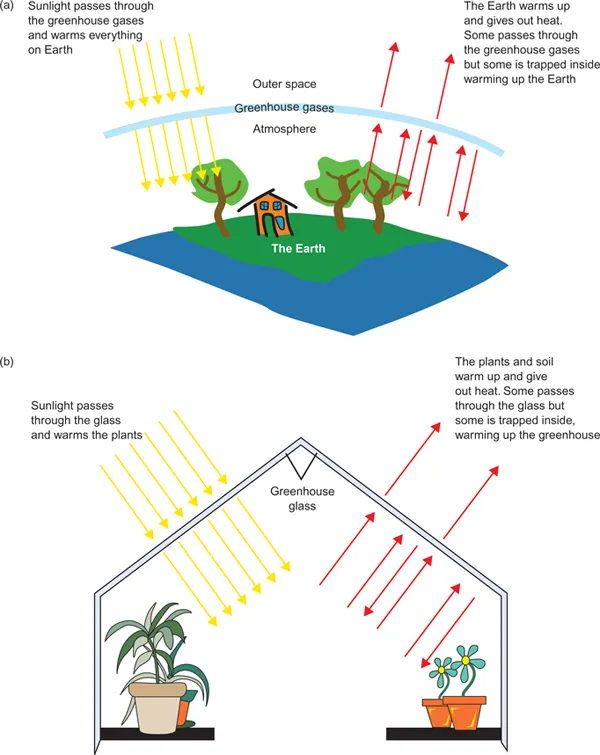
As you will see throughout this book, people can apparently be ‘familiar’ with the excellent science of climate change, and ‘know’ intellectually the problems that exists, but still fail to engage with them, or act upon that knowledge. We know now that many of the gases we emit from the burning of fossil fuels are altering the climate. Every schoolchild learns, or should learn, how these gases are building up in the upper atmosphere to form an increasingly dense layer that allows solar radiation into the Earth’s atmosphere, but as this layer gets denser, it prevents more and more heat from radiating back out into space, so warming the lower atmosphere and changing our climate.6
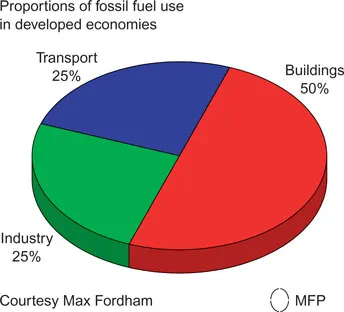
The evidence for climate change is growing more alarming each year. The exceptionally hot summers such as those of 2003 and 2005 warned experts that the pace of this warming is faster than previously envisaged in their worst case scenarios.7 Yet rather than acting to reduce emissions, many apparently well-meaning and well-informed people appear to act wilfully to make the situation worse in communal acts of ‘denial’, and nowhere more so than in the built environment. Buildings are responsible for producing over half of all climate change emissions, but year on year, ‘modern’ buildings become more and more energy profligate and damaging to all our children’s future. Climate change is personal. ‘They’ are harming ‘our’ grandchildren.
In London, for instance, where more is known about the urban impacts of climate change than for almost any other city in the world, the Greater London Authority and the then Deputy Prime Minister heavily promoted the huge developments of the Thames Gateway area. Situated to the east of the capital on the coastal flood plains of the Thames Estuary this area has periodically flooded throughout history, well before rising sea levels and stronger storm surges increased the risk of loss of life and property to the seas here. Leading architects have even suggested that proposed settlement densities are too low, even when they must ‘know’ of the risks of putting buildings and people in such locations. Are such architects going to live there themselves? Are they ignorant or simply cynically exploiting a business opportunity? How much do such architects and developers really ‘know’?
Former US President George W. Bush had repeatedly refused to acknowledge that climate change is happening at all, to the extent that by the end of 2003 there were 12 US states suing the US Environmental Protection Agency because of the failure of the US Government to take action against climate change. And yet the US administration knows of the dangers of climate change to their own homeland because a Pentagon Report in 2003 told them of the endemic war and conflict the world would face as a result of it.2 Bush changed his mind on this issue in 2007 when he publicly admitted that climate change was happening and yet his administration continued to obstruct action to mitigate and adapt to the changing climate. His successor Barak Obama had swiftly passed a radical Climate Change Bill through Congress in June 2009.
1.2.
The basics of climate change are taught in all British schools and such images of how the greenhouse effect (b) works in relation to the global atmosphere (a) are very familiar to children by the age or 7 or 8.
Source: http://www.defra.gov.uk/environment/climatechange/schools/12–16/info/cause.htm.
1.3.
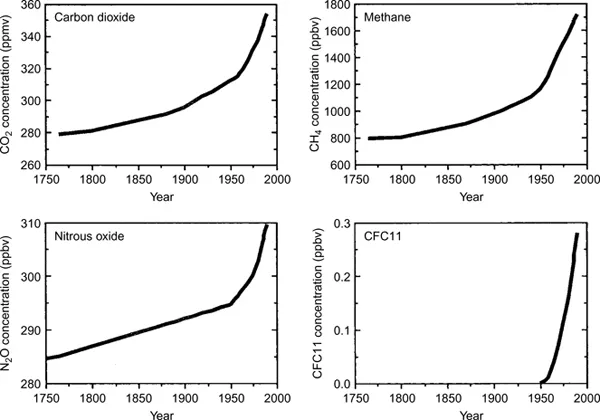
In the middle of the twentieth century more and more of the world’s rapidly growing population bought cars and heated and cooled their buildings, resulting in a rapid increase in concentrations (parts per million/billion by volume) of the major greenhouse gases in the global atmosphere: carbon dioxide (CO2), nitrous oxide (N2O), methane (CH4) and CFC11.
Source: Houghton J.T., Jenkins, G.J., Ephraums, J.J. (eds) (1990) Climate Change: The IPCC Scientific Assessment. Cambridge: Cambridge University Press, p. xvi.
1.4.
Graph showing the relatively large impacts of buildings in the developed world in terms of their emissions of climate change greenhouse gases.
Source: Max Fordham and Partners.
The Australian government continues to be oblivious to the pleas for shelter of the islanders of Tuvalu, where the whole island is more frequently being covered completely by the rising sea every year; and, with impending disaster so close to their own doorsteps, the Australians are refusing not only to give the islanders a refuge but also to consider cutbacks in their own greenhouse gas emissions, on this, the most vulnerable continent on the planet to the impacts of the warming climate. But, perhaps it is too difficult to connect the idea of gas emissions to environmental impacts in remote islands, and it could be understandable that the Australian people feel no sense of responsibility for the plight of the people of Tuvalu, despite the fact that the government of Australia has now begun to take on board the severity of the impacts of climate change as a result of an entrenched drought in parts of the country and the recent report to government of Ross Garnaut on their dire social and economic implications for Australia. But how much do the Australian people ‘know’ about the plight of their own sunburnt country in a changing climate? Drought is teaching them rapidly now.
Should the word ‘know’ here be replaced, perhaps, with ‘care’?
No wonder that so many people today feel that ‘it’s a mad world’, but why? Surely we are a rational species? Perhaps it all has to do with the actual process of changing, the extent and speed of the required changes, and the costs and risks of acting, or not acting, to make those changes happen.
J.K. Galbraith noted in 1958 that ‘conventional wisdom’ generally makes people indisposed to change their minds and reminds readers of John Maynard Keynes’ famous words:8
Conventional wisdom protects the continuity in social thought and action. But there are also grave drawbacks and even dangers in a system of thought which by its very nature and design avoids accommodation to circumstances until change is dramatically forced upon it … the rule of ideas is only powerful in a world that does not change. Ideas are inherently conservative. They yield not to attack of other ideas but to the massive onslaught of circumstances with which they cannot contend.
We are faced now with the massive onslaught of the circumstances of climate change. This book describes some of those circumstances in relation to buildings, settlements and lifestyles of this, and future decades. As you read on it will become clearer how very difficult, if not impossible, we will find it to contend with the impacts of climate change, to meet head on the challenges of changing ‘social thought and action’, and to redirect the supertanker of conventional wisdom.
That is why you, the reader, are important, and why this book has been written to make you ‘disposed to change your mind’, and in turn change the minds of those in your circle of influence, and those in theirs, and so on until the ripple grows to be a tidal wave of change in the attitudes of our society. And though none of us wants it, and we may wish that we lived in different times, it is the responsibility of each and every one of our generation, and ours alone in the whole history of humankind, to take up arms in this battle for our very survival.
But why has it taken us so long to act? The Climate War is already upon us. How did it come to this?
The Enemy was Sighted Long Ago
The possibility that the climate could be changing was first identified as far back as the 1960s, and the battle against climate change, and its main contributory gas, carbon dioxide (CO2), began.
Physical measurements of global CO2 emissions have been taken since the 1950s.9 The Mauna Loa atmospheric CO2 measurements constitute the longest continuous record of atmospheric CO2 concentrations available in the world. The clear upland atmosphere of the Mauna Loa volcano on the Pacific island of Hawaii is one of the most favourable locations on the planet for measuring undisturbed air because possible local influences of vegetation or human activities on atmospheric CO2 concentrations are minimal and any influences from volcanic vents may be excluded from the records.
The methods and equipment used to obtain these measurements have remained essentially unchanged during the 50-year monitoring programme. Because of the favourable site location, continuous monitoring, and careful selection and scrutiny of the data, the Mauna Loa record is considered to be a precise record and a reliable indicator of the regional trend in the concentrations of atmospheric CO2 in the middle layers of the troposphere. The record shows an 18% increase in the mean annual concentration, from 316 parts per million by volume (ppmv) of dry air in 1959 to 373 ppmv in 2002 and 389 in 2009. The 1997–98 increase in the annual growth rate of 2.87 ppmv was the largest single yearly jump since the Mauna Loa record began in 1958.
Such data are used to inform and validate the computer models of the climate10 which have been used to depict and predict former, current and future climates right down to a resolution of fifty, and now even five, kilometre squares.11 Such models have provided sufficiently credible evidence, where, for instance, pred...