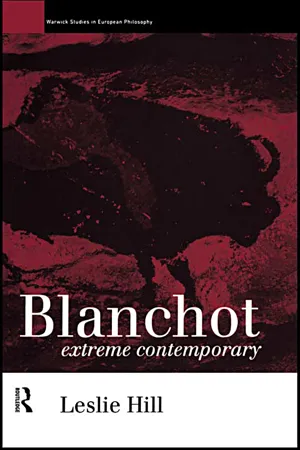
Blanchot provides a compelling insight into one of the key figures in the development of postmodern thought. Although Blanchot's work is characterised by a fragmentary and complex style, Leslie Hill introduces clearly and accessibly the key themes in his work. He shows how Blanchot questions the very existence of philosophy and literature and how we may distinguish between them, stresses the importance of his political writings and the relationship between writing and history that characterised Blanchot's later work; and considers the relationship between Blanchot and key figures such as Emmanuel Levinas and Georges Bataille and how this impacted on his work.
Placing Blanchot at the centre stage of writing in the twentieth century, Blanchot also sheds new light on Blanchot's political activities before and after the Second World War. This accessible introduction to Blanchot's thought also includes one of the most comprehensive bibliographies of his writings of the last twenty years.
- 320 pages
- English
- ePUB (mobile friendly)
- Available on iOS & Android
eBook - ePub
About this book
Information
1: An intellectual itinerary
Why Blanchot?
To write on is, in any case, without propriety. But to write on the event that is precisely designed (among other things) to make it no longer possible ever to write on – by way of epitaph, commentary, analysis, eulogy, or condemnation – is to distort it in advance and to have always already missed it.
‘Tracts, affiches, bulletin’ (BR, 204)
There is little doubt today that the name Maurice Blanchot signs some of the most challenging and influential literary and philosophical texts of the last fifty years. Dispersed across a variety of different genres, Blanchot’s writings are extensive and numerous. They include countless critical essays on literary and philosophical topics, three full-length novels, ten or more shorter narratives or récits, as well as a significant amount of political journalism, not to mention a host of other fragmentary texts that resist all attempt at stable classification. Despite a reputation for sparseness and impenetrability, they display a matchless lucidity and relentless commitment to explanation, self-commentary, and gloss; taken as a whole, they constitute perhaps one of the most remarkable and enduring of monuments in the whole of recent intellectual history to the perseverance and assertiveness of thought itself.
Blanchot is a writer whose work eludes easy categorisation. His writing straddles literature and philosophy, which is to say that, while it belongs to both, it falls subject to neither. This is not to claim for Blanchot’s writing a position of extraterritorial neutrality or metalinguistic immunity; nor is it to suggest that Blanchot’s own texts are somehow able to arbitrate authoritatively and decisively on the question of the relation between literature and philosophy as such. Indeed, the case is almost exactly the reverse. While asking fundamental questions of philosophical and literary texts alike, Blanchot’s own writing is itself characterised by an awareness of its own irremediable and necessary incompletion, and by the knowledge that, just as all legislation is a response to lawlessness, so limits too are always but a tribute to the limitlessness that inhabits them as an ineluctable and indelible condition of their possibility. Blanchot here pushes philosophy and literature towards the unspoken margins that constitute them as what they are. In so doing he deconstructs and transforms them, radically altering the terms in which today it is possible, indeed necessary, to think not only the question of literature, but also the deeper question of which Blanchot writes in L’Entretien infini (The Infinite Conversation) that it is the questioning that eludes and outstrips, precedes and exceeds the question of the whole (EI, 16–21; 14–17).
Blanchot’s intervention, then, is fundamental. What changes, with Blanchot, is not just a localised sector of the literary critical or philosophical landscape, but the manner in which the relationship between literature and philosophy, writing and thought is articulated at all. Blanchot, one might say, is the thinker who has most consistently shown the relevance of philosophy for the practice of literature as such; but he is also the writer who has demonstrated most powerfully the radical extent of the questions addressed in its turn by literature to philosophy as a whole. As a result, Blanchot in his writing has renewed the critical debate concerning the ontological – or non-ontological – status of literature and art in general, and profoundly transformed the manner in which it is necessary to think the question of the ethical demand to which writing is a response. Philosophy, Blanchot contends, cannot escape the words that make it possible, but neither can literature do without philosophy; indeed, as Blanchot puts it in L’Écriture du désastre (The Writing of the Disaster),
to write in ignorance and without regard for the philosophical horizon, a horizon punctuated, gathered together or dispersed by the words that delimit it, is necessarily to write with facile complacency (the literature of elegance and good taste). Hölderlin, Mallarmé, so many others, do not allow us this.
(ED, 160; 103)
Blanchot is probably best known as a critic of literature. As such, he is the author of some of the most perceptive and probing essays of the last fifty years. His texts on Sade, Kafka, Hölderlin, Mallarmé, Rilke, Bataille, Char, Beckett, Duras and many others, make him one of the most distinctive and cogent analysts of modern and contemporary literary culture. But Blanchot’s contribution does not stop there. He is also an incisive reader of many of the central philosophical texts of the last two centuries, an astringent commentator of Hegel, Nietzsche, Heidegger, Levinas, Foucault, Derrida, and others, while as a novelist he is the author of some of the most trenchant – and intractable – of modern literary texts, texts which, in their limpid clarity and irredeemable obscurity, give voice, as Georges Bataille once wrote, to the vertiginous extremity of that which is itself without limits and which, as Derrida has shown, remains radically uncontainable within the bounds of discourse, including the genre of narrative itself.1
For all his exemplary centrality within twentieth-century thought, Blanchot remains a figure of irreducible and striking singularity. Like others of his generation, Blanchot was never an academic, preferring instead to derive his livelihood from his activities as a journalist and from his publications as a literary critic and novelist.2 As a thinker, Blanchot is in any case a writer deeply alert to that which all systems of thought necessarily repress or exclude and which, more often than not, turns out to be the dissimulated basis of whatever it is they in fact seek to propound. Consequently, Blanchot’s critical or philosophical writings are most often couched in the form of fragmentary commentary, and frequently present their arguments by way of a complex movement of citation, paraphrase, and gloss. As a philosopher or critic, Blanchot writes, so to speak, within the margins of other texts, within the interstices of the writings that, by chance or necessity, he encounters as a reader. One might claim as a result, and with some justice, that Blanchot in his own right is therefore not an original thinker at all. He produces – and this is one of the radical departures characteristic of Blanchot’s writing in general – few, if any, authentically philosophical or theoretical concepts that may be called his own. Indeed, the terms with which his name is associated, words such as worklessness (désœuvrement), the outside (le dehors), the neuter (le neutre), or disaster (désastre), are precisely not terms, not stable points of anchorage, but, as it were, fragments of a singular, still unspoken or long forgotten other language, or language of otherness, made up of words or traces constantly being effaced from within by the strange displacements to which they silently bear witness, always already undoing the discursive oppositions within which they function.
Blanchot’s literary or philosophical project, then, like that of Bataille in L’Expérience intérieure (Inner Experience), is precisely not a project. This is in part what gives it its singular force and compelling originality. For Blanchot attempts something more essential than simply the task of devising yet another theoretical discourse or conceptual frame within which to arraign art or literature and domesticate the questions it poses to both philosophy and thought. Instead, by persistently occupying the texts of others – from Hegel to Heidegger, Mallarmé to Paulhan, Nietzsche to Rilke – Blanchot tires out these discourses, pushes them to the limit of their endurance. Exhausting them in this way, he is then able to begin to address the fundamental otherness lying dormant within them or having been excluded from them. The consequences here are dramatic. For what comes to be inscribed in Blanchot’s writing, both within and beyond philosophy, both within and beyond criticism and literature, is the radically ineliminable character of that – without origin or identity, beyond memory and meaning – which paradoxically both enables and disables the totality of thought as its simultaneous condition of both possibility and impossibility.
One may begin here to measure the scale of Blanchot’s importance and the reasons why, in France and beyond, his work has come to exert a decisive influence over literary critics, novelists, and philosophers alike. For Blanchot’s remarkable achievement is not only to have written some of the most demanding fiction of the age and to have challenged and displaced many of the basic assumptions that continue to inhabit modern philosophy and literary theory; it is also, in the words of Jacques Derrida, in a double gesture, to have both maintained the necessity of philosophy and yet to have questioned philosophy itself from a site – the site of poetical thinking and writing – which has always resisted the endeavours of philosophy to assign to it its particular – always already philosophical – truth.3
‘Waiting for us, still to come, still to be read and re-read by the very ones who have been doing so ever since they first learned to read and thanks to him’: with these words, in 1976, Derrida once paid homage to Blanchot.4 What they serve to indicate today is both the urgency and the disjoined temporality with which we contemporary readers are each addressed by Blanchot’s writing, enjoined in our turn to transform reading – and reading Blanchot – into what Pierre Madaule once hoped, in a homage of his own, would be a – deadly – serious task.5
An ethics of discretion
Discretion – reserve – is the place of literature.
‘Le Rire des dieux’ (A, 194)
Despite his undoubted stature as a key intellectual figure in France from the 1950s onwards, Blanchot is a writer who, for many years, has consistently and single-mindedly resisted the gradual appropriation of literature (especially in France) by the mass media, maintaining as a result an anonymity and a reserve of quite exceptional integrity. There are few photographs of the author, no published accounts of his life, little in his work that would seem to warrant biographical extrapolation. For all that, his intellectual itinerary has often had a fiercely public dimension, and indeed, as though to acknowledge as much, albeit in fragmentary ways, in response to readers’ inquiries, in occasional published letters, and in one or two rare autobiographical asides and unprompted vestigial narratives of his own, Blanchot in recent decades has been concerned to disclose, deliberately but allusively, some of the historical circumstances surrounding the turning points in his writing life.
Yet while knowledge of these events does make it now possible to begin to describe some of the pivotal stages in Blanchot’s complex and lengthy intellectual career, there remain many areas of the author’s life about which little, if any, information is available. Blanchot himself has rarely departed from an overriding commitment to what one might call an ethics of discretion: an ethics that shuns the risk of indiscriminate self-exposure in order to affirm the value of distance and silence and by so doing preserve what in 1984 Blanchot termed ‘the right to the unexpected word’ (‘le droit à la parole inattendue’).1 As a result, Blanchot’s autobiographical moments are never confessional or introspective, nor do they seek to accredit the authority of a single, all-embracing narrative. Memory, Blanchot has often suggested, is itself a function of forgetting; and it is as though, through the fragmentary ways in which he has divulged some of the facts of his autobiography, Blanchot is concerned to remind his readers that a necessary condition of all acts of recollection is the effacement of much else that is essential, and that indeed the essential may in fact best be respected by patient attention to the infinite reserve of forgetting itself.
In Blanchot’s fragmentary curriculum vitae, scenes of friendship loom large. So, too, do moments of political hiatus. Both have in common, on Blanchot’s reading, their fundamental resistance to the teleology of narrative presentation. Political upheaval and fidelity to friendship belong to history but, more importantly, also interrupt it; they allow the opening of a space in which a relation with otherness intervenes to defer historical closure. Blanchot’s discretion, then, both translates a desire for privacy and implies a belief in historical discontinuity; and it is as though, when writing his name into history, Blanchot is more concerned to display, in the margins of that history, the anonymity that precedes the inscription of any name. So when for instance in 1973, in Le Pas au-delà (The Step Not Beyond, PA , 9; 2), in one of his earliest covertly autobiographical digressions, he may be found reflecting elliptically on the radical discrepancy between his duties as a professional journalist and his experiences as an apprentice novelist in the years leading up to the publication of Thomas l’Obscur in 1941, Blanchot’s purpose is not to provide the reader with a reassuringly linear narrative frame. It is rather to underline that fundamental dissymmetry between workaday activity and artistic non-activity which marked his career at its inception. The effect is to compel the reader to reconsider the relationship between history and writing in such a way that what now becomes primary is not so-called historical truth in its apparent (and misleading) self-evidence, but rather the irreducibility and alterity of that which is exterior to historical narrative because it is what has always already preceded the construction of history as narrative.
In this regard, it is no accident that elsewhere in the same book, in pages first published the previous year in homage to Edmond Jabès, Blanchot also raises the question of how to address the historical – yet more than historical – event of the Holocaust (PA , 56–7, 156; 38–9, 114).2 For here, as in Blanchot’s reflections on his own beginnings as a writer, what is at stake is a requirement that one attend, not to the meaning of history, but to the limits of historical understanding, not to the teleology and so-called objectivity of history, but to the burden of responsibility that history imposes, willingly or not, on those who are its actors or protagonists. For Blanchot in Le Pas au-delà, rather than explaining writing by recourse to narrative history, it is more a case of mobilising the resources of writing itself in order to bear witness – impossibly – to that in history which escapes historical representation. It is to uncover, within memory, a question not of history, but of writing, and within that question of writing, an ethical question that is not a question of history as such, but of political responsibility and of experience.
This issue of the relationship between writing and history is at the heart of much of Blanchot’s thinking during the 1970s and 1980s. In 1983, Blanchot returned to the topic in another discreet autobiographical self-commentary, where, uncharacteristically, arguably by way of a response to recent controversy surrounding his early involvement with the nationalist right, he acceded to a demand – one he describes as also originating somewhere within himself (AC, 91; 63) – to supply, under the title Après coup (After the Fact), a retrospective commentary to a reissue of Le Ressassement éternel (Vicious Circles), a collection of two early short stories from the mid-1930s that first appeared in 1951. Rereading these texts, Blanchot used the occasion to reconsider the connection between those stories and the historical events – more precisely the event of the Holocaust – that at least one of the narratives, ‘L’Idylle’, in its evocation of a penitentiary workhouse, may be seen to parallel, if not indeed eerily to predict (AC, 94–6; 65–7). Blanchot, however, remains resistant to this apparent convergence between text and history. ‘History’, he concludes, ‘does not control meaning [ne détient pas le sens], any more than meaning, which is always ambiguous – plural – may be reduced to its historical realisation, were this the most tragic and weightiest imaginable’ (AC, 96; 67).3 History, then, is not established truth, and provides no authorised translations; indeed, in some cases, Blanchot implies, history itself may turn out simply to have borrowed, in an act of plagiarism, the totalising impetus sometimes to be found within literary narrative itself. But equally, if history is at times just a displaced version of an oppressive, all-inclusive fiction, so, too, in the encounter with historical experience, fictional narrative sometimes also meets its limits. A story such as ‘L’Idylle’, writes Blanchot – indeed, any story whatever – will only ever fall short of the irreducibly singular historical event of those years, which in his text Blanchot names simply as: Auschwitz. ‘No matter when it may be written,’ we read, ‘every story will henceforth be before Auschwitz’ (AC, 99; 69).
These reservations with regard to narrative representation do not amount to a withdrawal from political exigencies, nor an abandonment of the obligation to bear historical witness. Rather the reverse. To read history, as does Blanchot, as a discontinuous space, irreducible to chronological narrative, is, by rejecting temporal closure, to affirm the necessary futurity of politics and political responsibility. Indeed, it was clearly to reinforce this very point that, some months after Après coup, at the age of 76, Blanchot followed up that book with another short text, La Communauté inavouable (The Unavowable Community), based on a discussion of recent work by Jean-Luc Nancy and Marguerite Duras, in which he undertook to draw the philosophical and political lessons of three significant moments in his own political itinerary: the pre-war commitment to action in small volatile groups existing outside of mainstream political parties, the struggle against the Algerian War, and the Paris événements of May 1968. In retracing that history, Blanchot’s aim was not primarily to engage in an exercise in retrospective justification or self-criticism, but, more importantly in his view, to affirm the vital actuality of what he describes as ...
Table of contents
- Cover Page
- Title Page
- Copyright Page
- Blanchot
- Warwick Studies in European Philosophy
- Acknowledgements
- Abbreviations
- 1: An Intellectual Itinerary
- 2: The (Im)Possibility of Literature
- 3: Writing the Neuter
- 4: The Absence of the Book
- 5: Extreme Contemporary
- Notes
- Texts by Blanchot
Trusted by 375,005 students
Access to over 1.5 million titles for a fair monthly price.
Study more efficiently using our study tools.
Frequently asked questions
Yes, you can cancel anytime from the Subscription tab in your account settings on the Perlego website. Your subscription will stay active until the end of your current billing period. Learn how to cancel your subscription
No, books cannot be downloaded as external files, such as PDFs, for use outside of Perlego. However, you can download books within the Perlego app for offline reading on mobile or tablet. Learn how to download books offline
Perlego offers two plans: Essential and Complete
- Essential is ideal for learners and professionals who enjoy exploring a wide range of subjects. Access the Essential Library with 800,000+ trusted titles and best-sellers across business, personal growth, and the humanities. Includes unlimited reading time and Standard Read Aloud voice.
- Complete: Perfect for advanced learners and researchers needing full, unrestricted access. Unlock 1.5M+ books across hundreds of subjects, including academic and specialized titles. The Complete Plan also includes advanced features like Premium Read Aloud and Research Assistant.
We are an online textbook subscription service, where you can get access to an entire online library for less than the price of a single book per month. With over 1.5 million books across 990+ topics, we’ve got you covered! Learn about our mission
Look out for the read-aloud symbol on your next book to see if you can listen to it. The read-aloud tool reads text aloud for you, highlighting the text as it is being read. You can pause it, speed it up and slow it down. Learn more about Read Aloud
Yes! You can use the Perlego app on both iOS and Android devices to read anytime, anywhere — even offline. Perfect for commutes or when you’re on the go.
Please note we cannot support devices running on iOS 13 and Android 7 or earlier. Learn more about using the app
Please note we cannot support devices running on iOS 13 and Android 7 or earlier. Learn more about using the app
Yes, you can access Blanchot by Leslie Hill in PDF and/or ePUB format, as well as other popular books in Literature & French Literary Criticism. We have over 1.5 million books available in our catalogue for you to explore.