- 422 pages
- English
- ePUB (mobile friendly)
- Available on iOS & Android
eBook - ePub
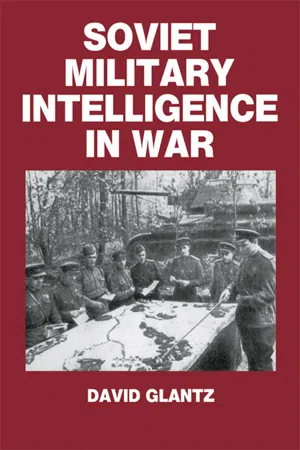
Soviet Military Intelligence in War
About this book
This text is the second of three volumes written by Colonel Glantz on the contribution of intelligence and deception operations to the Soviet victory over Nazi Germany. It examines the area where intelligence and operations overlap; the nature of co-ordination between the two; and the support provided by intelligence to operational planning and execution (or the absence of such support). This is not a study of intelligence work as such, but of how intelligence can improve the chances of success on the battlefield by facilitating the more effective and economical use of troops.
CHAPTER ONE
INTRODUCTION
The term military intelligence normally evokes the image of shadowy wartime schemes, devised at the highest levels of national intelligence, designed to reveal and thwart the strategic military plans of an attacking or defending opponent. This image is replete with agents and spies insinuating themselves into the highest enemy military or political councils of state and brilliant codebreakers eavesdropping on the most sensitive of military secrets. It recalls the feats of a Mata Hari, the impact of a lost operational order falling into the hands of a lucky enemy soldier, and the codebreaking contributions of Ultra. The scarcity and notoriety of these examples prompt us to romanticize them and generalize from them to conclude that such brilliant strokes of intelligence work often determine the course and outcome of war. More importantly, the existence of these popularized cases blinds us to one of the realities of modern combat — that intelligence in war is a mundane, time-consuming, and often frustrating process which frequently confuses, as much as it clarifies, the course of battle and war.
Intelligence, simply defined as knowledge of the enemy and his intentions, is seldom a decisive factor in war. It does not alter such concrete realities of war as the strength of contending armies and the overall war aims of contending states, and it may have only minor effect on the planning and conduct of operations. A force which lacks good intelligence may still succeed because of its strength, sound planning, and military efficiency. Conversely, a force possessing good intelligence may still fail because of weakness, planning failures, and combat inefficiency.
Sound intelligence produced by systematic study of the enemy and terrain conditions can, however, provide a marked advantage over an opposing force. It can even affect a nation’s decision to go to war in the first place. Once at war, it can place an enemy in a disadvantageous position by revealing his intentions and his dispositions. Intelligence provides a fundamental foundation for sound planning. If accurate, it can place the enemy at a disadvantage regarding the timing of an attack, concentration of forces, selection of a main attack axis and objectives, and assessing the likely duration of an operation. Intelligence can also validate planning and provide a basis for both conducting and verifying the effects of deception. In essence, intelligence provides leverage with which to accentuate the positive effects of military actions, be they offensive or defensive.
Intelligence collection, analysis, and exploitation is a difficult process, made more so by the very fog of war itself. Chance in war makes its effects even less predictable. Throughout the twentieth century, the growing complexity, scale, and technological level of war have provided greater opportunity for intelligence collection while at the same time complicating the process of analyzing and exploiting its effects. What is certain is that intelligence will remain a difficult and challenging task.
Few nations have developed a healthier respect for the relationship between intelligence and warfare than the Soviet Union. The four years of warfare on the Eastern Front during the Second World War, known by the Soviets as the Great Patriotic War, were unprecedented in scale and intensity. From the commencement of Barbarossa on 22 June 1941 to the end of the European War in May 1945, intelligence played a significant role in the course and outcome of operations. Most Westerners have only a sketchy awareness of that role. The Soviet intelligence failure of June 1941 and the apparent intelligence success at Kursk in 1943 have received attention in numerous works. Yet the appreciation of both has been, at best, superficial, replete with generalizations which have characterized most descriptions of war on the Eastern Front.
This book tests those generalizations by examining intelligence as a system whose maturation occurred over time, beginning in the pre-war years and extending through 1945 into the post-war years. It summarizes the theoretical basis of Soviet intelligence work in the pre-war period and how those theories translated into practice during war-time in what was, in effect, an arduous education conducted during the course of war.
Accurate analysis of the performance of Soviet war intelligence organs throughout the winter of 1942–43 is now possible because some Soviet classified studies are available for that period. Soviet open source literature accurately reflects those studies but contains significantly less detail and candid analysis. For the period after March 1943, little former classified Soviet archival material is available, although Soviet operational accounts, memoirs, and unit histories cover the later period more thoroughly.
Numerous German archival sources, principally from the files of Fremde Heere Ost (Foreign Armies East), are available, which cast considerable light on Soviet intelligence operations and their effects. These data, juxtaposed against the actual operations of the Red Army, provide valid grounds for judgements regarding Soviet intelligence capabilities.
Post-war Soviet writings on intelligence operations and declassified and open-source Western assessments permit description of current Soviet intelligence capabilities and intentions. These take on an added dimension when viewed against the panorama of Soviet intelligence operations in the past.
This study, then, provides a baseline from which future historians can analyze more effectively Soviet intelligence operations during and after the Second World War. It is, however, clear that definitive work on Soviet intelligence cannot be completed until more extensive Soviet archival material becomes available to military scholars.
CHAPTER TWO
THE NATURE OF INTELLIGENCE (RAZVEDKA)
The Soviets use a single generic term – razvedka – to describe all actions necessary to achieve a better understanding of their enemy, while the English language applies the distinctive terms “intelligence” and “reconnaissance” to information collection and analysis at various levels. The Soviet and U.S. approaches differ more than just semantically. The Soviets view razvedka as a single entity encompassing mundane actions at the lowest combat level as well as highly sophisticated procedures used at the national level to collect and process information on enemies or potential enemies. The term razvedka means both intelligence and reconnaissance and, with an appropriate adjectival qualifier, it pertains to every possible means of intelligence collection and analysis.
Soviet razvedka treats reconnaissance as a process, and intelligence as the product. The two are closely interrelated and equally important, and only context distinguishes between the two. The Soviets define military razvedka as:
the obtaining, collection, and study of data about military-political conditions in individual countries and in probable or actual enemy coalition nations; their armed forces and military-economic potential; the composition, dispositions, condition, nature of actions, and intentions of groups of forces; and also about the theater of operations.1
Razvedka is one of many functions the Soviets include under the rubric protecting combat actions (obespechenie boevykh deistvii), which includes other functions, such as defense against weapons of massive destruction (ZOMP), maskirovka(deception), engineer protection, troop security, and rear area protection.2 Collectively, these protective functions preserve the combat readiness of forces and facilitate their successful use in combat while simultaneously reducing the effectiveness of enemy forces. Commanders and staffs at all levels are responsible for conducting razvedka at all times, in all situations, and under all circumstances. Razvedka can be strategic, operational, and tactical depending on its scale and purpose; and, because activities at all three levels are closely interrelated, success at higher levels depends directly on the efficiency and effectiveness of like measures at lower levels.
At the highest level, strategic razvedka examines enemy planning and conduct of operations in a theater of operations or in war as a whole. It arises “simultaneously with armed struggle.”3 The means of conducting strategic razvedka have matured in consonance with advancing technology. Whereas in the past nations relied primarily on agents to obtain strategic information, today they rely heavily on aviation, communications, and cosmic razvedka. The High Command and national political authorities organize and conduct continuous strategic razvedka to determine:
The composition, condition, and distribution of enemy armed forces in a theater of military operations; views on the nature and means of conducting war; enemy plans for preparing (conducting) war; military-economic potential; the condition and prospective development of arms and military equipment, especially weapons of mass destruction; measures for immediate preparation for unleashing war; and preparation of the theater of military operations.4
Today, the primary concern of strategic razvedka is determining the likelihood of nuclear war. It focuses on the timely disclosure of enemy concentration of strategic nuclear weapons, determination of enemy preparedness to use those weapons, and judgements concerning the timing of those enemy preparations. All Soviet national razvedka assets concentrate on achieving that priority aim. The Soviets believe centralization of strategic razvedka assets is an absolute criterion for achieving effective results in a world potentially threatened by nuclear war.
Operational razvedka employs “an aggregate of measures for the gathering and study of information about actual or probable enemies in the region of military actions in the interests of preparing and successfully conducting operations.”5 Intelligence collection at the operational (front and army) level seeks information concerning: preparations for war; prospects for the use of nuclear weaponry; the grouping and capabilities of forces and weaponry; the probable nature of operations; the presence and location of enemy nuclear weapons, fire support systems, radio-electronic means and control posts; the location and likely actions of aircraft, anti-aircraft, and anti-rocket defenses; the system of rear area support; the political-morale condition of enemy forces; and other information required by the commander. In addition, operational razvedka must discern the physical nature of the area of operations, the availability of local resources, and the political sentiments of the local population.
While strategic razvedka knows no geographical limits, the scope of operational razvedka varies with the size of the theater of military operations (TVD), the size and configuration of the force, and the nature of its assigned missions. Regardless of the dimensions of the TVD, razvedka is ubiquitous throughout its depth and breadth, both before and during hostilities. At front and army level, as at all other levels, razvedka is a command function and responsibility.
Tactical razvedka relates to all measures undertaken to obtain and analyze information concerning the enemy in preparing for and conducting battle (boi). It is organized at all levels below army and in all types of forces under direct supervision of the commander and his staff. It is “conducted simultaneously on land, in the air, and at sea by specially designated razvedka organs, by aircraft (helicopters), and by ships.”6
Tactical razvedka organs are responsible for determining enemy strength, dispositions, combat readiness, manner of operations, and intentions; the presence and location of nuclear weaponry, fire support systems (including high-precision weapons), radio-electronic means, and command and control posts; the location of air defense systems and the basing and operational methods of aviation; and new combat techniques and methods and means of conducting combat actions. In addition, tactical reconnaissance clarifies the physical nature of the area of operations by detecting: the presence of obstacles and ground features which may affect operations; changes in terrain caused by use of nuclear weapons; the trafficability and presence of roads in the region; and enemy barrier systems, enemy engineer fortifications, and areas blocked by rubble. The depth of tactical razvedka varies with terrain, the size of the force, and its assigned missions. As is the case at higher command levels, the commander is responsible for its conduct.
The Soviets classify razvedka according to type and method of intelligence collection. Distinct types of razvedka reflect the specific missions to be accomplished, the force designated to conduct these missions, and how that force conducts its missions. Types of razvedka have multiplied throughout the century and today include: agent (agenturnaia), air (yozdushnaia), cosmic (kosmicheskaia), special (spetsial’naia), radio (radiorazvedka), radio-technical (radiotekhnicheskaia), ship (korabel’ nia), troop (voiskovaia), artillery (artilleriiskaia), engineer (inzhenernaia), radiological (radiatsbnnaia), chemical (khimicheskaia), biological (biobgicheskaia), radio-technical (radio-tekhnicheskaia), radiolocation (radiolokatsbnnaia), topographical (topograficheskaia), mine (minnaia), rear area (tylovaia), and technical (tekhniches-kaid) 7 Although each type is separate and distinct, all are centrally controlled and coordinated at whatever level of command they are employed.
The Soviets also classify razvedka functionally by virtue of the method employed to collect intelligence information. These methods today include: combat action of forces, observation (nabliudenie), eavesdropping (podslushivanie), photography (fotografirovanie) interception (perekhvataia rabota), direction finding (pelengatsiia), radio-electronic means (radioelektronnye sredstva), sweeps (poisk), raids (nalet), ambushes (zasada), reconnaissance in force (razvedka boem), interrogation of civilians (opros), interrogation of prisoners (dopros), and study of documents. Newer collection methods include: thermal (teplovaia), magnetic-metrical (magnitometricheskaia), and radio-thermal (radioteplovaia) .8 Closely related to these methods is the Soviet concept of the commander’s personal reconnaissance of the battlefield, which they refer to as rekognotsirovka.9
Although the Soviets catalogue a wide array of razvedka types and methods, often employing sophisticated technological equipment, and emphasize the systematic and scientific planning and conduct of razvedka, they continually emphasize the human factor as the most critical element. They believe man, using his judgement, is always more important than technology.
Regardless of type and method, the Soviets believe razvedka must be continuous; active; timely; authentic; and, above all, organized with a clear goal in mind. Its focus must correspond closely with the overall aim of any strategic, operational, or tactical plan to provide unity of purpose necessary for all intelligence fragments to form a meaningful and useful mosaic of the en...
Table of contents
- Front cover
- Half Title
- CASS SERIES ON SOVIET MILITARY THEORY AND PRACTICE
- Title Page
- Copyright
- CONTENTS
- List of Maps
- List of Figures
- Abbreviations
- Preface by Michael I. Handel
- 1. Introduction
- 2. The Nature of Intelligence (Razvedka)
- 3. To 1941
- 4. The First Period of War
- 5. The Stalingrad Counteroffensive
- 6. The Kursk Operation
- 7. The Vistula–Oder Operation
- 8. The Legacy of War: Contemporary Razvedka
- Notes
- Index
Trusted by 375,005 students
Access to over 1.5 million titles for a fair monthly price.
Study more efficiently using our study tools.
Frequently asked questions
Yes, you can cancel anytime from the Subscription tab in your account settings on the Perlego website. Your subscription will stay active until the end of your current billing period. Learn how to cancel your subscription
No, books cannot be downloaded as external files, such as PDFs, for use outside of Perlego. However, you can download books within the Perlego app for offline reading on mobile or tablet. Learn how to download books offline
Perlego offers two plans: Essential and Complete
- Essential is ideal for learners and professionals who enjoy exploring a wide range of subjects. Access the Essential Library with 800,000+ trusted titles and best-sellers across business, personal growth, and the humanities. Includes unlimited reading time and Standard Read Aloud voice.
- Complete: Perfect for advanced learners and researchers needing full, unrestricted access. Unlock 1.5M+ books across hundreds of subjects, including academic and specialized titles. The Complete Plan also includes advanced features like Premium Read Aloud and Research Assistant.
We are an online textbook subscription service, where you can get access to an entire online library for less than the price of a single book per month. With over 1.5 million books across 990+ topics, we’ve got you covered! Learn about our mission
Look out for the read-aloud symbol on your next book to see if you can listen to it. The read-aloud tool reads text aloud for you, highlighting the text as it is being read. You can pause it, speed it up and slow it down. Learn more about Read Aloud
Yes! You can use the Perlego app on both iOS and Android devices to read anytime, anywhere — even offline. Perfect for commutes or when you’re on the go.
Please note we cannot support devices running on iOS 13 and Android 7 or earlier. Learn more about using the app
Please note we cannot support devices running on iOS 13 and Android 7 or earlier. Learn more about using the app
Yes, you can access Soviet Military Intelligence in War by Colonel David M. Glantz in PDF and/or ePUB format, as well as other popular books in History & Military & Maritime History. We have over 1.5 million books available in our catalogue for you to explore.