The idea which I shall present here came to me more or less out of the blue. I was on a train some five years ago, on my way to spend a day at Headingley, and I was reading a book about the death camp Sobibor... The particular, not very appropriate, conjunction involved for me in this train journey...had the effect of fixing my thoughts on one of the more dreadful features of human coexistence, when in the shape of a simple five-word phrase the idea occurred to me.'
The contract of mutual indifference
In this classic work, newly reissued here with a preface by Oliver Kamm, Norman Geras discusses a central aspect of the experience of the Holocaust with a view to exploring its most important contemporary implications. A bold and powerful synthesis of memorial, literary record, historical reflection and political theory, Geras's argument focuses on the figure of the bystander – the bystander to the destruction of the Jews of Europe and the bystander to more recent atrocity – to consider the moral consequences of looking on without active responses at persecution and great suffering. This book argues that we owe a duty of help to those who are suffering under terrible oppression.
Geras contends that the tragedy of European Jewry – so widely pondered by historians, social scientists, psychologists, theologians and others – has not yet found its proper reflection within political philosophy. Attempting to fill the gap, he adapts an old idea from within that tradition of enquiry, the idea of the social contract, to the task of thinking about the triangular relation between perpetrators, victims and bystanders, and draws a sombre conclusion from it. Geras goes on to ask how far this conclusion may be offset by the hypothesis of a universal duty to bring aid.
The contract of mutual indifference is an original and challenging work, aimed at the complacent abstraction of much contemporary theory-building. It is supplemented by three shorter essays on the implications of the Jewish catastrophe for conceptions of human nature and progress.
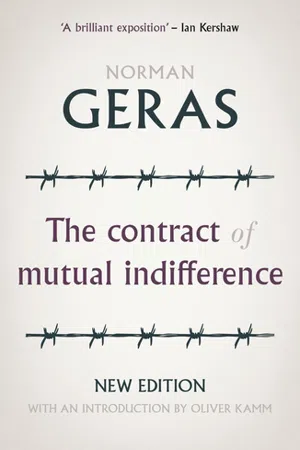
eBook - ePub
The contract of mutual indifference
Political philosophy after the Holocaust
- 181 pages
- English
- ePUB (mobile friendly)
- Available on iOS & Android
eBook - ePub
About this book
Information
Publisher
Manchester University PressYear
2020Print ISBN
9781526104755
9781526149527
eBook ISBN
9781526104779
Topic
PhilosophySubtopic
Ethics & Moral Philosophy1
The Contract of Mutual Indifference
The idea which I shall present here came to me more or less out of the blue. I was on a train some five years ago, on my way to spend a day at Headingley, and I was reading a book about the death camp Sobibor. Headingley, for those who may not know this, is a cricket ground in Leeds. At Sobibor between May 1942 and October 1943, the Germans killed a quarter of a million people. The particular, not very appropriate, conjunction involved for me in this train journey, reading about a place of death while bound one summer morning for an arena of entertainment, had the effect of fixing my thoughts on one of the more dreadful features of human coexistence, when in the shape of a simple five-word phrase the idea occurred to me.
It was not a welcome idea when it did. I have been unable to evade it since that day. Unwelcome as it is, I now give formal shape to it, and for the following familiar sort of reason: to face up to things unpleasant in the hope of finding an answer to them if there is one; of seeking, or prompting, some opposed or mitigating line of persuasion.
The idea I put forward, then, is not in its immediate content a happy one. Perhaps, further along, something positive also may be derived from it. If so, one may think of the argument initially to be made here as being like a segment, though a centrally important segment, of a larger picture. The argument itself carries a preamble.
I ‘Consider that this has been’
Early in Claude Lanzmann’s movie Shoah, he and his interpreter speak to a man, Czeslaw Borowi, who has lived all his life at Treblinka. Treblinka was the site of one of the three death camps – Sobibor and Belzec were the other two – set up for the so-called Aktion Reinhard, in which most of the Jews of Warsaw, along with hundreds of thousands of the rest of Polish Jewry, were murdered. Lanzmann asks Borowi whether he and others working nearby, seeing the transports of Jews arriving at the camp, were afraid (as he has indicated they were for themselves) also for the Jews. The interpreter gives Borowi’s reply: ‘Well, he says, it’s this way: if I cut my finger, it doesn’t hurt him.’1 Writing of this same period, the period of the first great deportation from the Warsaw ghetto in the summer of 1942, Adina Szwajger, a woman who worked in the children’s hospital there, recalls a scene: ‘They kept going past and it was a sweltering day … On the balcony of a house on Zelazna Street – there, on the other side [of the ghetto wall] – a woman in a flowered housecoat was watering plants in window boxes. She must have seen the procession below, but she carried on watering her flowers.’2
This was July 1942. The next spring, in April 1943, the Warsaw ghetto uprising began. The Germans set fire to the ghetto, the remnant of its already doomed population trapped within. Szwajger remembers that on a square nearby the ghetto wall there was a merry-go-round. ‘There were children sitting on this merry-go-round, while it went round and round, and I could hear the music playing. Maybe I imagined it? The children were laughing and the people going by were smiling. And on the other side of the walls you could hear shooting.’3 One Aaron Landau put on record at the time:
I, who write these words
I state, as an eye-witness
that all the theatres, movie theatres,
show-places, and all sorts of casinos
and other places of amusement
were open and operating according
to their daily routines, at the
time when up above, in the Warsaw skies,
were rising coils of smoke from the
burning ghetto, and inside burning alive
tens of thousands of souls.4
Polish stories, but their theme is a continental one. Across the face of Europe, the victims and prisoners of the Third Reich feel abandoned. Testimony and memoir are thick with the sense of it. Most Germans will no longer associate with their Jewish friends, even under cover of darkness. Neighbours in a small Hungarian town observe the rules on not greeting or speaking to Jews; their doors are shut, the shades drawn on every window, when the Jews are taken away. In other places in Hungary also, people line the streets to watch them go. Many smile; some hide their smiles. Some throw stones, yell insults, spit. Some stand there crying, while others, afraid to stand and cry, go back into their houses.5
And all over Germany, prisoners are marched back and forward: from the station to the concentration camp, from the camp to a work site, back to the camp, to the station for another camp. They see the outside world, see people. These people raise their fists against them. Or they spit, look the other way, turn their backs. Or they somehow do not ‘see’ – daily, a mass of wretched prisoners. Or they do see, but look on with indifference.6 One day on a station platform at Weimar, Austrian Jews in transit between Dachau and Buchenwald are struck and kicked by the SS unit receiving them into its charge. Passengers on a train standing opposite crowd to the windows and applaud the SS. At a factory near the village of Troeglitz in the same region, young women, secretaries and typists there, point and laugh at a group of exhausted prisoners as they are about to be marched back to the camp. The women make abusive and sexually suggestive gestures at them.7
From the other side of the line now, we have the memory of someone, a child at the time, concerning the last twelve, mostly elderly, Jews in her town, assembling one morning on the instructions of the SS to be taken away. She recollects having called her parents to the window to see the departure of the couple who lived opposite. ‘Her mother burst into tears and refused to come to the window while her father hastily pulled down the window shade.’8 A woman, Erika S., who lived at Melk in Austria near the site of one of the subcamps of Mauthausen, gives a frank account of the way she dealt with this physical proximity. She did sometimes see things, unavoidably. She tells of having felt pity in particular for the plight of one Jew she observed, though a pity, it has to be said, that was mixed with something darker, namely amusement at the incongruous gait – ‘like a circus horse’ – forced upon this man by the pain in his bare feet and the whipping of the guards. Her general attitude, however, Erika S. characterizes as follows: ‘I am happy when I hear nothing and see nothing of it. As far as I am concerned, they aren’t interned. That’s it. Over. It does not interest me at all.’9
Perhaps it is this attitude, this mental turning away, or perhaps the combination of all these responses to calamity brought upon others, that one of Saul Bellow’s characters, Artur Sammler, a survivor of the shooting pits in Poland, has in mind when he says: ‘I know now that humankind marks certain people for death. Against them there shuts a door.’10
In any event, just as in memoir and testimony, so also in a wider literature, in the novels, stories and poetry to which the Shoah has given rise, the bystander is a prominent figure – passive and indifferent, or worse. In Louis Begley’s Wartime Lies, many of the inhabitants of Warsaw go up on their roofs to watch the ‘entertainment’ when the Germans bombard and burn the ghetto. And this is the scene as a German throws the narrator of Jiri Weil’s Life with a Star off a tram in Prague: ‘I looked around the tram. It was quite full. People’s faces were set; they were looking at the floor, as if they were searching for a coin that had rolled under the wooden slats. Nobody spoke. Only his sharp voice was heard: “Get out, you swine …”’ Ida Fink, in one of her most powerful stories, places the blank external perspective of an onlooker who has overheard a man’s remark which he considers to be foolish and inconsequential in counterpoint with the internal world of this man and his wife and child as they are led away to be slain, and as, attempting to save the child’s life at the last moment, the parents see her shot.11
There is also a memorable poem by Czeslaw Milosz on this subject, entided ‘Campo dei Fiori’.12 The Campo dei Fiori in Rome is where Giordano Bruno was burned by the Inquisition in 1600. The poet remembers it one April day in Warsaw, on that same square with a carousel that we have already come across:
… that day I thought only
of the loneliness of the dying,
of how, when Giordano
climbed to his burning
he could not find
in any human tongue
words for mankind,
mankind who live on.
of the loneliness of the dying,
of how, when Giordano
climbed to his burning
he could not find
in any human tongue
words for mankind,
mankind who live on.
Already they were back at their wine
or peddled their white starfish,
baskets of olives and lemons
they had shouldered to the fair,
and he already distanced
as if centuries had passed
while they paused just a moment
for his flying in the fire.
or peddled their white starfish,
baskets of olives and lemons
they had shouldered to the fair,
and he already distanced
as if centuries had passed
while they paused just a moment
for his flying in the fire.
Those dying here, the lonely
forgotten by the world,
our tongue becomes for them
the language of an ancient planet.
Until, when all is legend
and many years have passed,
on a new Campo dei Fiori
Rage will kindle at a poet’s word.
forgotten by the world,
our tongue becomes for them
the language of an ancient planet.
Until, when all is legend
and many years have passed,
on a new Campo dei Fiori
Rage will kindle at a poet’s word.
Consternation at the loneliness of the doomed, their own sense also of having been abandoned, these merge sometimes into a broader metaphysical theme. It is of the place of human suffering in an unnoticing cosmos. That the suffering should simply pass thus leaving the natural universe unaffected, although a fact which is itself entirely natural, is nevertheless a source of dismay or at any rate surprise; there is a feeling that it ought not to be so. A poem by W. H. Auden, ‘Musée des Beaux Arts’, relies by implication on the existence of such a sentiment. Auden writes there of the perceptive treatment of human suffering in the Old Masters: ‘how it takes place/While someone else is eating or opening a window or just walking dully along’; how during even a dreadful martyrdom ‘the torturer’s horse/Scratches its innocent behind on a tree’; how, in Brueghel’s Icarus, ‘the sun shone/As it had to on the white legs disappearing into the green/Water’.13
In the annals of earlier Jewish sufferings, the protest at how things can be so is registered more than once. Following a massacre of over a thousand Jews in Mainz in 1096 – ‘babes and sucklings who had not sinned or transgressed, the souls of innocent poor people’ – Solomon bar Simson, in a lament that has been borrowed from by the historian Arno Mayer, wrote: ‘Why did the heavens not darken and the stars not withhold their radiance, why did not the sun and moon turn dark?’14 After the Kishinev pogrom of 1903, the poet Chaim Nachman Bialik observed in his turn: ‘the sun is shining, the acacia is blooming and the slaughterer is slaughtering’. These words of Bialik’s are then recalled in July 1942 in the diary of Abraham Lewin: on a ‘lovely morning, the sky … wonderfully beautiful’ and, outside in the Warsaw ghetto during the first great deportation already aforementioned, ‘shouts and screams’.15 Simon Srebnik, one of only two or three survivors of the death camp at Chelmno where more than three hundred thousand Jews met their deaths, returns there many years later to bear witness. He comes to the place where, as he explains to Claude Lanzmann, ‘they burned people’, burned them in ‘two huge ovens’. The setting is a rural one, deep green and bright summer, as he speaks: ‘It was always this peaceful here. Always. When they burned two thousand people – Jews – every day, it was just as peaceful. No one shouted. Everyone went about his work. It was silent. Peaceful.’16
How to come to terms with the likes of it? ‘So many children died of hunger, so many were gassed … so many, so many … Six million people died, and the sun didn’t cease to shine!’17
Language of this kind is rather less common today, in the secular public discourses of the late twentieth century. For great numbers of its inhabitants the world is godless – either really or to all intents and purposes. If one does not believe in a sympathetic higher intelligence such as would protest its anguish through the very elements, if one does not, in some version of the pathetic fallacy, ascribe moral sentiments to nature itself, there is no reason at all why the sun should cease to shine on mass murder, on genocide, on anything. Even so, the expressions of a sentiment of incomprehension that it does not may have their point. Perhaps nature also stands in in this sort of observation and lament for the inaction of people. Its lack of a sympathetic response may be offered, consciously or otherwise, as a metaphor for the failures of human beings, the indifference of the natural world as an image for the indifference of what we also sometimes refer to as ‘the world’ – of humanity. With this world, we like to think we are in another domain: not just brute thinghood, unresponsive natural causalities incapable of thought or feeling, but a sphere of intentionality and will, of the possibility of compassion, of indignation at avoidable suffering and injustice. Human beings, at least, need not remain peaceful, silent, in the presence of atrocity. Precisely in a godless world, it is they alone who can constitute a realm of saving norms and sustain these by their actions.
Indeed, on one conception of things, it is true even in a world in which God survives, that only by way of human action, human choices, can any benign purpose or normative realm be secured; it is the responsibility of our kind. Such is the view, for example, of Hans Jonas, reflecting on the implications of the Shoah for Jewish theological belief. The Divine, according to Jonas, in a kind of act of divestment or ‘self-forfeiture’ whose reasons we cannot know, has chosen to give itself over ‘to the chance and risk and endless variety of becoming’. This has led by way of a long evolution, one ‘carried by its own momentum’, to ‘the advent of man’; therewith, to ‘the advent of knowledge and freedom’ and ‘to the charge of responsibility under the disjunction of good and evil’. The image of God here ‘passes … into man’s precarious trust, to be comp...
Table of contents
- Cover
- Half Title
- Title Page
- Copyright
- Dedication
- Contents
- Foreword
- Preface
- 1 The Contract of Mutual Indifference
- 2 Socialist Hope in the Shadow of Catastrophe
- 3 Progress Without Foundations?
- 4 Marxists before the Holocaust
- Bibliography
- Index
Trusted by 375,005 students
Access to over 1.5 million titles for a fair monthly price.
Study more efficiently using our study tools.
Frequently asked questions
Yes, you can cancel anytime from the Subscription tab in your account settings on the Perlego website. Your subscription will stay active until the end of your current billing period. Learn how to cancel your subscription
No, books cannot be downloaded as external files, such as PDFs, for use outside of Perlego. However, you can download books within the Perlego app for offline reading on mobile or tablet. Learn how to download books offline
Perlego offers two plans: Essential and Complete
- Essential is ideal for learners and professionals who enjoy exploring a wide range of subjects. Access the Essential Library with 800,000+ trusted titles and best-sellers across business, personal growth, and the humanities. Includes unlimited reading time and Standard Read Aloud voice.
- Complete: Perfect for advanced learners and researchers needing full, unrestricted access. Unlock 1.5M+ books across hundreds of subjects, including academic and specialized titles. The Complete Plan also includes advanced features like Premium Read Aloud and Research Assistant.
We are an online textbook subscription service, where you can get access to an entire online library for less than the price of a single book per month. With over 1.5 million books across 990+ topics, we’ve got you covered! Learn about our mission
Look out for the read-aloud symbol on your next book to see if you can listen to it. The read-aloud tool reads text aloud for you, highlighting the text as it is being read. You can pause it, speed it up and slow it down. Learn more about Read Aloud
Yes! You can use the Perlego app on both iOS and Android devices to read anytime, anywhere — even offline. Perfect for commutes or when you’re on the go.
Please note we cannot support devices running on iOS 13 and Android 7 or earlier. Learn more about using the app
Please note we cannot support devices running on iOS 13 and Android 7 or earlier. Learn more about using the app
Yes, you can access The contract of mutual indifference by Norman Geras in PDF and/or ePUB format, as well as other popular books in Philosophy & Ethics & Moral Philosophy. We have over 1.5 million books available in our catalogue for you to explore.