eBook - ePub
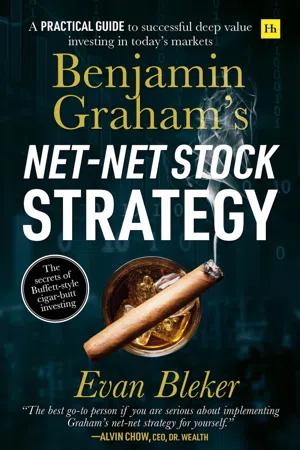
Benjamin Graham’s Net-Net Stock Strategy
A practical guide to successful deep value investing in today’s markets
- English
- ePUB (mobile friendly)
- Available on iOS & Android
eBook - ePub
Benjamin Graham’s Net-Net Stock Strategy
A practical guide to successful deep value investing in today’s markets
About this book
IN 1975, legendary value investor Benjamin Graham wrote that his net-net stock strategy worked so well that he had renounced all other value investing strategies.
In his 2014 shareholder letter, Warren Buffett wrote that he earned the highest returns of his career employing this 'cigar butt' approach to investing.
And despite the widespread assumption that net-net stocks are a relic of the past, Graham's net-net stock strategy is just as viable today for small private investors as it was for Buffett's 'superinvestors' during their early careers. Net-net investing remains the most powerful value investing approach a small investor can adopt.
This book is your ultimate practical guide to implementing it – and reaping the rewards – in today's markets.
Evan Bleker has spent ten years studying Graham's strategy to uncover its real-world performance, how to employ it, and why it works. He's also dug deeply to identify additional criteria to boost returns and ensure a greater number of winners.
In this book, Evan defines the strategy for investors, then walks readers through the strategy's philosophy, as well as academic and industry studies assessing the framework, and its implementation by world-class value investors such as Benjamin Graham, Warren Buffett, and Peter Cundill.
He also compiles selection criteria into a practical checklist for investors, and documents how the strategy works in today's markets with exclusive detailed case studies.
Information
Subtopic
Investments & SecuritiesIndex
BusinessPart 1
What is Net-Net Investing?
1
Net-Net Investing Defined
Net-Net Investing Defined
by now you’re well aware of just how tough I found investing before I realised that a net-net stock strategy was actually viable in this day and age. It’s amazing that after all these years, this strategy still works so well.
It’s also amazing that many investors haven’t even heard of Graham’s famous net-net stock strategy. Ben Graham isn’t exactly a nobody in the world of investing and the strategy itself has been crushing the market since at least the 1930s. Since Graham is a legend in the investment world, and since his strategy has been around for so long, you’d expect that every small value investor would be using it to earn market-beating returns. Yet only a handful of thoughtful value investors actually are.
There are very important reasons for this odd state of affairs, but before we dive into that, we need to define exactly what net-net stocks are.
Let’s get started.
A simple definition of net-net investing
Net-net investing is the process of buying a company’s common shares below a conservative estimate of the firm’s per-share liquidation value. Assessing a company’s liquidation value in a conservative manner and then buying its common stock at or below that value is the essence of net-net investing.
Unlike other liquidation value approaches, such as low price to book4 or net tangible asset value,5 net-net investors completely disregard long-term assets during the valuation process. The result is a figure known as net current asset value (NCAV), a much more conservative estimate of liquidation value. It’s helpful to think of NCAV as book value per common share, less the firm’s long-term assets.6
These kinds of stocks have had a few different names over the years. While Ben Graham referred to them in The Intelligent Investor as working capital or net working capital stocks, contemporary investors prefer to call them net-net stocks, which is what I do throughout the rest of this book.
As you can see from the above definition, there are two crucial steps here:
- Obtain the per-share NCAV of the company; and then
- Check to see whether the company’s shares are trading at a price below that figure.
1. Obtain the firm’s per-share NCAV
Let’s start with the first of these steps. In order to estimate a company’s NCAV, the investor must turn to the firm’s financial statements and pay specific attention to the balance sheet.
Company financial statements
A firm’s financial statements are split into three main parts:
- Balance sheet: A record of what the company owns, what it owes, the value of each, and what’s left over for shareholders after liabilities are covered.
- Income statement: A document that reports sales, expenses, and how the balance sheet has changed over a period of time.
- Cash flow statement: A statement that shows the company’s sources and uses of cash.
Many investment strategies start by looking at a company’s income statement or cash flow statement. From the data in these statements, the investor assesses a firm’s profit potential and then assigns some multiple to the figure, or combines it with other information to predict future cash flows, which are then discounted back to the present, using an appropriate discount rate. These calculations help an investor value a company’s current or future profits. But valuations based on earnings often prove evanescent as earnings fail to materialise, or the company’s current profitability erodes.
Net-net stock investing is different. Rather than valuing a firm’s current profits, or how much future profits are worth today, net-net stock investors focus on buying assets cheaply. Often, little if any thought is given to a firm’s profitability, since net-net investors are not buying earnings; they’re buying assets. And the only statement that a net-net stock investor can use to determine just how much the firm’s assets may be worth, after factoring in the firm’s financial obligations, is the balance sheet.
The balance sheet
The balance sheet is divided into three sections:
- Assets: Things the company owns.
- Current assets: Items the company expects to use up in less than 12 months, such as inventory the firm wants to sell, or receivables due from customers.
- Long-term assets: Items the company won’t use up within a year, such as property, vehicles, or a manufacturing plant.
- Liabilities: What the company owes.
- Current liabilities: Items due in less than 12 months, such as IOUs from vendors, debt due within a year, or taxes payable.
- Long-term liabilities: Things like bank loans or capital leases that the company has committed to and that won’t be paid back within a year.
- Shareholder equity: Essentially, the value of assets left after the company covers all of its liabilities.7 The most relevant items for the investor are:
- Preferred equity: Capital raised through the sale of preferred shares.
- Shareholder equity: The accounting value of a company’s net assets, comprised of the firm’s total assets less its total liabilities. This figure is often referred to as book value.
Of the assets listed, net-net investors are mostly interested in the firm’s current assets, since these come into play when calculating NCAV. Again, while they may add value, long-term assets are completely ignored in the assessment. More on that ahead.
Calculating NCAV
Once investors note the company’s current asset value, they subtract the firm’s total liabilities to reach a rough, conservative estimate of the company’s real-world liquidation value.
Graham referred to this value as net working capital. Working capital is the excess of current asset value over current liabilities. And net working capital is the excess of current assets over total liabilities and other senior claims, such as bonds, and preferred equity. This is shown in the formula:
Net Working Capital = Current Assets – Total Liabilities and Senior Claims8
Graham’s original formula has been revised over the years, but modern net-net investors have arrived at the following:
Current Assets
Less Total Balance Sheet Liabilities
Less Preferred Shares
Less Off-Balance-Sheet Liabilities
Equals NCAV
This formula is simple and runs a good balance between conservatism and statistical backing. In the 1950s and 1960s, some acclaimed investors preferred to further discount a firm’s current asset account values to obtain a fire-sale9 valuation for the firm. Contemporary investors have applied a standardised formula known as the net-net working capital (NNWC) formula to try to replicate this approach. While more conservative than the above formula, a NNWC approach to valuation requires expert knowledge and may provide little benefit when applied to today’s balance sheets. More on this ahead.
Net-net investing is one of the few outstanding investment strategies that have the support of academic and industry studies. Graham tested his investment strategy as far back as the 1930s,10 and many studies have been conducted since. This academic backing helps make Graham’s net-net stock approach a very compelling strategy for small investors.
But academic studies do not usually include preferred shares and always ignore off-balance-sheet obligations when assessing how Graham’s liquidation value approach performs. More often, studies reduce a firm’s current assets by total liabilities alone in order to study net-net stock performance. This is a much less conservative assessment because, if present, off-balance-sheet items and preferred shares extract a cost during liquidation.
The approach described in this book doesn’t rely on expert judgement to further discount current asset account values, but it does require that an investor account for preferred shares, including off-balance-sheet liabilities, when arriving at the final value. In this respect, the formula I use is more conservative than the one used by academics but not as conservative as the one used by famous practitioners, which is discussed later. In a liquidation scenario, a liquidator would have to reduce current assets by the value of the preferred shares and cover liabilities that the company may face but that are not listed on the balance sheet.
2. Check to see whether the company’s shares are trading below NCAV
While we now have the company’s NCAV, we still need to put that value on a per-share basis. Small investors usually buy shares, not entire companies, so it’s useful to compare per-share values to the company’s share price.
Luckily, this process is fairly straightforward. Investors should scan the firm’s financial reports for the company’s fully diluted shares outstanding figure. I use the company’s diluted share count for conservatism, since it represents all of the company’s outstanding shares plus any financial instruments that can be converted to common shares.
During a liquidation, an investor might face further claims on the company’s assets, as holders of preferred shares, convertible debt, or stock options convert their instruments to common stock to cash in on the liquidation. Failing to take these instruments into account when valuing the firm means arriving at a less conservative liquidation value and possibly seeing that value eaten away by holders of convertible instruments. The price paid for the company, in that case, may have proven too high relative to its underlying value and may actually result in a loss.
To arrive at the firm’s per-share NCAV, simply follow this formula:
NCAV / Diluted Shares Outstanding = Preliminary NCAV Per Share
Alert readers will immediately spot the fact that I skipped discussion of a firm’s off-balance-sheet items. In order to tell whether a company is trading below its NCAV, investors need to factor in all obligations a liquidator would have to cover before realising ...
Table of contents
- About the Author
- Preface
- PART 1 – WHAT IS NET-NET INVESTING?
- PART 2 – THE EVIDENCE THAT NET-NET INVESTING WORKS
- PART 3 – NET-NET INVESTING METHOD
- PART 4 – TACTICS: NET-NET INVESTING BEST PRACTICES
- PART 5 – NET-NET CASE STUDIES
- Epilogue: Build Your Character
- Bibliography
- Acknowledgements
Trusted by 375,005 students
Access to over 1.5 million titles for a fair monthly price.
Study more efficiently using our study tools.
Frequently asked questions
Yes, you can cancel anytime from the Subscription tab in your account settings on the Perlego website. Your subscription will stay active until the end of your current billing period. Learn how to cancel your subscription
No, books cannot be downloaded as external files, such as PDFs, for use outside of Perlego. However, you can download books within the Perlego app for offline reading on mobile or tablet. Learn how to download books offline
Perlego offers two plans: Essential and Complete
- Essential is ideal for learners and professionals who enjoy exploring a wide range of subjects. Access the Essential Library with 800,000+ trusted titles and best-sellers across business, personal growth, and the humanities. Includes unlimited reading time and Standard Read Aloud voice.
- Complete: Perfect for advanced learners and researchers needing full, unrestricted access. Unlock 1.5M+ books across hundreds of subjects, including academic and specialized titles. The Complete Plan also includes advanced features like Premium Read Aloud and Research Assistant.
We are an online textbook subscription service, where you can get access to an entire online library for less than the price of a single book per month. With over 1.5 million books across 990+ topics, we’ve got you covered! Learn about our mission
Look out for the read-aloud symbol on your next book to see if you can listen to it. The read-aloud tool reads text aloud for you, highlighting the text as it is being read. You can pause it, speed it up and slow it down. Learn more about Read Aloud
Yes! You can use the Perlego app on both iOS and Android devices to read anytime, anywhere — even offline. Perfect for commutes or when you’re on the go.
Please note we cannot support devices running on iOS 13 and Android 7 or earlier. Learn more about using the app
Please note we cannot support devices running on iOS 13 and Android 7 or earlier. Learn more about using the app
Yes, you can access Benjamin Graham’s Net-Net Stock Strategy by Evan Bleker,Evan Bleker in PDF and/or ePUB format, as well as other popular books in Business & Investments & Securities. We have over 1.5 million books available in our catalogue for you to explore.