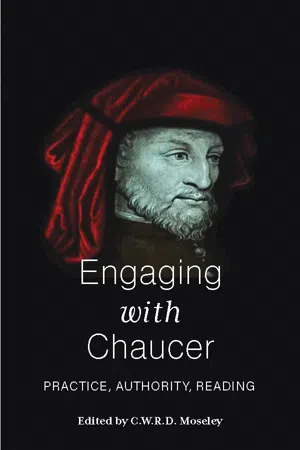
Why do we still read and discuss Chaucer? The answer may be simple: he is fun, and he challenges our intelligence and questions our certainties. This collected volume represents an homage to a toweringly great poet, as well as an acknowledgement of the intellectual excitement, challenges, and pleasure that readers owe to him as even today, his poems have the capacity to change the way we engage with fundamental questions of knowledge, understanding, and beauty.
- 226 pages
- English
- ePUB (mobile friendly)
- Available on iOS & Android
eBook - ePub
About this book
Trusted by 375,005 students
Access to over 1 million titles for a fair monthly price.
Study more efficiently using our study tools.
Information
Chapter 1
‘And gret wel Chaucer whan ye mete’
Chaucer’s Earliest Readers, Addressees and Audiences
Sebastian Sobecki
Little can be said with any certainty about the earliest reception of Chaucer’s works. We do not really know how his writings were experienced. Were the poems enjoyed in silence by individual readers who may or may not have mouthed the words as they were moving their fingers along each line? Or were his works read aloud to groups of eager listeners, as is suggested by the celebrated frontispiece illumination in the copy of Troilus and Criseyde in Cambridge Corpus Christi College, MS 61?1 Where and when, in which locations and on what occasions, did Chaucer’s readers first experience his poetry? If some of his works were performed, were these readings punctuated by interjections or even topical exchanges? Were his earliest audiences socially diverse?
Often the best answers are afforded by diligent manuscript work, the painstaking combing through often multiple interrelated versions of a text in an attempt to learn more about the process of copying, assembling, correcting and annotating medieval texts. Scribes are therefore the earliest readers of medieval texts we encounter. A good deal can be gleaned by observing their craft. A scribe may copy the same work on a number of occasions, and his hand can appear in other texts, too. Scribal mistakes, self-corrections and countless other palaeographical practices open up a window into the sophisticated and arcane world of professional copyists. Yet for all their significance, scribes are not readers in a typical sense, of course: they interfere with texts; they interpret and censure, elaborate and forget, interpolate and confuse, update and condense. As valuable a source of textual knowledge as they are, scribes are not necessarily representative of other categories of medieval audiences. Their engagement with a text may be intimate yet ultimately intermediatory; they are not recipients but handlers.
As far as we know, no single manuscript containing Chaucer’s known works can be dated to his lifetime, although it is not impossible that the Ellesmere Canterbury Tales, now San Marino, Huntington Library MS EL 26 C9, might have been started before 1400, the year in which Chaucer probably died. But we do know that Chaucer was read during his lifetime. Some of the evidence is circumstantial and some of it has reached us in the form of other poets’ use of Chaucer’s work before 1400. This article will attempt to take stock of what we know about Chaucer’s earliest audiences, that is, about uses of and references to his work made during his lifetime.2 Such a fixed chronological boundary is useful in the sense that the consumption of secular literature usually was limited to defined social circles or particular circulation networks. At a time when writers interacted with one another and with their audiences through their writings, the biological availability of a writer represented an opportunity for exchange. Literary conventions were differently configured during a period where writers did not call themselves authors, where willed anonymity was the default condition of texts, where retractions relied for their effect on the intentional fallacy, and where the death of the writer became the birth of the author.
As concerns Chaucer’s earliest readers, one of the most exciting finds in recent years was Martha Carlin’s discovery that Thomas Spencer, a scrivener from Southwark and member of the London scriveners’ company, used ‘a certain book called Troylous’ to repay a debt in 1394.3 In all probability, Troylous is Chaucer’s Troilus and Criseyde, not least because Spencer was closely acquainted with John Brynchele, another Southwark resident and later clerk who, according to his will of 1420, was one of the earliest known owners of a copy of The Canterbury Tales.4 Two Chancery clerks were also known to have owned a copy of the work. In his will of 1419, Richard Sotheworth left his fellow Chancery clerk John Stopyndon ‘quendam librum meum de Canterbury Tales’.5
A second set of readers can be inferred from the probable addressees of some of Chaucer’s shorter poems. The envoy to ‘Truth’, also known as ‘Balade de Bon Conseyl’, is directed at a certain ‘Vache’:
Therfore, thou Vache, leve thyn old wrecchednesse;
Unto the world leve now to be thral.
Crye him mercy, that of his hy goodnesse
Made thee of noght, and in especial
Draw unto him, and pray in general
For thee, and eek for other, hevenlich mede;
And trouthe thee shal delivere, it is no drede.5
The addressee in question is in all likelihood Sir Philip de la Vache (d. 1408), a courtier and later Garter knight.6 The narrator’s gentle moralizing even suggests a certain degree of intimacy between the speaker and the persona of the recipient. At any rate, as the poem’s dedicatee, de la Vache can be safely counted among Chaucer’s earliest audiences.
By the same token, the addressees of Chaucer’s two ‘Lenvoys’, to ‘Scogan’ and ‘Bukton’ respectively, belong among Chaucer’s first readers. The Scogan of the first poem is usually believed to be Henry Scogan (d. 1407), lord of the manor of Haviles from 1391. Scogan was a squire in Richard II’s household and later tutor to the future Henry V and his brothers.7 A poet himself, Scogan even receives a hypothetical speaking part in the poem:
But wel I wot, thow wolt answere and saye,
‘Lo, olde Grisel lyst to ryme and playe!’
Nay, Scogan, say not so, for I m’excuse —
God helpe me so! — in no rym, dowteles8
With medieval poems frequently invoking allusions to their own performativity, a speaking part is more than a literary trope: Scogan’s persona and person are summoned at the same time, making him both a part of the audience and of the poem. The third of Chaucer’s lyrics with a named addressee is the ‘Lenvoy de Chaucer a Bukton’. The ‘My maister Bukton’ of the first line of the poem is Sir Peter Bukton (d. 1414), a knight and politician.9
It is difficult to assess how many of Chaucer’s other dedicatees or addressees can be counted among his earliest readers and listeners. While it is probable that John of Gaunt and his household were familiar with The Book of the Duchess, a work likely composed to commemorate the death of John’s wife Blanche, it is more difficult to ascertain whether Richard II, the nominal addressee of ‘Lak of Stedfastnesse’ ever saw the pontificating envoy dedicated to him:
Lenvoy to King Richard
O prince, desyre to be honourable,
Cherish thy folk and hate extorcioun.
Suffre nothing that may be reprevable
To thyn estat don in thy regioun.
Shew forth thy swerd of castigacioun,
Dred God, do law, love trouthe and worthinesse,
And wed thy folk agein to stedfastnesse.10
By the same token, the ironic though earnest ‘Complaint of Chaucer to His Purse’, written as a request to the recently crowned Henry IV in the hope that the new monarch would pay Chaucer’s arrears, was probably not meant for its famous dedicatee. Although the poem may have reached neither the king’s eyes nor his ears, it surely ended up in the hands of some royal administrator since the records show that payments to Chaucer later resumed. Other names, such as Chaucer’s surmised son ‘Lyte Lowys’, who appears as the addressee of the poet’s Treatise on the Astrolabe, can be added to Chaucer’s earliest audience, though in this case not of poetry but of scientific prose. And if ‘Chaucer’s Wordes unto Adam, His Owne Scriveyn’ was indeed written by Chaucer, then the scribe Adam named here (whether his surname was Pinkhurst or not) is another early, if allegedly careless, reader and copyist.
Chaucer’s contemporary poets certainly belong to the earliest documented audience of his works, and there have been new developments in this field, too. The trilingual poet John Gower (d. 1408), a leading English writer, appears to have had personal dealings with Chaucer in 1378, when he was charged with the power of attorney by Chaucer ahead of a continental voyage.11 While it is not clear whether their relationship was personal or professional at this point in time, by the late 1380s, when Gower composed his best-known English work, the Confessio Amantis, he refers to Chaucer by name in the earliest version of the work:
And gret wel Chaucer whan ye mete,
As mi disciple and mi poete:
For in the floures of his youthe
In sondri wise, as he wel couthe,
Of Ditees and of songes glade,
The whiche he for mi sake made,
The lond fulfild is overal:
Whereof to him in special
Above alle othre I am most holde.12
Chaucer reciprocates this praise, at about the same time, in the penultimate stanza of his Troilus, when he extols (or perhaps gently mocks) Gower’s virtues:13
O moral Gower, this book I directe
To the and to the, philosophical Strode,
To vouchen sauf, ther nede is, to correcte,
Of youre benignites and zeles goode.14
Gower is of course not the only addressee of this stanza. ‘Philosophical Strode’, the second name mentioned here, is not a certain identific...
Table of contents
- Cover
- Title Page
- Copyright Page
- Contents
- Introduction: ‘The craft so long to lerne…’
- Chapter 1: ‘And gret wel Chaucer whan ye mete’: Chaucer’s Earliest Readers, Addresses and Audiences
- Chapter 2: Unhap, Misadventure, Infortune: Chaucer’s Vocabulary of Mischance
- Chapter 3: Chaucer’s Tears
- Chapter 4: In Appreciation of Metrical Abnormality: Headless Lines and Initial Inversion in Chaucer
- Chapter 5: Blanche, Two Chaucers and the Stanley Family: Rethinking the Reception of The Book of the Duchess
- Chapter 6: ‘Tu Numeris Elementa Ligas’: The Consolation of Nature’s Numbers in Parlement of Foulys
- Chapter 7: Troilus and Criseyde and the ‘Parfit Blisse of Love’
- Chapter 8: Hateful Contraries in ‘The Merchant’s Tale’
- Chapter 9: String Theory and ‘The Man of Law’s Tale’: Where is Constancy?
- Chapter 10: The Pardoner’s Passing and How It Matters: Gender, Relics and Speech Acts
- Chapter 11: ‘Double Sorrow’: The Complexity of Complaint in Chaucer’s Anelida and Arcite and Henryson’s Testament of Cresseid
- Index
Frequently asked questions
Yes, you can cancel anytime from the Subscription tab in your account settings on the Perlego website. Your subscription will stay active until the end of your current billing period. Learn how to cancel your subscription
No, books cannot be downloaded as external files, such as PDFs, for use outside of Perlego. However, you can download books within the Perlego app for offline reading on mobile or tablet. Learn how to download books offline
Perlego offers two plans: Essential and Complete
- Essential is ideal for learners and professionals who enjoy exploring a wide range of subjects. Access the Essential Library with 800,000+ trusted titles and best-sellers across business, personal growth, and the humanities. Includes unlimited reading time and Standard Read Aloud voice.
- Complete: Perfect for advanced learners and researchers needing full, unrestricted access. Unlock 1.4M+ books across hundreds of subjects, including academic and specialized titles. The Complete Plan also includes advanced features like Premium Read Aloud and Research Assistant.
We are an online textbook subscription service, where you can get access to an entire online library for less than the price of a single book per month. With over 1 million books across 990+ topics, we’ve got you covered! Learn about our mission
Look out for the read-aloud symbol on your next book to see if you can listen to it. The read-aloud tool reads text aloud for you, highlighting the text as it is being read. You can pause it, speed it up and slow it down. Learn more about Read Aloud
Yes! You can use the Perlego app on both iOS and Android devices to read anytime, anywhere — even offline. Perfect for commutes or when you’re on the go.
Please note we cannot support devices running on iOS 13 and Android 7 or earlier. Learn more about using the app
Please note we cannot support devices running on iOS 13 and Android 7 or earlier. Learn more about using the app
Yes, you can access Engaging with Chaucer by C.W.R.D. Moseley in PDF and/or ePUB format, as well as other popular books in Literature & Literary Criticism. We have over one million books available in our catalogue for you to explore.