eBook - ePub
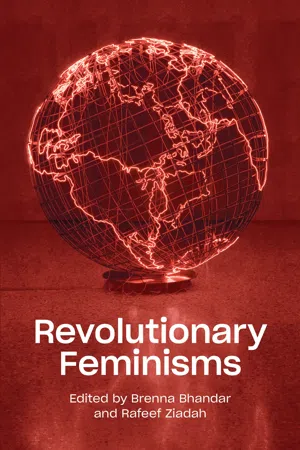
Revolutionary Feminisms
Conversations on Collective Action and Radical Thought
- 240 pages
- English
- ePUB (mobile friendly)
- Available on iOS & Android
eBook - ePub
Revolutionary Feminisms
Conversations on Collective Action and Radical Thought
About this book
In a moment of rising authoritarianism, climate crisis, and ever more exploitative forms of neoliberal capitalism, there is a compelling and urgent need for radical paradigms of thought and action. Through interviews with key revolutionary scholars, Bhandar and Ziadah present a thorough discussion of how anti-racist, anti-capitalist feminisms are crucial to building effective political coalitions. Collectively, these interviews with leading scholars including Angela Y. Davis, Silvia Federici, and many others, trace the ways in which black, indigenous, post-colonial and Marxian feminisms have created new ways of seeing, new theoretical frameworks for analysing political problems, and new ways of relating to one another. Focusing on migration, neo-imperial militarism, the state, the prison industrial complex, social reproduction and many other pressing themes, the range of feminisms traversed in this volume show how freedom requires revolutionary transformation in the organisation of the economy, social relations, political structures, and our psychic and symbolic worlds. The interviews include Avtar Brah, Gail Lewis and Vron Ware on Diaspora, Migration and Empire. Himani Bannerji, Gary Kinsman, Leanne Betasamosake Simpson, and Silvia Federici on Colonialism, Capitalism, and Resistance. Ruth Wilson Gilmore, Avery F. Gordon and Angela Y. Davis on Abolition Feminism.
Information
Colonialism/Capitalism/Resistance
Himani Bannerji
Himani Bannerji is a professor in the Department of Sociology (York University, Canada). Her research and writing life extends between Canada and India. Her interests encompass anti-racist feminism, Marxism, critical cultural theories and historical sociology. She has done extensive research and writing on patriarchy and class formation in colonial India as well as on different strands of nationalism, cultural identity and politics in India. She has also written extensively on Canada from an anti-racist feminist and Marxist perspective, and edited and contributed to one of the earliest volumes on anti-racist feminism, Returning the Gaze: Essays on Gender, Race and Class by Non-white Women (1993). Bannerji is a founder and life fellow of the School of Women’s Studies at Jadavpur University, Kolkata, and an honorary visiting professor and general council member of the Institute of Development Studies, Kolkata. She has taught at Delhi University, Jadavpur University and Calcutta University, and was awarded the Tagore Memorial Prize by the Government of West Bengal’s literary academy for her work on the social and cultural history of Bengal.
BB/RZ In 1947, India won its independence from Britain. At the same time, the country was partitioned, leading to a massive loss of life, forced displacement and migration, and a legacy of communal violence. Can you please speak to us about the impact of Partition on your early political formation?
HB I was born in 1942 and Indian independence came in 1947. My life before then was that of a little girl, but I have scattered memories of the Hindu-Muslim riots that led up to the Partition of India. My memories are based on overhearing people talk, a feeling of a strained environment and long silences. I should mention that my father was a judge in the British judiciary, a role he continued in the postindependence era.
The images of fire and smoke in the night sky, going to the district magistrate’s house for protection, sandbags, locked iron gates and sentries with rifles had a great impact on my emotional and political growth. The word ‘riot’, which is still pervasive in Indian media, was one of my earliest nonfamilial words. I also had heard of the Indian National Congress and Mahatma Gandhi – he was revered by my parents. My mother had a soft spot for the Congress volunteers and gave them rice and vegetables for their common kitchen. This was done on the quiet, as her husband worked for the British government.
These few things I ‘knew’, or rather felt, are what I remember of colonialism. I overheard the word ‘partition’, but didn’t get any of what it meant until my grandmother said that we would go to another city, in a different country – another part of Bengal, which would become East Pakistan. ‘Independence’ and ‘freedom’ (swadhinata in Bengali) were other important words for me. Living in a quarter of the city restricted to government officials, cut off from the rest of the city by the civil line, I had no experience of neighbours or of many visitors. The main people who visited were my three older brothers, who lived in then-Calcutta to study. My parents, my older sister and I, and eventually a brother lived in a district town called Medinipur (later part of India), in an old shady house surrounded by high walls and enclosed gardens and servants’ quarters. After 14 August 1947 (Pakistan’s birth), I learned another new word in English – ‘option’. I did not understand what it meant, but by the speed with which our belongings were being packed, I knew that we were leaving for our desh, our birthland. In a vague, chaotic and powerfully experiential way, the colonial times – especially their ending – left a lifelong impression on me. I felt, even then, that while something new was beginning, something was also sad. This sadness was mainly picked up from my mother and grandmother.
At this point I should mention that we were a Hindu family and my father could have stayed on in India. In fact, this is what virtually 100 per cent of Hindu government officials did. In some way, I knew of Hindus and Muslims, and also that they were different from each other. India and Pakistan were their own free countries, but my father was ‘opting’ for Pakistan because his brothers and their joint families were in East Bengal (East Pakistan). My relatives were unable to ‘migrate’ because their asset was in landholdings and their economic situation would be dire if they came to India. Millions were ‘migrating’ in the wake of Partition, accompanied by riots, slaughter, violences of all kinds, including against women, and complete dispossession. These carnages were perpetrated by both Hindus and Muslims, and even Sikhs took part in them. How much of this would I have been able to articulate then? Very little, but when I feel back to the time, pieces of images, words, feelings of anxiety and fear flash like fish caught in a dark net. Children are knowledgeable in their own way. Some words and images are burnt into the mind space.
How did these memories, this ‘knowing’, influence me for the future that was then almost wholly ahead of me? I assume that they contribute to what I feel when I hear about other partitions, other exiles. This unconscious, I am sure, still lingers under what I feel about Palestine. It plays a role in how I feel about Hindu-Muslim communalisation, about the Hindutva (Hindu nationalist) project of the Modi government, about political classes and parties left behind by the colonial rulers as they fight over the spoils, the leftovers.
The discourse of postcolonialism was not common as I grew up. We used the discourse of independence from colonialism/imperialism, and we had immense respect for those who fought to bring it to us. This feeling still lingers in me. I learned to question nationalism – particularly for its disregard for class, caste and patriarchy, leaving us a distorted ‘independence’ – and I and others still think of India as an independent entity, and not solely as a ‘post’ phase of colonialism. By my teens, I became aware that India had given birth to a particular kind of dependent capitalism integrally connected with the worst aspects of the metropolitan capital, with Indigenous ruling classes who fetishised modernisation, a phenomenon characterised by high technology and production of scale without the social critical imperatives of ‘modernity’. This drive was accompanied by the invention of cultural traditions to rein in political modernity, that is, an effective use of individual and civil rights. This invention of tradition, creating a national unity in a society of profound class inequality, began from the late nineteenth century with the Indian National Congress taking the leadership of the Indian independence movement. This contradiction, characteristic of bourgeois democracy, still continues today.
This story is the only real way in which I can approximate an answer to your questions regarding the postcolonial context and the impact of the Partition on me. Like millions, I was marked for life. If I were to be political at all, I had ample reasons to wish for a better world, one of true independence.
BB/RZ Can you tell us about the nature of communist politics in India during these times, given the complexity of the anti-colonial struggle and independence?
HB It should be noted that I was not a member of the Communist Party, but a dedicated sympathiser and consistent participant in its organising activities concerning the situation of women in India. My early identification with communism persists, way past the dissolution of the Soviet Union. My idea of communism was not that of an authoritarian rule and loss of individuality and personal will. I had no fear of collectivity. What communism meant to me, and in many other parts of the world, was far from the Cold War version of communism prevalent in the United States and the West. The demonisation, or an atavistic view of communism that prevail(ed/s) in the West, and that still haunts its political sphere, is even now still absent from what is called the Third World. There were attempts to hegemonise the world by cold war, especially on the part of the United States. Their attempts were, however, only partially successful. For many people in India, nothing that came from the United States was above suspicion.
It should be noted that nationalism mattered even for those who were communist, in a personal, emotional and imaginative sense. This came from a social and cultural politics which embraced everyone. When anti-colonialism is seen in sheer propertarian and economic terms, what is left out is the passion, the love and longing that people feel in their fight against colonial domination. To call it ‘nationalism’ in conventional political terms is to forget that anti-colonial nationalism was undergirded by a huge tide of affect. The key Bengali word for nationalism, swadhinata, or freedom, was saturated by the conditions and feelings of unfreedom to which colonised people were subjected. This explains the vast mobilisation power of the Indian National Congress and Gandhi’s charisma. The communist movement shared the emotions of the character of anti-colonialism, and it centrally posed the concepts of class and class struggle as shaping forces for decolonisation, which is a true liberation. The struggles for the creation of the Soviet Union, as well as the cultural richness emanating from them, also provided an imaginative and affective element in communist politics in India. Soviet and Russian literary classics and children’s books were much loved by people, irrespective of their political affiliations.
Communist cultures of resistance also deeply influenced our feelings about communism. The Indian People’s Theatre Association, and the Antifascist and Progressive Writers Associations were part of the collective imaginary for struggle against capitalism and the imperialism of the Second World War. The militancy of the Tebhaga movement, a sharecroppers’ insurgency in southern Bengal encompassing India and East Pakistan, was a great source of inspiration and conveyed its message of the peasant movement through rousing folk songs, plays and art. This was all organised by the Communist Party of India. I was also attracted to communism by its openness to women’s participation in militant class struggle. Women’s participation in Indian nationalism definitely predisposed me to this aspect of communism. Experientially speaking, I had witnessed the violence of caste patriarchy among the households of landed Bengali high-caste gentry. Women’s overall unfreedom in sexual repression and in the drudgery of the household, and the torture of widows, were appalling. So it was not surprising that I admired communist militancy. By the time I was sixteen, I fully endorsed armed liberation struggles with an equal place for women.
Another source for my predisposition for feminism was my high school (an exclusive girls’ school), in which debates were held regarding how girls and women should dress and behave. Sporting activities for girls were also discussed among students and teachers, particularly because of the interference by orthodox parents of some of the students. During my last two years, issues of women’s rights in the context of citizenship and of choice in marriage and women in professions were much discussed and debated. The roles of women in nation building were becoming prominent in the media, as well. Another feminist intellectual influence came from our Fabian English headmistress, who was a hard-line anti-traditionalist and a dedicated suffragette. Her whole life was spent training women to go beyond marriage and domesticity and she embodied that part herself as a professional woman. She was the earliest and most important feminist example in my life up to then, and her copy of Mary Wollstonecraft’s A Vindication of the Rights of Woman was thoroughly underlined and commented upon by me.
Looking back now, I realise that I never saw patriarchy separately from the caste/class organisation of society. This was the base from which I critiqued the separation of racialisation and heteronormativity from class. Furthermore, in the Indian context, the social mores and values of feudalism cannot be overlooked in considering the position of women. Not only economically, but in moral regulation, Bengali Hindu families were organised in semifeudal terms, especially for those whose roots lay in landholding. The same goes for the Muslim women. As my paternal family mostly depended on rent, I saw from inside the workings of the family in our own home, as well as in our village. Though well-to-do, this family (and others) had no place for women except as wives, mothers and domestic workers, and provided them with little or no educational opportunities. The peculiar feudal notion of ‘honour’ enjoined this oppression – the idealisation of the grihalaxmi (goddess of the hearth), also common among urban professionals, was accompanied by restraints on all sides, a veritable incarceration within the home (or household, in the case of a joint family).
The urban, upper-class professional families expressed their class status by educating women to some extent. This gentry sought an educated wife as a part of the companionate marriage they advocated. Women were educated enough to become good wives and mothers, and to run a home in an orderly manner, entertain colleagues and so on. Gradually, women from this background went on to become professionals, mainly schoolteachers and some doctors. The consciousness of this group also involved gendering of their personal and professional lives. All my women friends in Calcutta are daughters of these mothers. Women’s political participation came from this class fraction. Not that it did fully erase the feudal Brahminical mores, but these were mutated to suit the intermediary class position between colonial and indigenous elites. The development of my feminist critique lies both in the everyday life and the intellectual tradition here described.
BB/RZ In your book Thinking Through, you describe how you grew up in a postcolonial context where ‘the white man finally had left us, the states were ours, but inscriptions and fossils of colonialism lay everywhere, though often unrecognisable as such because they were so effectively internalised’.1 Tell us more about what you meant by ‘colonial inscriptions’ and their internalisation.
HB In terms of colonial inscriptions and the supremacy of English language, I need to make some qualifications and comments, because what I wrote more than three decades ago requires some reconsideration. English-language, British property laws and laws of civil governance are of signal importance among the colonial inscriptions. Indian laws today are derived from them, as is the language of the judiciary, and English as the lingua franca. Even religious ‘personal’ laws of marriage, inheritance, adoption, and so on – compiled from Hindu and Muslim theological traditions by the East India Company, along with the common-law practices of the Whig government on other matters – continued to be present in the workings of the Indian courts. Though family laws were somewhat modified regarding age of marriage, consent, widow remarriage, polygamy and so forth, in the main, personal laws still rely on faith traditions. I would like to suggest a modification on the colonial nature of the Indian legal apparatus by pointing out that Hindu modernist traditionalists and reformers were deeply involved in shaping Indian legal philosophy and practices. This legal situation which produces the colonial hegemony is a peculiar kind of construction, because it is a combination of the wishes of both the colonisers and the resistant colonised. It is no surprise, then, that as Indians we have ceased to recognise our legal heritage as a colonial legacy.
As for English language and literature, the history is even more complicated. Initially there was no attempt by the East India Company to teach English to Indians or conduct their administration in it. In fact, it was the Bengali elite and the urban middle classes who insisted on learning English to participate in the process of governing and economic development. This had been a common practice – to learn Persian and Arabic, for example – in pre-British times. In this, both ‘traditional’ and reformist Hindu gentry united, and they hired Englishmen to establish private schools and tutoring. It was not until the late 1830s, with the end of the company and the rise of the Whig utilitarian state in England, that English teaching gained prominence in India. Eventually all schools taught English, though all were not English medium. As India was inserted in the British Empire, as opposed to being only a colony, by the third quarter of the nineteenth century an English-knowing middle class had developed, and English served as a device for social mobility and was a great influence in the area of culture.
In relation to learning English, we need to distinguish between English as a language which opened the world of European social and political thought and literature to Indians, and one that served as an instrument of hegemony. The British hegemonic intentions were somewhat subverted by some of the kinds of ideas that entered India, which were anti-authoritarian and anticolonial. Books by radical thinkers, such as Thomas Paine and William Godwin, were banned in India. But they arrived among other contraband from ships at their docking bays in the Calcutta ports. They sold out very quickly. This was the unintended consequence of Baron Macaulay’s colonial policy of teaching English to Indians, but the intended hegemonic aspect was also very much in evidence. A large portion of the Bengali elite fulfilled Macaulay’s dream by striving to be English in their cultural and political ambitions, though brown in colour. To this we need to add the Anglo and French material culture of lifestyle, interiors and architecture. Venetian mirrors, Carrara marble and oleographs from Germany crowded the houses of the semifeudal colonial bourgeoisie.
But what happened to Bengali and other Indian languages? Did they become subordinate to English? Quite the contrary. Bengali language and literature flourished as never before, to the extent that this period has been called the era of Bengal Renaissance. The meeting with European art and culture strengthened Bengali literary and other art forms. Printing presses worked overtime; theatres were full; bookshops flourished. This cultural politics...
Table of contents
- Cover Page
- Halftitle Page
- Title Page
- Copyright Page
- Dedication
- Contents
- Acknowledgements
- Introduction
- Conversations
- Colonialism/Capitalism/Resistance
- Abolition Feminism
- Afterword: Revolutionary Feminisms in a Time of Monsters by Lisa Lowe
- Notes
Trusted by 375,005 students
Access to over 1.5 million titles for a fair monthly price.
Study more efficiently using our study tools.
Frequently asked questions
Yes, you can cancel anytime from the Subscription tab in your account settings on the Perlego website. Your subscription will stay active until the end of your current billing period. Learn how to cancel your subscription
No, books cannot be downloaded as external files, such as PDFs, for use outside of Perlego. However, you can download books within the Perlego app for offline reading on mobile or tablet. Learn how to download books offline
Perlego offers two plans: Essential and Complete
- Essential is ideal for learners and professionals who enjoy exploring a wide range of subjects. Access the Essential Library with 800,000+ trusted titles and best-sellers across business, personal growth, and the humanities. Includes unlimited reading time and Standard Read Aloud voice.
- Complete: Perfect for advanced learners and researchers needing full, unrestricted access. Unlock 1.5M+ books across hundreds of subjects, including academic and specialized titles. The Complete Plan also includes advanced features like Premium Read Aloud and Research Assistant.
We are an online textbook subscription service, where you can get access to an entire online library for less than the price of a single book per month. With over 1.5 million books across 990+ topics, we’ve got you covered! Learn about our mission
Look out for the read-aloud symbol on your next book to see if you can listen to it. The read-aloud tool reads text aloud for you, highlighting the text as it is being read. You can pause it, speed it up and slow it down. Learn more about Read Aloud
Yes! You can use the Perlego app on both iOS and Android devices to read anytime, anywhere — even offline. Perfect for commutes or when you’re on the go.
Please note we cannot support devices running on iOS 13 and Android 7 or earlier. Learn more about using the app
Please note we cannot support devices running on iOS 13 and Android 7 or earlier. Learn more about using the app
Yes, you can access Revolutionary Feminisms by Brenna Bhandar,Rafeef Ziadah, Rafeef Ziadah,Brenna Bhandar in PDF and/or ePUB format, as well as other popular books in Social Sciences & Black Studies. We have over 1.5 million books available in our catalogue for you to explore.