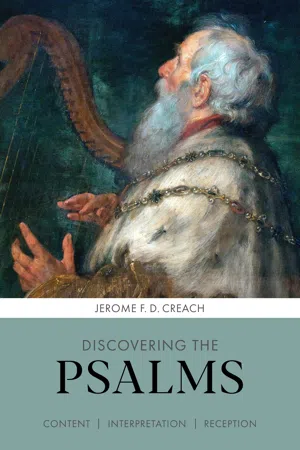
This introduction to the interpretation of the Psalms encourages in-depth study of the text and genuine grappling with the historical, literary and theological questions that it poses. It draws on a range of methodological approaches as complementary rather than mutually exclusive ways of understanding the text. It also reflects the growing scholarly attention to the reception history of the Psalms, increasingly viewed as a vital aspect of interpretation rather than an optional extra.
'This introduction to the Psalms, by a scholar who has been studying them and praying them for decades, amply demonstrates their potential to feed our worship and revolutionize the way we pray.'
John Goldingay, Professor Emeritus of Old Testament, Fuller Theological Seminar, California
'The best introduction to the Psalms that I have ever seen.'
J. Clinton McCann Jr., Evangelical Professor of Biblical Interpretation, Eden Theological Seminary, St. Louis, Missouri
'A valuable resource for ministry students and any Christian who wants to go deeper with the Psalms.'
Jenni Williams, Vicar of St Matthew with St Luke, and former Tutor in Old Testament at Wycliffe Hall, Oxford
'An eminently readable introduction.'
Sue Gillingham, Professor of the Hebrew Bible, University of Oxford
eBook - ePub
Discovering the Psalms
Content, Interpretation, Reception
- English
- ePUB (mobile friendly)
- Available on iOS & Android
eBook - ePub
Discovering the Psalms
Content, Interpretation, Reception
About this book
Information
Part 1
Issues in reading the Psalms and the Psalter
1
What is a psalm?
The word ‘psalm’ refers to a religious poem or song from Ancient Israel. Psalms were part of the Israelites’ public worship and private prayer. Therefore, it should not be a surprise that psalms appear in Old Testament narrative reports of Israelites praising God (Exod. 15.1–8) or calling on God for help (Jonah 2). The Hebrew prophets frequently include psalms to help convey their messages of judgement or hope (Isa. 44.23) or to plead with God on behalf of the people (Jer. 8.18—9.3). These and all other psalms in the Old Testament share many literary and stylistic features. The term ‘psalm’, however, has a special meaning when it applies to the poems and songs in the book we call ‘The Psalms’. This book is a deposit of religious poems and songs that now forms a distinct part of the canon for Jews and Christians. Although the poems in this book are in many ways like the prayers and songs that appear in narrative and prophetic sections of the Old Testament, they are part of a unique collection that became a distinct canonical book. The Church recognizes this book as perhaps its greatest spiritual resource and one of the most important sources of theology as well.
The distinctive place the book of Psalms occupies in Christian Scripture and tradition is due in part to its identity as a collection of model prayers and songs that give believers words to say in prayer and worship. While the psalm-like passages in narrative books appear as the prayers of particular characters – Moses (Deut. 33) and Hannah (1 Sam. 2.1–10), for example – those in the Psalms are uniquely our prayers. Even if we read them as people have for centuries as prayers of David, it is clear that David does not own them. Rather, he is our example and he offers the words to us to take up as our own.
Titles for the book
The expression ‘book of Psalms’ appears first in Acts 1.20 in Peter’s first address to the disciples after the Ascension of Jesus. By that time ‘Psalms’ had already become an accepted title for the collection and Christians recognized it as a canonical book (see Luke 24.44). ‘Psalm’ comes from a Greek term, psalmos, that refers to a song with musical accompaniment. The verbal root from which the word derives (psallo) means ‘to play a stringed instrument with the fingers’. This title appeared for the first time on a Greek manuscript in the fourth century ce (Codex Vaticanus). This Greek title, however, translates the Hebrew term mizmor, which appears in the titles of many individual psalms. The Hebrew word also refers to a song accompanied by stringed music. So, this most familiar title for the book refers to the collection of psalms as a songbook. Many interpreters have therefore called the Psalms ‘the hymnal of the Second Temple’.
Another common title for the book is Psalter, from the Greek word psalterion. This term refers to the lyre, the instrument David played to soothe Saul’s troubled spirit (1 Sam. 16.14–23) and the favourite of musicians in the Jerusalem Temple (1 Chron. 15.16, 21, 28; 16.5). A fifth-century manuscript, Codex Alexandrinus, uses this expression as the title for the Psalms, most likely because those who wrote the document thought these poems were songs meant for singing or performing.1
The Hebrew tradition gives a title that describes more the content than the purpose of the psalms in the book. It calls the collection sepher tehillim, which means ‘book of praises’. The Jewish philosopher Philo and the Jewish historian Josephus, both in the first century ce, translated this expression with the Greek word meaning ‘hymns’. It is curious that the Hebrew scribes and these two early interpreters used words that highlight praise as the purpose and character of the Psalms. Most of the psalms are in fact prayers that complain to God and petition God for help. So, in what sense is this book a ‘book of praises’? This label may come from the fact that the Psalter moves from complaints and prayers for help, which dominate the first part of the book, to psalms of praise that conclude it (Pss. 146—150).2 Or ‘praises’ may intend to capture the Psalter’s variegated expressions of faith, including doubt and lament, in a way that acknowledges all of it as appropriate address to God and in some sense as praise.
What is certain is that the titles of this book reflect the various uses of the Psalms for Jews and Christians. The Psalms are liturgy, song and prayer. In all their uses they give words for us to respond to God’s salvation with praise and thanksgiving and to cry to God for help when we are in trouble or grieving. As a book of Scripture, they also provide a rich resource for theology.
How many psalms?
Those who read the Psalms in English encounter 150 individual psalms. The answer to the question ‘How many psalms?’, however, is much more complex than our English translations let on. There are two dimensions to the problem. First, the Hebrew and Greek versions of the Psalms both have 150 psalms, but they come to that number in different ways. The primary Hebrew manuscript, known as the Leningrad Codex (which dates to 1008 ce; some now call it the St Petersburg Codex), has the arrangement of psalms that English translators follow today. Thus, the Hebrew tradition seems to present the same 150 psalms that we find in the Bible. The Greek version of the Hebrew Scriptures, sometimes called the Septuagint, however, divides some of the psalms differently. Assuming that the Hebrew order is the standard, the Greek version:
- combines Psalms 9 and 10 into one psalm;
- combines Psalms 114 and 115 into one psalm;
- divides Psalm 116 into two psalms (vv. 1–9, 10–19);
- divides Psalm 147 into two psalms (vv. 1–11, 12–20).
In addition, the Greek version includes an additional psalm (Ps. 151) that does not appear in the Leningrad Codex. A note attached to...
Table of contents
- Contents
- Acknowledgements
- Abbreviations
- Introduction: The role of the Psalms in the life of the Church
- Part 1 Issues in reading the Psalms and the Psalter
- 1 What is a psalm?
- 2 It’s poetry!
- 3 Did David write the Psalms?
- 4 A psalm for every occasion: types of psalms
- 5 Settings for performance of the Psalms
- Part 2 Reading the Psalms together
- 6 Going by the book: the Psalter as a guide to reading the psalms
- 7 The theology of the Psalms, Part 1: ‘The Lord reigns!’
- 8 The theology of the Psalms, Part 2: What is the human being?
- Part 3 The Psalms as prayers
- 9 The tradition of psalmic prayer, Part 1: Opening fully to God
- 10 The tradition of psalmic prayer, Part 2: Psalms that pray for vengeance
- Conclusion: The Psalms and Jesus Christ
- Works cited
- Copyright acknowledgements
- Index of Scripture references and ancient authors
- Index of modern authors
- Index of subjects
Trusted by 375,005 students
Access to over 1.5 million titles for a fair monthly price.
Study more efficiently using our study tools.
Frequently asked questions
Yes, you can cancel anytime from the Subscription tab in your account settings on the Perlego website. Your subscription will stay active until the end of your current billing period. Learn how to cancel your subscription
No, books cannot be downloaded as external files, such as PDFs, for use outside of Perlego. However, you can download books within the Perlego app for offline reading on mobile or tablet. Learn how to download books offline
Perlego offers two plans: Essential and Complete
- Essential is ideal for learners and professionals who enjoy exploring a wide range of subjects. Access the Essential Library with 800,000+ trusted titles and best-sellers across business, personal growth, and the humanities. Includes unlimited reading time and Standard Read Aloud voice.
- Complete: Perfect for advanced learners and researchers needing full, unrestricted access. Unlock 1.5M+ books across hundreds of subjects, including academic and specialized titles. The Complete Plan also includes advanced features like Premium Read Aloud and Research Assistant.
We are an online textbook subscription service, where you can get access to an entire online library for less than the price of a single book per month. With over 1.5 million books across 990+ topics, we’ve got you covered! Learn about our mission
Look out for the read-aloud symbol on your next book to see if you can listen to it. The read-aloud tool reads text aloud for you, highlighting the text as it is being read. You can pause it, speed it up and slow it down. Learn more about Read Aloud
Yes! You can use the Perlego app on both iOS and Android devices to read anytime, anywhere — even offline. Perfect for commutes or when you’re on the go.
Please note we cannot support devices running on iOS 13 and Android 7 or earlier. Learn more about using the app
Please note we cannot support devices running on iOS 13 and Android 7 or earlier. Learn more about using the app
Yes, you can access Discovering the Psalms by Jerome F. D. Creach,JEROME F. D. CREACH,Jerome Creach in PDF and/or ePUB format, as well as other popular books in Theology & Religion & Biblical Criticism & Interpretation. We have over 1.5 million books available in our catalogue for you to explore.