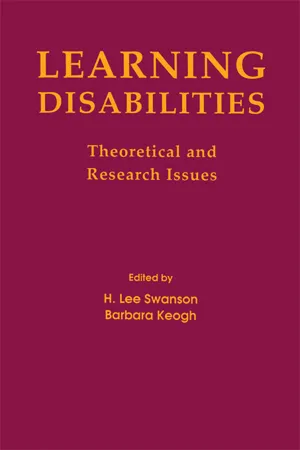
This volume has been developed as a direct result of a conference sponsored by the International Academy for Research in Learning Disabilities, held at the University of California at Los Angeles. The text provides a review and critique of current research in the areas of intelligence, social cognition, achievement, and subtyping as they relate to learning disabilities. In addition, the concept that social behavior is an aspect of intelligence and the relationship between language and reading are discussed in detail by noted experts.
- 384 pages
- English
- ePUB (mobile friendly)
- Available on iOS & Android
eBook - ePub
About this book
Information
Topic
EducationSubtopic
Education General1 | Definitional Assumptions and Research Issues |
Learning disabilities represent a major educational/clinical enterprise and a substantive topic of scientific inquiry. Each is supported by extensive human and financial resources. According to the U.S. Department of Education's Ninth Annual Report to Congress, in 1985–86 almost 5% of school children nationally were identified as learning disabled and received special educational services. This figure is in contrast to the next most prevalent categories of handicap, speech impairment (2.86%) and mental retardation (1.86%). It should be emphasized that learning disabilities is the only handicapping condition that increased in prevalence over a 10-year period, the percentages of children identified and served growing from 1.79% in 1976 to 4.73% in 1986.
Mandates in PL 94–142 have resulted in a proliferation of programs, increased demands for trained personnel, and a heavy financial demand on school districts. Following the passage of PL 94–142 in 1975, financial expenditures for special education rose at a rate of 14% annually, a figure almost twice that for regular education (Stark, 1982). In the 1981 Rand Corporation study of the costs of special education, Kakalik, Furry, Thomas, and Carney (1981) reported that the cost of educating a learning disabled child averaged $2875 above that already expended for regular education, and they anticipated increasing additional costs in subsequent years. Based on both prevalence and costs, it is clear that special education in general, and learning disabilities in specific, represent practical educational problems of major importance.
Concern for learning disabilities as a topic of scientific study is evidenced also in the proliferation of published studies and in increased research support from funding agencies. In 1986 the National Institutes of Health and the U. S. Department of Education allocated over $40,000,000 to learning disabilities specific research and over $103,000,000 to learning disabilities related research (Interagency Committee on Learning Disabilities, 1987). This support covered a diverse range of topics, e.g. cognitive phenotypes in familial dyslexics, brain mechanisms in learning and memory, brain imaging, auditory and attentional functions, developmental agraphia, and dyslexia.
With some exceptions, research funded by the Department of Education has been directed at applied problems, at programmatic, organizational, and policy concerns (Interagency Committee Report, 1987). Topics addressed in recent years include identification, classification, and placement procedures, adherence to PL 94–142 requirements, prevalence of handicapping conditions, barriers to service, and policy related to the Regular Education Initiative. These are important questions, given the number of individuals with learning problems. However, policy and programmatic research sheds limited light on etiological and functional aspects of learning disabilities. Clearly both “basic” and “applied” efforts involving a number of disciplines are necessary if we are to understand learning disabilities and what to do about them. Somewhat paradoxically, it is the need for input from different disciplines that leads to inconsistencies and confusions. Findings from different perspectives do not necessarily translate well, and too often research efforts are parallel rather than integrated. Intervention techniques based on biomedical or neuropsychological models may lack validity within an educational context, and educationally important data may have little relevance for research on specific cognitive processing functions.
It should not surprise us that educational, psychological, and biomedical approaches to learning disabilities are often parallel rather than integrated, nor should we necessarily view this as a negative. As with other conditions that lack clear definition, our understanding of learning disabilities is both plagued and enhanced by the diversity of perspectives and by the range of indicators or symptoms presented by individuals identified as learning disabled. Historically, the search has been for a unified condition and a single encompassing definition. This has lead to long and often heated arguments, and to definitions that are so broad they do not differentiate among conditions or to definitions that are so narrow they lack coverage. Indeed, few operational definitions meet the Blashfield and Draguns (1976) criteria of reliability, coverage, descriptive validity, and predictive validity. The problem is partly because we do not deal with a single condition or syndrome, nor is there a single etiology. Reviewing the array of conditions or symptoms that have been used to describe learning disabilities, it is logical to argue for a multiple rather than a single syndrome approach.
If learning disabilities are viewed as a set of related but partially independent conditions with a number of possible etiologies, we can put aside the futile search for a single condition and respond in orderly fashion to a range of problems. Recognition that the term, learning disabilities, refers to a heterogeneous set of conditions or problems allows us to deal with a diversity of symptoms or attributes and the educational or clinical responses to them. The multiple syndrome approach is not novel, and there is increasing consensus that the diversity in any group of learning disabled individuals is not due just to errors in identification and classification, but rather represents real and legitimate variation. Part of the conceptual task is to impose order on the variation, and part of the applied task is to link differentiated and powerful clinical/educational responses.
COMMON ASSUMPTIONS
It should be emphasized that there are some commonly held assumptions which cut across the array of attributes associated with learning disabilities and which bring some consensus to the various conceptualizations or definitions. First, it is assumed that a learning disability is locused in the individual. The most prevalent early inference was that a learning disability was a direct consequence of neurological damage or central nervous system pathology, a view based primarily on clinical reports of medically diagnosed patients. The notion of minimal brain dysfunction, an extrapolation of the neural damage hypothesis, received major impetus from the work of Strauss, Kephart, Lehtinen, and their coworkers, and was explicitly tied to learning disabilities by Cruickshank (see Doris, 1986 for review). This tradition has been expanded and developed by work in the neurosciences and neuropsychology which has focused on identification of brain-behavior links (see Knights & Bakker, 1976; Obrzut & Hynd, 1986; and School Psychology Review, Volume 10, 1981). Recent work derived primarily from information processing paradigms also implicates a range of within-individual problems (Swanson, 1988) but emphasizes functional processing problems rather than structural ones. Despite differences in the nature of the causal hypotheses, however, the assumption of an individually based problem is fundamental, and leads to the incorporation of the troublesome “exclusionary criteria” (e.g., social or economic disadvantage, lack of educational opportunity) in most definitions.
A second common assumption is that learning disabled individuals do not function at levels consistent with their intellectual potential. The aptitude-achievement discrepancy has been operationalized with different formulae and different measures (see Cone & Wilson, 1981; Reynolds, 1984–1985). The discrepancy model has been analyzed, supported, and criticized, and a number of investigators have described inconsistencies in decision making related to the method of assessment, the formulae, or the statistics applied (Shepard, 1980, 1983; Ysseldyke, Algozzine, Richey, & Graden, 1982). There is also disagreement as to what and how much constitute a meaningful discrepancy. A large literature addresses these problems (see Learning Disabilities Research, Volume 3, number 1, 1987). However, the notion of a discrepancy between aptitude and achievement continues to be fundamental to most definitions of learning disabilities, and is one of the indicators that presumably differentiates learning disabled individuals from slow learners or retarded learners.
A third assumption has to do with specificity (Stanovich, 1986). Broadly stated, it is argued that learning disabled individuals exhibit unexpected failures in certain, but not all, academic or educational tasks (e.g., reading, arithmetic, spelling). Stanovich (1986) notes that the assumption of specificity “… is a necessary concomitant to the idea of a learning disability, because violation of the assumption undermines the utility of the label” (p. 232). If depressed performance or achievement were evident in all academic areas, the individual would more likely be considered a slow learner, mildly retarded, or lacking in motivation. A number of causal hypotheses have been proposed to explain the specific failure, most inferring some links between neural or cognitive functions and the demands of particular academic tasks. Thus, we might expect a specific deficit in short-term memory to present problems for certain kinds of tasks but not in others; similarly, we would expect short-term memory deficits to have different consequences than deficits in elaborative coding. The notion of specificity provides a way of differentiating the learning disabled poor achiever from other groups of poor achievers. It also provides direction for identification of qualitatively different types of learning disabilities.
CLASSIFICATION AND IDENTIFICATION
Critics quite rightly challenge both the conceptualizations and the operational definitions that have guided both research and practice in learning disabilities. Yet, lack of agreement is not necessarily bad; indeed premature consensus might lead to narrow and inequitable inferences. It is possible, too, that the challenges have been based on inappropriate evidence. A good deal of the controversy about definition relates to imprecise measurement and inadequate clinical/educational practices used to identify individuals as learning disabled. Definitions are derived or inferred from identified groups. The consequence is that the conceptualization of learning disabilities has been confused with the operational data of assessment. Too often classification and identification issues have been confounded, leading to faulty inferences and improper generalizations (Keogh, 1987). Famham-Diggory (1986) summarized the research catch 22: “We are trying to find out what's wrong with children whom we won't be able to accurately identify until after we know what's wrong with them.” (p. 155).
Closely related, there are possible and reasonable differences in definitional and operational criteria as a function of the purposes of classification (Keogh, 1983). Definitional criteria for delivery of services and for research on particular neuropsychological processes are quite different. Thus, we should expect some subject differences when identification is made for research or for clinical purposes, or when research is directed at different aspects of learning disabilities. These differences do not negate the validity of the problem condition. Indeed, a growing literature documents the reality of learning disabilities while at the same time acknowledging the inconsistencies and ambiguities that characterize the condition.
RESEARCH ISSUES
Looking to the future, several steps are necessary if we are to understand learning disabilities as a personal and educational problem. Many of these are addressed in subsequent chapters in this volume.
First, the primary criterial attributes which distinguish learning disabilities from other problem conditions must be specified and agreed upon. Critics have argued that learning disabled children are no different from slow learners or mildly retarded individuals. If so, there is no need for detailed diagnostic assessment or specialized instructional programs. Establishment of the validity and independence of the condition, thus, is a major and important challenge.
Second, it is necessary to organize and order the diversity captured in the learning disabilities rubric. The first point dealt with interproblem characteristics, the second with intraproblem attributes. A number of efforts toward organization have been attempted and many are currently in progress (McKinney, 1988). These efforts may well lead to an accepted taxonomy of learning disabilities which could improve diagnostic precision and clarify research findings.
The need for a detailed and comprehensive taxonomy or organization of the heterogeneity within learning disabilities is also apparent when applications to interventions are considered. Thus, a third consideration relates to the search for aptitude-treatment interactions. Historically this search has proved disappointing (Cronbach & Snow, 1977) but the effort seems promising in learning disabilities. Swanson (1988) has argued that past efforts have failed because of imprecisely defined and poorly operationalized psychological processes, nonspecific and inappropriate treatment strategies, and weak statistical analyses. If it is possible to specify legitimate and meaningful subgroups of learning disabilities, then it is possible to develop and test appropriate and powerful educational and clinical responses. It is clear that the aptitude-treatment interaction model is not effective for learning disabilities broadly defined, but rather, must be based on the specification of coherent and theoretically sound subgroups.
Fourth, and closely related, understanding learning disabilities requires understanding of the content and organization or structure of the tasks to be learned. From this perspective, learning disabilities do not exist in a vacuum, but rather are specific to particular demands or learnings, and are contextually based. Thus, disabilities in reading may differ from disabilities in mathematics, not just because the individuals differ in perceptual or cognitive abilities, but because the demands of the tasks differ. Even if we were able to agree upon precise sampling criteria, thus ensuring homogeneity of subjects, we should expect different expressions of problems as a function of the constraints in the learning tasks themselves. This perspective mandates research on the demands and constraints inherent in the content of schooling, including social and affective accomplishments. It also moves us beyond the historical notion of an exclusive in-child deficit (e.g. visual perceptual or auditory perceptual problems) as the basis of learning disabilities.
A fifth consideration relates to practice and concerns the need to test competing models. The literature on learning disabilities is filled with descriptions of particular programs and treatments. Many claim success, although the evidence in support is often limited in power and lacking in generalization. While many approaches claim some success, the relative success of programs is unknown. There are few reported efforts to compare program effectiveness or to test competing hypotheses about diagnosis or treatment. This question is of interest from a theoretical perspective, as comparative analyses may shed light on the nature of various subconditions subsumed by learning disabilities. The issue is important on a practical level given the extensive human and financial resources which go into clinical decision making and treatment. There is an incredible array of diagnostic techniques and treatment programs designed to remediate learning disabilities. Yet, we are uncertain if the time and cost of particular approaches lead to more insightful diagnosis and more powerful remediation than other simpler and less detailed efforts. As example, it is reasonable to ask if strategy training programs are more efficacious than applied behavioral techniques, if vision training is more effective than direct remedial instruction. Clinical experience suggests that almost any treatment or intervention has an effect, that some intervention is better than no intervention. However, global and unspecified effectiveness is not enough, from both theoretical and applied perspectives. The relative effectiveness of competing programs requires test.
Finally, there is increasing consensus that learning disabilities are expressed across a wide age range, and that problems are not limited to school age children. There is, however, little longitudinal evidence to document the developmental course of learning problems, and the mechanisms and dynamics which influence their expression are unspecified. Unraveling the developmental issues will necessitate consideration of both individual and contextual variables, and will a...
Table of contents
- Cover Page
- Half Title page
- Title Page
- Copyright Page
- Contents
- Preface
- Overview of Theoretical and Research Issues
- 1. Definitional Assumptions and Research Issues
- Part I: Intelligence and Learning Disablities
- Part II: Social Cognition: Motivational and Social Aspects
- Part III: Subtyping Research
- Part IV: Cognition and Academic Performance
- Author Index
- Subject Index
Trusted by 375,005 students
Access to over 1.5 million titles for a fair monthly price.
Study more efficiently using our study tools.
Frequently asked questions
Yes, you can cancel anytime from the Subscription tab in your account settings on the Perlego website. Your subscription will stay active until the end of your current billing period. Learn how to cancel your subscription
No, books cannot be downloaded as external files, such as PDFs, for use outside of Perlego. However, you can download books within the Perlego app for offline reading on mobile or tablet. Learn how to download books offline
Perlego offers two plans: Essential and Complete
- Essential is ideal for learners and professionals who enjoy exploring a wide range of subjects. Access the Essential Library with 800,000+ trusted titles and best-sellers across business, personal growth, and the humanities. Includes unlimited reading time and Standard Read Aloud voice.
- Complete: Perfect for advanced learners and researchers needing full, unrestricted access. Unlock 1.5M+ books across hundreds of subjects, including academic and specialized titles. The Complete Plan also includes advanced features like Premium Read Aloud and Research Assistant.
We are an online textbook subscription service, where you can get access to an entire online library for less than the price of a single book per month. With over 1.5 million books across 990+ topics, we’ve got you covered! Learn about our mission
Look out for the read-aloud symbol on your next book to see if you can listen to it. The read-aloud tool reads text aloud for you, highlighting the text as it is being read. You can pause it, speed it up and slow it down. Learn more about Read Aloud
Yes! You can use the Perlego app on both iOS and Android devices to read anytime, anywhere — even offline. Perfect for commutes or when you’re on the go.
Please note we cannot support devices running on iOS 13 and Android 7 or earlier. Learn more about using the app
Please note we cannot support devices running on iOS 13 and Android 7 or earlier. Learn more about using the app
Yes, you can access Learning Disabilities by H. Lee Swanson,Barbara K. Keogh in PDF and/or ePUB format, as well as other popular books in Education & Education General. We have over 1.5 million books available in our catalogue for you to explore.