- 184 pages
- English
- ePUB (mobile friendly)
- Available on iOS & Android
eBook - ePub
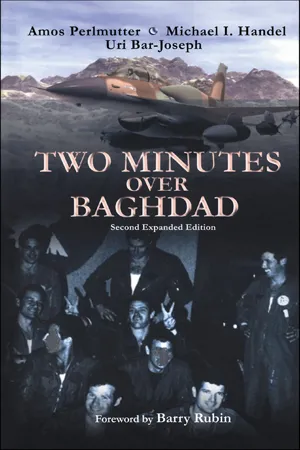
Two Minutes Over Baghdad
About this book
A detailed account of the way Israel dealt with the Iraqi nuclear buildup between its launch in 1974 and the destruction of the Tamuz I reactor on 7 June 1981. This updated account includes formerly classified information and photographs taken during the mission and from US spy satellites.
PART ONE
THE CALL TO ARMS AND THE NUCLEAR RACE
1
Ben Gurion’s Dilemma
1957
David Ben Gurion nervously paced his office like a caged lion, glaring at the large map of the Middle East hanging on the wall and turned once more to his intimate aides. Yitzhak Navon—later Israel’s president—remembers the moment well.
‘All night I could not sleep’, Ben Gurion sighed. ‘What is Israel? …only a small spot! One dot! How can it survive in this Arab world?’ The white-haired veteran, as Prime Minister as well as Minister of Defence for virtually the entire period since Israel’s birth in the wake of the 1948 war, had become intimately acquainted with his country’s national security. Although not himself a professional military expert, he had his own definite ideas concerning the long-range strategy that Israel would have to implement.
He understood that in the long run Israel’s fate might be the same as that of the Crusader Kingdom of the Holy Land which had disappeared at the end of the thirteenth century. Certainly the conditions were not identical but the lessons the Crusaders learnt continued to occupy his mind—in particular in the light of his enemy in the Arab World, Gamal Abd al-Nasser.
The Egyptian President frequently liked to compare Israel with the Crusader Kingdom, and himself to Salah al-Din, the Muslim warrior who had finally eliminated the Christian presence in the Levant. Nasser had reminded his people that the Arabs were endowed with infinite patience. They had waited 200 years to eradicate the Crusaders’ stronghold in the Muslim world. If they calculated their moves correctly they would almost certainly be able to drive the Jews out of the region in a much shorter time. Ben Gurion feared that there was more than a grain of truth in the word of the Egyptian Ra’is. How was he to neutralize this permanent threat to the survival of the State of Israel?
Ben Gurion was a hard-core realist: after having tried through numerous channels to engage in a dialogue with the leaders of the Arab world, experience convinced him that they were not yet ready for a radical change in their attitude to the Jewish State. He knew Arab character, and knew that as long as the Arabs were convinced that the Jews could be ‘pushed into the sea’ they would not accept the existence of the State of Israel as a living entity among the Middle Eastern countries.
One alternative to reach peace that would make Israel secure from the hostile Arab world was to conclude a military pact between Israel and one or more of the Great Powers. However, neither the US nor Great Britain was ready at that time to consider even informal military relations with Israel—let alone conclude a fullyfledged military alliance with it. The reason for this was their desire to build the so-called Northern Tier (later known as the Baghdad Pact), concluded on 24 February 1955, a coalition of Muslim states (Turkey, Iraq, Iran, Pakistan) and Great Britain that was supposed to contain the Soviet drive to the Middle East and the Persian Gulf. A treaty with so many Muslim states hostile to Israel excluded the possibility of any military relations with it.
The USSR itself, as one of the first states to recognize the newlyborn State of Israel following its Declaration of Independence on 14 May 1948, and as a supplier of weapons through Czechoslovakia to the Israeli Army fighting for its life, was considered as a potential ally. However, after the British withdrawal from Palestine and towards the end of the War of Independence, the Soviet Union, under Stalin’s control, made a radical shift in its Middle Eastern policies and Israel was no longer seen as being capable of furthering Soviet interests in the region. Now, the USSR turned to the Arabs.
In September 1955 the Czech (i.e. Russian)-Egyptian arms deal was made public by Nasser. Israel was shocked. The deal included, among other items, 200 modern bomber fighters, 230 tanks, 200 troop carriers and close to 600 artillery pieces. At the time it was an unprecedented qualitative and quantitative increase in the level of armaments in the Middle East. In one stroke the regional balance of power was shattered.
The only hope at that critical point in Israel’s history was France. The war in Algeria, the help provided by Nasser to the FLN, the natural sympathy felt towards the heroic and lonely struggle of Israel by the maquis (French Resistance), and the Suez crisis, all contributed to the development of closer relations between the two countries. It was France which secretly supplied Israel with the necessary weapons for the defeat of the Egyptian Army in its blitz campaign in the Sinai in October 1956. In addition, France consistently supported Israel in the international diplomatic arena, as well as economically. However, following its withdrawal from IndoChina and the Suez Canal it became clear that France was now only a secondrate power. Only a few months earlier, during the height of the Suez campaign, Bulganin, the Soviet premier, sent letters to the British and French premiers, threatening them with a thermonuclear holocaust.
The combined pressure of US and Soviet threats on both the British and French, which forced them to abort the Suez operation, demonstrated their decline in importance in relation to the superpowers, and did not escape the notice of Prime Minister Ben Gurion, who received a personal letter from the Soviet premier which contained, among other threats, the following:
Fulfilling the will of others, acting on instructions from abroad, the Israeli government is criminally and irresponsibly playing with the fate of peace, with the fate of its own people. It is sowing a hatred for the state of Israel among the peoples of the east such as cannot but make itself felt with regard to the future of Israel and which put in jeopardy the very existence of Israel as a State. (5 November 1956)
Ben Gurion knew only too well that the Soviet threat was nothing more than a bluff, but even now, a year later, he still shuddered at the thought of Bulganin’s letter. Even in the aftermath of Israel’s victory in the Sinai campaign—the second defeat of the largest Arab army within less than a decade—Arab hostility towards Israel did not diminish. Ben Gurion was convinced that in the absence of some drastic change in the Arab-Israeli conflict this hatred would continue for years to come. None of the Great Powers could guarantee Israel’s security in the long run—and only an independent Israeli move of some kind could in Ben Gurion’s mind be relied upon to secure Israel’s continued survival without external aid.
One such solution was both suggested and supported by two of his most intimate aids in security affairs—General Moshe Dayan, the Chief of Staff of the IDF, and Ben Gurion’s close deputy, Shimon Peres. To compensate for Israel’s territorial vulnerability and shortage of manpower, these two senior national security advisors pushed towards the development of an independent Israeli nuclear option, which would allow wider room for diplomatic manoeuvring vis-à-vis the Arab world and the Great Powers. This big decision was so sensitive that Ben Gurion even kept it secret from most of his cabinet members. But it was to be an irrevocable decision, and since there was no other failsafe way to guarantee Israel’s existence and security, Israel would turn to France—its only close ally—for assistance in developing an Israeli nuclear research centre.
In early October 1957 the French government agreed to help Israel lay the foundation for the nuclear knowledge and ability which Ben Gurion saw as the ultimate guarantee for Israel’s long term survival. Shimon Peres, who was in charge of the clandestine Israeli-French negotiations, reported to Ben Gurion that an agreement had been reached.
The nuclear race in the Middle East had begun.
2
The Lion and the Lambs: The Birth of Israel’s Nuclear Debate
On 16 December 1960 sensational headlines in the Daily Express declared that Israel was in the process of developing nuclear weapons. The report was based on US and UK intelligence sources and discussed the great concern in the West over the possibility of developing nuclear weapons in Israel. Two days later the Washington Post reported that from official estimates in Washington (i.e. the CIA) Israel would be able to produce nuclear weapons within five years. The New York Times of the same day reported that the Israeli nuclear effort was being made in collaboration with France.
These disclosures upset Ben Gurion deeply. His efforts to preserve a veil of secrecy over the nuclear research project had been to no avail. Between October 1957 and December 1960 hundreds of Israeli engineers and technicians participated in building the Israeli nuclear research centre in Dimona.
But the change of government in France—and the establishment of the Fifth Republic under de Gaulle—was to create a temporary crisis in the special relationship between France and Israel. On 14 May 1960 the French Foreign Minister Couve de Murville had called the Israeli Ambassador Walter Eitan to the Quai d’Orsay and informed him that France would not deliver the uranium promised to Israel for nuclear research by the earlier French government. In addition, Couve de Murville had demanded that Israel should make public its nuclear research. It can be assumed that this change of heart had been initiated by President de Gaulle, who wanted to terminate the special relationship between the two states and improve French relations with the Arab world.
Ben Gurion, for whom this was not only a serious personal disappointment but who now feared that Israel’s security would be compromised and damaged, had arrived in Paris on 13 June 1960 for a meeting with the President. The official visit appeared to be highly successful, except for the problem of the Israeli-French nuclear collaboration. A compromise had been reached between the two leaders: Israel gave assurances that it did not intend to produce nuclear weapons and that it would not build a separate plant for plutonium, while the French promised to supply Israel with the remainder of the parts needed for the completion of the Israeli nuclear reactor. It had also been agreed that Israel would publicly announce the construction of a nuclear facility for peaceful purposes at Dimona.
It can be assumed that the French had not taken Israeli promises at face value concerning this highly sensitive area. Therefore, they leaked some information concerning the Israeli nuclear facilities in Dimona to the USA. It seems, however, that the CIA had already known about the new Israeli project. In March 1958, only a few months after the decision was accepted both in Paris and in Jerusalem, the Israelis monitored on their radar screens a plane flying high over the Negev, probably on a reconnaissance mission. Two Mystere IV planes were sent to intercept the unidentified plane and when they failed to do so, Israel operated for the first time its most advanced fighter the Super Mystere B-II. However, all efforts were in vain, and Israeli pilots could only identify the reconnaissance jet as the famous American U-2. The conclusion for Israel’s decisionmakers was simple: the CIA had learned about the new secret project. It seems that after Ben Gurion’s mission in Paris, the French decided to combine American pressure to their own on Israel, and news of the reactor was leaked to the press.
Ben Gurion now had to admit that Israel was indeed building a research facility in Dimona. On 21 December 1960 he announced in the Knesset that Israel was constructing a nuclear reactor in the Negev in order to contribute to the development of the region. The reactor would be 24 megawatt, its purpose to train scientists for agriculture, medicine, industry and science, so that Israel would be able to design and develop its own nuclear reactor within ten or fifteen years. He emphasized that Israel had no intention whatsoever of producing nuclear weapons. This declaration did not appear to alleviate the US government and Intelligence community’s fears concerning Israel’s real intentions.
On 3 January 1961 the US Ambassador in Israel presented the Israeli Foreign Minister, Mrs Golda Meir, with a letter listing a set of ultimatum demands in which Israel was urged to explain its plans and intentions concerning the plutonium that would be produced by the reactor, to agree to external inspections of the reactor’s facilities, and to declare unequivocally that it would not produce any nuclear weapons. Ben Gurion was deeply insulted by the commanding tone of the letter and had a long conversation with the newly appointed US Ambassador. He reassured the Ambassador that the Israeli-French collaboration in this delicate area would be similar to the one that was established between Canada and India, or any other unilateral nuclear collaboration agreement. Any plutonium produced by the reactor would be returned to the country supplying the enriched uranium. At the same time Ben Gurion expressed his objection to foreign inspection of the reactor. ‘We are not interested in any hostile states meddling in our internal affairs,’ he explained to the young ambassador. On the other hand he was ready for an American or any other friendly state visit to Israel’s nuclear facilities, but not in the near future—only after a relaxation of the excitement created following the disclosure of Israel’s nuclear project.
Growing American pressure revived the internal debate in Israel concerning the desirability of achieving nuclear independence. Cabinet members and party colleagues—still ignorant of their own country’s nuclear programme—began to express their own opinion on the matter. Ben Gurion came under cross-fire from his domestic adversaries as well as international friends and foes. Members of his ruling party Mapai, such as Eshkol, Golda Meir and Sapir, expressed their objections to his decision to develop a nuclear option for Israel. Eshkol and Sapir, both economic experts, were afraid of the enormous costs of this project. Golda Meir, for many years an enemy of Peres, based her objections to the project more on personal than on logical and objective reasons.
Thus in the early 1960s the Israeli political elite became divided over Israel’s nuclear policies. The question was: on what would Israel rely during the next decade, a strong conventional army primarily based on tanks and tactical aircraft or on ‘the forecasted technologies of the 1970s’, as the pronuclear parties in Israel’s security community euphemistically referred to Israel’s nuclear programme?
Dayan and Peres found themselves in a minority in the ensuing debate. Yigal Allon, the former commander of the ‘Palmach’ and one of the most original and brilliant Israeli military minds, brought a number of strong arguments against them.
It seems that, faced with these external pressures, as well as other domestic problems, Ben Gurion decided to retire and leave the rest of the job to the younger generation. It was a hard decision for him. For many years he had cleverly navigated Israel through political storms and crises, using his political instincts. His aim had always been to bring Israel to a safe port, but like Moses, he was not to reach that Promised Land. And although peace with the Arabs was by no means promised, Ben Gurion still hoped that the nuclear infrastructure laid down by him and his aides would be a safe guarantee against any Arab drive to destroy the country of Israel, and that by achieving a nuclear option, a balance of terror would be created in the Middle East, thus leading to peace.
But the developments that were to follow put an end to such hopes.
3
Nasser’s Nightmare, Sadat’s Solution
For Nasser’s Egypt, as well as for Ben Gurion’s Israel, the nuclear question became (like other elements of the Arab-Israeli confrontation) a purely ‘zero-sum game’, an all-or-nothing question. Nasser’s ambitions were to liquidate the Jewish state and to rub its name off the Middle East map, as a means to reach Arab unity under his control. If Israel were to acquire the bomb it would thwart this and in order to neutralize such a threat to his aims, Nasser tried out certain countermeasures.
At the beginning of 1961, immediately after the Israeli efforts leaked out, Nasser convened the Arab Advisory Commission of Military Affairs’. This consisted of all the chiefs of staff of the Arab armies and its aim was to provide Nasser with a scheme for a preemptive strike against the Israeli reactor in Dimona. Nasser himself admitted as much to a conference that met at the time because he ‘was worried about the development of nuclear Israeli weapons’.
But this was not enough for the ambitious Egyptian president. He realized that it would take the divided Arab world at the height of the ‘Arab Cold War’ many more years before it would be ready to unite in a war against Israel. Nasser felt that he had to act immediately in order to create a counter threat which could, according to his philosophy, neutralize the new Israeli atomic threat.
By the end of 1959 an Egyptian effort to build supersonic warplanes and surface-to-surface missiles had already started. Hundreds of German scientists, mainly Nazi veterans, were mobilized to work in Egypt in three top-secret projects. The first was called Project 36. Willi Messerschmitt—the famous father of the ME109 of World War II—was busy building a new type of plane for the Egyptian dictator, named HA300. In the second project, codenamed 135, Ferdinand Brandner headed a group of German and Egyptian engineers and technicians who tried to develop a jet engine for the fighter built by the first group. The most secret project was called 333 or ‘thalathat’ in Arabic. In this plant medium-range surface-to-surface missiles were built. Their range was supposed to be between 280 and 580 km, or, as Nasser put it in one of his speeches, they could hit every target south of Beirut.
It seems that when Nasser found out about the Israeli activities in Dimona, he decided to change his plans a little. Before, he had planned to arm the warheads of his missiles with conventional explosives. Now he decided to go into new projects which would supply him with unconventional warheads. The first project was called Ivis I, the second Operation Cleopatra.
Ivis I was supposed to supply the missile warheads with new dangerous materials: Cobalt 60, a radioactive isotope which would spread deadly radiation over vast areas of Israel. Other alternatives, such as chemical or biological materials, were considered as equally fitting to this aim.
The second project was aimed at supplying nuclear warheads as a counterthreat to the supposed Israeli atomic bomb. Since Egypt had no nuclear reactors by that time, or at least no reactors with the capacity to supply weapon-grade materials, Egypt intended to buy low-grade uranium in the free international market and enrich it by using new special techniques of centrifuge developed in West Germany and Holland.
But neither independent Egyptian efforts nor Nasser’s efforts to reunite the Arab World succeeded. Arab rulers, though worried about the Israeli bomb, were not ready to put their armies under Egyptian command: they knew the ambitious president and were sure that first of all he would undermine their regime and only then would he turn to deal with the Israelis.
Israel, for its part, started a highly secret operation against the German scientists working for Nasser. By the end of 1962 letters ...
Table of contents
- Cover Page
- Title Page
- Copyright Page
- List of Illustrations
- Foreword to the Second Edition
- Introduction to the First Edition
- Introduction to the Second Edition
- Prologue
- Operation Opera: A Chronology of Events
- Part One: The Call to Arms and the Nuclear Race
- Part Two: The Decision is Made
- Part Three: the Preparations for Operation Babylon
- Part Four: Judgment
- Epilogue to the Second Edition
- Appendices
Trusted by 375,005 students
Access to over 1.5 million titles for a fair monthly price.
Study more efficiently using our study tools.
Frequently asked questions
Yes, you can cancel anytime from the Subscription tab in your account settings on the Perlego website. Your subscription will stay active until the end of your current billing period. Learn how to cancel your subscription
No, books cannot be downloaded as external files, such as PDFs, for use outside of Perlego. However, you can download books within the Perlego app for offline reading on mobile or tablet. Learn how to download books offline
We are an online textbook subscription service, where you can get access to an entire online library for less than the price of a single book per month. With over 1.5 million books across 990+ topics, we’ve got you covered! Learn about our mission
Look out for the read-aloud symbol on your next book to see if you can listen to it. The read-aloud tool reads text aloud for you, highlighting the text as it is being read. You can pause it, speed it up and slow it down. Learn more about Read Aloud
Yes! You can use the Perlego app on both iOS and Android devices to read anytime, anywhere — even offline. Perfect for commutes or when you’re on the go.
Please note we cannot support devices running on iOS 13 and Android 7 or earlier. Learn more about using the app
Please note we cannot support devices running on iOS 13 and Android 7 or earlier. Learn more about using the app
Yes, you can access Two Minutes Over Baghdad by Uri Bar-Joseph,Michael Handel,Amos Perlmutter in PDF and/or ePUB format, as well as other popular books in History & Middle Eastern History. We have over 1.5 million books available in our catalogue for you to explore.