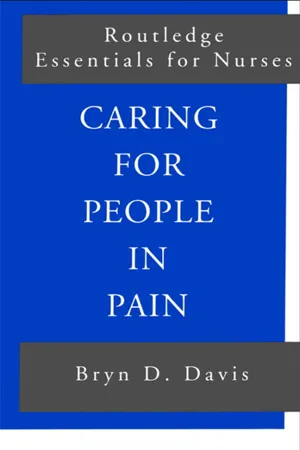
An excellent introduction for nurses to all aspects of pain and its management. Topics examined are relevant to all areas of health care practice and include:
*types of pain
*the experience of pain, including psycho-social factors
*interventions (pharmocological, physical and psychological)
*alternative and complementary therapies.
Caring for People in Pain clearly sets out the research base for practice and provides a thorough and accessible text for students of this core topic on all entry level and many post-registration nursing courses.
- 264 pages
- English
- ePUB (mobile friendly)
- Available on iOS & Android
eBook - ePub
Caring for People in Pain
About this book
Information
Topic
MedicineSubtopic
Health Care DeliveryPart I
Introduction
What is pain?
Chapter 1
Introduction
The ‘inside story’
There has been a great deal of development in the understanding of the pain experience over the last forty years or so and particularly over the last ten to fifteen. The pace of research and development seems even to be increasing. The kind of picture that we now have of the kinds of experiences people have when they are in pain, and the mechanisms that help to bring those experiences about, is very complex. It involves all aspects of our nature from our physiology and biochemistry to our emotional and motivational make up, to our psychological processes and being, to our social relationships and to our sense of spiritual awareness.
In attempting to help people in pain it is most important that we understand that complexity and that, in our assessments of need, and planning of care, we incorporate that range of knowledge and insight. Each of the facets mentioned above does not act in isolation, but as part of an interacting dynamic whole. When someone experiences pain, their whole being can be involved, and we can use aspects of that whole being to help them, and to help them to help themselves.
The experience of pain is essentially an individual, internal experience, known only to the person with the pain. We who try to help them come to it very much from the outside. What we know of it is what we can learn from that person. This knowledge can, of course, add up to a lot of general insights into pain, but each person’s experience is different, and personal. The purpose of this book then is to try to demonstrate that ‘inside story’ of pain. The mechanisms and processes, at physiological/biochemical, emotional/motivational, cognitive/evaluative and social/cultural levels will be considered to present a holistic view. It is hoped that those caring for people in pain will be able to gain insight into the individual’s own experience and to develop a plan of care that meets those individual needs.
Who is this book for?
This book is aimed at those practitioners who are involved in caring for people in pain. Primarily this means nurses. However, there are other health-care professionals involved in this area, and it is hoped that they might also find the volume useful.
The main focus of the book is on the needs of the undergraduate pre-registration student. However, there are many registered nurses who are involved in the management of pain who wish to update theirknowledge.They might be undertaking a post-registration degree or even a master’s level study of pain. It is hoped that the level of the book will meet the needs of these different groups. Even if not undertaking a formal course it is hoped that the practising nurse will be able to access the information here in order to enhance her or his practice.
Why do we need this book?
One of the main reasons for this book is the continuing evidence for poor pain management. This is associated with the continuing existence of many myths and misconceptions about the pain experience and its care (e.g. IASP 1992; McCaffrey et al. 1994). There is evidence for poor pain assessment (Seers 1987; Paice et al. 1991), the under or over assessment of pain by staff (Carr 1990; Zalon 1993) and failure to prescribe or administer enough analgesics (Bonica 1980; Donovan et al. 1987; Closs 1990; Paice et al.1991). This applies also and particularly to children and infants (Mather and Mackie 1983; Beyer and Byers 1985; Carr 1990; Gonzalez "ORG_1951"et al. 1993; Carter 1994).
Poor levels of knowledge have been identified as an important aspect (Sofaer 1984; Watt-Watson 1987; Fothergill-Bourbonnais and Wilson-Barnett 1992; McCaffrey et al. 1994). This applies to nurses in a variety of settings. These results also demonstrate a failure to improve the situation over a long period.
The knowledgeable carer
In order to address this latter factor of poor knowledge and to facilitate educational developments for nurses and other health-care professionals, this volume has been written with a particular approach which it is felt has not been offered before. The emphasis is more on the experience of being in pain and how this should influence the care given to those in pain. Thus from an exploration of the factors influencing the experience of pain, and the way that the experience of pain can vary from individual to individual, an approach to care will be advocated that should lead to more effective management of pain. In this way the practitioner should therefore be able to claim to be offering a more caring role to those in pain.
By caring is meant a more considerate role; an approach that is much more concerned with the needs of the individual, but one that shows a much more understanding, empathetic relationship with the sufferer. It also benefits from insights gained from an understanding of the factors and mechanisms that can operate on and within individuals. These include the physical, emotional, cognitive, social and cultural factors (Leininger 1991; Morse 1995, cited in McKenna 1997). It includes the desire to work with the individual in pain, rather than a desire to do things to or for him or her (Gazda et al. 1987). This will then lead to the development of a very individualised plan which when implemented will show care.
In many ways then this book is not so much about nociception, that is, the transmission of noxious stimuli from the periphery to the central nervous system. It is more about what factors or processes lead to a particular experience, by an individual, that leads to the claim that he or she is in pain. From an understanding of these, and the development of skills in assessing these individual processes and factors, the nurse or other health-care professional will be in a position to help in the management of that pain.
Diamond and Coniam (1991) argue that the pain experience arises from the functioning of both the body and the mind. This insight reflects a long history in attempts to understand it (see Merskey 1980). Others, for example Cassel (1991), have argued that we should incorporate the concept of suffering as well because in some pain experiences it is difficult to specify a particular pain as the experience is more holistic and thus justifies the term suffering rather than pain.
As a student the reader is expected to incorporate the information in this book into their developing practice. It should be read in conjunction with other reference texts, such as those in psychology and sociology, as well as pharmacology, anatomy, physiology and biochemistry. As a staff nurse or other practitioner, the reader is expected to draw on his or her experience and previous reading to place this volume in context.
The structure of the book
The book is organised into parts. The first part sets the scene, and describes the different kinds of pain with which the practitioner might be faced. This is particularly aimed at the relative new comer so that lack of experience should not prevent a proper understanding of the information in the book. However, it is hoped that the more experienced practitioner may come across some different aspects of pain from those with which they are familiar or at least be able to confirm their experience, in the examples given.
The second part is perhaps the main part. In these four chapters the nature of the pain experience and in particular the ‘inside story’ is explored. By this is meant the range of factors, including peripheral nociception, but certainly not exclusively, that lead to a painful experience. Certainly the neuro-physiological mechanisms will be considered and of course the importance of the Gate Control Theory offered by Melzack and Wall (1965) in explaining the processes that seem to produce that painful feeling. It is from this theory that the particular approach taken in this volume is taken.
However, a more substantial part of this second part will cover the emotional, motivational, and cognitive-evaluative aspects of the pain experience. As well as receiving information coming in from the periphery,the central nervous system and its cognitive, emotional, experiencing functions are creating meanings and defining experiences. These are related to any incoming information but not necessarily directly and sometimes without any apparent relationship.
As well as these emotional, motivational and cognitive-evaluative factors and processes, social and cultural factors will be explored. Through these the individual learns patterns of behaviour or of thought and feeling that influence the kind of meaning and definition that he or she will put on any experience. These will in their turn lead to forms of expression of the experience that will vary from individual to individual or from time to time in the same individual. These forms of expression will also include ways of coping (or not coping) with the pain. They will also influence the reaction or response to various interventions that may be offered or applied to prevent or treat the pain.In Part III these various interventions will be considered. It is from a study of the factors and processes involved in the pain experience of any individual that we can gain a proper understanding of how interventions might work or how they might best be used. They will include the traditional pharmacological preparations that have been and continue to be developed and refined to help people cope with pain. These are of course an important aspect of the management of pain. However, in many instances they are not as successful as might be wished, or they lose their efficacy over time.
This then leads to the study of other complementary or alternative approaches which can involve both physical and psycho-social measures. There are a variety of physical interventions, including electrical, heat and cold, massage and aromatics, and counterirritation. However, there are also many interventions based on psychology that can help to prevent pain or to enable the sufferer to develop meanings for the pain that give him or her a greater sense of control over the situation. Other psychologically based approaches include relaxation and distraction.
Also included in this important part are other approaches derived from other models of health and illness, perhaps from different cultures. They include acupuncture and herbal medicine. With many of these interventions there is a great opportunity for nurses and other health-care professionals to develop their relationship with the patient. In this way they can become more of a partner with him or her, allowing the sufferer a much more important, perhaps leading, role in the management of their pain.
In the final part the role of the nurse in particular is considered. The nurse of course is a member of a multi-professional team and as such must be aware of the various parts that can be played by each of the professions involved. A particular aspect of the management of the patient’s experience of pain is that of the assessment of that experience. The patient is the only person who can do this and the role of the nurse or other professional is to help the sufferer express adequately the nature and intensity of the pain so that suitable and adequate interventions may be proposed and implemented. As well as assessing the pain there is an important role in the regular monitoring of the effectiveness or otherwise of any interventions that might be implemented. In this way modifications to the interventions or alternatives may be introduced.
Nurses have a very important role in the administration of many of the interventions, and particularly in information giving and education. Other health-care professionals may also be involved here and it is important that the team agree as to who is to be responsible for what activity so that there is no unnecessary repetition and there are no gaps. Many nurses have developed specialist roles regarding the management of pain and there are now many pain clinics where specialist teams are employed. Some of these deal only with certain kinds of pain or with special client groups, in the hospital setting or in the patient’s own home or in hospices, as part of palliative care.
In the final chapter there will be a summary of what has gone before, and a discussion as to where the care of people in pain should be going in the future. It is important that education, at both preand post-registration levels, is developed, and that nurses, and other professionals, recognise the need for regular updating, of knowledge, attitudes and skills. The utilisation of research in practice, so that more clinically effective care is available to people in pain, is a professional responsibility. Also, there is still much more research needed, not only into various mechanisms of the pain experience but also into interventions or even the management and administration of the interventions that we have. It is in this way through research and development that a more personalised, caring and effective approach to helping the sufferer may be achieved.
The evaluation of current and new methods of helping people in pain is all part of the ongoing management of care and of the account ability of the professional. The purpose of this book is to help the professional to be aware of the processes and factors involved, of the research that gives us this information and the practices that are based on this research. With all the information available today there is little need for any person to be in unmanaged pain. Yet there is recent evidence that this does still occur, in the acute and the chronic situation, with the very young and with the elderly. This evidence will be considered in more detail in a later chapter dealing with pain management. It is mentioned here to remind the reader of the importance of the study of ways of caring for people in pain.
Chapter 2
Some experiences of pain
The least pain in our little finger gives us more concern and uneasiness than the destruction of millions of our fellow-beings.
William Hazlitt
Introduction
The main focus of this volume is the experience of people in pain. It is an attempt to explore the kinds of experiences that sufferers have, and the factors and processes that create the experience that sufferers call pain.
For professionals there is a tendency to see or approach pain from the outside of the sufferer, in terms of tissue damage, and neuro-physiological processes. Indeed many professionals seem to have their own views as to what is allowed to be called pain, and when any intervention might be necessary (McCaffrey et al.1994).
Yet pain can be seen as being essentially ‘all in the mind’, being the interpretation by the sufferer of information coming from the peripheral nervous system (which may also include internal parts, such as the abdomen, thorax, cranium and the spine), into the cortex and related emotional centres. The interpretation is influenced by physical, psychological and socio-cultural factors and processes. As some definitions have it, it is what the patient says it is and occurs when the patient says it does (e.g. McCaffrey 1968). Other definitions try to incorporate some indication of the link with tissue damage (e.g. Sternbach 1968; Mountcastle 1980; Merskey 1986). This latter is one that is frequently referenced in other texts. However, Melzack and Wall (1996) discuss this question of definitions and find it difficult to accept in its entirety any of these. They argue that pain research has not yet developed to a level at which it is possible to give a definition from which practice, education and research can develop. Pain can mean so many things to so many different people that we must be careful in tying ourselves down to a particular definition yet.
There is, of course, often tissue damage present in some obvious form to ‘explain’ or justify the claim of being in pain by the sufferer. Nevertheless the pain sometimes is reported when the tissue damage seems to have been repaired, or to be out of proportion to the apparent damage. There are instances of what is called ‘central pain’ whereby there is no apparent peripheral source of the pain, or of pain being reported in relation to non...
Table of contents
- Cover Page
- Title Page
- Copyright Page
- Illustrations
- Acknowledgements
- Part I What is pain?
- Part II Factors influencing the pain experience
- Part III Interventions to help the person in pain
- Part IV The management of pain
- Appendix
Trusted by 375,005 students
Access to over 1.5 million titles for a fair monthly price.
Study more efficiently using our study tools.
Frequently asked questions
Yes, you can cancel anytime from the Subscription tab in your account settings on the Perlego website. Your subscription will stay active until the end of your current billing period. Learn how to cancel your subscription
No, books cannot be downloaded as external files, such as PDFs, for use outside of Perlego. However, you can download books within the Perlego app for offline reading on mobile or tablet. Learn how to download books offline
Perlego offers two plans: Essential and Complete
- Essential is ideal for learners and professionals who enjoy exploring a wide range of subjects. Access the Essential Library with 800,000+ trusted titles and best-sellers across business, personal growth, and the humanities. Includes unlimited reading time and Standard Read Aloud voice.
- Complete: Perfect for advanced learners and researchers needing full, unrestricted access. Unlock 1.5M+ books across hundreds of subjects, including academic and specialized titles. The Complete Plan also includes advanced features like Premium Read Aloud and Research Assistant.
We are an online textbook subscription service, where you can get access to an entire online library for less than the price of a single book per month. With over 1.5 million books across 990+ topics, we’ve got you covered! Learn about our mission
Look out for the read-aloud symbol on your next book to see if you can listen to it. The read-aloud tool reads text aloud for you, highlighting the text as it is being read. You can pause it, speed it up and slow it down. Learn more about Read Aloud
Yes! You can use the Perlego app on both iOS and Android devices to read anytime, anywhere — even offline. Perfect for commutes or when you’re on the go.
Please note we cannot support devices running on iOS 13 and Android 7 or earlier. Learn more about using the app
Please note we cannot support devices running on iOS 13 and Android 7 or earlier. Learn more about using the app
Yes, you can access Caring for People in Pain by Bryn Davis,Bryn D. Davis in PDF and/or ePUB format, as well as other popular books in Medicine & Health Care Delivery. We have over 1.5 million books available in our catalogue for you to explore.