- 244 pages
- English
- ePUB (mobile friendly)
- Available on iOS & Android
eBook - ePub
Arts, Entertainment and Tourism
About this book
'Arts, Entertainment and Tourism' is a pioneering text that, by focusing on the consumer, investigates the relationship between these 3 industries and how this relationship can be developed to its best competitive advantage.
Issue-led, this text draws on appropriate disciplines rather than using one single approach, to examine issues in arts and entertainment within the framework of cultural tourism.
Written to meet the needs of students studying on management courses in the arts, tourism and leisure, 'Arts, Entertainment and Tourism':
* Describes the general arts and tourism background
* Identifies a framework for analysis that acknowledges differing levels of interest in the arts and entertainment
* Discusses the arts and entertainment that feature (past and present) in tourism
* Examines the reasons why the arts, entertainment and tourism have an interest in each other and how they go about developing the relationship
* Examines the relationship: are there tourists in audiences and do the arts and entertainment attract tourists to a destination?
* Evaluates the wider effects (good and bad) on both the arts and tourism
* Discusses the direction of future developments by arts and tourism organizations and for future research
1
Introduction

All of these have a tourism connection: the concert by Oasis attracted an audience of 80,000. A fan of Cliff Richard travelled from Perth in Australia to London to see him perform and 90,000 people attended Glastonbury (1997) to hear performances by the likes of Van Morrison and New Order. A new 450-seat theatre (1998) nicknamed Madonna’s Bra will, it is hoped, revive Ilfracombe’s tourist trade. Over 40 per cent of those attending the Edinburgh International Festival are from outside Scotland. The descriptions of Chicago and Greece are promotional slogans to encourage international visitors to the two places. ‘Seaside Special’ is a traditional end-of-pier variety show at an English seaside town and the Righteous Brothers appear in a US seaside town that now draws most of its visitors for gaming purposes. For the first performances of the Ring Cycle in Australia, over half of the persons attending were from outside the state of South Australia. Inclusive packages of transport, accommodation and show tickets are offered to attract people from the UK to travel to see Tina Turner perform in Paris or Cologne. The ‘Fiesta fun’ refers to a ‘special night out’ of dressage exhibitions by horses and a ‘colourful flamenco show’ provided for sun and beach holidaymakers in Spain.
These examples illustrate a relationship between the arts and entertainment on the one hand and tourism on the other. They illustrate, in particular, two aspects of the relationship (see Chapter 4 for further discussion):
Table 1.1 Initial definitions
Such members of the audience are ‘tourists’ (see Figure 1.1). Some of the audiences at performances will be local residents, others are non-local and will have had to travel some distance but have not stayed overnight and are ‘day visitors’. The non-locals who have stayed overnight are conventionally termed ‘tourists’ (see Table 1.1 and see also Chapter 3 for further discussion of these terms). The distinguishing features of the tourist are travel and overnight stay. The word ‘tourist’ is often used interchangeably with ‘visitor’ but there are two types of visitor – those who stay overnight (the tourist) and those who do not (day-visitor or excursionist). The word ‘visitor’ is commonly used by many people and in this book it usually refers to the tourist. It is tourists, their activities and the organizations which seek to attract them that are the subject of this book.
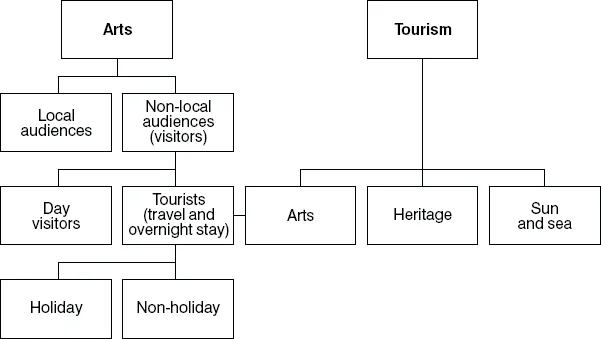
Figure 1.1 Tourism and the arts
Tourism usually refers to people on holiday but it also, confusingly, refers to travel and stay away from home for business reasons or to visit friends or in order to see a specific concert or play (without being on holiday) (see Figure 1.1). There is further discussion of this in Chapters 3 and 4.
The other focus of this book, apart from tourism, is of course the arts and, in particular, live performances of the performing arts. It is concerned with performances before an audience of music, plays, opera, dance and the like in places such as theatres, concert halls, arts centres and arenas. What is meant by ‘the arts’ and by ‘entertainment’ is discussed further in Chapter 2.
There is a great deal of current discussion about attracting tourists, especially in the holiday sense, to arts audiences with a particular emphasis on foreign tourists. Associated with that, though to a lesser extent, is the issue of the arts and domestic tourists. These perspectives are probably of greatest significance to tourist boards (see Table 1.1) and the tourist industry in a strategy to determine new tourism opportunities. The range of attractions for tourists is considerable and the arts is but one of those (see Figure 1.1). The approach is to develop and encourage arts that are part of the tourist (usually holiday) experience or to develop promotional strategies that will appeal to that market.
In the arts world there may be little concern about whether audiences are tourists or holidaymakers. There may, though, be a desire to extend the catchment area for audiences. The tourist market may be only one of several they choose to explore and exploit in order to catch the more ‘distant’ market. The approach will be to develop and encourage arts that will appeal to a wide geographical area (perhaps by being distinctive) and to have promotional strategies that will reach such a wide audience. Some may, if considered appropriate, be more deliberately aimed to appeal to tourist and holiday audiences. There is further discussion of this in Chapter 6.
The perspective in this book is derived from cultural tourism rather than from the arts. Much of this book will focus on tourists and those who are on holiday. This reflects current discussion. It will, however, also assist in illuminating issues that arise for arts managers in attempting to widen their catchment area. There is consideration of the arts perspective throughout the book and especially in Chapters 6 and 9.
For those who manage arts organizations, such as theatres, events arenas or concert halls, there is a particular interest in examining this segment of the audience. It is often represented as being an additional market to target in order to increase audiences and revenue. It is widely considered to be a growing market as more people are apparently seeking an arts related tourist trip, and to be a worthwhile market to capture because of the potential spending power of such tourists. In these circumstances a study of this specific market segment is appropriate. It will draw the attention of arts managers to the opportunities and hazards involved in seeking to include tourists in the audiences and enable them to develop appropriate managerial strategies and policies.
Culture and tourism
It is possible to ident...
Table of contents
- Front Cover
- Half Title
- Dedication
- Title Page
- Copyright
- Contents
- Acknowledgements
- Abbreviations
- 1 Introduction
- 2 The arts context
- 3 The tourism context
- 4 The arts-related tourist
- 5 The arts-related tourism product
- 6 The arts perspective
- 7 The tourism perspective
- 8 Impact
- 9 Conclusions and implications
- Some illustrative cases
- References
- Index
Trusted by 375,005 students
Access to over 1.5 million titles for a fair monthly price.
Study more efficiently using our study tools.
Frequently asked questions
Yes, you can cancel anytime from the Subscription tab in your account settings on the Perlego website. Your subscription will stay active until the end of your current billing period. Learn how to cancel your subscription
No, books cannot be downloaded as external files, such as PDFs, for use outside of Perlego. However, you can download books within the Perlego app for offline reading on mobile or tablet. Learn how to download books offline
Perlego offers two plans: Essential and Complete
- Essential is ideal for learners and professionals who enjoy exploring a wide range of subjects. Access the Essential Library with 800,000+ trusted titles and best-sellers across business, personal growth, and the humanities. Includes unlimited reading time and Standard Read Aloud voice.
- Complete: Perfect for advanced learners and researchers needing full, unrestricted access. Unlock 1.5M+ books across hundreds of subjects, including academic and specialized titles. The Complete Plan also includes advanced features like Premium Read Aloud and Research Assistant.
We are an online textbook subscription service, where you can get access to an entire online library for less than the price of a single book per month. With over 1.5 million books across 990+ topics, we’ve got you covered! Learn about our mission
Look out for the read-aloud symbol on your next book to see if you can listen to it. The read-aloud tool reads text aloud for you, highlighting the text as it is being read. You can pause it, speed it up and slow it down. Learn more about Read Aloud
Yes! You can use the Perlego app on both iOS and Android devices to read anytime, anywhere — even offline. Perfect for commutes or when you’re on the go.
Please note we cannot support devices running on iOS 13 and Android 7 or earlier. Learn more about using the app
Please note we cannot support devices running on iOS 13 and Android 7 or earlier. Learn more about using the app
Yes, you can access Arts, Entertainment and Tourism by Howard Hughes in PDF and/or ePUB format, as well as other popular books in Business & Entertainment Industry. We have over 1.5 million books available in our catalogue for you to explore.