- 512 pages
- English
- ePUB (mobile friendly)
- Available on iOS & Android
eBook - ePub
About this book
This book discusses the nature and process of change in human society over the past two million years. The author draws on economic, historical and biological concepts to examine the driving forces of change and looks to likely developments in the future. This analysis produces some very thought-provoking and controversial conclusions.
Information
1
CHARIOTS OF CHANGE
Behold there came four chariots out from between two mountains …These are the four spirits of the heavens.
Zechariah, VI, 1, 5
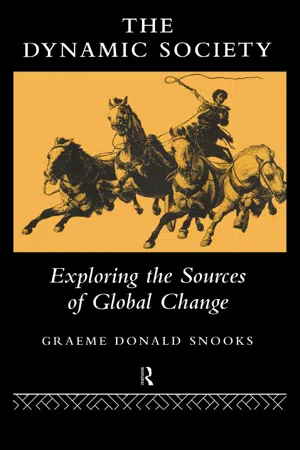
In the beginning was the word. And the name of the word was change— eternal change. The explosive beginning imparted an energy to matter that has continued to drive our expanding universe ever since. It is a dynamic that will continue forever, either in a universe that goes beyond the limits, or in a universe that reaches its limits and contracts upon itself. To begin again anew. It is a universe vibrant with energy from its greatest to its smallest parts. Even life on a seemingly insignificant planet called Earth is characterized by ceaseless change. The vehicles of this change are the various species of animal and plant life, which are driven by individuals striving with great determination to survive and, with survival, to consume. In the eternal struggle to survive and prosper— a struggle that generates endless change—the riders in the chariot adopt one of four strategies: procreation, predation/conquest, genetic/technological change, and symbiosis/commerce. These are the four chariots of Zechariah— the four spirits of the heavens.
This book is about the Dynamic Society of mankind. It explores the nature and process of change in human society over very long periods of time. It asks questions about the vehicle of change, about those who drive it, about its path through time, and about its likely destination in the future. To understand the dynamics of human society, we need to go back beyond the beginning of the modern era, beyond the beginning of civilization, beyond even the beginning of mankind. We need to begin at the very beginning— some 4 billion (4,000 million) years ago when the first signs of life on Earth emerged.
Why not focus upon the more recent past? Even the last few millennia? The answer has had a major influence in shaping this work. In order to understand the riders in the chariot of change—those who are driving the dynamic society progressively forward—we need to understand their genetically determined nature. We need, in other words, to know the real nature of mankind. And this requires an understanding of the nature of life itself. We also need to understand the various strategies that riders in the chariot have employed to achieve their dynamic goals which, in turn, requires an understanding of the entire sweep both of human society and of life itself. Yet even more importantly, we can only gain useful insight about the future by employing a very longrun approach to the past. The current myopic methods of prediction about the future of human civilization, it will be shown, are both flawed and misleading.
THE DYNAMICS OF LIFE AND SOCIETY
Until recently we knew little of the great longevity and continuity of life. And only since the time of Charles Darwin (1809–1882), barely more than a century ago, have we possessed any understanding of the mechanism by which it was achieved. While Darwin was the originator of the natural selection hypothesis, he was far from being the first to discuss evolution (Mayr, 1991). What is truly remarkable is that despite considerable intellectual effort by thousands of science s most talented and hardworking scholars, Darwin’s central hypothesis remains as the only persuasive explanation of the evolution of life (Dawkins, 1986). Many have attempted to carve out reputations for themselves by disputing Darwin’s thesis of natural selection, but none has succeeded. Once the excitement of each new attempt has died down, it has been seen by the scientific community merely as a gloss on Darwin’s original hypothesis.
Neo-Darwinists claim that evolution involves a very gradual change in life’s species owing to genetic mutation that occurs in a cumulative way through an intensive struggle for survival and reproduction. Only those individuals possessing a genetic advantage survive to pass it on to future generations. The rest are ruthlessly weeded out. According to that enthusiastic and highly persuasive interpreter of neo-Darwinism, Richard Dawkins (ibid.: 306–12), evolution is not a random process as some have claimed. Quite the opposite. Genetic change is non-random in the sense that it is the systematic outcome of a tenacious force within all life forms to survive, and only random in the sense that it can be either a cost or a benefit to the individual life form. It is only through the process of natural selection—whereby those who gain an advantage through mutation survive, and those who suffer a disadvantage are eliminated—that species change gradually by the slow accumulation of successful genetic changes. Life as we know it is such an improbable event that random chance would have given it no chance at all.
What is the driving force in Darwin’s theory of evolution? It is the intense competition between life forms for the resources required for survival and, thereby, for reproduction. The former is more important than the latter. According to Darwin, this ‘struggle for existence’ involves intense competition between individuals in a particular species as well as with those from other species, and with its physical environment (Darwin, 1979: ch. 3). Darwin refers to this struggle as ‘the war of nature’ (ibid.: 459). Adopting this metaphor, Dawkins (1986:178) compares the struggle for life to an arms race: ‘I regard arms races as of the utmost importance because it is largely arms races that have injected such “progressiveness” as there is in evolution’. And when discussing Darwin’s theory of natural selection, Dawkins (ibid. 5, 313) says it is an ‘unconscious, automatic process’, it ‘has no purpose in mind’, and that it involves ‘successful unconscious “choices’”. The individual life form is not concerned with ultimate ends but only with the immediate problem of life or death. Those who survive get to pass their genes on to the next generation. But the struggle for life comes first. Darwin, who regarded ‘sexual selection’—which is based upon ‘a struggle between the males for possession of the females’—as subsidiary to natural selection, argued that ‘sexual selection will give its aid to ordinary selection, by assuring to the most vigorous and best adapted males the greatest number of offspring …[It] will also give characters useful to the males alone, in their struggles with other males’ (Darwin, 1979:442, 170). Hence the ever-present driving force in life is the struggle for survival in a hostile environment. Some sociobiologists, however, have subtly reinterpreted Darwin to downplay the ‘struggle for existence’ and to highlight the struggle for reproduction. Hence they claim (Trivers, 1985:15) that ‘natural selection refers to differential reproductive success in nature, where reproductive success is the number of surviving offspring produced’.
The fossil evidence, however, challenges the neo-Darwinian view that genetic change occurs at a very slow and relatively constant rate over extremely long periods of time as a result of natural selection. The evidence shows sharp breaks in fossil development. While the fossil record is clearly incomplete, some neo-Darwinists (Mayr, 1963) have attempted to explain it in terms of more rapid change taking place in small subgroups of a species that have become separated from the parent population. A more controversial and unorthodox attempt to explain the step-like pattern in the evidence is the ‘punctuated equilibria’ hypothesis of Eldredge and Gould (1972). They argue that stasis, or stability, rather than change is the normal state of affairs because any process of selection is ‘stabilizing’ rather than ‘directional’. The stationary state is ‘disturbed’ or ‘punctuated’ only rarely by ‘rapid and episodic events of speciation’ that can be explained, not by natural selection, but by unusual environmental conditions (‘allopatric speciation’). The physical science explanation of the ‘punctuationists’ contrasts with the economic explanation of Darwin.
In Chapter 4, I argue that this debate can be resolved: by recognizing that genetic change is only one of a number of dynamic strategies—including procreation, predation, and symbiosis as well as genetic change—that are ‘pursued’ by species competing for survival; by focusing not on evolution but on the development of life as a whole; and by isolating the driving force in life. What we require is not just a mechanism to explain genetic change, but a more comprehensive dynamic model that can show how the ‘pursuit’ of alternative strategies will produce both the step-like pattern in the fossil evidence and the wave-like pattern in the development of life as a whole. As we shall see, these patterns of genetic change and of life are similar to the patterns of technological change and of society, and they are generated by a similar dynamic mechanism.
The story of life in the round has many points in common with the story I have been telling for a number of years about the forces driving human society over the last few millennia (Snooks, 1990a; 1993a; 1994a; 1994b). This is a story, based firmly on quantitative evidence, about the competition between individuals within human society for material ends. It is a story in which the principal characters are motivated by an overwhelming desire to gain control over scarce resources—both natural and man-made—in order that they might increase their consumption, wealth and, thereby, power. This has involved, in the earliest period of human history, the gradual absorption of natural resources into economic production through family multiplication and, at a later stage, the application of new ideas to the ways in which economies were organized and their goods and services were produced. The driving force in this process of economic change is, what I have called, materialist man who persistently and ingeniously attempts to maximize his material advantage over his lifetime. It is a force that dominates the fortunes of the Dynamic Society, a force I propose to call dynamic materialism. As we shall see, this force is the outcome of individual decision-making and is in no way deterministic in the sense of involving historical inevitability. The dynamic objectives of economic decision-makers are pursued through the use of dynamic strategies encompassed by the four chariots of Zechariah: family multiplication, technological change, commerce, and conquest which, as we shall see, have their counterparts in the rest of life. These strategies are adopted according to their cost effectiveness and they are employed to increase material advantage at first by pioneering individuals but, owing to a mechanism I call strategic imitation, also by society as a whole. The dynamics of human society is the systematic outcome of the adoption and exhaustion of these distinctive strategies. And it is the exhaustion of dynamic strategies, not the scarcity of natural resources, that generates diminishing returns in the dynamic process.
In order to avoid confusion we must be clear about these central concepts from the very beginning. And we must be precise. Not only do we require an accurate characterization of human motivation, we also need to state it in a testable form. A vague discussion of utility maximization is virtually meaningless because it borders on the truistic—whatever people do is regarded as economically rational—and because it cannot be adequately tested. More useful is the bolder but potentially falsifiable hypothesis that the average decision-maker—not all decision-makers—attempts to maximize the probability of survival and material prosperity. By material prosperity I mean the accumulation and consumption of tangible goods and services. It is also important here to distinguish between ends—the pursuit of material considerations—and means—either individual or cooperative (not be confused with ‘altruistic’) action. And we need to distinguish between human motivation and human activities involving adventure, entertainment, leisure, work, and family and cultural events. As will be explained in Chapter 7, the term ‘materialist man’ is used in preference to the economists’ term ‘economic man’ because the former is a dynamic and realist concept while the latter is a static and analytical device.
The effect of these forces in human society was to drive the frontier of human settlement forward and the level of material living standards higher. This has been achieved through what I have called the great technological paradigm shifts (Chapter 9), involving the Palaeolithic Revolution (1.6 million years ago), the Neolithic Revolution (10,600 years ago), and the Industrial Revolution (200 years ago). In turn these paradigm shifts—which introduce major changes both in the economic system and in potential material living standards—have been driven by three great dynamic mechanisms, which owe their energy to the determination of human beings to survive and, having survived, to maximize their material advantage. The first of these is the ‘primitive dynamic’ that has been called here the great dispersion, by which unused natural resources are brought into production through family multiplication (Chapter 8). This dynamic process was responsible for modern humans migrating throughout the entire habitable world. The ‘ancient dynamic’ can be represented by, what I call here, the great wheel of civilization, which maps the path of material standards of living through a great circular motion of rise, stagnation, fall, and collapse for each successive society without any form of permanent progress (Chapter 12). This great wheel revolves slowly in space without gaining traction—without carrying human society from the plains of Sumer into the heady hills of affluence— because ancient civilization is trapped within a neolithic technological framework. The rise in material living standards beyond the neolithic base level is achieved by ancient societies through the pursuit of the dynamic strategies of conquest (Chapter 10) and/or commerce (Chapter 11); its stagnation occurs when these dynamic strategies have been exhausted; and its collapse is the result of being thrown back upon a neolithic revenue structure to finance the overexpanded empires cost structure. Ultimately it crumbles. Yet with each turn of the wheel the Dynamic Society is brought closer to the technological limits of the neolithic paradigm through population expansion and the transmission of existing technical ideas.
The ‘modern dynamic’ is a process of linear, not circular, growth that can be represented by what I have elsewhere called (Snooks, 1993a; 1994b), the great linear waves of economic change, which describe very long upswings and downswings of about 300 years in duration around a growing very longrun trend. These great waves are driven by technological change (Chapter 9 ). While the modern pattern can be traced back a thousand years, it was only with the Industrial Revolution (Snooks, 1994B) that the great ancient wheel—the eternal recurrence of war and conquest—was finally broken. The dynamic society, therefore, is the great chariot of economic change, which is driven by materialist man. And it is this vehicle that is now carrying life of all kinds into the future. But there have been serious spills in the past, which may well occur again.
How close we are to the edge of darkness is taken up in the final chapter. There are some—the ecological engineers of the Limits to Growth and Beyond the Limits variety—who claim that we are very close to the abyss and argue that we should pull back immediately from the edge before it is too late. The present dominant growth-inducing technology strategy, they insist, should be outlawed and we should, under their guidance, seek to establish the stationary state. The conclusions of this book are very different. Using the ‘dynamic-strategies’ approach developed in Chapters 8 to 12, I attempt to show that if the technology strategy is outlawed, the eternal driving force within human society will adopt the only available alternative strategy— conquest. In this event, the technological progressiveness of the present would give way to the eternal recurrence of war and conquest. The great wheel of ancient civilization would replace the great linear waves of modern progress. This is demonstrated in the final chapter by modelling a world in which the Industrial Revolution never happened: what, we ask, would the world be like in AD 2000 without the Industrial Revolution? There can be little doubt we would see the emergence of a global empire based upon conquest that would have made even Augustus feel envious. Yet this is not to deny the current existence of severe environmental problems that can, must, and will be attended to. It is a proper balance between social and environmental goals that must be sought.
There are clearly strong parallels between the traditional story of life on Earth and my schematic account of dynamic change in human society. But, I hasten to add, this is not because I subscribe to any form of social Darwinism or, its more fashionable relative, economic evolutionism. Indeed, I will argue that the Darwinian hypothesis is incomplete and should be recast as a dynamic economic model. Only then can it explain the dynamics of life as opposed to the mechanics of genetic change. Both systems—of life and of human society—can be interpreted as dynamic systems that have produced accelerating waves of change over vast periods of time. These include the step-like pattern of genetic change, and the great technological paradigm shifts of the Dynamic Society. On the one hand, this dynamism generated a cumulative development of biological life, and on the other it led to the cumulative development of material standards of life—either actual or potential—in human society. The vehicle of biological change is the species, which is driven by the individual life form’s instinctive struggle for survival using a variety of dynamic ‘strategies’ of which genetic change is but one. On the other hand, the vehicle of economic change is human society, which is, and always has been, driven by the individual’s determination, through the use of the dynamic strategies, to maximize their material returns.
In both cases, natural resource constraints—or rules of the game—are involved. For biological evolution, the constraints are dictated by physical and chemical laws that determine both the physical environment and the supply of natural resources. Biological evolution as a whole emerges from an interaction between individual life forms of one or more species and the environment. While variation in access to natural resources has been influenced by changes in the physical environment (Crawford and Marsh, 1989), it has probably depended more upon genetic changes (or changes in biological ‘ideas’). In the Dynamic Society as a whole, natural resources can be accessed and extended by a change in technological ideas. Economic change involves an interaction between individuals mediated through institutions within society on the one hand, and the effective supply of natural resources on the other. Material maximization can be pursued in human society, because technological change makes it possible to accumulate a surplus in the form of productive capital. This possibility was not available to life forms before the Dynamic Society. Before the Dynamic Society, to...
Table of contents
- COVER PAGE
- TITLE PAGE
- COPYRIGHT PAGE
- FIGURES
- TABLES
- PREFACE
- ACKNOWLEDGEMENTS
- 1. CHARIOTS OF CHANGE
- PART I: THE TIDE OF TIME
- PART II: SHADOW OF THE TOWER
- PART III: WHEEL OF FIRE
- GLOSSARY OF NEW TERMS AND CONCEPTS
- REFERENCES
Trusted by 375,005 students
Access to over 1.5 million titles for a fair monthly price.
Study more efficiently using our study tools.
Frequently asked questions
Yes, you can cancel anytime from the Subscription tab in your account settings on the Perlego website. Your subscription will stay active until the end of your current billing period. Learn how to cancel your subscription
No, books cannot be downloaded as external files, such as PDFs, for use outside of Perlego. However, you can download books within the Perlego app for offline reading on mobile or tablet. Learn how to download books offline
Perlego offers two plans: Essential and Complete
- Essential is ideal for learners and professionals who enjoy exploring a wide range of subjects. Access the Essential Library with 800,000+ trusted titles and best-sellers across business, personal growth, and the humanities. Includes unlimited reading time and Standard Read Aloud voice.
- Complete: Perfect for advanced learners and researchers needing full, unrestricted access. Unlock 1.5M+ books across hundreds of subjects, including academic and specialized titles. The Complete Plan also includes advanced features like Premium Read Aloud and Research Assistant.
We are an online textbook subscription service, where you can get access to an entire online library for less than the price of a single book per month. With over 1.5 million books across 990+ topics, we’ve got you covered! Learn about our mission
Look out for the read-aloud symbol on your next book to see if you can listen to it. The read-aloud tool reads text aloud for you, highlighting the text as it is being read. You can pause it, speed it up and slow it down. Learn more about Read Aloud
Yes! You can use the Perlego app on both iOS and Android devices to read anytime, anywhere — even offline. Perfect for commutes or when you’re on the go.
Please note we cannot support devices running on iOS 13 and Android 7 or earlier. Learn more about using the app
Please note we cannot support devices running on iOS 13 and Android 7 or earlier. Learn more about using the app
Yes, you can access The Dynamic Society by Graeme Snooks in PDF and/or ePUB format, as well as other popular books in Social Sciences & Business General. We have over 1.5 million books available in our catalogue for you to explore.