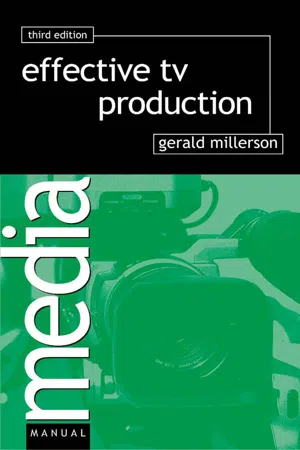
Effective TV Production gives a succinct but thorough overview of the production process. Whatever your role in television, this book outlines the main functions of your job, placing them in the context of all other operations and showing how they are interrelated.
The book shows how, within the often severe limitations of time and money, it is possible to originate interesting and competitive television programmes. It describes the essentials of good camerawork and relates them to considerations of audio, staging, lighting, make-up and wardrobe techniques and the way in which a production is developed in approach and style form the initial stages to the moment of shooting.
This edition is substantially revised to reflect developments in technology and contemporary production styles.
Gerald Millerson'd books on television have long been acknowledged as among the best ever published.
- 224 pages
- English
- ePUB (mobile friendly)
- Available on iOS & Android
eBook - ePub
Effective TV Production
About this book
Information
Contents
INTRODUCTION TO THE THIRD EDITION
TELEVISION TODAY
The scale of operations
Live or taped
TELEVISION PRODUCTION
Opportunities and limitations
Style
THE PRODUCTION TEAM
THE DIRECTOR’S ROLE
The director’s task
The director’s approach
TV CAMERA UNITS
Single camera units
Multi-camera units
A STUDIO TOUR
Studio features
TV cameras
Support areas
PRODUCTION CONTROL
Typical features
Control room layout
THE TV/VIDEO CAMERA
The camera head
Main features
The zoom lens system
Types of viewfinder
CAMERA CONTROLS
Camera adjustments
Camera movements
CAMERA FACILITIES
The camera lens
The viewfinder
Indicators
Audio
SUPPORTING THE CAMERA
Hand-held cameras
The pan head/panning head
The tripod
The pedestal
Crane arms
WHAT ARE ‘LENS ANGLES’?
Zoom ratio
Image size
Lens angle and perspective
WIDE-ANGLE LENS
Advantages
Disadvantages
NARROW-ANGLE LENS
Advantages
Disadvantages
Camera handling
Depth of field
USING THE ZOOM LENS
Zoom lens controls
Take care!
WHY ZOOM?
The effect of zooming
How the zoom lens can help
Dramatic zooms
DEFINING THE SHOT
Getting the shot
Changing the shot size
Terms
Camera height
CHOOSING THE SHOT
Why change the shot?
Viewing conditions
The picture’s purpose
Pictorial variations
CLOSE SHOTS
Cameraman’s ...
Table of contents
- Cover
- Half Title
- Title Page
- Copyright Page
- Table of Contents
- Introduction to the Third Edition
- Television Today
- Television Production
- The Production Team
- The Director’s Role
- TV Camera Units
- A Studio Tour
- Production Control
- The TV/Video Camera
- Camera Controls
- Camera Facilities
- Supporting the Camera
- What Are ‘Lens Angles’?
- Wide-Angle Lens
- Narrow-Angle Lens
- Using The Zoom Lens
- Why Zoom?
- Defining The Shot
- Choosing the Shot
- Close Shots
- Long Shots
- Moving The Camera
- Motivated Camera Movement
- Composing the Picture
- Clarifying the Shot
- The Production Switcher – Vision Mixer
- Choosing Picture Transitions
- Intercut Shots
- Choosing Microphones
- Audio Control
- Methods of Sound Pickup
- Practical Sound Pickup
- Practical Sound Problems
- Scenery
- The Aims of Lighting
- Lighting Problems
- The Aims of Makeup
- Clothes on TV
- The Need for Production Techniques
- Production Treatment
- Styles and Formats
- Basic Productional Methods
- Single-Camera Production
- Multi-Camera Production
- Changing Shot – Moving Performer
- Changing Shot – Camera and Switching
- Shooting the Moving Subject
- Production Formats
- Basic Production Styles
- Developing a TV Production
- Planning Visual Treatment
- Shot Development
- Pictorial Variety
- What Facilities Are Needed?
- Is Planning Really Necessary?
- Production Approaches
- Organizing Production Mechanics
- Plans And Elevations
- Developing the Staging Plan
- Planning Shots
- Scripting for Television
- Production Paperwork
- Pre-Studio Rehearsal
- Studio Rehearsals
- The Floor Manager
- Guiding the Crew
- Production Timing
- Visual Padding
- How to Direct Audience Attention
- Creating and Controlling Interest
- Influencing Audience Attitude
- Confusing or Frustrating Techniques
- Stretching the Facilities
- Economy Thinking
- Sound Ideas
- Unorthodox Treatment
- Continuity
- Using Titling
- Using Graphics
- Using Film
- Using Videotape
- Electronic Insertion
- Guiding the Talent
- Cuing
- Prompting
- The Commentary
- The Single Performer
- Interviews
- Talk Shows
- Newscasts
- The Illustrated Talk
- Demonstrations
- Music and Dance
- Quiz and Game Shows
- TV Drama
- The Studio Audience
- Reminders on Effective Directing
- A Check List of Common Errors
- Shooting on Location
- Color
- Appendix–Calculating Shots
- Further Reading
- Glossary
Trusted by 375,005 students
Access to over 1.5 million titles for a fair monthly price.
Study more efficiently using our study tools.
Frequently asked questions
Yes, you can cancel anytime from the Subscription tab in your account settings on the Perlego website. Your subscription will stay active until the end of your current billing period. Learn how to cancel your subscription
No, books cannot be downloaded as external files, such as PDFs, for use outside of Perlego. However, you can download books within the Perlego app for offline reading on mobile or tablet. Learn how to download books offline
We are an online textbook subscription service, where you can get access to an entire online library for less than the price of a single book per month. With over 1.5 million books across 990+ topics, we’ve got you covered! Learn about our mission
Look out for the read-aloud symbol on your next book to see if you can listen to it. The read-aloud tool reads text aloud for you, highlighting the text as it is being read. You can pause it, speed it up and slow it down. Learn more about Read Aloud
Yes! You can use the Perlego app on both iOS and Android devices to read anytime, anywhere — even offline. Perfect for commutes or when you’re on the go.
Please note we cannot support devices running on iOS 13 and Android 7 or earlier. Learn more about using the app
Please note we cannot support devices running on iOS 13 and Android 7 or earlier. Learn more about using the app
Yes, you can access Effective TV Production by Gerald Millerson in PDF and/or ePUB format, as well as other popular books in Media & Performing Arts & Film & Video. We have over 1.5 million books available in our catalogue for you to explore.