Though Foucault is now widely taught in universities, his writings are notoriously difficult. Reassessing Foucault critically examines the implications of his work for students and researchers in a wide range of areas in the social and human sciences.
Focusing on the social history of medicine, successive chapters deal with his historiographical, methodological and philosophical writings, his ideas about prisons, hospitals, madness and disease, and his thinking about the body.
The book also suggests ways in which Foucault's influence will continue to dominate cultural history and the social sciences.
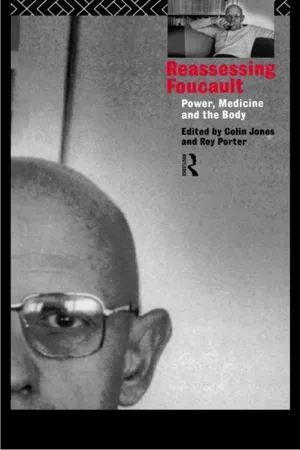
eBook - ePub
Reassessing Foucault
Power, Medicine and the Body
- 240 pages
- English
- ePUB (mobile friendly)
- Available on iOS & Android
eBook - ePub
About this book
1
INTRODUCTION
Colin Jones and Roy Porter
Has any intellectual been more influential since the 1970s than Michel Foucault? His vision and temper perfectly suited that moment in American and English intellectual affairs when the upsurge of liberationist optimism characteristic of the 1960s imploded under the weight of its own contradictions. The 1970s sank into a soberer recognition that walls did not come tumbling down at the first sound of the trumpet, whether the latter was played by Herbert Marcuse, R. D. Laing, Che Guevara or whoever. Foucault gave substance to the new realism (or pessimism) through his own brand of intellectual radicalism, whose challenge to existing political, institutional and cultural structures was grounded upon the most profound appreciation of their extraordinary tenacity.1
In all his mature writings, Foucault called into question the liberal vision of the autonomous individual, past or present, able by personal choice to make his or her own way in the world. He constantly pointed to the priority over the free, thinking individual, the Cartesian cogito, of what were widely called ‘structures’ of thought and practice2 – the ‘epistemes’ or overriding, holistic mental paradigms of The Order of Things, the ‘discourses’ of much of his later oeuvre.3 He mocked as shallow and self-serving all manner of Whig or progressive views that purported to show the rise in the West of that humane, emancipatory reason blueprinted by the Enlightenment and constructed by bourgeois liberalism. In a manner which seemed to carry echoes of Nietzsche, Weber and the Frankfurt School,4 Foucault argued – notably in Madness and Civilization (1967) and Discipline and Punish (1979) – that the rise of rationality should be read as the legitimizing of power rather than as a challenge to it. This collusion of knowledge and power (savoir/ pouvoir) created institutions, of disciplination – schools, prisons, reformatories, psychiatric facilities – which, though often promoted in the name of ‘improvement’, in reality consolidated administrative authority, bureaucratic regulation and what a quite different sociological tradition called ‘hegemonic social control’.5 Force was power no doubt; but whether in the Catholic confessional or the court of law, so was the inquisition of truth.
Somewhat comparable in its robust overturning of conventional judgements, Foucault’s History of Sexuality – originally planned as a six-volumed enterprise, though only three volumes appeared before the death of the author in 1985 – portrayed the development of sexology in the nineteenth century up to and including Freud not (as it liked to represent itself) as humankind’s delivery from sexual ignorance and regression, but as the forging of newly enveloping systems, with underpinning labels, identities and rules. From the eighteenth-century emergence of the Cameralist polity to the modern welfare or therapeutic state, the new technologies of control, Foucault seemed to be suggesting, could thus entail not less but more subjection, a more exhaustive, protracted and panoptic6 disciplining of the person. The mailed fist, the hangman’s noose, had given way to the velvet glove, operating in recent times through such ‘enlightened’ innovations as the juvenile officer, the psychiatric social worker, probation officer, parole worker and, more peripherally, the doctor, marriage guidance counsellor, psychotherapist and other voluntary agencies.7 It was clearly with good reason that Foucault cast a disenchanted eye over today’s pieties. Are the modern ‘caring professions’ really, as we sanctimoniously hope, less physically intrusive than their predecessors? ‘Pindown’, the system of retraining youths used in Staffordshire child-care centres until 1991, when it became the subject of public exposure, was shown to be as brutal as anything experienced in the Dickensian workhouse.8 Foucault thus drew attention to the shifting profiles of social power and resisted easy moral judgements upon them. In the administration of justice or the upholding of public order, a long-term curbing of brute force – or at least its discreet muffling – may have occurred; but has not this been accompanied, perhaps outweighed, by a creeping growth in subtler control mechanisms?
Aiming to write what he called ‘histories of the present’, Foucault undoubtedly created a sombre and largely persuasive vision of the expanding and tightening mesh of power. But was what he said about the past genuinely historical? Foucault could be as scathing about conventional history-writing as about some of his fellow philosophers. He chided the latter for slavish adherence to a limited canon – he himself ranged as an outsider on the margins of the philosophical enterprise, gave special attention to what he saw as ‘limiting’ cases, and immersed himself in the little-known works of little-known technical authors. (His oeuvre is, among other things, a tribute to the range of holdings of obscure printed works in the Bibliothèque Nationale.) He saw the conventional historical enterprise as riven with trifling and time-serving prejudice: academic historians wore particular blinkers; they assumed the status quo was somehow natural; they took for granted slow, fore-ordained, evolutionary change; and they aimed to plot ‘influences’. Where academic historians saw the interconnectedness of events in the past, Foucault by contrast depicted startling ‘ruptures’; where they charted change over time, he emphasized synchronic strands of continuity. His rejection of liberal humanism in fields – psychiatry, medicine, penal reform – traditionally dominated by bienpensant gradualism cost him dear amongst historians, as did his iconoclastic calls for the ‘death of [the category of] man’ and his demolition of the notion of the author. The conviction that class and class struggle were the motors of history – that creed of Left-Bank Marxists – Foucault dismissed as the opium of the intellectuals; Marxism itself needed to be understood as an expression of the nineteenth-century project to create an overarching ‘anthropology’ of that discursive subject, ‘man’. Foucault even devised a new terminology to distance himself, his critics have held, from routine academic enquiry: ‘history’ was to be rejected in favour of ‘genealogies’ or ‘archaeologies’.
Partly perhaps for these reasons, there has been a conspicuous distrust among many Anglo-American historians towards Foucault’s renderings of the past, as Randall McGowen in this volume suggests. ‘Indifference, scepticism and downright hostility’ is Felix Driver’s summing-up of the views of the Anglo- American academy. Foucault’s French confrères have been cautious, too, in according him his titres de noblesse as a historian, while the reception of his work in Germany, as Martin Dinges documents, has included a wide spectrum of hostile or uncomprehending views.9 Foucault has been widely accused of wilfully and provocatively turning his back on the events which compose the customary warp and woof of the past, and of extrapolating back from a priori theoretical positions, thus inventing a fantasy past, a reversed image of Whig history, characterized not by the ever onward and upward march of progress, but rather by the sad chronicle of ever more powerful control mechanisms. For some, his approach has faults widely assumed to be directly connected to the sin of being French: he is accused of playing fast and loose with the facts – and getting away with it, thanks to the deceitful opacity of his jargon! On occasions, it is suggested, Foucault seemed to espouse the post-structuralist position that texts and language, as it were, ‘wrote themselves’ and that, in some sense, all history was ‘scripted’ by, or inscribed within, discourse – a position held to bear at least superficial similarity to the Hegelian, idealist position that all history is the history of Geist (spirit).10 Thus, for example, in his account of the development of concepts of sexuality in the nineteenth century, while systematically denying the validity of the obsolete commonsensical language of agency, he contended that ‘we must not look for who has the power in the order of sexuality (men, adults, parents, doctors) and who is deprived of it (women, adolescents, children, patients); nor for who has the right to know and who is forced to remain ignorant’.11 Foucault’s seeming refusal to relate his analyses of knowledge/power to class, to gender, to professional interests and to the state – most blatantly exemplified in his aloof indifference to mere ‘events’ such as the French Revolution – have been seen by many as threatening to squander the most valuable conceptual gains made by social history over the last generation.
The exceptional range and thoroughness of his reading, and his immersion in topics which, before he wrote, most mainstream historians left to antiquarians and specialists, are sometimes forgotten in the rush to condemn him for the undoubted shakiness of some of the empirical foundations of his work.12 A number of scholars – most notably perhaps Erik Midelfort and Andrew Scull – have endeavoured to show that Madness and Civilization is beset by fundamental empirical flaws, or at least by hasty universalization from the exceptional case of France. Foucault was mistaken, Midelfort argues, to give prominence to such doubtful or fictitious entities as the ‘ship of fools’ or to construe the early modern madman as a symbolic successor to the medieval leper. Roy Porter has contended that, while the notion of a ‘great confinement’ as adduced by Foucault may make sense of the French way of handling the insane between the 1650s and the close of the eighteenth century, it is not helpful for describing what was happening at that time in other regions of Europe, including Britain, where state policy and interference in the affairs of the mad were less powerful and systematic. Colin Jones has further queried some of the uses to which the term ‘great confinement’ has been put by Foucault and his acolytes even in the French case.
Yet one may still acknowledge that Foucault has had an often highly beneficial impact on the study of the past without necessarily authorizing his exact interpretations or exhibiting wilful blindness to his empirical errors. Foucault’s analyses of the histories of madness, of the hospital (Birth of the Clinic), of criminal law and the penitentiary, (Discipline and Punish) have attracted enormous attention and respect. Historians have particularly appreciated Foucault for his rejection of the common supposition that the objects of history are somehow ‘given’ or ‘natural’. Foucault’s aim was to defamiliarize, to expose seemingly natural categories as constructs, articulated by words and discourse, and thus to underline the radical contingency of what superficially seems normal. Nothing in history could be taken for granted; all history was culturally fabricated; everything had therefore to be questioned. No one should approach Foucault in the expectation that his work contained, potentially at least, an interpretation, a solution, of every historical problem, or even a methodology or a tool-kit. He himself was sometimes disarmingly frank about his shortcomings as a historian. Nor must it be forgotten that his viewpoint shifted radically from The Order of Things, through The Archaeology of Knowledge to Discipline and Punish – indeed even between the first and second volumes of The History of Sexuality. His reputation does not rest on a set of holy texts. No tablets of granite inscribed with Foucauldian commandments are likely to be unearthed.
In a curious way, the gadfly brilliance and timeliness of his wideranging intelligence, which have radically challenged entrenched orthodoxies, provoked debate and shaped research agendas, recall the impact of the controversial writings of E. P. Thompson – a figure very far from Foucault in most respects, and indeed a heavy-handed critic of ‘theory’, but one similarly located on the margins of the academy and similarly excoriating of ‘professional’ pieties.13 Just as the enormous amount of research on English social history in the early modern period is inflected by Thompson’s writings, so most current work on the history of insanity and psychiatry, on jails, on the administration of poverty and the Poor Law, on schools of social welfare and rehabilitation and on the wider emergence of the ‘disciplines’ now has to grapple with the profound issues raised by Foucault. Indeed, research in all these fields which neglects his work does so at the risk of tumbling into unreflected antiquarianism. Foucault’s influence has in many cases been determinate in bringing these topics out of the byways of specialism into the mainstream of historical preoccupations. Those who spring to attack him have been quick to forget some of the dismal catalogue of ‘filiations’, ‘influences’ and ‘precursors’ which characterized much of the history of ideas at the time his earliest works appeared. A succession of fine scholarship has, moreover, substantially endorsed Foucauldian positions, as for instance Michael Ignatieff’s A Just Measure of Pain: The Penitentiary in the Industrial Revolution (1978), a study of the rise of the modern prison in England, and two studies of nineteenth-century French psychiatry, Robert Castel’s The Regulation of Madness ([1976] 1988) and, in a more modulated way, Jan Goldstein’s Console and Classify (1987).14
Despite much of the sound and fury accompanying the polemics, bridges can be – and indeed have been – built between the Foucauldian and the orthodox historical enterprises. That scope exists for lessening some of these gaps lay behind the organization in 1990 of a conference, under the auspices of the Society for the Social History of Medicine, on ‘Michel Foucault and the History of Medicine’, from which the present volume has sprung. At that conference it was apparent – as it is clear in this volume – that no consensus exists, or indeed is likely, because of the nature of the stakes at issue, to exist for...
Table of contents
- COVER PAGE
- TITLE PAGE
- COPYRIGHT PAGE
- CONTRIBUTORS
- ACKNOWLEDGEMENTS
- 1. INTRODUCTION
- 2. BODIES OF KNOWLEDGE/ KNOWLEDGE OF BODIES
- 3. ON ANTI-MEDICINE AND CLINICAL REASON
- 4. MEDICINE, HISTORY AND THE PRESENT
- 5. INVENTING MOUTHS: DISCIPLINARY POWER AND DENTISTRY
- 6. POWER AND HUMANITY, OR FOUCAULT AMONG THE HISTORIANS
- 7. BODIES IN SPACE: FOUCAULT’S ACCOUNT OF DISCIPLINARY POWER
- 8. APPLYING FOUCAULT: SOME PROBLEMS ENCOUNTERED IN THE APPLICATION OF FOUCAULT’S METHODS TO THE HISTORY OF MEDICINE IN PRISONS
- 9. FOUCAULT’S THEORY OF DISCOURSE AND HUMAN AGENCY
- 10. THE RECEPTION OF MICHEL FOUCAULT’S IDEAS ON SOCIAL DISCIPLINE, MENTAL ASYLUMS, HOSPITALS AND THE MEDICAL PROFESSION IN GERMAN HISTORIOGRAPHY
- BIBLIOGRAPHY
- SELECT BIBLIOGRAPHY
Trusted by 375,005 students
Access to over 1.5 million titles for a fair monthly price.
Study more efficiently using our study tools.
Frequently asked questions
Yes, you can cancel anytime from the Subscription tab in your account settings on the Perlego website. Your subscription will stay active until the end of your current billing period. Learn how to cancel your subscription
No, books cannot be downloaded as external files, such as PDFs, for use outside of Perlego. However, you can download books within the Perlego app for offline reading on mobile or tablet. Learn how to download books offline
Perlego offers two plans: Essential and Complete
- Essential is ideal for learners and professionals who enjoy exploring a wide range of subjects. Access the Essential Library with 800,000+ trusted titles and best-sellers across business, personal growth, and the humanities. Includes unlimited reading time and Standard Read Aloud voice.
- Complete: Perfect for advanced learners and researchers needing full, unrestricted access. Unlock 1.5M+ books across hundreds of subjects, including academic and specialized titles. The Complete Plan also includes advanced features like Premium Read Aloud and Research Assistant.
We are an online textbook subscription service, where you can get access to an entire online library for less than the price of a single book per month. With over 1.5 million books across 990+ topics, we’ve got you covered! Learn about our mission
Look out for the read-aloud symbol on your next book to see if you can listen to it. The read-aloud tool reads text aloud for you, highlighting the text as it is being read. You can pause it, speed it up and slow it down. Learn more about Read Aloud
Yes! You can use the Perlego app on both iOS and Android devices to read anytime, anywhere — even offline. Perfect for commutes or when you’re on the go.
Please note we cannot support devices running on iOS 13 and Android 7 or earlier. Learn more about using the app
Please note we cannot support devices running on iOS 13 and Android 7 or earlier. Learn more about using the app
Yes, you can access Reassessing Foucault by Colin Jones, Roy Porter, Colin Jones,Roy Porter in PDF and/or ePUB format, as well as other popular books in History & Historiography. We have over 1.5 million books available in our catalogue for you to explore.