- 224 pages
- English
- ePUB (mobile friendly)
- Available on iOS & Android
eBook - ePub
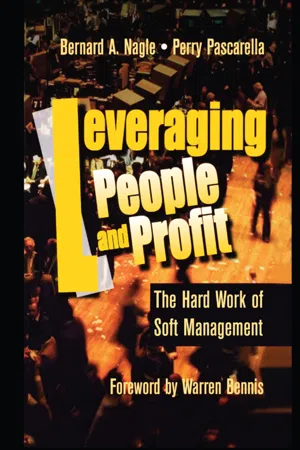
Leveraging People and Profit
About this book
The manager who can balance the people and profit factors has the best chance of succeeding in tomorrow's corporation. The "altrupreneur"_one who conducts the affairs of an enterprise with conspicuous regard for the welfare of others_builds communities that produce value for all the organization's stakeholders. This new breed of leader responds to the needs of the organization and the demands of people coming to the workplace and marketplace.
Drawing examples from top and middle management, the authors describe the characteristics of altrupreneurs and the core principles by which they operate: their values and vision, optimism, integrity, confidence, and enthusiasm. Altrupreneurial organizations create innovation-friendly environments, where it is not only safe to innovate, it is encouraged.
This book shows what it means to challenge the routine, be other-centered, and build community.
Bernard A. Nagle has over 22 years of executive operations experience in the fields of manufacturing, quality assurance, supply chain management, distribution, strategic planning, and new product development. A native of Pennsylvania, Mr. Nagle currently resides in the St. Louis area.
Perry Pascarella is a nationally recognized authority on humanistic management, worker motivation, and the role of business in society. Until 1996, he was vice president-editorial of Penton Publishing Inc., publisher of 42 business and professional magazines. Mr. Pascarella has collaborated with such celebrated management experts as Peter Drucker, Tom Peters, and Frederick Herzberg. He lives in the Cleveland area.
1
Healing the Wounds of Betrayal
This is an exciting place to work. All our employees are empowered to participate in decision-making. We rely on teamwork as we strive for excellence. We are eliminating your job.
… MESSAGE FROM TOP MANAGEMENT
Over the past decade, America’s executive core has repeatedly demonstrated recklessness in its stewardship of our business organizations. It engaged in rampant downsizing and acquisition-consolidation that destroyed the illusion, if not the reality, of mutual loyalty between company and employee. Even people-oriented companies laid off long-term veterans. At the same time, CEOs pumped up their already high compensation in painful contrast with declining employee pay. By 1995 they had moved their compensation to 141 times that of the average employee-an outrageous increase from the already high multiple of 42 in 1980 (Business Week, 100).
It is little wonder that millions of people think of management as selfish and heartless, squeezing out any humanity the corporate world may have once had. Although we should not condemn all managers for behaving this way, we, nevertheless, take the numbers as a measure of the extent to which management has become disconnected with its workforce. We can’t help asking ourselves: How can we pledge our loyalty to the corporation any longer?
Millions believe they have been betrayed not simply because of the salary disparities, or even the job reductions in themselves, but because these things came at the time when management was talking about the value of people-customers and employees-to the enterprise. Rather than tackling tough challenges in these fast-changing times, too many executives took the easy way out and looked for quick ways to improve short-term profitability. While they talked about quality, employee empowerment, and teamwork, they continued to operate in a top-down, short-term mode. They were bragging, “This is an exciting place to work; all our employees are empowered to participate in decision-making; we rely on teamwork as we strive for excellence, “ while they were telling employee after employee, “We are eliminating your job.” As a result, survivors felt as victimized as the people who lost their jobs because they saw the gap between the talk and the walk.
Loyalty: The Critical Resource
Although employees were being elevated in management literature and speeches, they were, in fact, being pushed aside. The resultant death of loyalty caused a critical fracture in many business organizations, leading many of us to suspect that our business organizations were far less effective than they could be. The negative impact of the loss of loyalty spills over from employees to all of us, because its loss robs our business organizations of the ability to deliver the value we expect from them. Poring over the financial records of many companies, Frederick Reichheld and his colleagues at Bain & Company, a Boston-based consulting firm, found some with amazingly high levels of cash flow These companies attained exceptional results by winning superior loyalty from their constituents, he concludes in his book The Loyalty Effect. He measures loyalty essentially by the rate of retention of customers, employees, and investors. If we take retention as the measure of success, or the first step in winning financial success, most informed observers would give American business a low score. But maybe not low enough! Reichheld’s numbers are startling: “On average, U.S. corporations now lose half their customers in five years, half their employees in four, and half their investors in less than one” (Reichheld, 1).
On average, U.S. corporations now lose half their customers in five years, half their employees in four, and half their investors in less than one.
… FREDERICK REICHHELD
This low level of loyalty reflects the frightening reality that business, in general, is not producing sufficient value for any of its constituents. Value creation and loyalty make up the heart of a business, Reichheld insists. Other management thinkers have pointed out the basic need for business to create value, but Reichheld goes on to explain how loyalty pays off: long-term customers buy more and are less expensive to serve; the company attracts and retains the best employees, who improve quality and productivity; and investors become partners.
Throughout the Quality Era many companies have emphasized serving the customer. That’s fine. Reichheld agrees that creation of value for the customer should drive the business. Yet, customer loyalty by itself will not sustain a business, he warns. Management’s role is to create a system that incorporates “customers, employees, and investors in a single constellation of common interest and mutual benefit” (Reichheld, 26). This tall order suggests that business needs either a lot of learning on the part of today’s management, or an influx of replacements possessing broader vision and an outward commitment to others.
Today, management feels that its most pressing concerns have to do with the shareholders or the stock market. Professional managers were born into an investor orientation when owners delegated responsibilities to them at the turn of the century, but today they have resorted to short-term tactics like never before. It’s supremely ironic, therefore, that investors’ loyalty has fallen sharply in the last three decades, and that they have the highest defection rate of any business constituent.
Established customers exert tremendous leverage on revenues and profits compared with those who stay for only a short time. Their loyalty brings many fruits: customer acquisition costs can be reduced; they tend to spend more and more over time; serving them costs less than serving customers not familiar with the organization, its products, and methods; they do not have to be offered trial discounts; and they are likely to recommend the company to others (Reichheld, 42-50).
Winning customer loyalty is impossible without loyal employees to do the winning. There are not only ethical or feel-good reasons for earning employee loyalty but hard dollars-and-cents reasons. Across a range of industries, Bain & Company has found seven areas in which a company can reap economic benefits from employee loyalty: recruiting investment, training, efficiency, customer selection, customer retention, customer referral, and employee referral.
You would think, then, that top management would make employee loyalty a top priority. Yet, “many chief executives don’t inspire loyalty in those who work for them because they are impatient, impulsive, manipulative, dominating, self-important and critical of others, “ according to a study by the Hagberg Consulting Group. The study shows that the number of chief executives who are loners has increased to about 70% from 50% five years ago (Cleveland Plain Dealer, CI).
Many chief executives don’t inspire loyalty in those who work for them because they are impatient, impulsive, manipulative, dominating, self-important and critical of others.
… HAGBERG CONSULTING GROUP
Easy Way Out
Over the past two decades we have seen a proliferation of buzzwords and new management techniques flooding the marketplace. Most of them would give the impression that management is finally on the track to properly valuing the human factor. From every quarter have come consultants racing to develop the next generation of miracle cures for communicating, team-building, improving quality and so on. Corporate America has been engaging in one of its favorite pastimes-fad surfing, as described with wonderful humor by Eileen C. Shapiro in her book Fad Surfing Corporate Boardroom. Her purpose for writing the book was not to select good techniques and distinguish them from fads but to “buck the trend toward panacea thinking and to take responsibility for the hard work of using the available tools to craft solutions tailored to a company’s unique context and needs” (Shapiro, xvii).
Management bought the tools for quality and productivity improvement, but they didn’t buy what was usually the most essential ingredient: a change of culture toward truly valuing people-toward other-centeredness. In fact, they weren’t even shopping for it! They didn’t get involved in “the hard work” of dealing with the “soft” human factors.
Without the proper philosophical base, they were doomed to poor results, if not outright failure, in their efforts. In the ‘80s, Perry, an early supporter of the Quality Circle movement, warned management: “Lack of trust in the company and management’s lack of respect for its workers are common reasons why many companies aren’t suited to the QC approach. QCs are not something you do to your workers, or even for them, but something you do to yourself (Pascarella, 50). But changes in management’s mindset (despite consultants offering programs even on that) didn’t occur often.
Predictably, by the early ‘90s, the most widely read business publications began to question whether this “employee involvement thing” was really going to work. Examples of large-scale failures in the workplace were autopsied as an overwhelming percentage of companies embarking on this journey were turning back in frustration after only two or three years.
Perhaps no management technique or concept was more badly abused than reengineering, a concept that surfaced in the late ‘80s. Michael Hammer and James Champy, who popularized the concept in their 1993 book Reengineering the Corporation, wrote: “At the heart of business reengineering lies the notion of discontinuous thinking” (Hammer and Champy 3). But that sort of thinking does not come naturally to most managers. They tend to look for proven prescriptions and processes in order to minimize risk. Once again, management bought the trappings and missed the message. Rather than restructuring the companies’ processes so that people could work more creatively and effectively they concentrated all too often on simply removing people. They skipped the people-related portions of the book, such as:
Companies are not asset portfolios, but people working together to invent, make, sell, and provide service.
Reengineering is not restructuring or downsizing. These are fancy terms for reducing capacity to meet current, lower demand…. [D]ownsizing and restructuring only mean doing less with less. Reengineering, by contrast, means doing more with less.
Not surprisingly, as companies cut employment ranks rather than reorganizing the way people worked, many of them failed to get improvements in performance. Although Hammer claims in a more recent book that reengineering and Total Quality Management (TQM) were “different pews in the church of process improvement” (Hammer, 82), they have critical differences in how much the congregation is or is not involved. Reengineering’s top-down approach to radically restructuring a company’s processes better fit the prevailing management mindset; the steady, everybody-involved TQM approach required more patience and concern for the people involved in the processes. Thus, the greatest betrayal of all had its bible.
Reengineering and Beyond
Many peddlers of reengineering contributed to management’s misuse of the concept, but even Hammer takes some of the blame. He says that he and others in the $4.7 billion reengineering industry forgot about people: “I was reflecting my engineering background and was insufficiently appreciative of the human dimension. I’ve learned that’s critical” (Wall Street Journal, 1). Champy likewise, has changed his emphasis: “There’s a need to figure out how to change culture and behavior more quickly” he says; therefore, he uses “business transformation” as the name for his new blend of reengineering, strategy, and culture change (Wall Street Journal, 1).
The reengineering “industry” offered a worthwhile contribution to management know-how by calling attention to the importance of rethinking the company and rethinking the processes involved in meeting customers’ needs. But management needs to go a step farther than that. It has to learn to deal with both process and people. You can’t do anything constructive about processes if you don’t understand the people relationships that drive those processes. Any corporate process, after all, is totally a creation of people. People-to-people relationships determine what processes a company has and how well they are performed. A process may be shaped in response to the customer. Or it may be shaped according to what someone in management simply wants it to be. Or it may be shaped by the workers who have inherited it and have to maintain it. When properly structured-or restructured-it serves all stakeholders.
A process may look like one thing when you map it out on paper, but something else if you were able to determine precisely who really does what. So, when you mess with processes, you had better understand what individuals are doing, what they can do, what they want to do, and how they interact with one another. The relationships (or the culture) determine what processes a company employs, how well they are performed, and in what ways those processes can be changed.
In recent years, business has learned how to optimize its physical and technological assets and has leveled the playing field in those areas. The truly successful organizations in the next century will be those that learn how to engage and energize the creativity and enthusiasm of their human assets. This is the next frontier in competitive advantage. Managers are learning that anyone can copy their investments in hard assets and technology. In fact, there’s always likely to be someone out there who can outspend you on those things. What makes your company unique is your people. When they are empowered, their innovation, creativity, and enthusiasm can’t be copied; and, if that uniqueness is directed to creating processes, products, and services that are better than your competitors’, you have an unbeatable advantage.
The truly successful organizations in the next century will be those that learn how to engage and energize the creativity and enthusiasm of their human assets.This is the next frontier in competitive advantage.
… BERNIE NAGLE, STRATEGIC LEADERSHIP SEMINAR
Annette Cramer, Director of Human Resources at Zytec when it won the Baldrige Award, says: “When I ask myself why TQM works at Zytec, methods are not the key part of the answer. The processes we use are available to everyone in the public sector through Dr. Deming’s teachings, TQM, and other continuous improvement methodologies. What is different at Zytec is that those tools have fallen on fertile ground. Our people share unconditional trust and respect for one another, and we try to encourage people to operate as whole human beings. These attributes drive out fear, break down barriers, empower people, and allow us to celebrate each other’s pride in our ...
Table of contents
- Cover
- Halftitle
- Title
- Copyright
- Contents
- Foreword by Warren Bennis
- Preface
- Acknowledgments
- 1. Healing the Wounds of Betrayal
- 2. Why Now?
- 3. Inside the Altmpreneur
- 4. The Altrupreneurial Paradox
- 5. The Pains of Conversion
- 6. Throwing Out the Managerial Models
- 7. Traits of Altrupreneurial Organizations
- 8. Creating a Mindset for Change
- 9. Clearing the Functional Minefields
- 10. Building Community from Complexity
- Afterword
- Bibliography
- Index
Trusted by 375,005 students
Access to over 1.5 million titles for a fair monthly price.
Study more efficiently using our study tools.
Frequently asked questions
Yes, you can cancel anytime from the Subscription tab in your account settings on the Perlego website. Your subscription will stay active until the end of your current billing period. Learn how to cancel your subscription
No, books cannot be downloaded as external files, such as PDFs, for use outside of Perlego. However, you can download books within the Perlego app for offline reading on mobile or tablet. Learn how to download books offline
Perlego offers two plans: Essential and Complete
- Essential is ideal for learners and professionals who enjoy exploring a wide range of subjects. Access the Essential Library with 800,000+ trusted titles and best-sellers across business, personal growth, and the humanities. Includes unlimited reading time and Standard Read Aloud voice.
- Complete: Perfect for advanced learners and researchers needing full, unrestricted access. Unlock 1.5M+ books across hundreds of subjects, including academic and specialized titles. The Complete Plan also includes advanced features like Premium Read Aloud and Research Assistant.
We are an online textbook subscription service, where you can get access to an entire online library for less than the price of a single book per month. With over 1.5 million books across 990+ topics, we’ve got you covered! Learn about our mission
Look out for the read-aloud symbol on your next book to see if you can listen to it. The read-aloud tool reads text aloud for you, highlighting the text as it is being read. You can pause it, speed it up and slow it down. Learn more about Read Aloud
Yes! You can use the Perlego app on both iOS and Android devices to read anytime, anywhere — even offline. Perfect for commutes or when you’re on the go.
Please note we cannot support devices running on iOS 13 and Android 7 or earlier. Learn more about using the app
Please note we cannot support devices running on iOS 13 and Android 7 or earlier. Learn more about using the app
Yes, you can access Leveraging People and Profit by Bernard Nagle,Perry Pascarella,Warren G Bennis in PDF and/or ePUB format, as well as other popular books in Business & Business General. We have over 1.5 million books available in our catalogue for you to explore.