- 199 pages
- English
- ePUB (mobile friendly)
- Available on iOS & Android
eBook - ePub
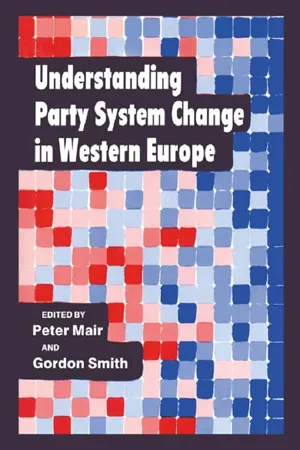
Understanding Party System Change in Western Europe
About this book
Published in the year 1990, Understanding Party System Change in Western Europe is a valuable contribution to the field of Politics.
Information
Dimensions of Party System Change:
The Case of Austria
K.R. Luther
For much of the post-war period, the Austrian party system was widely regarded as highly stable. In the literature describing that system up to the late 1970s,1 six elements figure prominently and may be considered to have constituted its‘core’ features.2 The first is the existence of two more-or-less encapsulated political subcultures, or‘Lager’,3 each allied to one of Austria's major political parties: the Sozialistische Partei Österreichs (SPÖ) and the Österreichische Volkspartei (ÖVP) and used by them to maintain their political power, especially vis-à-vis the parliamentary party lacking such extensive networks, namely, the Freiheitliche Partei Österreichs (FPÖ).4 Thus the high degree of political organisation of the SPÖ and ÖVP5 was largely predicated upon the Lager, with their wide range of auxiliary associations. Prominent among the means used by the parties to retain the support of their Lager, and thus their political duopoly, were group patronage and patronage of individual Lager members.6 The second and concomitant core characteristic of the Austrian party system was a persistently high degree of two-party domination of the vote. Between 1945 and 1979, the mean combined share of the ÖVP and SPÖ vote at National Council elections was 90.2 per cent (see Tables 1 and 2).
Third, the Austrian party system therefore predictably exhibited a high degree of parliamentary concentration. With the exception of the 1949 to 1959 period, there were until 1983 only three parliamentary parties. Moreover, two-party control of National Council seats rose from 87 per cent in 1949 to 96 per cent in 1970, and though there was then a slight decline as a result of the introduction of a more equitable electoral system, in 1983 the two major parties still controlled 93 per cent of National Council seats and 100 per cent of those in the Federal Council.7 Fourth, from 1947 to 1983, the SPÖ and ÖVP exercised a duopolistic control over the federal government, often in the form of a grand coalition. Indeed, the accommodative policy-style of the two major parties was the fifth characteristic of the Austrian party system. This accommodation was partly a consequence of a shared commitment to Austrian national unity in face of Austria's inter-war divisions, as well as of a policy consensus which came to be known as‘Austro-Keynsianism’. However, it was also not unrelated to the political stalemate faithfully recreated by the electoral system, which meant that with the exception of 1945–49, it was not until 1966 that one party was able to achieve an absolute majority of parliamentary seats (see Table 1). A sixth and final important characteristic of the Austrian party system was the relative insignificance, in policy-making terms, of the Austrian Parliament, as compared to the corporate channel, the decisions of which it largely rubber-stamped.8
Table 1
NATIONAL COUNCIL ELECTIONS 1945–86: VOTES AND SEATS1
NATIONAL COUNCIL ELECTIONS 1945–86: VOTES AND SEATS1

Recent publications on the Austrian party system9 have identified changes in many of these six features. The main aim of the present account is not merely to indicate the nature and extent of the major changes that have occurred but to advance a model for their discussion in a systematic manner so as to identify and explain party system change.
THE DIMENSIONS OF PARTY SYSTEMS
Before one can understand the extent and dynamics of party system change and resilience, it is necessary to identify the constituent elements, or dimensions of operation, of party systems. Thereafter, one can examine interaction within and between those dimensions, in the hope of reaching a better understanding of change and of which factors cause or hinder change. In short, it is necessary to develop a broad model of party system interaction. Central to such a model would be three major dimensions of party systems.
Table 2
CONCENTRATION OF THE VOTE IN THE ELECTORAL ARENAS AT FEDERAL AND LAND LEVEL FROM 1945–87. (Combined Vote of the ÖVP and the SPÖ)
CONCENTRATION OF THE VOTE IN THE ELECTORAL ARENAS AT FEDERAL AND LAND LEVEL FROM 1945–87. (Combined Vote of the ÖVP and the SPÖ)

Source: As Table 1.
A first and obvious constituent feature of party systems are one or more parties or actors. Their role will be influenced by a number of aspects more or less exogenous to the party system, including elements of the institutional structure within which it operates, as well as the attitudinal environment of the relevant political system. Changes in either of these parameters can affect parties' interaction. However, parties should not be seen as mere expressions of their institutional or attitudinal environment. Both the role within a party system of individual parties and the degree of change and resilience of the party system as a whole can be significantly influenced by the nature of the parties themselves and, in particular, by the extent to which parties respond to, or initiate change. Party change and party system change are thus inextricably linked.
Among the factors that affect parties' competitive capacity are their internal organisation and structure; their goals and ideology, their voter-party linkages and their political style or strategy. These factors will influence the extent to which a party's approach to its interaction with other parties is conflictual or accommodative, as well the nature of its priorities as between the various arenas and levels of the party system. They could therefore well help explain party system change and resilience.
A second dimension of party systems are the arenas in which parties interact. Though all party systems will have some arenas of party interaction in common, the variety and significance of the arenas are likely to differ between political systems. In Austria, political parties are particularly ubiquitous, but the politically most significant arenas in which they interact are fivefold:
i. the electoral arena (which is of course not limited merely to election campaigning);
ii. the parliamentary arena;
iii. the governmental arena;
iv. the corporate arena;
v. the bureaucratic arena.
A full understanding of the operation of the party system in these arenas would require reference to the rules of interaction within the latter, the number and relative size of the actors represented, their strategies for maximising their political influence, the competitiveness of their interaction and the values and goals they pursue. It is also important to examine the relative political salience of these arenas.
Third, the arenas and actors operate at a number of different levels of the political system. In federal systems such as Austria, the interaction of the actors in the above-mentioned five arenas will occur at:
i the federal (i.e. national) level;
ii the regional (i.e. Land or state) level;
iii and at the local (i.e. communal) level.10
The study of party systems has tended to focus almost exclusively upon the national level. While this is understandable in view of the greater pay-offs of the public offices and policies for which parties compete at the national level, the other levels should not be ignored. They can be significant both in terms of their potential impact upon the national party system (for example, by virtue of the (in)congruity of coalitions at different levels), and because of the significance of local offices and local policies to the various parties' activists and clients.
Although the above model seeks to present party systems in a simplified manner, they remain complex phenomena. Thus a comprehensive study of change and continuity in the Austrian party system at just the national and Land levels would involve a total of 50 arenas, in each of which between two and four significant actors operate. Such a study would need to examine not merely the interaction within these 50 arenas, but also the actions of the parties that‘straddle’ them, as well as the interrelationship between all these dimensions. It would have to include a consideration of at least three factors: first, change in the structure and interaction of the party system in different arenas and levels; second, change in the extent of symmetry between the party systems of two or more arenas or levels; third, change in the role of actors in one or more of the arenas at one or more levels.
Fortunately, it is not necessary to take on such a massive task, since our purpose is not to give an exhaustive account of party system change in Austria, but to consider whether adopting the framework outlined above enhances our understanding of party system change. In short, the purpose of the following material is merely to present an illustrative application of the above model for the analysis of party system change.
Most analyses of the Austrian party system have, for understandable and legitimate reasons, focused upon one or other of the two major actors in one or two of the arenas at the federal level. However, this has led to differences in the nature of party interaction at other levels and in other arenas being overlooked. The literature has also failed to give adequate coverage to the minor actors in the Austrian political system, though it has become increasingly apparent during the 1980s that their role constitutes one of the most significant elements of change in the Austrian party system. Accordingly, the following section concentrates upon a comparison of the structure and operation of the Austrian party system in the electoral, parliamentary and governmental arenas at federal and Land levels. We will then outline the role, in a range of dimensions, not of one of the major parties, but of a smaller actor, the FPÖ.
PARTY-SYSTEM CHANGE AND RESILIENCE IN SELECTED FEDERAL AND LAND ARENAS
1. The electoral arenas
Table 2 shows that after the Austrian party system settled down in 1956, it exhibited high and sustained degrees of concentration in its various electoral arenas. The overall picture at the federal level was of an average concentration of the vote between the two major parties of approximately 89 per cent from 1956 to 1962, rising during the period from 1966 to 1979 to an average of about 93 per cent. In most Länder, concentrations have been higher (up to 97 per cent), with Lower Austria and Burgenland regularly recording the highest levels. Meanwhile, the lowest have been in Vorarlberg (75.6 per cent), where the degree of concentration has fluctuated somewhat. During the 1980s, the trend at the federal level has been for a marked reduction in the two major parties' share of the vote, to a figure of 84.4 per cent in 1986. Though there has been little or no reduction in electoral concentration in some of the Länder, (e.g. Salzburg, Vienna and Lower Austria), in others such as Burgenland, Carinthia, Upper Austria, Styria and Tyrol, there has in many cases been a reduction analogous to that at the federal level, albeit often from a higher absolute level.
Such reductions in the major parties' domination of the electoral arenas has been the subject of much comment in the recent literature on Austrian politics, where it has largely been explained as being a consequence of attitudinal change in the electorate, with a substantial and continuing decline in partisan attachment and in the capacity of socio-structural variables to predict party choice.11 Seen from a different perspective, this means that the Lager are proving less effective vehicles for the retention and mobilisation of partisan support. This is caused not by significant changes in the major parties' strategies for maximising electoral support, where individual and collective patronage remain two of the central planks, but by a decline in output affect and by a significant change in the extent to which the excesses associated with these practices (above all the corruption and high-handidness of the political class) continue to be acceptable to the electorate. In short, the very mechanisms which previously helped to guarantee the resilience of the major parties in the electoral arenas are now increasingly working to their disadvantage. The obverse of this coin is that the minor parties' strategies in the electoral arenas are increasingly successful, as will be discussed below with reference to the FPÖ.
The two major parties' combined share of the vote is of course only one measure of concentration in the electoral arena. A rather different picture emerges when one examines whether any of the electoral arenas have experienced one-party dominance. The relevant statistics are contained in Table 3, which shows the vote of the largest party at all Second Republic elections at federal and Land levels. The table demonstrates that at the federal level, no one party ever succeeded in gaining an absolute majority of the vote until 1971, but that the SPÖ then managed that feat three times in succession. Since 1983, however, there has been a return to the position typical of the federal level electoral arena during most of the Second Republic: that is, no single party with an outright majority of votes.
However, the picture is often very different at the Land level, the electoral arenas of which have been of two kinds. First, there have been a number of Länder with high and continuous one-party electoral dominance. Thus Tyrol and Vorarlberg have always supplied absolute electoral majorities for the ÖVP, which has enjoyed electoral support of up to 70 per cent. With the exception of its 49.6 per cent showing in 1979, the ÖVP has also consistently had absolute majorities in Lower Austria. Conversely, majorities of 55–60 per cent for the SPÖ are the norm for ‘red’ Vienna. In the second category of Land level electoral arenas, there has been a predominant party, albeit one which has not always had an absolute majority of votes. These include the SPÖ stronghold of Carinthia and the ÖVP bastions of Upper Austria, Styria and Salzburg. That leaves Burgenland as the sole example of alternation in the dominant party at the Land level. Up to 1953, the OVP had an absolute majority of votes. From 1953 to 1964 it still attracted a relative majority of votes, but since then, the role of dominant party has been exercised by the SPÖ, which achieved absolute majorities of the vote from 1968 to 1987.
Table 3
ELECTORAL STRENGTH OF THE ST...
ELECTORAL STRENGTH OF THE ST...
Table of contents
- Cover
- Full Title
- Copyright
- Contents
- Notes on the Contributors
- Introduction: How are West European Party Systems Changing?
- Dimensions of Party System Change: The Case of Austria
- Patterns of Participation and Competition in Belgium
- Denmark: The Oscillating Party System
- Stages and Dynamics in the Evolution of the French Party System
- Party Strategies and System Change in the Netherlands
- Party System Change in West Germany: Land-Federal Linkages
- Party Strategy and Centre Domination in Italy
- Ireland: From Predominance to Moderate Pluralism, and Back Again?
- Norway: Levels of Party Competition and System Change
- Core Persistence: System Change and the ‘People's Party’
- Continuity, Change and the Vulnerability of Party
- Abstracts
Trusted by 375,005 students
Access to over 1.5 million titles for a fair monthly price.
Study more efficiently using our study tools.
Frequently asked questions
Yes, you can cancel anytime from the Subscription tab in your account settings on the Perlego website. Your subscription will stay active until the end of your current billing period. Learn how to cancel your subscription
No, books cannot be downloaded as external files, such as PDFs, for use outside of Perlego. However, you can download books within the Perlego app for offline reading on mobile or tablet. Learn how to download books offline
Perlego offers two plans: Essential and Complete
- Essential is ideal for learners and professionals who enjoy exploring a wide range of subjects. Access the Essential Library with 800,000+ trusted titles and best-sellers across business, personal growth, and the humanities. Includes unlimited reading time and Standard Read Aloud voice.
- Complete: Perfect for advanced learners and researchers needing full, unrestricted access. Unlock 1.5M+ books across hundreds of subjects, including academic and specialized titles. The Complete Plan also includes advanced features like Premium Read Aloud and Research Assistant.
We are an online textbook subscription service, where you can get access to an entire online library for less than the price of a single book per month. With over 1.5 million books across 990+ topics, we’ve got you covered! Learn about our mission
Look out for the read-aloud symbol on your next book to see if you can listen to it. The read-aloud tool reads text aloud for you, highlighting the text as it is being read. You can pause it, speed it up and slow it down. Learn more about Read Aloud
Yes! You can use the Perlego app on both iOS and Android devices to read anytime, anywhere — even offline. Perfect for commutes or when you’re on the go.
Please note we cannot support devices running on iOS 13 and Android 7 or earlier. Learn more about using the app
Please note we cannot support devices running on iOS 13 and Android 7 or earlier. Learn more about using the app
Yes, you can access Understanding Party System Change in Western Europe by Peter Mair,Gordon Smith in PDF and/or ePUB format, as well as other popular books in Politics & International Relations & Comparative Politics. We have over 1.5 million books available in our catalogue for you to explore.