- 304 pages
- English
- ePUB (mobile friendly)
- Available on iOS & Android
eBook - ePub
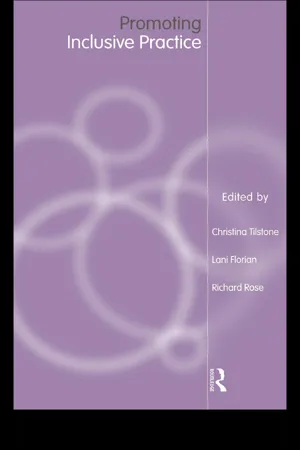
Promoting Inclusive Practice
About this book
Current policy demands that mainstream schools seek to include pupils with special educational needs. This book takes a close look at how exactly this aim can be achieved by examining the various parts of the educational process. The book discusses:
the practicalities of inclusive education
the gap between inclusive policy and practice
a re-configured role for special schools
how the process of inclusion will develop beyond the classroom.
Individuals who have learning difficulties are increasingly finding their place in non-specialist schools. This book considers the ways in which society can continue to support the process of inclusion as full-time education leads on to employment and independent living. The text reflects current developments in thinking and practice, and brings together a broad range of expertise and experience - it brims with enthusiasm for a positive approach that leads on to practical success.
Information
Chapter 1
Pragmatism not dogmatism
Promoting more inclusive practice
Lani Florian, Richard Rose and Christina Tilstone
Few areas of education have undergone the kind of development that has characterised special education over the past twenty-five years. The recent movement for the full inclusion of all pupils in mainstream schools is but one example of development where philosophical thought outpaces practice. Over the past ten years, a philosophy of inclusion and its associated meanings has been gaining momentum in many parts of the world (UNESCO, 1996). Although there are those who might argue that a book written by special educators cannot be about inclusion because the vocabulary, and indeed the nature of the profession, is focused on difference (see Florian, 1998), we take a more pragmatic view. It is the emphasis on difference that precludes some children from attending mainstream schools and perpetuates the continuation of a separate segregated system of special education. However, to suggest that the elimination of a separate system of provision will necessitate the development of a more responsive mainstream system is to forget that special schools were created to cater for pupils unable to be accommodated in mainstream schools. The complex social and historical reasons for this have received much attention in the literature (see e.g. Barton, 1988; Cole, 1989; Lazerson, 1983; Skrtic, 1991; Tomlinson, 1982). We believe that special educators, meaning those with expertise about the education of pupils who experience difficulty in learning at school, are important players in promoting more inclusive practice. That the term inclusion has found its way into several important international policy documents creates an unprecedented opportunity for improvement in the lives of people with disabilities. Though it has sparked as much debate as consensus, the notion of inclusive education has served to focus the field of special education on issues of quality and outcomes as never before. This book is about moving forward from where we are. It explores some of the theoretical and practical problems associated with inclusive education. The context for much of the discussion is the United Kingdom. However, many of the topics have wide applicability and relevance to the situation in other countries.
Since the Warnock Report in 1978, it has been assumed in the UK that about 20 per cent of school-aged children will have special educational needs requiring additional help at some point in their school careers. Furthermore, approximately 2 per cent of children will have severe physical, sensory, intellectual or emotional difficulties, some of which will remain with them throughout their lives. Historically this 2 per cent of children have been excluded from mainstream schools, receiving their education in special schools instead. In recent years, a growing sense of injustice regarding the idea of segregated special schooling for these pupils has led to calls for more inclusive educational opportunities as a matter of human right and equal opportunity. To date, efforts to decrease the number of pupils with special educational needs excluded from mainstream schools have taken two distinct routes. One is characterised by the attempt to integrate children from special schools into mainstream schools and classes through a range of provision whereby pupils with special educational needs spend part of the school day with peers of roughly the same chronological age (i.e. Beveridge, 1996; Lewis, 1995). The second and more recent approach currently under investigation has focused on improving the capacity of mainstream schools to accommodate diversity amongst their pupils (i.e. Booth et al., 1997; Hopkins et al., 1996).
At the same time, there has been increasing rhetoric about the immorality of segregated provision. Ideas about more inclusive schooling are appearing in education policies in many parts of the world. In the UK, they are central to the government’s education policies and have been incorporated into the recent education consultation documents of the new Labour government. One of these policy documents, Excellence in Schools states: ‘Where children do have special educational needs there are strong educational, social and moral grounds for their education in mainstream schools’ (DfEE, 1997a, p.34). The other, Excellence for All Children (DfEE, 1997b), endorses the 1994 UNESCO Salamanca World Statement on Special Needs Education which calls for the inclusion of pupils with special educational needs in mainstream schools. In addition, both papers call for stronger links between special and mainstream schools. The appearance of this type of rhetoric in government policy documents has put pressure on special education professionals to undertake a critical examination of the methods and means by which they work. Many have come to believe, indeed many have always believed, philosophically, in the right of children with special educational needs to the same educational opportunity as that available to other children. This opportunity has included access to mainstream schools and to the curriculum offered by those schools. What has not been so easy to agree are the terms of this access. The problem is not so much with the idea, as with uncertainty about the practice.
Uncertainty about practice stems from the conflict which arises when policies clash. Special education policy has been based on a deficit model of individualisation which regards people with disabilities as inherently flawed, and therefore requiring specialised instruction to meet individual need. Inclusive education is based on a social model which recognises the value of people with disabilities and the positive contributions they make to society. However, it is needs-led provision which characterises special needs legislation as well as other policies such as the Code of Practice (DfEE, 1994). In a review of major legislation affecting pupils with special educational needs, Lindsay (1997) noted that ‘there is a clear sense of commitment to children with SEN. This is not simply a welfare-caring approach, but rather one that has gradually extended their legal rights’ (p.25).
In the USA, Lipsky and Gartner (1997) have compared the movement towards more inclusive education for children with disabilities with the process of racial desegregation. Although pupils with disabilities are members of a minority group, the extent to which their oppression by the dominant culture can be redressed by models of racial equality has been questioned by advocates who wonder about the extent to which policies aimed at protecting individual rights against discrimination based on skin colour can promote true inclusion of people with disabilities (Zola, 1989). People with disabilities and members of racial minority groups are not directly comparable, even though both groups have been discriminated against in society. To be excluded from the educational mainstream because of the colour of one’s skin is very different than to be excluded because the mainstream curriculum is irrelevant to one’s needs. Full inclusion of all pupils with learning difficulties requires changes to the curriculum and the manner in which it is delivered. Consistent with this view, Hart (1996) has argued that the Code of Practice with its emphasis on documentation and stages of assessment may have inhibited inclusive practice. Full inclusion will not be achieved until education reform policies stop treating selected children as members of any minority group. The need is for flexible reform policies which are inclusive of all.
This book is about promoting inclusive practice. It takes the reality of daily life of school-aged children with learning difficulties as its starting point. In doing so, it takes a broad view of inclusion, emphasising that the ways in which we approach pupils, the perspectives we adopt and the efforts we make to provide for them the opportunity for an ordinary life are critical factors in implementing policies of inclusion. To explore these factors we have invited regional tutors on The University of Birmingham’s distance education course for teachers of children with learning difficulties to write about ways in which inclusive practice can be promoted. The tutors have recent practical experience and a wide knowledge of current developments and research in their specialist fields of study. They work or have worked in mainstream and special schools, and as educational psychologists, LEA advisers, school inspectors and university lecturers. All of them are committed to the idea that people with learning difficulties are entitled to the same chance for a good life as anyone else.
The number of pupils with severe learning difficulties who are already included in mainstream schools is not known as school records in the UK do not tend to identify pupils by disability category. However, close to 90,000 pupils (1.4 per cent of all 5–15 year olds) are enrolled in English special schools (Norwich, 1997) suggesting that many of the resources and much of the expertise currently available are not in mainstream schools. There is much work that needs to be done before the reconfigured role for special schools (as community special schools which support their mainstream counterparts) envisaged in government policy becomes reality. Part III offers the ideas of several special school heads about how to move practice forward. Some of these ideas are untested, others are currently under review (i.e. Sebba and Sachdev, 1997). Ainscow (1997) has suggested that the instructional methods developed in special schools may not transfer to inclusive settings. We are aware of Slee’s (1996) warning that recommendations for inclusive practice should avoid becoming ‘a misleading veneer for old special educational practices’ (p.29). Whilst it is easy to criticise the obstacles to inclusion which exist through the maintenance of a segregated system of special schools, we recognise that many contributions have been made to the education of pupils excluded from mainstream schools by the professionals working in them. Much of the innovative teaching practice which has influenced the raising of standards and expectation with regards to pupils with learning difficulties has its origins in special schools. The most well-documented British example can be found in the work which has assured access to the National Curriculum for pupils with severe learning difficulties (e.g. Carpenter et al., 1996; Sebba et al., 1993; Tilstone, 1991).
Research studies on inclusive education tend to be non-categorical, making it difficult to differentiate what works for whom, when and how. Part I looks at processes within mainstream schools from a school improvement perspective. The school improvement perspective on inclusion focuses on expanding a school’s capacity to respond to all its pupils. However, successful inclusion also requires that teachers’ views about pupils who experience difficulty are consistent with an expectation of learning and achievement. Attitudes are difficult to change, yet our experience suggests that when schools recognise that pupils respond positively to being involved in decision-making processes, increased participation in many aspects of learning is possible. Pupils need to feel wanted and respected in the classroom, and the marginalisation of pupils on the grounds that they are in some way different is a major obstacle to changing the current educational climate. Teachers who are prepared to accept that each child is an individual, and will therefore have specific needs at various times, are already making a contribution in the move towards more inclusive classrooms. By so doing they communicate to pupils that they respect them as individuals, understand that their learning needs are specific to them, and that together they should strive to gain the highest possible standards. The pupil who has a clear understanding of teacher expectations is more likely to be able to respond in ways which are appropriate to the achievement of individual targets, and to the requirements of a mainstream classroom. As has been noted elsewhere (McConkey, 1994; Tilstone, 1997), special school staff will have an important role to play in changing attitudes by preparing communities to accept differences, particularly through planned personal contact. Parts I and II include chapters on curriculum, pupil participation, teaching methods, the relationship between policies of inclusion and equal opportunities, and the conditions necessary for successful inclusive practice.
We also look at systemic issues of school change and multidisciplinary teamwork, as well as conceptual issues to do with challenging behaviour and teaching and learning styles. Two chapters in Part IV consider life after the school years. The relationship between inclusive education and quality of life is explored in the final chapter. Quality of life
is not something a person simply has or received, but something the individual actively works to create along with other people, as long as certain basic conditions are fulfilled. Living a ‘good life’ means that one is able to determine the course of one’s own life and has the opportunity to create an existence based on one’s own dreams, visions, wishes and needs.
(Holm et al., 1994, p.10)
The idea of participation as inclusion is a theme throughout the book. As discussed in the following chapter, inclusion is not only about attending mainstream school or getting a job. It is about the opportunity to participate in daily life. It is about living with integrity in whatever social form that might take. Christie (1989) has argued that the full inclusion of people with the most severe learning difficulties into industrialised societies is unlikely to protect them from the indignities associated with being the dependent clients of a professional class of caretakers. He suggests that inclusive living is a way of life that acknowledges the interdependence of people; a way of life where people with and without learning difficulties live and work together.
An attempt to apply this concept of inclusivity was made recently by the Committee on Students with Learning Difficulties and/or Disabilities in its report, Inclusive Learning (FEFC, 1996). Faced with t...
Table of contents
- Cover Page
- Half Title Page
- Title Page
- Copyright Page
- Contents
- List of illustrations
- Notes on contributors
- Foreword
- Acknowledgements
- Chapter 1 Pragmatism not dogmatism Promoting more inclusive practice
- Part I Inclusive schooling
- Part II Inclusive learning
- Part III A reconfigured role for special schools
- Part IV Towards a more inclusive way of life
- Author index
- Subject index
Trusted by 375,005 students
Access to over 1.5 million titles for a fair monthly price.
Study more efficiently using our study tools.
Frequently asked questions
Yes, you can cancel anytime from the Subscription tab in your account settings on the Perlego website. Your subscription will stay active until the end of your current billing period. Learn how to cancel your subscription
No, books cannot be downloaded as external files, such as PDFs, for use outside of Perlego. However, you can download books within the Perlego app for offline reading on mobile or tablet. Learn how to download books offline
Perlego offers two plans: Essential and Complete
- Essential is ideal for learners and professionals who enjoy exploring a wide range of subjects. Access the Essential Library with 800,000+ trusted titles and best-sellers across business, personal growth, and the humanities. Includes unlimited reading time and Standard Read Aloud voice.
- Complete: Perfect for advanced learners and researchers needing full, unrestricted access. Unlock 1.5M+ books across hundreds of subjects, including academic and specialized titles. The Complete Plan also includes advanced features like Premium Read Aloud and Research Assistant.
We are an online textbook subscription service, where you can get access to an entire online library for less than the price of a single book per month. With over 1.5 million books across 990+ topics, we’ve got you covered! Learn about our mission
Look out for the read-aloud symbol on your next book to see if you can listen to it. The read-aloud tool reads text aloud for you, highlighting the text as it is being read. You can pause it, speed it up and slow it down. Learn more about Read Aloud
Yes! You can use the Perlego app on both iOS and Android devices to read anytime, anywhere — even offline. Perfect for commutes or when you’re on the go.
Please note we cannot support devices running on iOS 13 and Android 7 or earlier. Learn more about using the app
Please note we cannot support devices running on iOS 13 and Android 7 or earlier. Learn more about using the app
Yes, you can access Promoting Inclusive Practice by Lani Florian,Richard Rose,Christina Tilstone in PDF and/or ePUB format, as well as other popular books in Education & Education General. We have over 1.5 million books available in our catalogue for you to explore.