- 224 pages
- English
- ePUB (mobile friendly)
- Available on iOS & Android
eBook - ePub
About this book
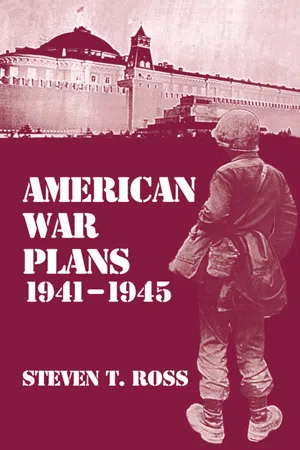
This is an examination of major American and Anglo-American war plans. Rather than discuss the history of planning, Ross considers the execution of the plans, compares the execution with the expectations of the planners and attempts to explain the differences.
1
The Grand Design
The United States and Great Britain reached a fundamental agreement on global strategy early in 1941 even before America became a participant in the Second World War. Washington and London agreed upon the paramount strategic importance of the Atlantic and European area, and in case of a two-ocean conflict the powers agreed upon the necessity of defeating a European enemy before seeking victory in the Pacific. The Anglo-American ABC 1 agreement and the American Rainbow 5 Plan set forth the basic assumptions that were to guide at least in broad outline the conduct of American strategy from 1941 to 1945. American military planners also produced a general plan for national mobilization in a global war.
The primacy of the Atlantic and European areas had been a cardinal element in American strategic thinking for many decades. During the interwar years American strategic planners had dealt with two broad categories of problem. The Joint Army and Navy Board produced a series of war plans to deal with possible contingencies including internal subversion, revolution in the Philippines, intervention in China and war against Mexico. United States forces could execute most of the plans with existing forces. The second set of plans dealt with war against a major power – Britain or Japan. The United States lacked the forces to cope with either country unless there was a major mobilization of human and economic resources. The planners, however, did not believe that war with either power was likely. Plan Orange for war against the Japanese Empire and Plan Red for war against the British Empire were essentially paper exercises designed to train staff officers in the complexities of waging a major conflict.
Almost all the Joint Board’s plans dealt with a conflict with a single power. The plan for intervention in China did have the United States acting in concert with other countries, but projected forces were small, and China was the single focus of Plan Yellow. The sole exception was the Red–Orange Plan, an exercise for a global war. Although a training effort, the Red–Orange Plan did establish a strategic concept that had a major impact on American thinking about a real global war.
Plan Red–Orange assumed that a hostile coalition consisting of the British Empire and Japan would be based on expediency. The European war would start first, and Japan would strike at the United States only after American forces were engaged against the British.1 The initial phases of hostilities in the Pacific would involve naval operations to contain the American Navy, air attacks against Hawaii and invasions of Guam and the Philippines.2
An invasion of continental United States was unlikely, but at the commencement of hostilities the country would be unprepared for a global war. The nation would have to mobilize its resources for a long war, and the development of adequate forces would tax its resources. As the nation mobilized for a maximum effort, forces in being would have to cope as best they could.3
Initially, the United States would have to accept territorial losses which might be regained later or at a peace conference. Available forces would focus their initial efforts on securing the north-eastern portion of the United States thereby defending the heart of American industrial might and the hub of the country’s commercial activity. US forces would also hold the Panama Canal. Outlying possessions including Guam, the Philippines and even Alaska would be defended by unreinforced local garrisons, and Orange forces would probably capture them.4
Once America had generated adequate forces she would take the offensive as soon as possible. The Joint Board rejected the strategy of standing on the defensive against both Red and Orange until the country was fully mobilized since such a course of action would leave the initiative to the enemy. Planners also rejected the concept of attacking Orange first. Orange was the weaker member of the hostile coalition and thus easier to defeat, but geography alone precluded a rapid defeat of Orange while doing little to weaken Red which was geographically much closer to vital areas in the continental United States. Consequently, the Joint Board decided to assume a defensive posture against Orange and concentrate on obtaining a favorable decision over Red.5 By defeating Red first American power would have developed to a point where the defeat of Orange was a foregone conclusion.
The Red–Orange Plan was not, of course, a precise forecast of the strategy of the Second World War. Since Britain was a presumed enemy, much of the plan dwelt on operations against Canada and British colonies in the Caribbean. Moreover, the plan never defined the conditions of victory. It presumed that the exhaustion of enemy resources would ultimately produce favorable, if undefined, peace terms. The plan also assumed that major fleet actions would be sought in the Atlantic and that the United States would fight without major allies of its own.6
Nevertheless, the Red–Orange Plan did establish the concept that in a global war an enemy in Europe posed a greater danger to the United States than an Asian opponent. Furthermore, the nation would seek to defeat the European foe first while standing on the defense and even accepting significant territorial losses in the Pacific. Thus, geography and resources led American war planners to adopt a ‘Europe first’ strategy. Finally, the plan enabled staff officers to identify and attempt to resolve a range of problems associated with waging a global war.
Written in the benign international environment of the 1920s and early 1930s, the Red–Orange Plan was little more than a staff problem. By the late 1930s, however, many American political and military figures came to view German, Italian and Japanese expansionism as potentially dangerous to the national interests of the United States. Although there was no national consensus on how to respond to the new disquieting security environment, military planners had to respond to changes in the international situation.
Shortly after Munich – 12 November 1938 – the Joint Board ordered its planning staff to undertake exploratory studies and estimates as to possible responses by the armed services to violations of the Monroe Doctrine by one or more of the Fascist powers and a simultaneous Japanese effort to expand further in the Pacific. Planners were to assume that the European democracies would remain neutral and that the United States would have to act unilaterally.7
Completed early in 1939, the exploratory studies dealt with three scenarios: Japanese aggression in the Pacific, German and Italian aggression in the Atlantic and combined action by all three powers. Unilateral Japanese aggression would make substantial initial gains including the seizure of the Philippines and Guam and sea and air attacks on Hawaii. The American response involved a counter-attack across the Central Pacific, reconquest of the Philippines and the ultimate blockade of the Japanese home islands8 – a replay of the Orange Plan which the Joint Board had been working on and revising for many years. German and Italian aggression would be limited by geographic constraints to submarine warfare and subversion in South and Central America. Germany and Italy might also attempt to seize bases in West Africa and the Atlantic islands in order to mount air raids on the Panama Canal. The American response involved naval action to deny the enemy access to the Americas and the creation of expeditionary forces to recapture German and Italian airheads and establish in their place American bases.9
In the case of a three-power attack the planners again emphasized the overriding importance of the Atlantic and European areas. The estimates explicitly stated that in the event of concerted aggression there was no doubt that American vital interests required offensive measures in the Atlantic against Germany and Italy to preserve the Caribbean and the Panama Canal. Consequently, at the start of hostilities, the United States would have to assume a defensive posture in the Pacific. Thus, despite the incongruity of the studies the Joint Board dealt for the first time with the prospect of a global war against likely enemies. Moreover, the Board again emphasized the strategic concept of the primacy of the Atlantic and the consequent requirement of defeating European opponents before dealing decisively with threats in the Pacific.
In July 1939, as war drew closer in Europe, the Joint Board ordered its planning staff to draw up a series of plans – the Rainbow Plans – based on a variety of strategic assumptions. Originally the Board established scenarios that required four different plans, but in April 1940 it agreed with the planners that the advent of war in Europe required a fifth scenario to enable the military to respond to an increasingly complex and dangerous situation.10
Rainbow 1, the only plan completed before the start of the Second World War, based its terms of reference on the need to protect the United States and the Western Hemisphere down to latitude 10 °S, just below the bulge of Brazil, from German and Italian aggression. At the same time, American forces would have to protect the Aleutians, Midway and Hawaii from Japanese attacks. The Philippines and Guam were not included within the American defense perimeter and would have to rely on local resources for their defense. In Rainbow 1 the United States would act alone.11 The army and navy would secure American bases in the Caribbean, occupy Natal in Brazil to deny potential air bases to the enemy and establish American bases in the area, and deny the enemy sea or air access to the Western Hemisphere north of latitude 10 °S. Action in the Pacific would be defensive. American forces would seek to hold Batan and deny Japan access to Manila Bay as long as possible.12
Rainbow 2 presumed that a European war was in progress and that the United States would enter the conflict on the side of England and France once Japan attacked the Far Eastern interests of the democratic powers. America’s major effort would be to operate almost exclusively in the Pacific in co-operation with the British, French and Dutch.13 Rainbow 3 dealt with a similar situation, but in this case American forces would at the start of hostilities conduct primarily defensive operations.14 Due to the rapidly changing global strategic situation, the government never approved Rainbow 2, and Rainbow 3 was never written.
In the wake of the German victories in Western Europe Rainbow 4 sought to protect the Western Hemisphere and the eastern Pacific up to and including Midway Island. The planners presumed that Germany and Italy had defeated England and France and would join Japan in a war against the United States which would have to fight alone. The US Navy with fifteen battleships, six aircraft carriers, eighteen heavy and nineteen light cruisers, 156 destroyers and 1,741 aircraft of all types would have been hard pressed to fulfill its missions under the Rainbow 4 scenario. The Army with eight infantry and one cavalry division supported by 2,200 aircraft would also have found it difficult to respond to the demands of the plan.15 America’s basic strategy closely resembled the concepts in Rainbow 1 with the significant difference that forces required for Rainbow 4 were much larger.16
Rainbow 5 originally focused on the Atlantic and Europe. The purpose of the plan was to provide for the projection of American forces to the eastern Atlantic as rapidly as possible. United States forces in conjunction with Great Britain and France would operate either in Africa or Europe or both continents to accomplish the decisive defeat of Germany.17 The plan did not initially envisage a two-ocean war. Rather, American forces were to defend the Western Hemisphere and project power against European enemies in conjunction with Allies much as had been done during the First World War.
The Rainbow Plans were quite limited in scope. Rainbows 1 and 4 were essentially defensive in orientation. The United States, acting alone, would counter attacks coming from Europe and the Pacific. Both plans in some respects resembled the old Red–Orange Plan. Rainbows 2 and 3 did have the United States operating as a member of a coalition, but action in both plans was confined to the Pacific. Initially, Rainbow 5 projected a scenario of war against European powers. The United States would ...
Table of contents
- Cover
- Halftitle
- Title
- Copyright
- Dedication
- Contents
- List of Maps
- Acknowledgements
- Introduction
- 1 The Grand Design
- 2 Response to Catastrophe
- 3 Seeking a Strategy — 1943
- 4 Strategic Alternatives — 1943–44
- 5 Assaulting the Citadels — 1944
- 6 Strategies in the Balance
- 7 Victory
- Conclusion
- Maps
- Selected Bibliography
- Index
Trusted by 375,005 students
Access to over 1.5 million titles for a fair monthly price.
Study more efficiently using our study tools.
Frequently asked questions
Yes, you can cancel anytime from the Subscription tab in your account settings on the Perlego website. Your subscription will stay active until the end of your current billing period. Learn how to cancel your subscription
No, books cannot be downloaded as external files, such as PDFs, for use outside of Perlego. However, you can download books within the Perlego app for offline reading on mobile or tablet. Learn how to download books offline
Perlego offers two plans: Essential and Complete
- Essential is ideal for learners and professionals who enjoy exploring a wide range of subjects. Access the Essential Library with 800,000+ trusted titles and best-sellers across business, personal growth, and the humanities. Includes unlimited reading time and Standard Read Aloud voice.
- Complete: Perfect for advanced learners and researchers needing full, unrestricted access. Unlock 1.5M+ books across hundreds of subjects, including academic and specialized titles. The Complete Plan also includes advanced features like Premium Read Aloud and Research Assistant.
We are an online textbook subscription service, where you can get access to an entire online library for less than the price of a single book per month. With over 1.5 million books across 990+ topics, we’ve got you covered! Learn about our mission
Look out for the read-aloud symbol on your next book to see if you can listen to it. The read-aloud tool reads text aloud for you, highlighting the text as it is being read. You can pause it, speed it up and slow it down. Learn more about Read Aloud
Yes! You can use the Perlego app on both iOS and Android devices to read anytime, anywhere — even offline. Perfect for commutes or when you’re on the go.
Please note we cannot support devices running on iOS 13 and Android 7 or earlier. Learn more about using the app
Please note we cannot support devices running on iOS 13 and Android 7 or earlier. Learn more about using the app
Yes, you can access American War Plans, 1941-1945 by Steven Ross in PDF and/or ePUB format, as well as other popular books in History & Military & Maritime History. We have over 1.5 million books available in our catalogue for you to explore.