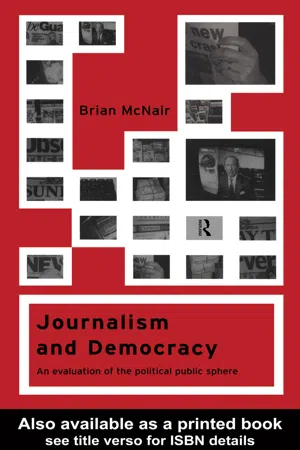
The public sphere is said to be in crisis. Dumbing down, tabloidisation, infotainment and spin are alleged to contaminate it, adversely affecting the quality of political journalism and of democracy itself. There is a pervasive pessimism about the relationship between the media and democracy, and widespread concern for the future of the political process.
Journalism and Democracy challenges this orthodoxy, arguing instead for an alternative, more optimistic evaluation of the contemporary public sphere and its contribution to the political process. Brian McNair argues not only that the quantity of political information in mass circulation has expanded hugely in the late twentieth century, but that political journalism has become steadily more rigorous and effective in its criticism of elites, more accessible to the public, and more thorough in its coverage of the political process.
Journalism and Democracy combines textual analysis and extensive in-depth interviews with political journalists, editors, presenters and documentary makers. In separate chapters devoted to the political news agenda, the political interview, punditry, public access media and spin doctoring, McNair considers whether dumbing down is a genuinely new trend in political journalism, or a kind of moral panic, provoked by suspicion of mass involvement in culture.
- 224 pages
- English
- ePUB (mobile friendly)
- Available on iOS & Android
eBook - ePub
About this book
Information
1
JOURNALISM AND DEMOCRACY
The debate
Modern politics are largely mediated politics, experienced by the great majority of citizens at one remove, through their print and broadcast media of choice. Any study of democracy in contemporary conditions is therefore also a study of how the media report and interpret political events and issues; of how they facilitate the efforts of politicians to persuade their electorates of the correctness of policies and programmes; of how they themselves (i.e., editorial staff, management and proprietors) influence the political process and shape public opinion. The political process, in its public manifestation, reaches citizens as the product of a set of journalistic codes and practices (the prevailing system of newsvalues, styles of interviewing, impartiality and objectivity guidelines), which interact with and are shaped by politicians and their professional communication advisors as they negotiate access to, or otherwise seek to influence the output of, political media in ways favourable to themselves. The accounts of political reality provided by the media are complex constructions embodying the communicative work of both groups, which ideally should, but need not always meet the standards of information accuracy and objectivity expected of political communication in a liberal democracy.
The political media are important because, as Anthony Sampson puts it, ‘a mature democracy depends on having an educated electorate, informed and connected through parliament’ (1996, p. 47), and it is principally through the media that such an electorate can be formed. That the actions of government and the state, and the efforts of competing parties and interests to exercise political power, should be underpinned and legitimised by critical scrutiny and informed debate facilitated by the institutions of the media is a normative assumption uniting the political spectrum from left to right. Analysts and critics may dispute the extent to which Britain has a properly functioning ‘public sphere’ – as Jurgen Habermas called that communal communicative space in which ‘private people come together as a public’ (1989, p. 27) – but all agree that such a space should exist, and that the media are at its core. Thus, in debates about the state of the democratic polity journalists figure large, and those who criticise the way in which the public sphere has actually developed focus their attacks on the media.
The ‘crisis of public communication’ identified by Jay Blumler and Michael Gurevitch in their book of the same name (1995)1 refers principally to two phenomena: firstly, a decline in the quality of political journalism, driven by what are variously described as processes of commercialisation, tabloidisation, Americanisation and, in the currently fashionable vernacular, ‘dumbing down’ – in short, the ascendancy of ‘infotainment’ over ‘serious’ reportage and analysis of politics. Nick Cohen typifies the argument when he writes of broadcast journalism in the New Statesman that ‘liberal news – by which I mean impartial coverage of issues of public importance – is in crisis. Its practitioners are nervous and unloved. Its self-confidence has been undermined by the preposterous but dominant intellectual fashion of postmodernism.’2
The assertion of crisis alludes, secondly, to a change for the worse in the relationship between journalists and politicians; an unwelcome shift in the balance of power between them, attributed in some variants of the thesis to the rise of the professional political communication specialists – the media consultants, communications managers and spin doctors who today inhabit the corridors and committee rooms of power – and, in others, to the destabilising effects of an overpowerful political media whose practitioners have gotten above themselves.
This book tests these assertions, thus entering a debate which straddles the sometimes separate worlds of the academic analyst and the journalistic commentator, as it blurs the ideological polarities of left and right. One is just as likely to encounter a lament for the decline of political journalism in the pages of the right-wing Spectator magazine as in the left-of-centre New Statesman, and in the Guardian as much as the Daily Telegraph. This book is not about the relative merits of different political ideas, then, but rather the capacity of our common media system – our public sphere – to service and support the democratic process for the benefit of the people as a whole, in accordance with the principles established to govern their operation at the birth of liberal capitalism in Britain some four centuries ago, and still held to be valid today. It is a debate which transcends politics and unites all species of partisan, all varieties of ideological warrior, in common contemplation of what the emergence of mass communication in the last century of the second millenium means for the present and future quality of our democratic polity. For that reason, the arguments draw on the widest possible range of academic and non-academic sources, as presented in books, articles, speeches and lectures, media interviews and analyses, and in interviews with practitioners of political journalism (and political communication) conducted by the author over a period of two years in 1997 and 1998.
Many significant voices are absent, nonetheless – most notably, those of the public themselves: that great mass of ordinary citizens who comprise the greatest part of the audience for political journalism, and for whose hypothetical collective benefit the whole infernal machinery of political communication functions. What do they think of the issues debated so intensely by academics, journalists and politicians on their behalf? In this study I have not sought to access their views directly. I have, however, devoted a chapter to ‘ the sound of the crowd ’, by which I mean the noise emanating from those proliferating spaces in the media given over to the facilitation of public access, such as political talk shows, phone-ins and related programme formats. In that chapter, and indeed whenever popular political culture is discussed, I have rejected the assumption of many contributors to this debate that popular means irrational and tabloid means trash; that entertainment cannot at the same time be informative; that serious news cannot at the same time be of human interest. Although my status as an academic defines me as a member of the elite group whose collective criticisms of political journalism are often challenged in the following pages, I am at the same time a fully paid-up member of the mass audience whose democratic rights and civic responsibilities drive the work, and I treat its patterns of media consumption with appropriate respect. I begin from the assumption that today’s media audiences are, in historical and cross-cultural perspective, relatively highly educated, well-informed, semiologically sophisticated, active consumers of media.
The crisis of the political media
What, then, is the specific nature of the ‘crisis’? Reading the pages of academic texts and newspaper articles in recent years, or listening to the reportage and commentaries of the broadcasters, one would have noted at various times all of the following criticisms being made of political journalism.
Dumbing down and the rise of infotainment
Firstly, the quantity of what is usually described as ‘serious’ political journalism circulating in the public sphere has steadily declined, and its substantive political content been diluted, to the detriment of the democratic process. The political media have been dumbing down, to use the phrase which has now become a routine element of British media commentary.3 German sociologist Jurgen Habermas, whose considered views on these issues, developed over three decades, underpin most variants of the dumbing down thesis, argues that the public sphere, while it has expanded in the course of the twentieth century to include the population as a whole (acknowledged by all but the most overtly reactionary of commentators to be a positive development), has at the same time been degraded by the growing influence of private, commercial interests on the output of media organisations (1989). In the process, the pursuit of profit has replaced that of serving the public interest as the driving force of journalism. News producers – even those like the BBC which are free of direct commercial pressures – have been required to become more and more oriented towards ratings, subordinating the journalistic obligation to inform to the more audience-friendly task of supplying entertainment. The result of these pressures has been an explosion of infotainment – journalism in which entertainment values take precedence over information content, presented at an intellectual level low enough to appeal to the mass audiences which comprise the major media markets (‘the lowest common denominator’, as critics frequently express it). Lower, too, than a healthy democracy demands. Political journalism is said to be conforming to the pressures of tabloidisation observed elsewhere in the media: a term which, used interchangeably with dumbing down and infotainment, functions as shorthand for the offence, as it is often characterised, of catering for popular tastes.
One manifestation of this trend would be the media’s contemporary fascination with elite deviance (sexual, financial or moral), as in the cases of Conservative and Labour politicians in Britain throughout the 1990s, and of course Bill Clinton, whose ‘sex addiction’ was a prominent theme of political journalism in Britain as well as the United States during the 1990s, exemplified by coverage of the Monica Lewinsky scandal in 1998–9. The ‘sleaze’ agenda (see Chapter 3) which featured prominently in British and American political news for most of that decade was alleged to be driven by market forces rather than public interest, in so far as the relentless commodification of journalism and the ever-increasing competitiveness of the media market put a commercial premium on sensationalism and prurience in coverage of politics.
Political information overload
Another criticism, which at first sight appears to stand in contradiction to the notion of dumbing down, asserts not that there is too little serious politics in the media, but too much. All observers agree that the media – and news media in particular – have expanded exponentially in the late twentieth century, and are likely to continue doing so for some time to come. Coverage of politics has always been at the heart of the British news agenda and, as the space available to news media has increased, so too has coverage of politics. David Walker has suggested that this amounts to a kind of political information overload and that, by boring audiences to distraction, ‘the massive scale of coverage merely diminishes public interest in politics’.4 During and after the 1997 general election, the broadcasters, and the BBC in particular, were accused of overloading their audiences with too much political coverage,5 resulting in the lower than usual ratings achieved by news programmes during the campaign period (see Chapter 8).
Elitism
Associated with this criticism is the perception that a quantitatively excessive political journalism has at the same time become too elitist or insider-oriented in its subject-matter; too focused on what commentators often refer to as the ‘horse-race’ – the process of political competition, and the race for electoral victory – and not enough on policy substance. Walker writes of the BBC’s political journalism (and the charge would apply equally to most other news organisations) that it suffers from ‘a fixation on party politics to the exclusion of matters of power and policy’,6 deriving in large part from excessive journalistic dependence on political sources.
An excess of interpretation
Another trend identified by critics is the tendency towards more interpretation and commentary as a proportion of total output, and the relative decline of straight reportage. Bob Franklin asserts that ‘the gallery tradition of reporting parliament is dead’ (1997, p. 232), adding his voice to those who interpret this as part of the wider process of tabloidisation/dumbing down of the British media. Ralph Negrine, too, sees the decline of straight parliamentary reporting as evidence of ‘the dangers of commercialisation’ (1996, p. 76). Media pundit Roy Greenslade suggests that the excessive quantity of political journalism now in circulation has resulted in a tendency to empty pontification,7 caused by the need to fill the space created for politics in the news and current affairs schedules. Columnist Iain MacWhirter argues that ‘the growth of the commentary industry is another manifestation of our degenerating political culture’.8
Hyperadversarialism
Degeneration of the political culture is also alleged in the trend towards more adversarial techniques of political interviewing seen in broadcast journalism. Writing of America, but in terms which apply with no less force to the United Kingdom, James Fallows accuses political journalism of hyperadversarialism – a combative style in which coverage of politics begins to resemble that subgenre of natural history broadcasting where the harsh and unending struggle for survival is portrayed as the only point of existence. Journalists, he argues, now place ‘a relentless emphasis’ on ‘the cynical game of politics’, undermining the integrity of public life by ‘implying day after day that the political sphere is mainly an arena in which ambitious politicians struggle for dominance, rather than a structure in which citizens can deal with wearisome collective problems’ (1996, p. 31). Where Habermas identified the deradicalising impact of commercialisation on the late nineteenth century press, Fallows has argued in turn that late twentieth century broadcasting was effectively depoliticised, the substance of political debate gradually being replaced by the superficial, entertainment-led spectacle of adversarial game-playing. Political journalism, he argues, has become excessively gladiatorial.
Excessive balance and outmoded impartiality
At other times, however, and in other contexts, political journalism is said to be not opinionated or gladiatorial enough, constrained instead by too much balance, artificial notions of neutrality, too-rigidly defined impartiality. During the 1997 general election, for example, critics including the future prime minister Tony Blair accused the BBC’s political journalists of sticking too closely to the balance guidelines,9 and of producing unengaging, formulaic, ‘tit-for-tat’ news which failed to involve audiences in the democratic process. These criticisms encouraged both of the main British broadcast news providers, the BBC and ITN, to undertake far-reaching post-election reviews of how political journalism should be produced and packaged (see Chapter 8).
Political public relations and the rise of spin
Last, but by no means least of the criticisms of political journalism currently in the public domain is the impact upon its content of public relations in its various forms, such as governmental information management, issues and image management, lobbying, and ‘spin’. Post-WWII, writes Habermas in the classic statement of the problem, ‘in the advanced countries of the West, they [public relations] have come to dominate the public sphere’, and have become ‘a key phenomenon for the diagnosis of that realm’ (1989, p. 192). The methods and practices of public relations are said to subvert the normative integrity of the public sphere by transforming it into a vehicle for the pursuit of vested interests, and the subordination of the public interest. In America, says Fallows, public relations has moved to ‘the centre’ of the presidency, and thus to the centre of political journalism (1996).10 Journalists have become dependent, or at the very least over-reliant, on the professional managers of information and image, to the detriment of the quality of their output, and of the citizens’ access to rational information.
Similar criticisms are frequently heard in relation to the United Kingdom, where the professionalisation of political advocacy is almost universally viewed as a negative trend, articulated through what I call in Chapter 7 ‘the demonology of spin’, denounced as another manifestation of Americanisation, to be condemned not only for the way in which spin doctors and other communication professionals seek to massage the news agenda on behalf of political clients, but for the reaction they have provoked from journalists who (as was noted above) are alleged to spend more and more time covering the process of political advocacy – ‘the game’ – than they do the ‘real issues’ of political life. Since New Labour’s election in May 1997 (and indeed for some time before that when it was re-emerging as an electable force) the British media have been engaged in more or less continuous commentary and speculation about the party’s information management system, and its adverse impact on journalists’ ability to report politics objectively.
Causes of the crisis
The above criticisms of political media are usually linked to two sets of causes. Advocates of economic causation, on the one hand, ...
Table of contents
- Cover
- Halftitle
- Title
- Copyright
- Contents
- List of tables and figures
- Preface and Acknowledgements
- 1. Journalism and Democracy: The debate
- 2. The Political Public Sphere: An anatomy
- 3. Policy, Process, Performance and Sleaze: An evaluation of the political news agenda
- 4. The Interpretative Moment: The journalism of commentary and analysis
- 5. The Interrogative Moment: The British political interview
- 6. The Sound of the Crowd: Access and the political media
- 7. ‘Spin, Whores, Spin’1: The demonisation of political public relations
- 8. The Media and Politics, 1992–97
- 9. Political Journalism and the Crisis of Mass Representation
- Notes
- Bibliography
- Index
Trusted by 375,005 students
Access to over 1.5 million titles for a fair monthly price.
Study more efficiently using our study tools.
Frequently asked questions
Yes, you can cancel anytime from the Subscription tab in your account settings on the Perlego website. Your subscription will stay active until the end of your current billing period. Learn how to cancel your subscription
No, books cannot be downloaded as external files, such as PDFs, for use outside of Perlego. However, you can download books within the Perlego app for offline reading on mobile or tablet. Learn how to download books offline
Perlego offers two plans: Essential and Complete
- Essential is ideal for learners and professionals who enjoy exploring a wide range of subjects. Access the Essential Library with 800,000+ trusted titles and best-sellers across business, personal growth, and the humanities. Includes unlimited reading time and Standard Read Aloud voice.
- Complete: Perfect for advanced learners and researchers needing full, unrestricted access. Unlock 1.5M+ books across hundreds of subjects, including academic and specialized titles. The Complete Plan also includes advanced features like Premium Read Aloud and Research Assistant.
We are an online textbook subscription service, where you can get access to an entire online library for less than the price of a single book per month. With over 1.5 million books across 990+ topics, we’ve got you covered! Learn about our mission
Look out for the read-aloud symbol on your next book to see if you can listen to it. The read-aloud tool reads text aloud for you, highlighting the text as it is being read. You can pause it, speed it up and slow it down. Learn more about Read Aloud
Yes! You can use the Perlego app on both iOS and Android devices to read anytime, anywhere — even offline. Perfect for commutes or when you’re on the go.
Please note we cannot support devices running on iOS 13 and Android 7 or earlier. Learn more about using the app
Please note we cannot support devices running on iOS 13 and Android 7 or earlier. Learn more about using the app
Yes, you can access Journalism and Democracy by Brian McNair in PDF and/or ePUB format, as well as other popular books in Social Sciences & Media Studies. We have over 1.5 million books available in our catalogue for you to explore.