- 336 pages
- English
- ePUB (mobile friendly)
- Available on iOS & Android
eBook - ePub
Timeshare Resort Operations
About this book
This book provides a complete overview of timeshare development and operation models. The authors take a comprehensive look at the present and future of this growing segment of the hospitality industry, including specialized approaches to marketing, human resources, service quality, finance, legal considerations and professional ethics.
Timeshare, or vacation ownership, is a relatively recent leisure phenomenon. It emerged in the late 1950s as a way to secure extra capital resources to fund property expansion. Shareholders had the right to use these properties on a regular basis. Although arrangements have grown in complexity and variation, the model allows for customers to buy rights to use a property for a fixed time period each year. Timeshare arrangements have experienced rapid international growth particularly in the last fifteen to twenty years and are now an important vacation arrangement. Most of the world's major hotel and resort developers now operate timeshare properties. Firms like Marriott, Hilton, Hyatt, Disney and Ramada have brought a new formality and legitimacy to timeshare development and operation.
Chapter 1
Evolution of the Timeshare Industry
Learning Objectives
After studying this chapter, you should be able to:
- understand what the concept of resort timesharing means.
- differentiate between the different timeshare products in terms of products and amenities offered.
- apply resort life-cycle theory to the timeshare industry.
- critically discuss factors that influence the growth of timesharing in an international market.
Introduction
Timesharing, a term that combines the words time and share, is simply that—the act of sharing vacation time at a luxurious resort facility in a geographical location of choice. As such, the timeshare sales representative promotes the timeshare product to interested consumers with the primary belief that the purchaser can achieve a higher level of intimacy by means of “sharing quality time” with people important in his or her life at a private resort that pampers consumers with recreational and leisure services that are unparalleled in quality.
The timeshare industry, otherwise known as vacation ownership, first appeared in Europe in the 1960s. One of the early entrants, a ski resort in France known as Superdevoluy, developed the first ownership program in the world. The purpose of the program was to give the owners of Superdevoluy a guaranteed opportunity to ski in the Alps (Baiman and Forbes, 1992). Not very long after the concept had taken hold in Europe the concept of sharing time at a resort was quickly adopted in the United States. The expansion was so pronounced that since the 1970s, the timeshare industry has recorded double-digit growth, which no other service sector has been able to do for this same period of time.
Many owners consider the timeshare industry to be a viable alternative vacation product to more traditional short-term and long-term lodging arrangements such as hotels, motels, bed & breakfasts, and condominiums (Upchurch and Gruber, 2002). Since the 1970s, the timeshare product has evolved in the metrics of sales volume, number of owners, and independent and brand-name developers that have entered the field. In addition, the range of product lines as well as the diversity of product designs has expanded over time.
A Short History of Timeshare
From a consumer perspective, purchasing a timeshare entails the purchase of access to a condominium style of accommodation for a designated period at a vacation resort that appeals to the purchaser’s lifestyle and vacation interests. This type of purchase means that the timeshare consumer is granted exclusive occupancy rights to a vacation home type of experience in increments of a week or more (Upchurch and Gruber, 2002). Because the timeshare product is typically sold in week increments, the buyer is not burdened with the daily upkeep costs normally associated with full home ownership. As such, the timeshare owner is free from the daily maintenance concerns of the resort and is therefore able to maximize his or her recreational and leisure experiences while the developer or a property management group maintains daily operational functions.
Key Point 1.1
Timeshare is defined as the right to purchase a specific time period in which to use a property at a geographical location of choice.
Product Registration: From Fixed Weeks to Float Weeks to Vacation Clubs
Another way to define the industry is through the process of product registration. To the novice consumer, the timeshare product is sold in increments of weeks with individual access being granted to a specific villa at the resort with open access to the resort’s common areas. This is true, but what exactly does the consumer own? The answer to this question depends on how the product is registered in the state in which the resort operates. In the 1960s, timeshare resorts were sold in “fixed-week” increments, which simply meant that the consumer was entitled to use the resort’s facilities at a set week, each week, every year for the length of the agreement. This fixed-week structure still exists, but it is not as prevalent as in the 1970s. A fixed-week purchase works as follows: if a consumer purchases week 32 at resort “X,” then this consumer is granted usage rights for week 32 for as long as the legally binding agreement remains valid.
Key Point 1.2
Timeshare developers have responded to consumer demands for product flexibility by changing the product offering to a more consumer friendly format. The product offering has progressed from a fixed week to a float week to a vacation club product that is sold based on points.
In the 1970s and 1980s, consumers began demanding more flexibility in how they could use their purchase, and the industry answered this concern with a “float week” offering. Simply put, a floating week offering means that the consumer is entitled to resort access rights within a specified range of weeks within a calendar year or as specified within the contract. The advantage of this format is that the consumer is offered more flexibility in product access versus that of a fixed-week structure. This flexibility in selecting a vacation week clearly is of benefit for the consumer who might be challenged in scheduling his or her annual vacation leave. Later in the 1970s to early 1980s, the timeshare consumer became more demanding in product use and access, which led to the creation of a float system (Upchurch and Gruber, 2002). Under a float system, the consumer had two options at her disposal depending on how the agreement was originally drafted. Under the week float option, the consumer was given use of a specific unit (also called a villa) while the week “floated” throughout the calendar year or within a given season. Under the unit float option, the consumer’s interval (i.e., week) remained the same while her choice of unit (same type in terms of one-bedroom, two-bedroom, etc.) location varied as long as the unit type was the same as the one she had originally purchased. Clearly, either float schedule offered the consumer a higher degree of week or unit flexibility that heretofore did not exist under a fixed system (Trowbridge, 1981).
In 1992, Disney was the first to roll out another legal format whereby consumers were not restricted to a fixed- or floatweek structure; instead, consumers could purchase points within Disney’s vacation club. Under this legal format, a timeshare product is registered under a vacation club structure, which means that the consumer purchases points instead of weekly increments. The purchased points, in turn, have a predetermined equivalent value of timeshare resort usage rights. Under this legal plan, the consumer has a greater degree of control over the type of product that best meets his or her needs. For instance, a vacation club owner could purchase enough points for a single-unit, a two-bedroom, or three-bedroom villa for X number of days. In addition, vacation clubs offer much more flexibility in the range of services consumed in that club membership is not restricted to villa usage rights. For instance, some vacation club plan offerings allow the consumer the option of purchasing cruise line experiences, hotel stays, golf packages, or other appealing recreational and leisure experiences using their point structure to do so (Baiman, 1992; Gruber, 1999a; ARDA, 1999b; Suchman, 1999). Under a vacation club points system, the consumer simply purchases enough points to satisfy his annual vacation needs. From the consumer perspective, this system is touted to offer the maximum amount of flexibility, while in contrast this system is quite complex for the developer to manage relative to inventory management purposes (Sherles and Marmorstone, 1994). From the developer perspective, a very robust reservation management system must be in place to track factors such as unit size, length of stay, location availability, seasonal issue, point allocation, and remaining point allocation. Basically, the point type of interval schedule, sometimes referred to as a vacation club, offers the consumer the highest degree of vacation options in contrast to either a fixed or a float type of interval arrangement (Burlingame, 1999 and 2001).
Reflective Practice
Survey current trade literature to determine who the major timeshare developers are in your region; include both branded and independent operators.
Basic Legal Forms of Conveyance
Another way to define the industry is to classify the timeshare product into the legal form under which it is sold. The three most common types of conveyance are (1) deeded interests, (2) right-to-use, and (3) leasehold agreements. Under the deeded interest method of conveyance, the purchaser receives title for the real property that is being purchased from the timeshare developer. If a consumer purchases a timeshare under a deeded arrangement, he or she has obtained legal ownership of the villa for a weekly interval that grants the owner the right to use the property for the week specified in the deed. Under this deeded type of conveyance, the purchaser has the legal right to: (a) use the real property (villa) in perpetuity, (b) will the real property to a family member, or (c) sell the real property at a point in which he or she no longer wants to use the property.
The right-to-use type of conveyance is not associated with deeding the underlying real property to the purchaser; instead, the individual is given contractual rights to use the timeshare facilities for a specified period of time. Upon expiration of this specified period (e.g., twenty years), the purchaser’s rights of usage terminate unless he or she purchases additional time.
Key Point 1.3
The timeshare product is categorized into three basic legal modes of conveyance: (1) right-to-use, (2) deed, and (3) leasehold agreements.
The conveyance mode known as a leasehold agreement is similar to a right-to-use contract in that the purchaser holds a leasehold interest or other interest that is less than a full ownership interest. In practical terms, this means that the purchaser has the right to inhabit the timeshare unit for a specified period of time, and at the termination of the lease, the property reverts to the timeshare developer. One of the fundamental differences between a leasehold agreement and a right-to-use agreement is that the leasehold is of shorter duration than the right-to-use contract (Suchman, 1999; ARDA, 2002b).
In practical terms, the vacation ownership product comes in either a deeded or a nondeeded version (often referred to as a right-to-use arrangement). Under either arrangement, the consumer, also known as an owner, is given use at a specific resort, a specific unit, and exclusive occupancy for a specified period of time. In short, this means that a given developer can build and sell an individual unit for fifty-one or fifty-two weeks out of a year, depending on whether a week is held out for general maintenance purposes (Upchurch and Gruber, 2002).
From a product perspective, the vacation ownership concept holds a unique position within the leisure product continuum owing the fact that either via a deed or a contract the consumer owns the right to use a specific unit at a specific resort, at a specific period of time. In comparison, under a hotel arrangement the consumer is given the opportunity to rent a unit by the day without any kind of underlying deed or right-to-use/contractual arrangement, whereas whole ownership connotes a legally binding interest in the underlying real estate (see Figure 1.1).
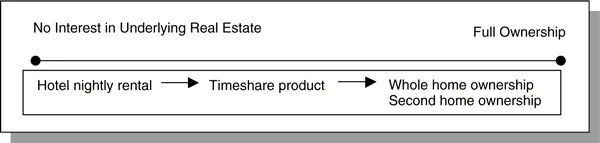
Figure 1.1 Product ownership continuum
A Macro View of the Timeshare Industry’S Growth Cycle
A common question asked is, “Where did the concept of resort timesharing begin?” Many in the United States would trace the roots of timesharing to the most popular geographical destination market located within the U.S. borders: Orlando, Florida. Although the state of Florida has a rich history reaching back to the 1970s, it would be logical to conclude that it is the home of the first-ever timeshare development, but that would be an error of judgment. Actually, the site that originally spawned the growth of the timeshare resort concept is not within the United States at all. As noted earlier, the first timeshare resort was located in Europe. In 1964, a European developer known as Superdevoluy began offering timeshare intervals at a ski resort in the Alps for ski resort enthusiasts (Trowbridge, 1981). The basic concept proffered by Superdevoluy is not largely different from the core timeshare definition in that Superdevoluy sold individual units to multiple owners for a specified period of time. This vacation offering allowed the ski devotee who wanted to own real estate at a premium ski resort location a guaranteed right to vacation at that resort at an affordable price (Trowbridge, 1981).
In less than ten years, this concept of selling individual resort units (villas) to multiple owners gained momentum in the United States. Indeed, the first reports concerning timesharing began to appear in publications in the 1970s (Trowbridge, 1981). In the 1970s, the timeshare concept migrated to the United States. During this time it was not uncommon for a timeshare resort development to be nothing more than a converted hotel project. This approach failed because many of these converted hotel projects were distressed properties and therefore were also not successful as timeshare resorts. The net result was that the concept of timesharing in the United States had a very difficult startup process owing to high failure rates and the resultant negative press. Other negative influences during this time centered on inflation and the economic downturn of the U.S. economy.
One of the less glamorous outcomes of the 1970s was that a few unscrupulous developers took advantage of unknowing consumers by selling a product that did not exist. As a result of such dishonest actions, state lawmakers began to consider extensive product registration and licensing for timeshare enterprises. Many in the industry therefore refer to the 1970s as the birth of timeshare’s negative image. It took years to counteract this bad image.
By the early 1980s, the practices of such unscrupulous developers were out of control. The net result was that Florida’s state legislature passed the state’s first timeshare law in 1983 that put an end to such unethical selling practices. This first timeshare law imposed strict restrictions on timeshare developers th...
Table of contents
- Cover
- Half Title
- Title Page
- Copyright
- Contents
- Preface
- Chapter 1: Evolution of the Timeshare Industry
- Chapter 2: Timeshare Resort Development and Financing
- Chapter 3: Real Estate Development
- Chapter 4: Timeshare Markets and Consumer Behavior
- Chapter 5: Relationship Marketing, Selling, and Beyond
- Chapter 6: Consumer Finance
- Chapter 7: Managing Human Resources in Timeshare Operations
- Chapter 8: Managing Service Quality in Timeshare
- Chapter 9: Home Owners Associations and Stakeholder Management
- Chapter 10: Business Ethics and Ethical Practice
- Chapter 11: The Future of Timesharing: A Matter of Strategy
- References
- Index
Trusted by 375,005 students
Access to over 1.5 million titles for a fair monthly price.
Study more efficiently using our study tools.
Frequently asked questions
Yes, you can cancel anytime from the Subscription tab in your account settings on the Perlego website. Your subscription will stay active until the end of your current billing period. Learn how to cancel your subscription
No, books cannot be downloaded as external files, such as PDFs, for use outside of Perlego. However, you can download books within the Perlego app for offline reading on mobile or tablet. Learn how to download books offline
Perlego offers two plans: Essential and Complete
- Essential is ideal for learners and professionals who enjoy exploring a wide range of subjects. Access the Essential Library with 800,000+ trusted titles and best-sellers across business, personal growth, and the humanities. Includes unlimited reading time and Standard Read Aloud voice.
- Complete: Perfect for advanced learners and researchers needing full, unrestricted access. Unlock 1.5M+ books across hundreds of subjects, including academic and specialized titles. The Complete Plan also includes advanced features like Premium Read Aloud and Research Assistant.
We are an online textbook subscription service, where you can get access to an entire online library for less than the price of a single book per month. With over 1.5 million books across 990+ topics, we’ve got you covered! Learn about our mission
Look out for the read-aloud symbol on your next book to see if you can listen to it. The read-aloud tool reads text aloud for you, highlighting the text as it is being read. You can pause it, speed it up and slow it down. Learn more about Read Aloud
Yes! You can use the Perlego app on both iOS and Android devices to read anytime, anywhere — even offline. Perfect for commutes or when you’re on the go.
Please note we cannot support devices running on iOS 13 and Android 7 or earlier. Learn more about using the app
Please note we cannot support devices running on iOS 13 and Android 7 or earlier. Learn more about using the app
Yes, you can access Timeshare Resort Operations by Randall Upchurch,Conrad Lashley in PDF and/or ePUB format, as well as other popular books in Business & Hospitality, Travel & Tourism Industry. We have over 1.5 million books available in our catalogue for you to explore.