The essays in this book focus on political strategies, pedagogical models, and community programs that enable adult ESL learners to become vital members of North American society. This is particularly important in our present time of contraction and downsizing in the education of non-native speakers. The authors represent a broad range of programs and perspectives, but they all have in common the goal of enabling both faculty and students to become full participants in our society and thereby to gain control over their futures. Readers of this book will develop an understanding of the ways in which innovative educators are creating strategies for maintaining language programs and services.
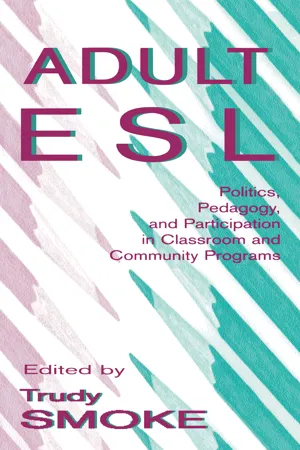
eBook - ePub
Adult Esl
Politics, Pedagogy, and Participation in Classroom and Community Programs
- 360 pages
- English
- ePUB (mobile friendly)
- Available on iOS & Android
eBook - ePub
About this book
Information
Topic
EducationSubtopic
Education GeneralI
POLITICS
1
The Politics of Adult ESL Literacy: Becoming Politically Visible1
The idea of democracy as opposed to any concept of aristocracy is that every individual must be consulted in such a way actively not passively that he himself becomes part of the process of authority, of the process of social control; that his needs and wants have a chance to be registered in a way that they count in determining social policy.
—John Dewey (1859–1952)
I can be somebody. I don’t have to sit home and do nothing and be nobody.
—Adult ESL Literacy Student (1993) Yakima Valley Community College
The teaching of English as a Second Language to adults is not a new field. It actually was born with all of adult education in this country in the years around World War I. The large wave of immigration at that time from southern and eastern Europe led some U.S. citizenry, then as now, to decry the newcomers’ differences in language and custom, railing that the immigrants would never be “like us.” That outcry led to the Americanization movement and the teaching of English to adult immigrants. The goal of the movement was to make the newcomers into “good citizens,” often meaning meek and accepting of the status quo (Appel & Appel, 1982; Crawford, 1992a, 1992b; Leibowicz, 1992; Weiss, 1982). The aim of education for the public, not individual, good has been a bane of the adult ESL field ever since. Public policy offers funding, still, with the expressed aim of producing newcomers who will be just “like us.”
We, in adult ESL, never needed to try so hard. Immigrants, to a large extent, believe in the American Dream more than those of us raised within it. The United States’ public relations lives and flourishes in the world. Many, many newcomers to this country are perfectly willing to blame themselves for the reality of their living far from the ideal of the American Dream. Feelings of failure and worthlessness are not uncommon.
As adult ESL literacy instructors, we truly are both in the middle—acting as buffers between our students and often-hostile communities—and on the front lines. We are political workers, whether we intended to be or not, whether we were trained to be or not. And, whether we want to be or not, we are either part of the solutions to the problems surrounding our students, or we are part of the problems.
As both a coordinator and an instructor in a community-college-based adult ESL literacy program serving primarily Mexican immigrants, I find myself in the middle of this dialogue around immigrants’ learning of English. My own questions have been: How do immigrants gain a voice, a political visibility? How do their needs become a rightful consideration of the dominant community? How do immigrants gain access to opportunities for education and jobs?
What we are experiencing here in the Yakima Valley seems, to me, to be an intense microcosm of the impact of current immigration in other parts of the United States. At the local level, there is political advocacy work to be done and visibility to be gained within the classroom, within the adult education department, within the college, and within the community. Many of these relationships overlap and intertwine in a smaller city, as they do where I live and work. I have opportunities to know people in many facets of their lives: at work, at their children’s school functions, at social occasions, and in just doing errands around town. It’s a balancing act to practice advocacy along with sensitivity to people’s receptiveness to listen.
I take my resolve to build the positive visibility of immigrants in this community with me into the adult ESL literacy classroom. ESL programs need both internal and external support. In the classroom, I use problem-posing as the basis for my ESL teaching. The real-life issues that affect us, as students and teacher, are the basis for language learning in the classroom. We look for the problems behind the issues we discuss. We look for ways to have impact on the problems. Students become political advocates for issues that are important to them, including ESL classes. As Wallerstein (1987) noted:
[Brazilian literacy educator Paulo] Freire’s central premise is that education is not neutral; whether it occurs in a classroom or in a community setting, the interaction of teacher and student does not take place in a vacuum. People bring with them their cultural expectations, their experiences of social discrimination and life pressures, and their strengths in surviving. Education starts from the experiences of people, and either reinforces or challenges the existing social forces that keep them passive. … Problem-posing is a group process that draws on personal experience to create social connectedness and mutual responsibility. (pp. 33-34)
Questions of who the students are and what they want become the basis for learning. The point of my instruction is to help students give label and voice in a new language to their own life experiences and needs. Immigrants come as students to the program with widely different levels of formal education and first language literacy. Students start their language learning with who they are. My instruction starts with that. The students are the the instructor’s manual. The language is the text.
Students at the intermediate level of my classes extend their learning into the action phase of Freire’s problem-posing process. At the beginning level, students have learned to describe and define some of their life situations. At the next level of classes, they continue into analyzing problems they share and planning for action. (If bilingual instruction were available [there are usually six or more language groups in the classroom], these steps would not need to be separated by language proficiency.)
From the first days in class, students are encouraged to learn about and use services at the college. Through tours and activities like “Scavenger Hunt,” they become familiar with the library, cafeteria, nurse’s office, gym, registration and financial aid offices, as well as various academic departments. Students learn about and attend free campus art shows and musical performances. They learn that the campus is theirs as well as any other student’s.
Intermediate students begin classes by working in small groups to answer these questions: What skill have you learned as an adult? What did you do to learn it? How did you feel while learning? In whole-group dialogue, students report their answers to what they have learned and have included driving a car, cooking, dancing, replacing a roof, changing a diaper, packing apples, and driving a forklift. They said they learned by having a need for the skill (motivation), thinking about the skill, demonstrating the skill, practicing, watching, and asking questions. While learning they felt nervous, scared, embarrassed, insecure, worried, and uncomfortable; later they felt happy, proud, and relaxed about their accomplishments.
I want students to understand that they know how to learn. They, as adults, already have the knowledge of successful learning practices and how learning feels. Just as they have been successful in other adult learning, they will be successful in learning English. From this, we talk about the learning environment they will need to be successful in the language classroom. Small groups write lists of the students’ and teacher’s responsibilities in the classroom. The lists are consolidated to make a poster to hang in the classroom. One year students wrote:
| Students’ Responsibilities | Teacher’s Responsibilities |
Pay attention | Explain to students |
Participate | Don’t be absent |
Sign attendance daily | Teach different topics |
Do homework | Be patient with all students |
Write in journal quietly | Answer questions |
Be on time to class | Respect the students |
Listen to the teacher | Give homework, but not every day |
Respect each other | Correct the students |
Don’t be absent | Give students motivation |
Speak English | Help with pronunciation |
Practice | Be in charge of the classroom |
Bring supplies to class | Listen to the students |
Help each other | Respect the students |
| Be motivated |
We reviewed the lists to see if we each were willing to accept the responsibilities the class had determined necessary. The only thing asked of me that I was unsure of was “give the students motivation.” We talked about the limits of my abilities to do this. I got out a “magic wand” that I keep in the classroom and told them I would use it if it helped! We agreed to the lists.
One year students wanted one rule only for the classroom: “No one laughs when someone makes a mistake.” That was also posted on the wall. I realize that I am more fortunate than many teachers in that I have (after years of advocating for it) dedicated classroom space that I do not share. Dedicated space allows me to hang pictures and posters on the walls. As students have brought in family snapshots to share, I have borrowed especially colorful ones that are representative of an aspect of family or culture. I have large, inexpensive, color photocopies made of them. I mount each photocopy on top of bright poster board and put the whole thing inside an acrylic poster frame. The pictures are frequently a topic of discussion for both visitors and students.
Since realizing that some students come to class without eating first, I have kept a snack table and a small refrigerator in the classroom. Snacks include dry mixes for coffee, tea, cocoa, juice, and soup, and also crackers. There is a cup for donations and a sign that says “25 cents, please.” Somehow, it always works out that there is enough money to replace what is used.
To get at common class themes, intermediate students begin by comparing their living situations in their native countries and in Yakima (see Auerbach, 1993, for extensive information on generating themes). In small groups, they brainstorm what was/is positive and negative in each context. Each small group makes a poster representing their themes and presents it to the class. The class analyzes what the common themes are among the groups. One year, they discovered that most of the class members were concerned with the crime rate, gangs, and graffiti in Yakima, as well as with immigration law, with domestic violence and child abuse, with the transportation system in Yakima, and with recreational opportunities available to them here. They decided they needed more information about each of these areas of concern. They brainstormed about ways to get information. The direction of our next several classes was set.
The class decided to start with the most pressing concern: the crime rate, gangs, and graffiti in the community. As a class, they composed a letter to the city’s chief of police, stating their concerns and need for information. They invited him to speak to the class. (This was authentic, meaningful literacy practice of letter writing form and content.) He responded and arranged to come to the class along with a gang specialist from the school district. The two men came to the classroom with confiscated gang clothing, weapons, symbolic paraphernalia, and a slide show of local graffiti. The class members, mostly parents, listened to graphic information on identifying gang-related behaviors. They actively questioned the speakers on preventative measures parents can take with their children, and on ways to organize neighborhoods to counteract gang influence.
My notes on the lectures and questions became class reading material to once again provide meaningful literacy practice, this time in reading. Over the next several classes, students continued to compare and report on plans for organizing neighborhood watch programs. For their next speaker, students invited the founder of an immigrants’ rights project in Seattle to come to speak to our class.
The community comes to the classroom. Governmental agencies as well as social service agencies often have employees whose job is to speak to the public about their services. Students get practice in asking clarifying and informational questions while they learn about the community. We routinely have judges, police and state patrol officers, housing authority officers, employment and welfare workers, and health officials speak to the class. Groups like Habitat for Humanity have also given presentations. (Three families of former students now have homes through Habitat!) Former students also return to talk about “life after ESL class.”
Students share community resources they hear about with each other, and make use of the resources. One class listened quietly to an Employment Security worker’s spiel about computer job searches and job placements. When the state employee asked if there were questions, one student started by asking, “Is this reality or is this fantasy?” and told of his experiences at the employment office. Students spoke, one after another around the room, telling of their dissatisfactions with their treatment at the office. The worker, appearing shaken, apologized for their experiences and said he would “look into it.” He left, and the students cheered for themselves.
I open my ESL classroom, and encourage other teachers in the program to do the same, to visitors. Many, many curious community members as well as teachers and administrators have observed my classes. We usually have a couple of visitors a week. Students are used to their presence. We’ve talked about the hoped-for benefits of having visitors watch us. Sometimes the visitors participate in class discussions; sometimes they don’t. Sometimes visitors are excited by the processes they see; sometimes they are not. At the very least, I expect that visitors will be able to put faces to the anonymous issues of “immigration” and “learning English.” Media representatives were, at first, invited and now frequently ask to return to the classroom. Students have learned to say, “Must be a slow news day!”
Whenever the ESL classes have a party (which usually means potluck), some administrators, staff, and faculty are invited to join us. Students write and deliver the invitations to offices around campus. They return to class and report on their receptions. After several years, I have found that administrators now anticipate the delivery of their invitations and look forward to that as a herald of the season! People’s thinking can begin to change as they eat and talk together. Social revolutions have started through the simple acts of eating, talking, and walking together. We are not near revolution on campus, but the adult ESL literacy program is now seen and spoken of by administrators as an integral part of the college’s mission to the community. We are no longer the temporary program housed inconspicuously in a corner of the second fl...
Table of contents
- Cover Page
- Half Title Page
- Title Page
- Copyright Page
- Contents
- Preface
- Part I Politics
- Part II Pedagogy
- Part III Participation
- Author Index
- Subject Index
- Notes on Contributors
Trusted by 375,005 students
Access to over 1.5 million titles for a fair monthly price.
Study more efficiently using our study tools.
Frequently asked questions
Yes, you can cancel anytime from the Subscription tab in your account settings on the Perlego website. Your subscription will stay active until the end of your current billing period. Learn how to cancel your subscription
No, books cannot be downloaded as external files, such as PDFs, for use outside of Perlego. However, you can download books within the Perlego app for offline reading on mobile or tablet. Learn how to download books offline
Perlego offers two plans: Essential and Complete
- Essential is ideal for learners and professionals who enjoy exploring a wide range of subjects. Access the Essential Library with 800,000+ trusted titles and best-sellers across business, personal growth, and the humanities. Includes unlimited reading time and Standard Read Aloud voice.
- Complete: Perfect for advanced learners and researchers needing full, unrestricted access. Unlock 1.5M+ books across hundreds of subjects, including academic and specialized titles. The Complete Plan also includes advanced features like Premium Read Aloud and Research Assistant.
We are an online textbook subscription service, where you can get access to an entire online library for less than the price of a single book per month. With over 1.5 million books across 990+ topics, we’ve got you covered! Learn about our mission
Look out for the read-aloud symbol on your next book to see if you can listen to it. The read-aloud tool reads text aloud for you, highlighting the text as it is being read. You can pause it, speed it up and slow it down. Learn more about Read Aloud
Yes! You can use the Perlego app on both iOS and Android devices to read anytime, anywhere — even offline. Perfect for commutes or when you’re on the go.
Please note we cannot support devices running on iOS 13 and Android 7 or earlier. Learn more about using the app
Please note we cannot support devices running on iOS 13 and Android 7 or earlier. Learn more about using the app
Yes, you can access Adult Esl by Trudy Smoke in PDF and/or ePUB format, as well as other popular books in Education & Education General. We have over 1.5 million books available in our catalogue for you to explore.