- 248 pages
- English
- ePUB (mobile friendly)
- Available on iOS & Android
eBook - ePub
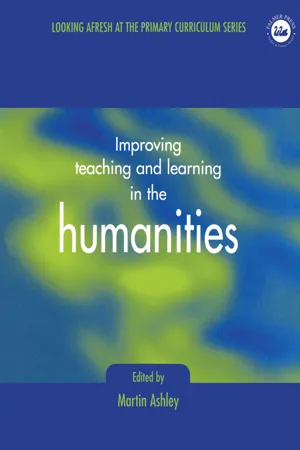
Improving Teaching and Learning in the Humanities
About this book
Focuses on religious education, history, geography and cross-curricular planning in the primary school. It includes discussion of the purpose of education, and how the humanities fit with this purpose, with particular reference to the 1998 Education Act and 1994 National Curriculum Review. The book deals with the themes of time, place, values, communication, responsibilities and decision-making. These link the chapters, and are fully complemented with case studies. For each concept there are suggestions for practical classroom activities. The reader will find the book invaluable in integrating the subjects across the National Curriculum.
Information
| Chapter 1 | The continuing value of a humanitarian curriculum |

It’s my personal approach that creates the climate.
It’s my daily mood that makes the weather.
As a teacher I possess a tremendous power to make a child’s life miserable or joyous.
I can be a tool of torture, or an instrument of inspiration.
I can humiliate or humour, hurt or heal.
In all situations, it is my response that decides whether a crisis will be escalated or de-escalated …
… and a child humanised or de-humanised. (Bagnall, Personal View)
Introduction and overview
In this chapter we look at what the humanities are and why there might be a continuing need for something called a humanitarian curriculum. We consider why you, the reader, might want to know these things and we give an overview of the whole book which, hopefully, will encourage your commitment to reading it. Our intention is that you will see how you might come to value an understanding of how to teach the humanities effectively as one of your highest priorities in developing personal excellence in primary school teaching. We assume that you are already confident and proficient in teaching the core subjects of English, maths and science and that you have a commitment to a broad and balanced education which develops children’s potential.
The book has been written by a team of authors from varied backgrounds who are committed to this ideal and who are committed to your achieving it. It has been written in a style which will support your own self-directed learning. It draws heavily on the practical classroom experience of the authors, and the students and teachers they themselves have supported in training. It includes a plentiful variety of classroom-based enquiry tasks which, if you are able to carry them out, will bring the text alive with stimulating first hand experience generated with your own children. The enquiry tasks and the associated reflection boxes are designed to enhance your ability to bring about school improvement through the reflective practitioner model. A commitment to the teacher as a reflective practitioner, who is pledged to the constant improvement of his or her teaching through the plan/implement/evaluate/plan cycle, is a fundamental value shared by all the authors.
We have included the word ‘value’ in the title of this opening chapter because this reflects the commitment of the book to certain values in education. The teacher as a person and as a reflective practitioner is certainly one of these. This is a book which values teachers and values their work. The children as young people, learners and future citizens are equally fundamental and important. This is a book which both values childhood and values children’s futures. You may well recognise that the words ‘… at the heart of the education process lies the child’ are drawn from the Plowden Report of 1967. You may realise that these words might be associated by some with what is popularly regarded as a discredited, so called ‘progressive’, or even (to use the most derogatory word in the armoury of the popular press), ‘trendy’ teaching style. You will probably be familiar with the emergence of a ten subject based National Curriculum in 1988. Depending on your own age and experience of primary education, you may be more or less aware of the significant shift from child-centred toward subject-centred teaching in primary schools that resulted from this.
You are likely to be familiar with the notoriously ‘overloaded’ nature of Education Secretary Kenneth Baker’s original National Curriculum and the subsequent ‘slimmed down’ version produced by Sir Ron Dearing in 1995. You may well recall the promise of Education Secretary, Gillian Shepherd, that there would be no more changes until the year 2000. If so, you may have been bemused by the changes introduced by Education Secretary, David Blunkett, during 1998. If you have studied the history of education, or are old enough to remember, you may well have noted the way in which David Blunkett’s reforms seem to give a further push to a pendulum swinging towards ideas about schooling fashionable in the 1870s. You may be wondering where it will swing next. The influences to which primary education has been subjected by politicians is a major topic of discussion in the next chapter.
This book is not about ‘trendiness’ or political fashion in education. The authors are concerned with what they perceive as enduring values which have evolved since classical times and far outlast the limited life span of any particular Education Act. Freedom of thought, rationality, the pursuit of truth and the principle of a broad and liberating education are fundamental. We have already stated that we value teachers and children. We also value our respective subjects. Some of us, for example, are historians because we value history and all that the study of history stands for. We see no conflict between child and ‘subject’. We take it as read that the attainment of high standards of literacy and numeracy always were and always will be absolutely fundamental to any child’s success. We value literacy and numeracy because of this, and we value literacy and numeracy because no civilised society can function without them.
Literacy and numeracy alone, however, are merely the foundations of a civilised, democratic society. We have to build above the foundations or that society will never become visible. This book is in two parts. The first, after considering the relationship between literacy, numeracy and the rest of the curriculum, discusses each of the humanities subjects in turn. The second broadens the discussion to look at the way in which humanities support the development of the whole child. There is a focus on the child’s spiritual, moral, social and cultural development. We consider important emerging issues that are closely related to the humanities, such as citizenship and the application of Information and Communications Technology. We conclude with a consideration of pressing global issues, such as the need to envision and educate for a more sustainable society. In so doing, we reassert the enduring value of the humanities subjects as a prerequisite foundation for a rational response to such matters as threats to our environment, real or imagined. Permeating all of these discussions is the National Statement of Values (Appendix to this chapter). In the remainder of this chapter we shall consider first, in a little more detail, the justification for a ‘humanitarian curriculum’. We shall conclude with a consideration of how this relates to some of the values that have been defined in the National Statement.
A humanitarian curriculum
Roberts (1996) has claimed, in the wake of the Dearing Reforms, that the United Kingdom (UK) National Curriculum is the least ‘humanitarian’ of all European curricula which seek to uphold democratic values. What prompted such a claim?
Enquiry task 1
You are likely to have some understanding of why the subjects of history, geography and perhaps religious education are collectively referred to as ‘the humanities’. You may believe that the assumption that schools exist for children is a valid one, even if you are open minded about the degree to which primary education should be ‘child centred’.
Discuss with some of your colleagues answers to these questions:

You may consider that a humanitarian curriculum might imply something a little more than a subject-based curriculum which allocates so many hours per week to history, geography and religious education. Behind the desire to teach the humanities there exists the desire for a c...
Table of contents
- Cover
- Halftitle
- Title
- Copyright
- Contents
- List of figures and tables
- Series editors’ preface
- Chapter 1 The continuing value of a humanitarian curriculum
- Chapter 2 The literacy hour and beyond
- Chapter 3 Looking afresh at history
- Chapter 4 Looking afresh at geography
- Chapter 5 Using artefacts to support children’s learning in religious education
- Chapter 6 Field work, visits and work outside the classroom
- Chapter 7 Spiritual, moral and cultural development
- Chapter 8 Citizenship: a new word for humanities?
- Chapter 9 ICT and the humanities
- Chapter 10 Sustainability and the humanities
- Chapter 11 Towards uncertain futures?
- Notes on contributors
- Index
Trusted by 375,005 students
Access to over 1.5 million titles for a fair monthly price.
Study more efficiently using our study tools.
Frequently asked questions
Yes, you can cancel anytime from the Subscription tab in your account settings on the Perlego website. Your subscription will stay active until the end of your current billing period. Learn how to cancel your subscription
No, books cannot be downloaded as external files, such as PDFs, for use outside of Perlego. However, you can download books within the Perlego app for offline reading on mobile or tablet. Learn how to download books offline
Perlego offers two plans: Essential and Complete
- Essential is ideal for learners and professionals who enjoy exploring a wide range of subjects. Access the Essential Library with 800,000+ trusted titles and best-sellers across business, personal growth, and the humanities. Includes unlimited reading time and Standard Read Aloud voice.
- Complete: Perfect for advanced learners and researchers needing full, unrestricted access. Unlock 1.5M+ books across hundreds of subjects, including academic and specialized titles. The Complete Plan also includes advanced features like Premium Read Aloud and Research Assistant.
We are an online textbook subscription service, where you can get access to an entire online library for less than the price of a single book per month. With over 1.5 million books across 990+ topics, we’ve got you covered! Learn about our mission
Look out for the read-aloud symbol on your next book to see if you can listen to it. The read-aloud tool reads text aloud for you, highlighting the text as it is being read. You can pause it, speed it up and slow it down. Learn more about Read Aloud
Yes! You can use the Perlego app on both iOS and Android devices to read anytime, anywhere — even offline. Perfect for commutes or when you’re on the go.
Please note we cannot support devices running on iOS 13 and Android 7 or earlier. Learn more about using the app
Please note we cannot support devices running on iOS 13 and Android 7 or earlier. Learn more about using the app
Yes, you can access Improving Teaching and Learning in the Humanities by Martin Ashley in PDF and/or ePUB format, as well as other popular books in Education & Education General. We have over 1.5 million books available in our catalogue for you to explore.