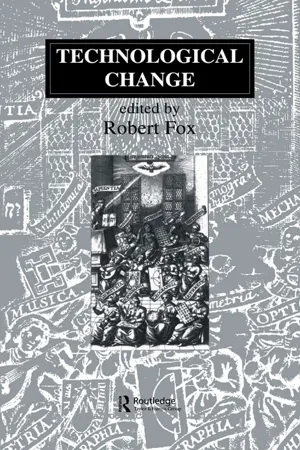
- 288 pages
- English
- ePUB (mobile friendly)
- Available on iOS & Android
eBook - ePub
About this book
In this volume, scholars from these two very different traditions are brought together. Never before has a single volume contained such a distinguished and diverse group of historians of technology.
Information
Technology Transfer and Industrial Transformation: An Interpretation of the Pattern of Economic Development Circa 1870–1914
Ian Inkster
ON THAT WHICH NORMALLY FAILS
Technology transfer is most often thought of as a very modern process. Even when our focus is firmly centred on the transfer of techniques between nation states (as against its transfer between industries or sectors within one economic system), attention is commonly drawn towards the relatively recent accelerations of growth that have seemingly arisen out of the transfer of technique from the USA to Europe and Japan. Just as recent are the more problematic, less successful transfers of technology from developed economies to those poorer nations attempting a programme of speedy economic modernization.1 Somewhere between these extremes lies the recent experience of the newly industrializing countries, especially the so-called “Asian tigers” — South Korea, Singapore, Hong Kong, and Taiwan — whose programmes of technology transfer and export promotion have been associated with the fastest rates of overall economic growth in the world.2
Yet technology transfer normally fails, and this is as true of recent times as it is of the distant past. It is, indeed, for precisely this reason that we may postulate that the combination of technological change and technology transfer has been a major determinant of the pattern of world development and underdevelopment from the eighteenth century to the present.3 The very particularity and peculiarity of both technological genesis and its creative adoption elsewhere has helped to forge a world of diversity, of tragedy and triumph, of poverty and prosperity. The movement of technologies has, clearly, never been osmotic. Capital and the capturing of intellectual property rights have never represented a sufficient combination for the successful transfer of either specific techniques or technological systems from one nation to another. This is so, even in cases where transfers have been tried between nations whose economic and institutional systems have had much in common. In post-war Europe and Japan, transfer in from the USA was only possible in association with tremendous institutional and attitudinal responses and adjustments.4 Indigenous technological systems, consisting as much of institutions, regulations, and cognitions as of mechanical or other techniques and artefacts, are evidently complex and distinctive, highly unlikely at any time to match the technical requisites of imported techniques.5
Despite the fact that policy makers must view historical experience in technology transfer as poor evidence of its rewards, it is precisely this tactic that appears at the heart of plans for radical economic modernization. From Independence onwards, Indian policy makers placed tremendous faith in the transforming power of technology transfer, just as they recognized the need for profound changes in institutional structure. As the First Five Year Plan put it, certain forms of indigenous “economic and social organisations are unsuited to or incapable of absorbing new techniques and utilising them to the best advantage”.6 One of the findings of the famous Mahalanobis Committee of the early 1960s was that existing large Indian enterprises were gaining special access to foreign technology, to the detriment of smaller firms and the workshop economy, and that a major tactic should be to forge complementarities between advanced foreign technologies and rural and smaller-scale technique.7 Belief in the power of foreign technology remained but was now formulated with an eye to the very recent experience of the only Asian “miracle economy” of the 1960s:
… import of know-how, particularly process know-how or product design, should continue to be allowed on a discriminatory basis, so that Indian industry is able to keep in touch with the world technological mainstream … it should be the endeavour of Indian research and development to build and develop it to suite Indian conditions, Indian environment and Indian raw material availability. This in fact is what Japan has done with great advantage to her economy.8
In summary, experience suggests that technology transfer is a potentially powerful mechanism of industrial revolution, that technology transfer normally fails, and that the creative effort and resource mobilization involved in successful technology transfer is in most senses quite equivalent to processes associated with initial, significant technological change within the core of advanced systems. At the same time, it is known that processes of technology transfer which weaken and swamp existing indigenous technological systems have been, in the long term, disastrous, and that this lesson is to be learnt from experience both recent and antique, both Asian and European.9
WINNERS AND LOSERS IN THE FIRST CLIMACTERIC
The years after the Crimean war, and especially after the Franco-Prussian war were ones of international industrial and commercial competition, imperial rivalry, and technological transfer, as statesmen and bureaucrats moved along a learning curve that described a very strong and hardening relationship between military success and industrial capacity. If around 1880 total industrial production in the new Germany was approximately one third of that of Britain, by 1913 that nation had overtaken the leader. Although in per capita industrial production Britain remained ahead, in certain areas of fairly sophisticated technique Europe and North America surged forward. The USA moved from approximate parity with Britain in steel production around the mid-1880s to a position in 1912 when annual steel production in the USA was running at 4.5 times that of Britain. Again, the dramatic rise of the German heavy chemical industry, revolving around a rapid application of the new Solvay process of soda manufacture, was associated not only with technology transfers but also with novel German technological innovations and organizational formats, the formation of enterprise-based research groups engaged in aggressive patenting and marketing, and the subsequent emergence of the electro-chemical industry.10 The mantle of technological modernity seemed to have passed quite rapidly from Britain to the USA and Germany and a small coterie of “winner” economies in which Austria, Hungary, Italy, Sweden, Russia, and Japan figured most prominently.
This industrial transformation of global proportions (global in terms of its range and its commercial, technological, and political impacts on most non-industrializing nations and regions) might be termed the first of the modern economic climacterics, a massively critical period in the natural history of the world-wide process of industrialization. While this climacteric may or may not have been characterized by the loss of strength within the industrial leaders, it is far less questionable that a major medium of transferred development was the movement of technology across the entire range of production, from agricultural machinery, through industrial prime movers, to entire transport systems (especially railways).11 It cannot be our purpose here to provide an explanation or strong interpretation of the locus of change, the mechanism of its spread, or the reasons for its stark limitation prior to 1914. Instead, we may more properly address the central importance of technology transfer in the climacteric and demonstrate certain features associated with two major cases of industrialization through transfer, those of Japan and Russia.
CASE STUDIES FROM JAPAN AND RUSSIA
Whatever the previous level of economic advancement in the Tokugawa era, as Kazushi Ohkawa has summarized, “Japanese modernisation — economic, political and social — began, at least symbolically in 1868 when the Emperor Meiji was restored to the throne”.12 It seems very clear that the first years of the Meiji period (to around 1881–4) were ones of enormous institutional innovation, characterized by a series of changes designed to remove feudal privileges without creating populist revolution, to formalize and centralize the collection of govern-ment revenues, and to establish new property rights. Finally, it may be judged that such institutional innovation was in some complex way requisite to the speedy introduction of a range of infrastructural, military, and industrial techniques from the West.13 In the years that followed, industrialization continued under the auspices of a massive governmental military programme and the continued absorption of surplus labour from agriculture into the industrial and services sectors of the economy.14
The Russian case is clearly different. Although the spurt of industrial growth in the years approximately 1887–1913 is unquestioned (per capita industrial output doubled, as did foreign trade and employment in mining, railway, and manufacturing), the tremendous difficulties of industrial diffusion within the setting of such a huge and hard terrain, compounded with the institutional backwardness of the agricultural sector, meant that the overall performance of the economy was mixed. Industrialization was enclavist.15 In Russia, a very major component of industrial modernization was the state-instigated railway, mining, and metallurgical and metalworking project in South Russia, composed of a great series of technological transfers involving European and American labour and engineering skills, entrepreneurs, financing and firms, joint ventures, and government guarantees, all primarily located within an area on the north coast of the Black Sea bounded by Odessa, Kharkov, and Rostov. This was the advanced technological site which best represented Finance Minister Sergei Witte’s vision for his nation and which best witnessed the playing out of Podkolzin’s “medley of various modes of production”.16 Whereas in Japan technology transfer became associated with a highly generalized process of economic transformation, in Russia a more concentrated effort led to a dualistic economic structure and a loss of political control at the turn of the century which was worsened by the war with Japan (1904–5), followed by a short but more broadly based industrial growth in the years 1908–13, a period of relative success brought to a close by the twin forces of war and revolution. The material on Japan and Russia that follows does not purport to provide a general survey of technology transfer to the two nations, much of which has already been delineated.17 Rather, the task here is to uncover salient features of the transfer process which illustrate the key moments of success and the importance of specific choices, mechanisms, and sequences.
THE SHIP OF STATE: JAPAN
Under the heading of statist scurrying might be demonstrated the vital importance of the Japanese government’s non-commercial and multifuctional interventions in the key years from 1868 to 1885. These ranged from original “search and buy” forays to the laying down of physical infrastructure incorporating Western techniques (docks, harbours, lighthouses, railways), training and skilling provisions, the direct employment of foreign experts at many levels, and the establishment of a system of social and political control which dampened effective resistance to new technologies. Between 1868 and 1895 some 2,500 students and officials were sent by the government to Europe and North America to study and investigate best techniques, and prior to 1910 Japanese technicians, artisans, and merchants participated in at least 38 major international exhibitions with the financial assistance of the government.18 The government’s own model factories were not merely designed as demonstrations but as part of the search and screening process. Established in 1874, its Akabane Engineering Office was designed to construct selected and tested machinery for purchase by private enterprise, a function also performed by the government printing office.19
Particularly in areas central to state interests (transport, shipping, and the military) the government set up a complex intelligence network in order to search out expertise, and a series of internal filters designed to exploit foreign employees to the advantage of industrial modernization. Once searched and screened, foreign employees were not mere technical go-betweens (itself an essential role...
Table of contents
- Cover Page
- Half Title page
- Studies in The History of Science, Technology and Medicine
- Title Page
- Copyright Page
- Contents
- Preface
- Introduction Methods and Themes in the History of Technology
- Models
- The Social Construction of Technology: A Review
- Towards a History of Technological Thought
- Bodies, Fields, and Factories: Technologies and Understandings in the Age of Revolutions
- Evolution and Technological Change: A New Metaphor for Economic History?*
- Medieval Technology and Social Change
- Lynn White's Medieval Technology and Social Change After Thirty Years
- Medieval Technology and the Historians: The Evidence for the Mill*
- Rethinking the Industrial Revolution
- Law, Espionage, and the Transfer of Technology from Eighteenth Century Britain
- Concepts of Invention and the Patent Controversy in Victorian Britain
- Technological Change During the First Industrial Revolution: The Paradigm Case of Textiles, 1688–1851
- Technology Transfer and Industrial Transformation: An Interpretation of the Pattern of Economic Development Circa 1870–1914
- The Japan That Can Say No: The Rise of Techno-Nationalism and its Impact on Technological Change
- Politics and the Passion for Production: France and the USSR in the 1930s
- Managing Complexity: Interdisciplinary Advisory Committees
- How Do We Know the Properties of Artefacts? Applying the Sociology of Knowledge to Technology
- Index
Trusted by 375,005 students
Access to over 1.5 million titles for a fair monthly price.
Study more efficiently using our study tools.
Frequently asked questions
Yes, you can cancel anytime from the Subscription tab in your account settings on the Perlego website. Your subscription will stay active until the end of your current billing period. Learn how to cancel your subscription
No, books cannot be downloaded as external files, such as PDFs, for use outside of Perlego. However, you can download books within the Perlego app for offline reading on mobile or tablet. Learn how to download books offline
Perlego offers two plans: Essential and Complete
- Essential is ideal for learners and professionals who enjoy exploring a wide range of subjects. Access the Essential Library with 800,000+ trusted titles and best-sellers across business, personal growth, and the humanities. Includes unlimited reading time and Standard Read Aloud voice.
- Complete: Perfect for advanced learners and researchers needing full, unrestricted access. Unlock 1.5M+ books across hundreds of subjects, including academic and specialized titles. The Complete Plan also includes advanced features like Premium Read Aloud and Research Assistant.
We are an online textbook subscription service, where you can get access to an entire online library for less than the price of a single book per month. With over 1.5 million books across 990+ topics, we’ve got you covered! Learn about our mission
Look out for the read-aloud symbol on your next book to see if you can listen to it. The read-aloud tool reads text aloud for you, highlighting the text as it is being read. You can pause it, speed it up and slow it down. Learn more about Read Aloud
Yes! You can use the Perlego app on both iOS and Android devices to read anytime, anywhere — even offline. Perfect for commutes or when you’re on the go.
Please note we cannot support devices running on iOS 13 and Android 7 or earlier. Learn more about using the app
Please note we cannot support devices running on iOS 13 and Android 7 or earlier. Learn more about using the app
Yes, you can access Technological Change by Robert Fox in PDF and/or ePUB format, as well as other popular books in Technology & Engineering & Historiography. We have over 1.5 million books available in our catalogue for you to explore.