eBook - ePub
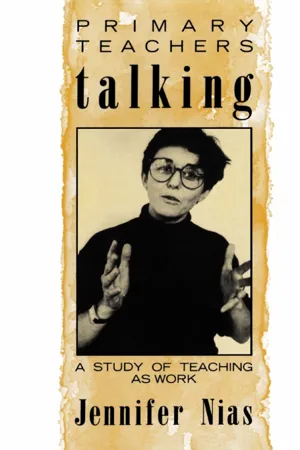
Primary Teachers Talking
A Study of Teaching As Work
- 244 pages
- English
- ePUB (mobile friendly)
- Available on iOS & Android
eBook - ePub
About this book
What is it like to be a primary teacher? The first detailed study of the personal and professional experience of primary teachers in England and Wales, Primary Teachers Talking makes extensive use of verbatim evidence supplied by teachers during interviews in their first decade of work and again ten years later. In Part I Jennifer Nias discusses the importance attached to the ways in which primary teachers see themselves and the main dimensions of that self-image. In Part II, she examines the subjective experience of 'being a primary teacher', looking at the main factors which contribute to job satisfaction and dissatisfaction, and at teachers' relationships with their colleagues. She shows that to 'feel like a teacher' is to learn to live with dilemma, contradiction and paradox and - at its best - to experience in their resolution the creative satisfactions of the artist.
Information
Part one
Chapter one
Teaching and the self
The claim that teaching is a personal activity is often advanced as a reason why it cannot be systematically taught to others or fully brought into the public domain. Yet this claim is seldom explicated or justified, to the detriment of mutual understanding among people inside and outside the profession. So, in this chapter, I show that to be a teacher in the primary (and in some instances, the middle) schools of England is to work in a historically determined context that encourages individualism, isolation, a belief in one’s own autonomy and the investment of personal resources. Each of these conditions stresses the importance in teaching of the teacher as a person, as distinct from, though not as opposed to, the teacher as the possessor of occupational knowledge and skills. In other words, the self is a crucial element in the way teachers themselves construe the nature of their job. In turn, this directs attention to theoretical formulations of the self, a hypothetical construct which has been explored by, among others, poets, philosophers, psychologists, social psychologists and sociologists. Here, I focus upon the sociological and psychological perspectives provided by symbolic interactionism, Freudianism, and self-psychology, and in particular upon the nature of the self as ‘me’ and the self as ‘I’.
Teaching as an individual activity
Unique and interpersonal
Most obviously, teaching is a personal activity because the manner in which each teacher behaves is unique. Teaching, like learning, has a perceptual basis. The minute-by-minute decisions made within the shifting, unpredictable, capricious world of the classroom and the judgements teachers reach when they are reflecting on their work depend upon how they perceive particular events, behaviours, materials, and persons. In turn, these perceptions are determined by schemata (‘persistent, deep-rooted and well-organized classifications of ways of perceiving, thinking and behaving’ which are also ‘living and flexible’, Vernon 1955: 181) or basic assumptions (‘schemata . . . organised in more generalised, vague or ill-defined patterns’, Abercrombie 1969: 64) which help us to order and make sense of the world around us. Schemata and assumptions are learned; they are slowly built up as, from birth, we develop and exercise the skill of seeing (or hearing, smelling, tasting, touching). They are modified by experience and activity. Since no two people have the same life experiences, we all learn to perceive the world and ourselves as part of it in different ways. So teachers, as people, ‘see’ and interpret their pupils and the latter’s actions and reactions according to perceptual patterns which are unique to themselves. No matter how pervasive particular aspects of a shared social or occupational culture may be or how well individuals are socialized into it, the attitudes and actions of each teacher are rooted in their own ways of perceiving the world.
This biological explanation for teachers’ individualism exists side by side with a persistent historical tradition which emphasizes the teacher’s personality. In his study of elementary schoolteachers in the USA, Lortie (1975: 79) pointed to an unchallenged orthodoxy, that ‘personal predispositions are not only relevant but, in fact, stand at the core of becoming a teacher’, and Connell (1985) noted the same with Australian secondary teachers. In the United Kingdom similar views have been expressed, not only by academics (Woods 1981; Pollard 1985; Sikes et al., 1985) but also by Her Majesty’s Inspectorate and the Department of Education and Science. The New Teacher in School (DES 1982: 6.2) claimed: ‘HMI found that the personal qualities of the teachers were in many cases the decisive factor in their effectiveness. A similar view was put forward by schools’; and the government White Paper Teaching Quality (DES 1983: 1.26) argued: ‘Personality, character and commitment are as important as the specific knowledge and skills that are used in the day to day tasks of teaching’. Small wonder, then, that practitioners themselves perpetuate a largely unquestioned assumption that ‘what gets taught is the teacher’.
This stress upon personality is encouraged by allegiance to philosophical traditions which see the personal relationship between teacher and learner as central to the educational process. Two centuries ago Rousseau wrote Emile, a prescriptive account of the education of one child by his tutor. On to this Romantic preoccupation with the individual, practising educationalists grafted the Christian tradition — expressed by Froebel and Pestalozzi as respect and concern for the whole child and by Buber as the ‘I-thou’ relationship (in which the teacher as a person becomes a resource for the self-activated development of the learner). Today many primary school teachers still see the personal relationship which they have with individual children not just as a means of establishing control and increasing motivation but also as the means by which education itself takes place (see, e.g. Lieberman and Miller 1984; Woods 1987a; Nias 1988).
Moreover, throughout their professional education and socialization, teachers are led to believe that they are capable of ‘knowing’ not just one child, but all the pupils in their care (Alexander 1984). When Kay Shuttleworth set up the first teacher training college in England at St John’s, Battersea, he took many of his ideas from Pestalozzi’s work in Switzerland. Among them were the notions that teaching should be inspired by love and that teachers should therefore live and work among their pupils. This aspiration was itself drawn partially from Froebel’s metaphysical concern for the centrality of unity and wholeness and his consequent belief that education should be an organic process, free of artificial and damaging divisions. Teachers socialized into this tradition tend to identify with their classes, to talk of themselves in relationship to their pupils as ‘we’. They tacitly believe that their personal relationship is with the whole class, not just one child.
Isolation and autonomy
The centrality of the personal relationship between teacher and pupils is further emphasized by the solitary nature of much primary teaching. Until recently, the architectural design of most English primary schools has unquestioningly followed the tradition, established in urban elementary schools in the nineteenth century, that instruction is best carried out in ‘box’ classrooms occupied by one teacher and a group of thirty to forty children. These classrooms are cut off from one another, though they are usually linked by a corridor, a staircase, or, in older schools, a central hall. In addition, windows are often placed so that it is difficult for passing teachers to see into one another’s rooms. The isolation imposed by architecture has helped to foster an occupational context from which teachers learn to expect that much of their working lives will be spent with children not adults; teaching will be not only private but lonely (Lieberman and Miller 1984).
Further, initial teacher education provides students with relatively few chances to observe their more experienced colleagues in action and, except in open plan schools, the latter seldom see one another teaching. This lack of opportunity to ‘sit by Nellie’ encourages students and probationers to feel that they must survive by their own efforts and to believe in an occupational rite de passage which equates the establishment of competence with suffering. As many have argued (notably Lortie 1975; Hargreaves 1980), teachers have little opportunity or incentive to develop shared professional knowledge or a collegial sense of the ‘state of the art’. As a result, in teaching as in social work (England 1986), there is a widespread belief in the intuitive basis of all professional action. Teacher education, experience, and conventional wisdom continually underline the uniqueness of the individual, the specificity of context and the primacy of the person.
These tendencies have been encouraged by the relative freedom from political control which primary teachers have until recently taken for granted (although, as Broadfoot and Osborn (1986) point out, in a comparative study of French and English teachers, the latter’s freedom is restricted in practice by the power of their head teachers). For much of the past hundred years, teachers in Britain have felt that it was their responsibility to make far-reaching decisions about the curriculum and teaching methods used in their classes, to the point that there is little continuity, communication or agreement between classes in some schools. Indeed, as Alexander (1984) points out, the more immersed teachers become in their own classes, the freer head teachers are to exercise leadership over the whole school, unchallenged by any demand from their staff for co-operative planning or decision-making. Teachers often learn to depend upon their own knowledge, interests and preferences in making pedagogic and curriculum decisions. Indeed, this freedom from external constraints and collegial influence is, for some teachers, one of the main attractions of the job (though others deplore the sense of incoherence which it sometimes gives to their work, Nias 1980).
A sense of autonomy in matters of curriculum and pedagogy is closely related to the ideological freedom which most British primary teachers enjoy. This is particularly important because few of them are satisfied with imparting only knowledge or skills to their pupils. Rather, they have always been chosen, or have selected themselves, in part for their concern with religious, moral, political, or social values (Rich 1933; Tropp 1957; Floud 1962). The study by Ashton et al. (1975) of primary teachers’ aims, found that the majority thought that aims relating to social and moral education were more important than those which were concerned with intellectual, physical, or aesthetic education, while Lortie (1975), Lacey (1977), Woods (1981; 1984), Connell (1985), Sikes et al. (1985), and Smith et al. (1986) have all highlighted the continuing existence within the profession of individuals with strong dedication to religious, political or humanitarian ideals. Kay Shuttleworth’s vision of a band of ‘intelligent Christian men entering on the instruction of the poor with religious devotion to their work’ (quoted in Rich 1933) is still, mutatis mutandis, a recognizable one in many schools.
However, as studies such as those by Hartley (1985) demonstrate, there is little agreement, even within single schools, on which moral or educational values should be transmitted. Indeed, given the different social and curricular traditions (Blyth 1967) which have shaped the primary system and into which its teachers are socialized, it would be surprising if there were. Educational writers such as Alexander (1984), Kelly (1986), and Delamont (1987) have drawn attention to the persistence of this plurality, arguing that conflicting views of the nature of knowledge, and thus of teaching and learning, still bedevil primary schools. The epistemological confusion which such authors describe, does, however, allow those teachers and head teachers who have a coherent philosophy to pursue it with relative impunity. Despite recent political developments, the English system still offers plenty of scope to individuals who wish to propagate particular views of the educational process.
Teachers’ freedom to make many of the decisions which closely affect their work and to select within broad limits the values which they seek to transmit, has also been protected in the past few decades by attempts to define teaching as a profession and therefore to regard it as self-governing. Although political decisions taken between 1986 and 1988 have undermined these efforts in England and Wales, habits of autonomy are likely to die hard. Teachers will probably go on expecting to enjoy large measures of personal choice and discretion in matters relating to the conduct of their classrooms.
Personal investment
Finally, there are some teachers who, consciously or unconsciously, reduce the boundaries between their occupational and other lives. For them, teaching is very ‘inclusive’ (Argyris 1964), i.e., it absorbs much of their time and energy and makes use of many of their talents, skills or abilities. For such people, teaching is particularly personal in the double sense that it draws upon interests and capacities which might, in other occupations, be reserved for non-work activities and that it allows little space for the development of alternative lives. Indeed, the more demanding it becomes of imagination, insight, problem-solving, and professional skills, the more it offers an outlet for creative potential, thereby reducing individuals’ need to seek the latter elsewhere. Similarly, when teaching is conceptualized as a relationship between two or more people, rather than as an instrumental activity, it becomes possible for teachers to find personal and emotional satisfactions within their working lives rather than outside them.
The fact that teaching as an occupation is potentially ‘inclusive’ is compounded by the chronic scarcity of resources from which it suffers. By definition, no teacher ever has enough time, energy and material resources to meet all the learning and personal demands of a large class of young children. To this shortage are now added recent expenditure cuts at both local and national levels. Yet as an occupation, teaching has a bottomless appetite for ‘commitment’ (i.e. ‘a readiness to allocate scarce personal resources’, Lortie 1975: 189). As a result, teachers are easily trapped. The more they identify with their jobs, the greater the satisfaction they receive from their personal relationship with individuals and classes, and the more outlet they find in their work for varied talents and abilities, the greater the incentive that exists for them to invest their own personal and material resources in their teaching. They are, in short, beset by the double paradox that the personal rewards to be found in their work come only from self-investment in it and that when the cost of the latter is too high, the rewards are also reduced. The ‘hidden pedagogy of survival’ (Woods 1979) brings teachers little satisfaction.
Individual teachers
Primary teaching is, then, an activity which for psychological, philosophical and historical reasons can be regarded as individualistic, solitary and personal, inviting and, in some senses, requiring a high level of self-expenditure. As Pollard (1982) has shown, although primary teachers do work under common structural constraints they perceive them differently and react to them individually, making personal meanings (shaped by their personalities, biographies, and work contexts) out of similar situations and reacting to them in ways which have meaning for them (see also Woods 1987b). It follows that any understanding of primary teachers’ actions and reactions must be based upon knowledge of them as people.
However, this line of thinking leads into poorly charted territory. Surprisingly, an occupation which has for nearly 200 years attached great importance to the idea of knowing and catering for the individual child has paid little formal attention to the concept of the individual teacher. Particular primary teachers have attracted some largely unflattering attention from fiction writers (see, for example, Biklen, 1986a), but very little from academics or from teachers themselves. There have been a few attempts (notably Elbaz 1983; Bussis et al. 1976; Brown and McIntyre 1986; Calderhead 1987 — in Canada, the USA, Scotland, and England, respectively) to examine the professional or craft knowledge of individuals, to portray their ‘ideologies’ (Hartley 1985) or personal constructs (Ingvarson and Greenway 1984), or to record their feelings (Hannam et al. 1971; Huggett 1986; Spencer 1986). One or two life histories exist (e.g. Aspinwall 1986) but, apart from the follow-up study undertaken by Smith et al. (1986) into the staff of an innovative American elementary school, there has so far been no work on individuals’ lives and careers comparable to that carried out by Sikes et al. (1985) or Connell (1985) on English and Australian secondary teachers. Individuals feature in the school studies of King (1978), Berlak and Berlak (1981) and Pollard (1985), but their opinions and activities are treated as if they were representatives of groups or sub-cultures. Moreover, studies such as these make more use of observation than of interviews. In short, few attempts have been made to portray the subjective reality of teaching from the standpoint of, or in the words of, teachers themselves.
Notions of self
To emphasize the personal nature of teaching is also to draw attention to the importance of the ‘self’. Yet, although terms such as ‘self-concept’, ‘identity’, ‘self-esteem’, ‘the ideal self’ have multiplied in educational writings, they are, like the notion of the ‘self’ itself, hypothetical constructs which do not refer to anything tangible or directly observable. Any choice of explanatory system for them is therefore to some extent arbitrary.
Symbolic interactionism: the self as ‘me’
One such system which offers many productive insights is symbolic interactionism, a set of ideas primarily associated with two Americans, Charles H. Cooley and George H. Mead. Although the psychologist William James made the distinction in the 1890s between ‘I’ and ‘me’, it was Cooley (1902, 1983 edn) who argued that through interaction with people to whose behaviour we attach symbolic meanings we learn to take other people’s perspectives and so to see ourselves as we think they see us. In doing so we come to have an awareness of ourselves as objects. Mead (1934) elaborated this idea, claiming that the self can be an object to itself (that is, ‘I’ (ego) can observe, be aware of and think about ‘me’ (alter)). We experience ourselves in the same ways that we experience the people and things with which we come in contact. More than that, by interacting (or talking, as Mead argued) with others, we become aware of the attitudes they hold towards us and this in turn shapes the way we see ourselves. Our ‘selves’ are inescapably social. Deprived of interaction with others we would have no sense of self, for ‘selves can only exist in definite relationships with other selves’ (Mead 1934: 164).
This is not to claim that all interactions are equally important in determining the way we see ourselves. Social psychologists now generally accept that ‘significant others’ (the idea, though not the term, was coined by Cooley) have a particularly powerful effect upon our self-concept. For, as Cooley (1902, 1983 edn: 175) argues: ‘In the presence of one whom we feel to be of importance, there is a tendency to enter into and adopt, by sympathy, his judgment of myself.’ Mead built upon this idea when he introduced the concept of the ‘generalised other’. His suggestion was that, in time and through repeated interactions, we internalize the attitudes not just of particular people but also of organized social groups (e.g. churches, political parties, community groups, work forces). When we do this, we supplement with new influences the forms of internal regulation we have acquired through identification with significant others. Our behaviour as adults is therefore likely to vary not just in relation to the social context of which we are immediately a part but also according to the ‘reference group’ (Newcomb 1950) whom we have in mind in any particular situation. In other words, Mead set the scene for the development of the notion of ‘multiple selves’, each sustained and regulated by reference to different ‘generalised others’.
‘Situational selves’ and ‘substantial self’
Yet few social psychologists would wish to defend a totally situational view of the self. Katz (1960) suggested that each individual develops an inner self or core through contact with significant others. Writing as a biologist, Abercrombie (1969) put forward similar views, arguing that, at birth, individuals begin to develop assumptions about the world and themselves as part of it, through the processes of perception. The most potent schemata or assumptions (including those which are self-referential) are established by close physical contact between the infant and growing child and those who care for him/her. Because they are formed before the child can talk, and ‘having been made non-verbally are very difficult to talk about’ (Abercrombie 1969: 73), it is particularly hard for individuals to uncover the fundamental assumptions they have about themselves. These therefore remain relatively impervious to change.
Ball (1972) used the term ‘substantial’ to distinguish this inner core, which, he argued, is persistently defended and highly resistant to change. It comprises the most highly prized aspects of our self-concept and the attitudes and values which are salient to them. This idea, that we most strongly protect from challenge those attitudes which are expressive of self-defining values, finds support from other theoretical perspectives. Rogers (1982) argued from his experience as a psychotherapist and educationalist that individuals need to maintain consistent self-concepts and will reject new ideas which they do not perceive as compatible with their view of themselves. Festinger (1957), observing that people often find it psychologically uncomfortable to hold views which are mutually incompatible or to act in ways which are inconsistent with one or more of them, suggested that we resolve the resulting ‘cognitive dissonance’ by changing our views or actions so as to bring them into line with one another. Rokeach (1973) went further, claiming that the dissonances most likely to precipitate change in an individual arise not at the level of views but of beliefs and values. By implication, it is against dissonance in values or between values and actions that we most strongly protect ourselves. The group psychotherapist, Foulkes, was also of this opinion. He argued that ‘the nuclear family imbues and impregnates the individual from his earliest phase of life and even before birth with the total value system of the culture of which this family is part’ (Foulkes 1975: 60). We become habituated to the patterns of behaviour derived from these values and very skilled in their defence, to the extent that in new situations we try to recreate the relationships which sustain and perpetuate the values from which our view of ourselves derives. There is, then, support from different disciplines for the idea that we each develop a relatively impervious ‘substantial self’ which can be distinguished from our ‘situational selves’ and which incorporates those beliefs, values and attitudes which we feel to be most self-defining. This is not, however, to argue for a completely static view of the self. To be sure the substantial self is hard to...
Table of contents
- Cover Page
- Title Page
- Copyright Page
- Acknowledgements
- Introduction
- Part one
- Part two
- References
Trusted by 375,005 students
Access to over 1.5 million titles for a fair monthly price.
Study more efficiently using our study tools.
Frequently asked questions
Yes, you can cancel anytime from the Subscription tab in your account settings on the Perlego website. Your subscription will stay active until the end of your current billing period. Learn how to cancel your subscription
No, books cannot be downloaded as external files, such as PDFs, for use outside of Perlego. However, you can download books within the Perlego app for offline reading on mobile or tablet. Learn how to download books offline
Perlego offers two plans: Essential and Complete
- Essential is ideal for learners and professionals who enjoy exploring a wide range of subjects. Access the Essential Library with 800,000+ trusted titles and best-sellers across business, personal growth, and the humanities. Includes unlimited reading time and Standard Read Aloud voice.
- Complete: Perfect for advanced learners and researchers needing full, unrestricted access. Unlock 1.5M+ books across hundreds of subjects, including academic and specialized titles. The Complete Plan also includes advanced features like Premium Read Aloud and Research Assistant.
We are an online textbook subscription service, where you can get access to an entire online library for less than the price of a single book per month. With over 1.5 million books across 990+ topics, we’ve got you covered! Learn about our mission
Look out for the read-aloud symbol on your next book to see if you can listen to it. The read-aloud tool reads text aloud for you, highlighting the text as it is being read. You can pause it, speed it up and slow it down. Learn more about Read Aloud
Yes! You can use the Perlego app on both iOS and Android devices to read anytime, anywhere — even offline. Perfect for commutes or when you’re on the go.
Please note we cannot support devices running on iOS 13 and Android 7 or earlier. Learn more about using the app
Please note we cannot support devices running on iOS 13 and Android 7 or earlier. Learn more about using the app
Yes, you can access Primary Teachers Talking by Professor Jennifer Nias,Jennifer Nias in PDF and/or ePUB format, as well as other popular books in Education & Education General. We have over 1.5 million books available in our catalogue for you to explore.