- 192 pages
- English
- ePUB (mobile friendly)
- Available on iOS & Android
eBook - ePub
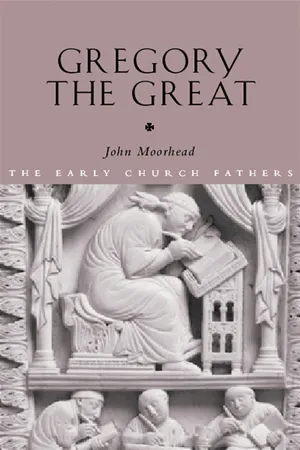
Gregory the Great
About this book
Gregory's life culminated in his holding the office of pope (590 - 604). He is generally regarded as one of the outstanding figures in the long line of popes, and by the late ninth century had come to be known as 'the Great'. Along with Ambrose, Jerome and Augustine, he played a critical role in the history of his time, while during the middle ages his intellectual influence was second only to that of Augustine.
This volume provides a biographical and intellectual context to Gregory the Great, and new translations of his most influential writings.
1
INTRODUCTION
The voice of Gregory the Great is a strange one, which speaks in accents alien to the modern West. Yet his works reveal great intellectual ambition, his Moralia in Iob being among the longest books to have been written in Latin at the time of its composition; the response to them was extraordinarily immediate, widespread and enthusiastic; and the sustained interest taken in them during the centuries which followed Gregory’s life has made him one of the most influential authors ever to have written in the West. Moreover, his books were not the products of an idle mind but written during the exercise of very demanding duties. Such considerations suggest that it may be worthwhile coming to terms with his achievement. Even in his strangeness, Gregory may speak to modern readers.
Life and deeds
Gregory’s life culminated in his holding the office of pope (590–604). He is generally regarded as one of the outstanding figures in the long line of popes, and by the late ninth century had come to be known as ‘the Great’, a title which is still applied to him. Yet he was unusual among the popes of late antiquity. These tended to be men of no great social standing who acceded to papal office on the basis of seniority among the clergy of Rome. Gregory, however, came from an established and wealthy family, and became heir to a large home on the Clivus Scauri, just opposite the Circus Maximus, which can still be seen in Rome.1 The family had strong church connections. Gregory was a great-great-grandson of an earlier pope, Felix III (483–92), and may have been related to another holder of that office, Agapetus I (535–36). His father, Gordianus, was an employee of the Roman church, three of whose sisters became nuns, although one later scandalized her nephew by marrying.2 We do not know the year of Gregory’s birth, but in about 573 he was holding public office, perhaps the important post of prefect of the city of Rome. However, following the death of his father, he turned the family home into a monastery, and established six monasteries in Sicily on the family estates. The gesture was a common one in the period: we know of monasteries founded in various parts of Italy not long before by two other men who had been administrators, Cassiodorus and Liberius, as well as the general Belisarius. But Gregory went one step further than many founders of religious houses by becoming a monk himself. He entered the monastery at Rome and devoted himself to monastic life with the utmost seriousness. He was in contact with some of the disciples of St Benedict, who some decades earlier had written what was to be the most important Rule in western monasticism. His followers had fled to Rome following the destruction of their monastery at Monte Casino by Lombards in about 585. Gregory’s dealings with them were to be of great importance in the fame of St Benedict, and his enthusiasm for the earlier monk suggests the importance of such ideals in his own life. In years to come, after he had been forced to abandon monastic life, he looked back with nostalgia on life in his monastery.
His family origins, secular career and monastic state make Gregory stand apart from most popes of the period. Yet he became marked for preferment in the Roman church. He was made deacon, that is a member of the clergy holding the rank from which popes were generally selected, and pope Pelagius II (579–90) used his talents in attempting a rapprochement with a group in Italy who had broken away from communion with Rome over what were called the Three Chapters, a body of texts which had been condemned, wrongly according to the schismatics, at the Council of Constantinople in 553. In about 579/580 Pelagius pulled Gregory out of his monastery and sent him to Constantinople, seat of the emperor, as papal ambassador, or apocrisiarius. While in the city, in many ways more central than Rome in the Christian world of the time, he developed a network of friends and acquaintances, although he did not learn Greek. This failure is a little hard to account for, particularly in a diplomat, but for much of the sixth century Constantinople was the most important city for Latin letters, and it may have been quite possible to discharge his duties without the need to learn the language which had come to predominate in the city.3 A few decades later this would have been much more difficult. His diplomatic activities are unknown to us, but it is reasonable to suppose that Gregory exerted himself to try to gain military aid for Italy, then suffering from a group of Germanic newcomers, the Lombards, but the resources of the empire were stretched, and any attempts were not successful. On returning to Rome in about 586 he re-entered his monastery. But no-one can have been surprised when, following the death of pope Pelagius in February 590, he was elected pope. Approval was obtained from the emperor Maurice in Constantinople, and Gregory was consecrated as his successor on 3 September 590.
Gregory therefore brought a number of qualities to papal office: the self-assurance which came from belonging to a wealthy and established family; a genuine concern with the spiritual life; and a track record of practical administration, both secular and ecclesiastical. But when he was elected he asserted vehemently that he did not wish to assume the office of pope. Before long it was being said in Gaul that he had written to the emperor declining the job.4 In a series of letters written during the month after he became pope, Gregory used metaphors to express his position. He told the patrician Narses that in advancing outwardly he had fallen from his lofty quiet and, while he may have looked like a lion, he was really an ape the (Reg. 1.6); the emperor had ordered that an ape become a lion, 1.5fin). But another metaphor came more readily to him. He told John, the patriarch of Constantinople, that he had received an old ship which the waves were washing into, its rotten timbers sounding shipwreck (Reg. 1.4). To the emperor’s sister he complained that, having become a bishop, he found himself having to deal with more business than he remembered having to transact when he was a layman, so that his outward rise involved an inner fall. He was being thrown about by the waves of business and sunk by storms (Reg. 1.5). To a former bishop of Antioch he wrote:
I am being smashed by many waves of affairs and afflicted by the storms of a life of tumults, so that I may rightly say: I am come into deep waters where the floods overflow me [Ps. 69:2]. And so, you who stand on the shore of virtues, stretch out the hand of your prayer to me in my danger (Reg. 1.7).
It would be possible to interpret Gregory’s reluctance, so vehemently expressed, in a negative way, for unwillingness to accept the office of bishop could, paradoxically, be seen as a sign that one was well suited to it. Such protestations of unworthiness, particularly coming from someone who must have been generally seen as papabile for some time, could therefore have been hypocritical manoeuvres designed to display his worthiness of the office. But as we shall see, such sentiments fit well with the general structures of Gregory’s thought. And beyond this, the situation of Italy at that time was parlous. It was a bad time to come to the exercise of authority.
At the beginning of the sixth century, Italy had enjoyed peace and a degree of prosperity under the long rule of Theoderic, king of the Germanic Ostrogoths (493–526). But in 535 it was invaded by an army sent by the emperor Justinian to bring it back under the control of the Roman Empire, the capital of which was now Constantinople. The war between the Ostrogoths and the Empire lasted for some twenty years, devastating the countryside and disrupting social organization. Rome suffered from repeated sieges, and during 546 the city lay uninhabited for forty days. The final victory of the imperial forces left Italy dangerously open to the attentions of another Germanic group, the Lombards. In 568, under their king Alboin, they made their way into Italy, and by force of arms steadily established themselves over most of the peninsula. Their advent and settlement, marked as it was by continuing military conflict, widespread expropriations of land, and a degree of religious persecution, the Lombards being sometimes of an anti-catholic disposition, were much more violent than that of the Ostrogoths had been.5 In the opinion of Gregory, the race of the Lombards was simply ‘most unspeakable’.6
Yet he had to deal with them. During late antiquity, bishops had come to shoulder heavy burdens of leadership in secular affairs; just a few decades earlier, for example, bishop Paulinus of Aquileia is said to have responded to a Lombard threat by the dramatic step of leading his people to a more secure settlement.7 Moreover, it took something like a month for a message to pass from Rome to Constantinople, and the Empire was involved in intermittent warfare with its old enemy Persia and pressing military difficulties of a new kind in the Balkans, so that Italy, which had so enticed Justinian, suddenly became a secondary concern. The official responsible for Italy, the exarch, did his best with few resources from his base in Ravenna, a town due north of Rome on the Adriatic coast, but his priorities were not always those of the bishop of Rome; what seemed like judicious compromise to a pope could look like treason to a servant of the emperor. And it had become clear during the sixth century that emperors looked on papal office in a way very different from the way the popes themselves did. In 537 pope Silverius had been deposed by the imperial authorities; his successor, Vigilius, who owed his appointment to the patronage of the empress, was later arrested and taken to Constantinople, which he was not to leave for ten years, while the following pope, Pelagius I, was an imperial nominee. The omens for relations between Gregory and Maurice were not good.
As it happened, Gregory became pope at a time of new leadership among the Lombards. Just two months after his consecration, Agilulf became their king, ruling from the northern town of Pavia, while the following year saw duke Ariulf installed at Spoleto, a town dangerously placed some 100 km to the north of Rome from which he was able to control traffic along the Via Flaminia, the traditional route between Ravenna and Rome, and another new duke at Benevento in the south of Italy. Before long, Gregory had to cope with attacks from Ariulf. In a way which must have been utterly uncongenial to someone who had already lamented the need to become involved in secular affairs, he now found himself organizing supplies and overseeing the movements of troops. In July 592 he concluded a peace with the duke of Spoleto, and in 593, when king Agilulf besieged Rome, Gregory was said to have met him on the steps of S Peter’s and prevailed upon him to leave. In 595 he chose to pick a quarrel over the assumption by the bishop of Constantinople of the title ‘universal patriarch’. To the emperor’s claim that Gregory was a fool he replied, thinking of one of his heroes from the Bible, that in this respect he was like Job (Reg. 5.36), and in a passage of wonderful hyperbole he expressed himself on the secular and ecclesiastical situations:
Behold, all things in the regions of Europe have been handed over to barbarians, cities have been destroyed, fortifications overthrown, provinces depopulated, no cultivators occupy the land, idol worshippers rage and lord it over the faithful every day to the point of killing them; and nevertheless priests, who should be throwing themselves onto the ground weeping with ashes, seek for themselves empty titles and take glory in new and profane words (Reg. 5.37).
Gregory was furious at the assumption of the title, although by this time it was scarcely ‘new’, seeing it as diabolical arrogance and a sign of the coming of the Antichrist, but the sustained campaign he waged against its use by the patriarch, like a number of his operations, could make no headway; such failures are a reminder of the weakness of papal authority in the period. The vehemence of his response suggests it touched something very deep, and later we shall note the importance of pride in Gregory’s thinking.
However, in important respects the situation in Italy improved as Gregory’s pontificate continued. Towards the end of 598 peace was concluded between the Empire and the Lombards, although trouble would rumble on. He was able to cultivate a Bavarian catholic, Theodelinda, who, being successively the wife of kings Authari and Agilulf, turned out to be an influential queen of the Lombards, sending her a copy of one of his books. He rejoiced when Adaloald, the heir to the Lombard throne, was baptized a catholic in 603.8 In 602 Phocas, an unsavoury soldier, overthrew the emperor Maurice, with whom Gregory’s relations had often been cool, and acceded to the throne, a development at which the pope professed hearty satisfaction. By the time of his death in March 604, Gregory could look with a degree of satisfaction on the affairs of Italy and the Empire.
As the bishop of the city, Gregory had particular oversight over Rome, which was by no means immune from the difficulties which faced Italy.9 Preaching at a particularly difficult time, Gregory wondered whether there was anything in the world which could give pleasure. Everywhere there were things to grieve at and groans to be heard. Cities had been destroyed, fortifications overthrown, fields depopulated, and the land turned into a wilderness.10 There was now no senate in Rome and its people were perishing; the few people who were left had to endure greater sufferings every day. In its old age, the eagle, formerly the symbol of Roman power, had become bald.11 The misery of the times prompted Gregory to speculate concerning the end of the world. He discussed the signs expected to precede this at the start of a homily preached to the people of Rome a few months after he became pope, which was placed at the beginning of his collection of homilies on the Gospels. Grimly, Gregory worked his way through a list given by Jesus: nation was rising up against nation and there was distress of nations on the earth more than in the past; earthquakes were destroying countless cities in other parts of the world; there were incessant plagues; although signs in the sun and moon and stars were not yet clearly to be seen, a change in the air showed that they were not far off; and while as yet there was no roaring of the sea and waves, the accomplishment of many of these signs left no doubt that the few which remained would follow (Hev. 1.1). At the end the Judge would come, to punish evil people and reward the good, and Gregory asked his congregation to consider the terror, confused embarrassment and dread with which people would be afflicted on that day (Hev. 12.4). When the deacon Peter asked why many things about souls which had previously been hidden had recently become clear, Gregory replied that, as the present world approaches its end, the future world comes close to touching it (Dial. 4.43.1f). And while no-one knew when the last hour would come, complacency was out of the question; the best plan was to prepare for the Judge by weeping and lamenting every day (Hev. 13.6). Gregory’s sharp concern with the end of the world stands out against the mainstream of preceding postbiblical Christian thought, although it is paralleled by the earliest suras of the Qur’an, revealed just a few years later, and a sense of the imminence of the end also occurs in some Christian works of the later seventh century.
It would be fatally easy to gain, on the basis of a number of powerfully worded passages such as those we have been considering, an overwhelmingly negative picture of Gregory and his times. We must resist the temptation to do this. Gregory found it possible to put a positive spin on temporal losses: they were the means through which one could return to eternal joys, so the whole aim of the Bible could be seen as providing a hope of abiding joy which would strengthen us in the midst of passing hardships (Mor. 26.16.26). And, quite apart from consolations of this kind, in some ways the Rome of his day was a congenial place. The forum remained a centre. A person going there or to the baths could invite someone with time on their hands to keep them company (Hev. 6.6). A story known in England has Gregory, before becoming pope, joining a crowd of people looking for things to buy there,12 and a few years after Gregory died the last monument known to have been erected in the forum, a statue in honour of the emperor Phocas, was placed atop an older column. Gregory was also tireless in finding ways to make life more tolerable. In the ninth century a big book could still be seen in the Lateran palace, the headquarters of the bishop of Rome, which showed the names, ages and professions of all those, in Rome and elsewhere, who received largesse from him.13 When he heard of a priest from out of town who was able to work miracles, Gregory summoned him and placed him in a hospital: ‘If he had the power of healing, it would quickly be proved there!’ Before long the priest had laid his hands on a sick person, prayed over him and cured him (Dial. 3.35). We know of 3,000 nuns resident in Rome who received a large sum annually, but Gregory considered the money well spent, believing that it was because of their tears and abstinence that Rome had been able to hold out for many years against the swords of the Lombards (Reg. 7.23).
Gregory also proved remarkably energetic in other areas.14 In some parts of Italy churches had been devastated by the coming of the Lombards; elsewhere there were clergy of appallingly low calibre. A letter to the bishop of Cagliari in Sardinia mentions a whole raft of issues: the archdeacon had defied the bishop’s direction to cease living with women; peasants who were not Christians were living on estates owned by the church; clergy were falling into sins of the flesh, so that it was imperative that only men capable of continence were ordained; and some people were scandalized by Gregory’s prohibiting priests to touch people who were to be baptized with chrism (Reg. 4.29). But the bishop of Cagliari may not have been the best man to deal with abuses, for word later came to Gregory that he had ploughed under someone’s harvest before mass one Sunday, and returned afterwards to pull up that person’s boundary markers (Reg. 9.1). There were all too many bishops whose conduct left much to be desired, and it is clear from Gregory’s correspondence that, no less than in other spheres of his activity, compromises continually had to be made in this area as well. Not surprisingly, where he was free to act, Gregory devoted considerable care to the appointment of men likely to be good bishops.
He also acted vigorously in distant areas. His greatest success was in Britain, whither in 596 he dispatched a team of forty monks to convert the English, who lived in a part of the world of which Gregory knew very little.15 He was able to report to the bishop of Alexandria that more than ten thousand people ‘placed in a corner of the world’ had been baptized at Christmas 597,16 and in centuries to come the English fondly remembered Gregory as ‘our ...
Table of contents
- Cover Page
- Title Page
- Copyright Page
- Abbreviations
- 1 Introduction
- 2 The Bible
- 3 Sermons to the People
- 4 Human Types
- 5 Morals on Job
- Notes
- Bibliography
Trusted by 375,005 students
Access to over 1.5 million titles for a fair monthly price.
Study more efficiently using our study tools.
Frequently asked questions
Yes, you can cancel anytime from the Subscription tab in your account settings on the Perlego website. Your subscription will stay active until the end of your current billing period. Learn how to cancel your subscription
No, books cannot be downloaded as external files, such as PDFs, for use outside of Perlego. However, you can download books within the Perlego app for offline reading on mobile or tablet. Learn how to download books offline
Perlego offers two plans: Essential and Complete
- Essential is ideal for learners and professionals who enjoy exploring a wide range of subjects. Access the Essential Library with 800,000+ trusted titles and best-sellers across business, personal growth, and the humanities. Includes unlimited reading time and Standard Read Aloud voice.
- Complete: Perfect for advanced learners and researchers needing full, unrestricted access. Unlock 1.5M+ books across hundreds of subjects, including academic and specialized titles. The Complete Plan also includes advanced features like Premium Read Aloud and Research Assistant.
We are an online textbook subscription service, where you can get access to an entire online library for less than the price of a single book per month. With over 1.5 million books across 990+ topics, we’ve got you covered! Learn about our mission
Look out for the read-aloud symbol on your next book to see if you can listen to it. The read-aloud tool reads text aloud for you, highlighting the text as it is being read. You can pause it, speed it up and slow it down. Learn more about Read Aloud
Yes! You can use the Perlego app on both iOS and Android devices to read anytime, anywhere — even offline. Perfect for commutes or when you’re on the go.
Please note we cannot support devices running on iOS 13 and Android 7 or earlier. Learn more about using the app
Please note we cannot support devices running on iOS 13 and Android 7 or earlier. Learn more about using the app
Yes, you can access Gregory the Great by John Moorhead in PDF and/or ePUB format, as well as other popular books in History & Ancient History. We have over 1.5 million books available in our catalogue for you to explore.