Film Into Video, Second Edition offers comprehensive, practical information on the complex process of converting motion picture film into video. All of the tools of the trade are explained in clear, simple language, as are the operational, business, and creative sides of film to video transfer. This easy-to use guide provides the reader with the necessary foundation to approach any technological advances in this fast-paced field.
Additions to the second edition include: information on the Philips Spirit Data Cine and the new Sony FVS-1000; a new section on the latest in flying spot telecines, including Cintel's C-Reality and Ursa Electrum; an examination of recent changes in color correction computers with da Vinci's 2K and Pandora's Mega-Def systems, and in respect to Philips Spirit DataCine and Cintel's C-Reality, a discussion relating to the area of data transfer and how this has changed the telecine industry.
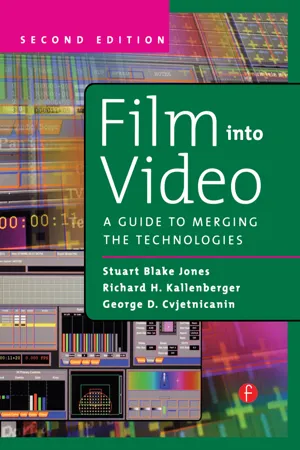
eBook - ePub
Film Into Video
A Guide to Merging the Technologies
- 416 pages
- English
- ePUB (mobile friendly)
- Available on iOS & Android
eBook - ePub
Film Into Video
A Guide to Merging the Technologies
About this book
Information
1
Film and Video: A Brief History
Assets of Film and Video
Despite years of sage pronouncements that film is an outmoded production medium shortly to be replaced by electronic technology, motion picture film is most definitely prospering in the current marketplace. The reasons for this are many. Motion picture film is a solidly founded technology, it is high in image quality, and it is supported by a large cadre of professionals skilled in its use. It is flexible, portable, and available in a number of formats suitable for a wide range of production requirements. In addition, film images have unique visual attributes that make up the “film look,” a sensory impact that is undeniably a part of our media culture.
In addition to the assets of film as a current production medium, there is also an enormous library of programming already produced on film. Feature films dating back to the beginning of the movie industry, early television kinescopes, news film, documentaries, and thousands of programs produced on film for television release all compose a remarkable resource for rerelease in the video format. For this reason alone, film will continue to be an important part of the entertainment scene for many years.
With due respect to all of the assets of film, video possesses important advantages that have brought it popularity as a production and distribution medium. Video is immediate. The image is there on the screen where results can be instantly examined and, if necessary, be immediately broadcast. During production, performances can be reviewed, and reshoot decisions can be made on the spot, providing a real financial savings. During post-production, electronically “spliced” takes can be rearranged quickly and easily, with the results instantly available. Electronic special effects can be introduced, experimented with, and incorporated without the delay of lab processing. This convenience both reduces costs and increases creative scope by allowing more to be accomplished within time constraints. Finally, the video-recording medium itself, videotape, is relatively inexpensive and reusable, allowing more to be done with a limited budget.
In today’s world, video is certainly the major visual entertainment medium. Each day, thousands of hours of programming are delivered worldwide through video technology. Broadcast television, cable television, satellite transmission, videocassettes, and now DVDs all compete for the audience’s attention. For cost and convenience, reaching the most viewers with the most images, video is the delivery medium of choice.
The Film-Video Interface
The film and video industries have been intertwined almost from the beginning of television broadcasting. After the initial novelty of live television production faded, broadcasters and program producers began working on two immediate problems: the need to time-shift broadcasts across geographic time zones and the need to improve program production values by preparing all or part of the programs in advance under controlled conditions. Both problems were solved by turning to film.
The time-shifting of live broadcasts was initially accomplished by the simple expedient of photographing a video monitor with 16mm black-and-white motion picture film, immediately processing it, and then replaying the film, or kinescope, back into the broadcast system at the desired time. News events were handled with film shot at the scene and rush-processed. “Film at 11” meant seeing a wide range of local and national events with a new immediacy.
Improving on the risky business of live broadcasting was simply a matter of adapting existing feature film production techniques to the scaled-down budgets and schedules of television. In addition, television filmmakers pioneered new techniques, such as multicamera shooting. Many of the early television programs are still with us today because they were either produced on film, or kinescoped.
As the technical quality of television improved and color broadcasting appeared on the horizon, program time-shifting methods turned to the newly developed technology of videotape. Meanwhile, engineers worked to develop film-to-video conversion devices, or telecines, that would do justice to the available color film product. Television broadcasts of existing feature films and weekly series programs produced on film called for consistent quality in color film-to-video transfer.
The technical approach to this problem differed in the United States and Europe because of the different requirements of film-to-video frame-rate conversion. In the United States, development centered on the color vidicon film chain. In this apparatus, the motion picture image from specially modified 16mm or 55mm film projectors was directed into a video camera equipped with color separation optics and three vidicon image tubes. This provided a reliable film-to-video conversion despite the inherent awkwardness of the projector-based film transport. At the same time, European engineers were adapting the flying spot scanner video-image system for film transfer use. In these devices, a light beam emitted by a cathode ray tube (CRT) scans the film to produce color video. Over time, both types of telecines were enhanced by accessory devices that provided for precise color correction and the scanning of film formats not conforming to standard television image geometry.
Ultimately, the flying spot scanner technology prevailed. Current flying spot telecines combine a smooth-running, projectorless film-transport system with electronically variable image size and position to provide a highly versatile and efficient film-to-video transfer device. Features that the telecine users of just 20 years ago could only dream of are commonplace today, including bi-directional variable-speed film motion, preprogrammable frame-by-frame color and geometry adjustments, and electronic noise and grain reduction. Recently, both Philips and Sony have provided two different methods of charge-coupled device (CCD) scanning on their respective telecines and now CCD technology is also being widely accepted throughout the industry.
Summary
As this brief description indicates, film and video have come a long way together. Gradually, the two technologies have begun to merge, each drawing on the strengths of the other to produce a more versatile and powerful result. In the remainder of this book, we will see how film and video can work together in useful ways, ultimately leading to the completely integrated electronic film systems of the future.
2
Film Technology
The Physics of the Film Medium
As a starting point in understanding the film-video interface, it is necessary to understand some of the physical basics of film technology, including film stock construction and image formation.
Film, Stock Construction
Color motion picture film is composed of a series of layers. Supporting the entire structure is a flexible strip of cellulose acetate or polyester that is known as the base. During manufacture, the base is extruded in wide sheets, which are then slit into strips of the desired width. The base gives the film stock its physical strength and mechanical properties.
The film base is coated with a series of emulsion, coupling, and filtering layers on which the image is formed and retained. Each of these layers is typically only 0.0003 of an inch thick and must be applied with great accuracy to ensure consistent film performance. Although the exact composition varies according to the type of film, most color films contain the following layers:
- Supercoat: This clear layer protects the emulsion layers from being scratched during handling.
- Emulsion Layers: Each of these three light-sensitive layers is formulated to respond as narrowly as possible to the red, green, or blue portion of the light spectrum.
- Filter Layers: These layers are inserted between the emulsion layers to help prevent unwanted light from reaching the layers beyond.
- Buffer Layers: Some films also incorporate buffer layers to prevent the chemicals of one layer from migrating to or interacting with the adjacent layers.
- Subbing Layer: The subbing layer is the “glue” that attaches the other layers to the base.

Figure 2-1. Typical color film stock construction.
The final component is an anti-halation coating applied to the back side of the base (the one farthest from the emulsions). It prevents light passing through the base from being reflected back onto the active layers and fogging the image.
Film stock is generally supplied on flangeless plastic hubs, called cores, 2 or 3 inches (51 or 76mm) in diameter. These cores are drilled with a 1-inch (25mm) keyed hole that engages the drive systems of camera magazines, processors, and other film-handling equipment. Film wound on the core with the emulsion facing the inside is designated emulsion in (El). The designation emulsion out (EO) indicates that the emulsion is facing the outside of the roll. The EO position is standard for stock that is ready for camera use.

Figure 2-2. Cutting manufactured film to width and length.

Figure 2-3. Film cores for 16mm and 55mm Aim.

Figure 2-4. Film stock (Copyright © Eastman Kodak Co. Reprinted with permission.)
Image Formation
When the emulsion layers of a film are exposed to light, the silver halide grains, which are the active part of the emulsion, undergo a chemical change that stores the pattern of light and dark areas in the scene as a latent image on the film. The latent image is so named because it is not immediately visible but must undergo further chemical reactions.
Film Parameters
While it is beyond the scope of this book to delve into film chemistry and physics, the following sections give an overview of the physical realities, which ultimately determine the quality of a film image when it is presented in the telecine.

Figure 2-5. Film grains magnified 1,200 times. (Copyright © Eastman Kodak Co. Reprinted with permission.)
Grain and Sensitivity
The silver halide grains themselves are of particular importance because their structure, density, and sensitivity to light determine the photographic capabilities of the film. Individual image sites, which may be as small as four atoms, are clustered on the surface of the silver halide grains. Naturally, the larger the grains, the greater the number of light-receptive sites, and the more sensitive the film is to light. These sensitive films are often referred to as fast films. They are capable of producing good exposures when the available light is limited. Unfortunately, the large grains are visible in the finished image, and for that reason, fast films often produce grainy images.
Improvements in film technology have resulted in emulsions comp...
Table of contents
- Cover
- Half Title
- Title
- Copyright
- Contents
- Preface
- Acknowledgments
- 1 Film and Video: A Brief History
- 2 Film Technology
- 3 Video Technology
- 4 Film into Video
- 5 Telecine Devices
- 6 Video Recorder Formats
- 7 Sound Formats
- 8 Sound Transfer Devices and Applications
- 9 Supporting Devices
- 10 Planning for Film-to-Video Transfers
- 11 Video Facilities and Costs
- 12 The Telecine Environment
- 13 Telecine Methods and Techniques
- 14 Five Sample Scenarios
- 15 Video-to-Film
- Appendix A: Cintel Ursa Transfer Speeds
- Appendix B: Philips Spirit DataCine Transfer Speeds
- Appendix C:
- Appendix D:
- Glossary
- Index
Trusted by 375,005 students
Access to over 1.5 million titles for a fair monthly price.
Study more efficiently using our study tools.
Frequently asked questions
Yes, you can cancel anytime from the Subscription tab in your account settings on the Perlego website. Your subscription will stay active until the end of your current billing period. Learn how to cancel your subscription
No, books cannot be downloaded as external files, such as PDFs, for use outside of Perlego. However, you can download books within the Perlego app for offline reading on mobile or tablet. Learn how to download books offline
Perlego offers two plans: Essential and Complete
- Essential is ideal for learners and professionals who enjoy exploring a wide range of subjects. Access the Essential Library with 800,000+ trusted titles and best-sellers across business, personal growth, and the humanities. Includes unlimited reading time and Standard Read Aloud voice.
- Complete: Perfect for advanced learners and researchers needing full, unrestricted access. Unlock 1.5M+ books across hundreds of subjects, including academic and specialized titles. The Complete Plan also includes advanced features like Premium Read Aloud and Research Assistant.
We are an online textbook subscription service, where you can get access to an entire online library for less than the price of a single book per month. With over 1.5 million books across 990+ topics, we’ve got you covered! Learn about our mission
Look out for the read-aloud symbol on your next book to see if you can listen to it. The read-aloud tool reads text aloud for you, highlighting the text as it is being read. You can pause it, speed it up and slow it down. Learn more about Read Aloud
Yes! You can use the Perlego app on both iOS and Android devices to read anytime, anywhere — even offline. Perfect for commutes or when you’re on the go.
Please note we cannot support devices running on iOS 13 and Android 7 or earlier. Learn more about using the app
Please note we cannot support devices running on iOS 13 and Android 7 or earlier. Learn more about using the app
Yes, you can access Film Into Video by George Cvjetnicanin,Richard Kallenberger, Stuart Blake Jones in PDF and/or ePUB format, as well as other popular books in Media & Performing Arts & Film & Video. We have over 1.5 million books available in our catalogue for you to explore.