- 196 pages
- English
- ePUB (mobile friendly)
- Available on iOS & Android
eBook - ePub
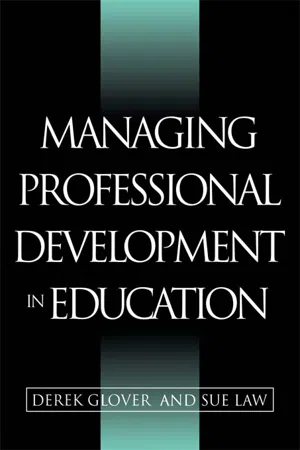
Managing Professional Development in Education
About this book
This work evaluates and attempts to produce a model for effective professional development. It contrasts the work in Britain with that in other countries, with case studies and exercises to illustrate points, highlighting good practice.
Information
CHAPTER 1
Establishing the Framework for Professional Development
Education Policy: A Focus on Change
This chapter outlines the framework of national and international policy development in education which has influenced CPD over recent decades. It begins by offering a brief overview of the social, political and economic influences which have underpinned educational developments during the post-war period. It also reviews the changing relationships between government, schools, LEAs and higher education institutions (HEIs) which have influenced the nature and management of INSET over recent years and goes on to consider the role played by CPD in developing strategies to promote ‘school improvement’ and ‘school effectiveness’. The chapter concludes by briefly examining ways in which recent developments in England and Wales match professional development trends within the wider international context—in Europe, North America and Oceania.
While professional development is often regarded as an individual matter for teachers, there is growing recognition of its crucial role as an enabling mechanism at departmental and institutional levels for creating a professional culture in which improvement strategies can flourish. During the post-war period inservice education has experienced dramatic changes. We have moved from an expansion in HEI-centred provision, supported by government-funded teacher secondments, through the development of LEA-managed INSET with a substantial cadre of advisers, to the growth of an embryonic INSET marketplace, involving a range of providers and schools as ‘customers’ and ‘clients’ and an increase in personally funded development.
For many educationalists in Britain, change now appears to be endemic. In a series of legislative forays since the early 1980s, successive Conservative governments have established a range of initiatives in schools, further and higher education and, in doing so, have articulated the need for teachers to manage change rather than merely cope with the process. While this chapter (and indeed the book) focuses most specifically on the schooling system, many of the issues and strategies outlined here are congruent with those occurring in further and higher education. In order to assess the impact of change on the nature of teacher development over the past 15 years or so, we begin our review of the wider policy context by identifying three broad aspects of change.
First, change has been driven by government legislation—most importantly the 1988 Education Reform Act (ERA), which initiated an ongoing reframing of both the ‘academic’ and ‘Vocational’ curriculum on a wide scale: in schools, further and higher education. Teachers have witnessed the introduction and review of the National Curriculum in schools (with hints of national curricula for higher and further education) and the introduction of National Vocational Qualifications (NVQs) accompanied by a focus on ‘competency’ at management levels through, for example, the Management Charter Initiative (MCI).
Second, we have seen changes to the organization and management of education, through the establishment of more ‘autonomous’ management in all sectors of education. We now have what Caldwell and Spinks (1988) have termed ‘self-managing’ schools as well as ‘incorporated’ or independent colleges and universities, where governing bodies have significantly greater responsibilities and control.
New funding patterns have been established across all sectors, giving greater local financial control—and a major focus on accountability. For example, the 1988 Education Reform Act initiated the demise of LEA financial control over schools, with budgets delegated for site-based management and the establishment of grant maintained schools (GMS). Within the tertiary sector, further education colleges gained independent status by 1992, with funding overseen by the Further Education Funding Council (FEFC). At the same time, the binary divide between LEA-maintained polytechnics and universities disappeared, with both kinds of institution being deemed universities funded through the Higher Education Funding Councils for England (HEFCE), Wales (HEFCW) and Scotland (SHEFC).
Third, during the 1990s, substantial and ongoing changes have been taking place in the structure and nature of teacher education, particularly in preservice teacher education where we have seen a government-driven movement towards ‘school-focused’—or even school-centred—initial teacher education. In addition, and less obviously perhaps, there have been changes in the management and control of inservice education, through tighter government funding mechanisms and the development of government-sponsored or targeted training.
The establishment of the Teacher Training Agency (TTA) in 1994, a quango with responsibility for both initial and inservice teacher education in England and Wales, has brought an even greater immediacy to an already rapidly changing scene. Clearly, within the limits of this chapter it is impossible to deal comprehensively with the array of changes which have influenced teachers’ professional development over recent decades. Nevertheless, by placing broader CPD initiatives within their historical context, we are better able to track developments in INSET perceptions, policy and practice and establish a clearer framework for understanding how professional development is being managed within schools and colleges.
Transformations in Teacher Education: The Policy Context
For much of the post-war period, CPD and INSET in England and Wales remained very much the ‘Cinderella’ of teacher education (Williams, 1991), largely ignored by government in policy debates, frequently sidestepped in legislation, and too often the subject of ‘recommendation and pragmatic action’ (Burgess, 1993). Nevertheless, despite this apparent neglect, both the structures and relationships around teachers’ professional development have undergone significant change over recent years, often because initiatives elsewhere in the education service have had a ‘knock-on’ effect on the nature of inservice provision.
We turn initially, therefore, to the policy framework surrounding teachers’ professional development, In the immediate aftermath of the Second World War, education alongside welfare and employment became a high priority on the government's reconstruction agenda and education policy development was framed by cross-party consensus. The 1944 ‘Butler’ Education Act was passed in the same year as the Beveridge Report with its focus on the welfare state and Keynes’ White Paper on Employment which sought to establish ‘high and stable employment’. Indeed, the thinking behind both the Beveridge and Keynes documents was influential in developing the pattern of post-war education provision. In line with the 1944 Education Act's commitment to ‘education for all’ at both primary and secondary levels as well as its commitment to raising the school-leaving age, policy-makers acknowledged the need to provide, with some rapidity, a trained teaching force capable of meeting the new demands.
The McNair Commission, set up to ‘investigate the sources of supply and the methods of recruitment and training of teachers’ (Board of Education, 1944), reported that there was a need to remedy the inadequacies of
pre-service teacher training provision in order to meet the expanding demand for teachers. In addition, McNair made a plea for improved inservice provision, recommending that ‘refresher and other courses’ should be widely available and that ‘necessary arrangements’ should be made for ‘teachers to be allowed sabbatical terms and in helping them to make the best use of them’. So while INSET was acknowledged as a valuable element in teacher education, for McNair it comprised little more than short, updating courses.
In your experience…
How far do you think that you and your colleagues think of professional development as comprising ‘updating’ or ‘refresher’ courses? Do you think policy-makers see it in this way today? Is this how INSET is used in most schools and colleges? If so, why might this be?
It may be that most of the INSET undertaken and funded by your own institution focuses on ‘refreshing’, ‘updating’ or ‘awareness raising’, since rapid changes and new initiatives expose our need for new knowledge. Over recent years, refresher courses and updating events have become commonplace, first because it is often easier to justify instrumentally focused training rather than more broadly based conceptions of development; second, it is cheaper than longer-term development-focused work; and third, because of imperatives to introduce massive ‘instructional training’ at speed in order to implement, for example, GCSEs, the National Curriculum and NVQs.
Between 1944 and 1950 there was a clear emphasis on the emergency training of new teachers with the immediate focus resting, not surprisingly, on initial training rather than inservice. The period up to 1970 also saw considerable expansion, both within the schools sector and in teacher education and training. As the schools system expanded, there were major implications for further and higher education, both of which needed to increase provision to meet rising student demand and to support this expansion with appropriately trained staff. However, the strategy of expansion harboured difficulties. For example, while the Robbins Report (DES, 1963) encouraged an expansion and consolidation of teacher education, only a decade later, in the mid-1970s, teacher training faced considerable contraction and rationalization as a result of reviewed demographic trends and a developing oil crisis and economic recession.
The 1970s were, in consequence, a period of transition which ended with the fracturing of the longstanding post-war liberal consensus around education policy which had involved the three key players responsible for the education service. This tripartite club—the Department of Education and Science, LEAs and teachers/teacher unions—had somewhat cosily overseen policy developments. Consensus had undoubtedly brought beneficial developments, such as the establishment of teachers’ centres, which demonstrated LEA commitments to teacher development and acted as a precursor to school-based approaches to inservice education. However, the club was also a'triangle of tension’ (Briault, 1976), which bred conflict—particularly in connection with the contested concept of ‘progressive education’ and the ‘failures’ of comprehensivization. Ultimately, the ‘triangle of tension’ led to what Ball (1990) describes as a ‘discourse of derision’, with New Right elements in the Thatcher government openly deriding what they saw as rampant ‘progressivism’. The 1972 James Report (DES, 1972a) had placed considerable emphasis on the importance of teachers’ professional development, calling for reforms to initial training provision and arguing for a three-stage cycle of teacher education and training, comprising personal education; pre-service education and training; and inservice education and training. The major focus of the report was the importance of the third cycle, INSET:
A large expansion of third cycle provision to give every teacher an entitlement to regular inservice education and training is an essential precondition of a more realistic and rational approach to initial training in the second cycle. (Para. 1.9, James Committee of Inquiry, DES, 1972)
Importantly, the concept of teacher entitlement was taken up again later in the report, when it was asserted that ‘all teachers should be entitled to release with pay for a minimum of one school term or the equivalent (a period of say, 12 weeks) in a specified number of years’—an aim which remains unrealized over 30 years later. The government's White Paper, Education: A Framework for Expansion (DES, 1972b), introduced later the same year by Margaret Thatcher, the then Education Secretary in Edward Heath's Conservative government, echoed many of the James Report's proposed changes. However, the White Paper in effect represented the peak of the old ‘expansionist’ focus in government education policy. From 1973 on, the OPEC oil crisis and economic recession brought a sharp decline in public spending and, along with falling school rolls from the late 1970s, hastened the contraction in teacher education and training.
By the end of the 1970s, increasing tensions within the triangular partnership of DES, LEAs and teacher unions were progressively characterized by conflicts over teacher accountability, the degree of government control over the curriculum, and the level of education resourcing during economic recession. The marker for these fractured relationships was laid down in Labour Prime Minister James Callaghan's 1976 Ruskin College speech, when he attacked what he claimed were a range of educational inadequacies in relation to the ‘secret garden’ of the school curriculum and school organization, and the inability of schools to prepare pupils for work. Arguably, he vocalized a growing disquiet—expressed most vociferously by New Right Conservatives through the Black Papers published between 1966 and 1977-and attempted to steal the New Right's thunder by addressing the perceived failures of comprehensivization (CCCS, 1981). Callaghan's speech made public a debate which, in many respects, only reached a crescendo with the passage of the 1988 Education Reform Act. The ‘Great Debate’ which flowed from his comments heralded the first obvious tightening of central government control over the curriculum and assessment, with, for example, the issuing of Circular 14/77, which required LEAs to establish clearer and more formal curriculum policies. For a decade from 1979 onwards, successive Thatcher governments capitalized on a growing neo-Conservative disquiet articulating, in particular, the need to return to ‘traditional values’, ‘standards’ and ‘choice’ in a more responsive ‘education marketplace’. This, the New Right asserted with growing confidence, would diminish what they perceived as the influence of the ‘educational establishment’ (eg, those working in education departments in higher education) and ‘progressive’ educationists in schools (eg, those apparently sympathetic to child-centred approaches).
Bolstered by right-wing think tanks like the Centre for Policy Studies, the Adam Smith Institute and the Institute of Economic Affairs (which, in the context of the 1980s, appeared to be prepared to ‘think the unthinkable’ in education policy terms), successive Thatcher governments sought to inject a market-forces and business-oriented approach into education. This, they argued, would facilitate increased consumer choice, efficiency and economy. A series of legislative interventions during the 1980s progressively undermined LEA control of education. However, the major piece of legislation—the 1988 Education Reform Act—was only introduced in the third Thatcher term, once the New Right's agenda for educational reform had gained momentum.
In establishing open enrolment, parental choice and local management of schools (LMS), which ensured that school funding was attached to pupil numbers, the 1988 Act created the embryonic ‘education market’ framework so beloved of the New Right. By the early 1990s the degree of centralization was clearly evident: the Secretary of State for Education gained considerable additional discretionary powers with the 1988 Act. This centralization was accompanied by a simultaneous (and in certain respects contradictory) delegation of day-to-day responsibility for the delivery of the curriculum, personnel management and budgetary responsibility to schools and colleges themselves. LEAs were, in effect, being squeezed out of their key remit of control.
During the early 1990s, both Major governments have maintained the Thatcherite focus on market-driven philosophies in their approach to restructuring the schooling system. However, the government focus has been further broadened to incorporate another aspect of the educational jigsaw-the reform of teacher education, and in particular, initial teacher training (ITT). The government asserted that by allowing schools and colleges to be involved in (or even to control) ITT, the quality of output, ie, the quality of new teachers, would improve. In effect, it was argued, ‘progressive’ liberal ideas and the ‘education establishment’ agenda which were still being disseminated through the HEI monopoly of teacher training (what Kenneth Baker, the Secretary of State for Education, described as ‘producer capture’) would be broken, just as the LEAs’ perceived stranglehold of the schooling system was also being broken. The apparently ‘unthinkable’ continued to be thought and acted upon.
In the schools sector, the 1992 Education Act effectively dismantled the long-standing inspection system in England and Wales, reliant on HMI by replacing it with a new body—OFSTED. In further education, the new FEFC established its own inspectorate along similar lines and the HEFCs and the Higher Education Quality Council (HEQC) also established inspection, audit and teaching assessment systems.
This series of policy developments in both schooling and teacher training systems provides the framework for assessing the ‘on the ground’ realities of INSET management and development. During the educational reforms of the 1980s and early 1990s, CPD remained very much in the half-shadows of the education debate, often influenced and implicated in various changes taking place in schools and initial training, but never centre-stage. In effect, CPD experienced change largely as a by-product of developments elsewhere in the system: For example, National Curriculum implementation, the introduction of local management and the establishment of appraisal in schools and colleges all led to significant demands for particular kinds of CPD and INSET, making it increasingly reactive in approach.
Alterations in funding patterns during this period also tended to destabilize providers’ attempts to plan proactively for long-term development. The increasing government focus on annual and changing CPD priorities and funding strategies has pushed providers towards more short-termist, ‘flavo...
Table of contents
- Front Cover
- Half Title
- Title Page
- Copyright
- Contents
- Abbreviations and Acronyms
- Acknowledgements
- Introduction
- 1 Establishing the Framework for Professional Development
- 2 The Changing Scene
- 3 Privatization, Priorities and Professional Development
- 4 ‘Measuring’ the Impact of INSET
- 5 Meeting Challenges, Making Responses
- 6 Professional Development in Practice: Three Case Studies
- 7 Towards Coherence in Professional Development
- References
- Index
Trusted by 375,005 students
Access to over 1.5 million titles for a fair monthly price.
Study more efficiently using our study tools.
Frequently asked questions
Yes, you can cancel anytime from the Subscription tab in your account settings on the Perlego website. Your subscription will stay active until the end of your current billing period. Learn how to cancel your subscription
No, books cannot be downloaded as external files, such as PDFs, for use outside of Perlego. However, you can download books within the Perlego app for offline reading on mobile or tablet. Learn how to download books offline
Perlego offers two plans: Essential and Complete
- Essential is ideal for learners and professionals who enjoy exploring a wide range of subjects. Access the Essential Library with 800,000+ trusted titles and best-sellers across business, personal growth, and the humanities. Includes unlimited reading time and Standard Read Aloud voice.
- Complete: Perfect for advanced learners and researchers needing full, unrestricted access. Unlock 1.5M+ books across hundreds of subjects, including academic and specialized titles. The Complete Plan also includes advanced features like Premium Read Aloud and Research Assistant.
We are an online textbook subscription service, where you can get access to an entire online library for less than the price of a single book per month. With over 1.5 million books across 990+ topics, we’ve got you covered! Learn about our mission
Look out for the read-aloud symbol on your next book to see if you can listen to it. The read-aloud tool reads text aloud for you, highlighting the text as it is being read. You can pause it, speed it up and slow it down. Learn more about Read Aloud
Yes! You can use the Perlego app on both iOS and Android devices to read anytime, anywhere — even offline. Perfect for commutes or when you’re on the go.
Please note we cannot support devices running on iOS 13 and Android 7 or earlier. Learn more about using the app
Please note we cannot support devices running on iOS 13 and Android 7 or earlier. Learn more about using the app
Yes, you can access Managing Professional Development in Education by Derek Glover,Sue Law in PDF and/or ePUB format, as well as other popular books in Education & Education General. We have over 1.5 million books available in our catalogue for you to explore.