First published in 2000. Intimacy and Alienation is an examination of contemporary male/female relationships. The authors present a conceptual framework for the types and degrees of estrangement that are present in intimate relationships.
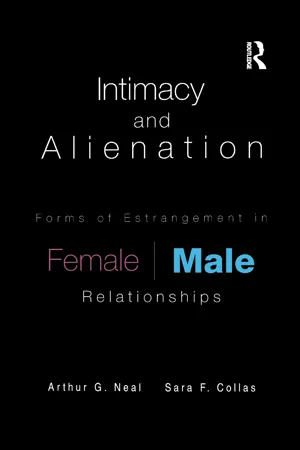
eBook - ePub
Intimacy and Alienation
Forms of Estrangement in Female/Male Relationships
- 228 pages
- English
- ePUB (mobile friendly)
- Available on iOS & Android
eBook - ePub
Intimacy and Alienation
Forms of Estrangement in Female/Male Relationships
About this book
Information
PART I
Introduction and Orientation
CHAPTER 1
Union of Strangers
Georg Simmel (1950,402) observed in his classical essay on the stranger that there is “a unity of nearness and remoteness” in every human relationship. Simmel conceptualized the stranger as one who is physically close to other people while psychologically feeling “far away.” Such variables as belonging, membership, and attachment do not, in Simmel’s view, preclude the many forms of estrangement experienced in intimate groups, as well as in the more secondary relationships of the marketplace. The literature on heterosexual dyads increasingly draws upon themes conceptually related to Simmel’s notions about the dialectic of nearness and remoteness that is present to some degree in all social relationships.
The theme of nearness is reflected in the romanticism and idealism that is embedded in heterosexual intimacy. Romanticism is an ideology that promises happiness, sexual pleasure, and self-affirmation from building an intrinsically rewarding relationship with another person. Such a relationship is idealized as one that places a high reward value on a specific person, that promotes expressiveness and emotional intimacy, and that promises a caring about the well-being of each other. Through such a relationship, individuals expect to find a sense of belonging, membership, self-fulfillment, and a type of attachment that will serve as a buffer against the many forms of loneliness that frequently prevail in our culture.
The idealism of romantic love is colliding with a contrasting set of images focused on the problematic aspects of married life. Recent studies have emphasized the difficulties men and women face when they enter into interactions with each other. For example, Lillian B. Rubin (1984) described the relationships between women and men as a union of “intimate strangers.” Jesse Bernard (1972) observed that the modern marriage may be accurately viewed as two marriages rather than one: “his” and “hers.” Others have emphasized the themes of “living-together loneliness,” “entrapment,” and “the lack of a sense of coherence.” Indeed, a paradigm shift occurred in studies of intimate relationships between the 1950s and the 1990s. This shift was accelerated through the emergence of feminist critiques of gender roles and relationships. The shift was away from the vocabularies of “adjustment,” “compatibility,” “joint enterprises,” and “self-fulfillment” and toward the vocabularies of “contested struggles,” “power equations,” “hassles,” “conflict,” and “alienation.” Within the context of these modern concerns, Simmel’s ideas about the conditions and forms of estrangement in human relationships are becoming increasingly relevant.
The contemporary idealism surrounding the heterosexual dyad becomes a charade in the mythmaking surrounding the notion of “romantic love.” According to the idealism of the myth, true love can strike at first sight without prior social interaction; there is only one other person that is the right one; true love can overcome obstacles and conquer all; “the loved one is nearly perfect in all respects; and two people who have found each other should follow their true feelings rather than be guided by rational considerations (Lantz, Schultz, and O’Hara 1977). Under such conditions, the physiological arousal of the pounding heart and the surge of sexual desire are accompanied by an obsessive focus on one specific person.
While few subscribe to the unrealistic details of the myth, the ideal frequently serves as a model for many seeking a potential partner. It is deeply embedded in contemporary culture and has subscribers among those who have not yet become jaded from their experiences with the dating and mating game. The emotional investments individuals make in their intimate relationships have historically increased as such relationships have grown fragile. People have come to expect to achieve self-fulfillment and self-affirmation through a deep involvement in a relationship with a member of the opposite sex. But in acting on such idealistic expectations, they encounter reality shocks. Ego boundaries become permeable, and individuals place themselves in a highly vulnerable position as they become “hooked” on another person. They become vulnerable in the sense that their defenses are taken down and secret aspects of the self are revealed in the process of building a relationship. When the relationship fails to work out as expected, people get hurt, become disillusioned, and have their sense of self-worth diminished.
In contrast to the emphasis some place on romanticism, others pride themselves in their capacities for making rational choices in forming social attachments and building a life structure. Those who adopt the rational-choice model see themselves as having social desirability and personal efficacy in the decision-making process. The rational-choice model draws upon ideologies resembling those of the marketplace in the process of forming and maintaining intimate relationships. Rational choice implies that individuals make use of a cost-benefit analysis in forming their social attachments (Becker 1991; Nye 1978), making choices through evaluating the advantages and disadvantages of forming a relationship with a specific person.
According to the rational-choice model, humans are self-centered, hedonistic creatures who seek to maximize their pleasure and to minimize their pain. Each has control over resources that may be desired by another, and, through a process of negotiation, desired resources may be exchanged. The exchange is mutually rewarding insofar as each receives benefits that exceed the cost of their attainment. For example, those who have control over such resources as money, status, and power may be willing to share or exchange them for access to another person who is physically attractive, who has sex appeal, and who has a compatible personality. Each thus mentally calculates the rewards to be derived from forming and developing a relationship with the other. In this exchange, women are reduced to objects of desire, while men are seen as objects of security and stability.
Both the romantic-love myth and the rational-choice theory are flawed models of the attraction process. Rational choice is based on the assumption that one has information that is not readily available about another person. People are not commodities, and the rational-choice model inappropriately applies the market mentality to areas of human behavior that follow a different set of rules. Stereotypes and impression management frequently shape the judgments we make about other people. The love affair always begins as an illusion. Intimacy and emotionality are built around images, since the true substance of another person cannot be known initially. Individuals tend to fill in the gaps of missing information and assume that the qualities that are visible and admired correlate with other positive qualities that have not been revealed. Through wishful thinking, we tend to impute to others the qualities we want them to have in the process of building a relationship (Stern 1979). The result is frequently an erroneous set of assumptions on the part of individuals who think that they are rationally planning the intimacy spheres of their lives.
The mate-selection process usually involves some mixture of romantic idealism and the rational calculations of the marketplace. Some individuals do internalize and attempt to follow the romantic-love model, while others pride themselves in their abilities to make the right kinds of decisions through applying the rational-choice model. In either case, people have come to expect higher levels of rewards from intimate relationships than they can reasonably obtain.
The ugliness of male/female relationships has become a part of modern consciousness. In contrast to the idyllic images of family life that prevailed during the 1950s, we now recognize the abuse of children on the part of their caretakers, spouse abuse among married couples, sexual harassment in the workplace, and acquaintance rape among dating couples. We now have ways of labeling the “unnamed problem” that only lurked beneath the surface of social life prior to the 1960s. The inventory of pathologies growing out of intimate relationships keeps getting larger and larger. The underlying message seems to be that male/female relationships are difficult.
SEXUAL ANOMIE
Our sense of comfort is shaped not only by what is happening in our personal lives, but also by what is happening in society at large. We are not isolated units of meaning. The contours of our personal lives are shaped by the templates of the larger collectivities to which we belong. Our perceptions of the typical behavior patterns of our society provide us with guidelines on how to live our lives, what options are available, and what goals are worth pursuing. We are indeed social beings, and, as a result, some response is necessary, either through accepting or rejecting the behavior patterns that prevail in our time and place. Social awareness requires dealing in some way with the lures and the pitfalls implicit in social living.
Metaphors reflecting negative typification of relationships between men and women abound in popular music, in mass entertainment, and in everyday patterns of speech. Men frequently complain of women: “We can’t live with them, and we can’t live without them, so what the hell are we going to do?” The comments of women mirror a similar sense of despair: “There are a lot of rotten men out there” and “you have to kiss a lot of frogs before you find a prince.” Such messages from popular culture on sexual drama frequently suggest that “you’re damned if you do, and you’re damned if you don’t.” The metaphors employed by both men and women suggest that the world of the singles is “a jungle,” and a sense of disillusionment is apparent in the bumper-sticker caption that “Shit Happens.” Such symbolism in the vernacular conveys meanings similar to the sedate observations by academics that “the relationships between men and women are difficult.”
The pathos and tragedy surrounding love affairs reflect a pantheon of troubles, resembling what Simmel referred to as a sense of psychological distance in relationships among strangers. Marital sadness, disloyalty of a spouse or a partner, having wants and desires that remain unfulfilled, wanting someone you cannot have, receiving promises that are not kept, dealing with the abuse of alcohol, confronting marital infidelity, and suffering the tragedy of breaking up are among the staples in the mood states evoked by country music.
While these themes are individualized in that they portray personal troubles of individuals in specific situations, the generalized context is one of a sense of malaise in male/female relationships. Rather than a neutral set of observations about the borders and fringes of sexual conduct, the messages more nearly reflect generalized themes of despair and resignation. A study by Steven Stack and Jim Gundlach (1992) of forty-nine metropolitan areas found that those areas devoting a greater amount of airtime to country music had higher suicide rates. Apparently, the mood states generated by country music can build upon and accentuate the sense of despair in heterosexual relations that prevails on an everyday basis.
In the classical writings of Emile Durkheim ([1897] 1951) on modern society, a central theme is the crisis of meaning in the lives of individuals. Durkheim used the term anomie to describe several aspects of the crisis of meaning. These include having wants and desires that cannot be fulfilled, placing a high reward value on socially unacceptable and deviant behavior, and feeling that one’s personal life is fragmented and lacking in a clear sense of purpose (Tiryakian 1981). Such perceptions convey disturbing implications for both individuals and society. Social norms fail to adequately regulate our biological and animal nature; rules are lacking for adequately distinguishing appropriate from inappropriate conduct; and social relationships lack the ingredients for a sense of coherence and predictability. As a consequence, we enter into social relationships with some degree of suspicion and distrust. We are not able to take social interactions at face value; instead, we are required to look behind appearances and performances for “the hidden motive.” We feel vulnerable and expect to be manipulated, exploited, or betrayed. While Durkheim used the term anomie to describe the generalized condition of meaninglessness and disorder in a modern, mass society, we are using the term sexual anomie as it may be applied to the specific context of human sexuality.
The present use of the concept of sexual anomie is drawn from the classical works of Emile Durkheim on Suicide in which the term anomie referred to a state of disorder within a social system. Conditions of anomie prevail when a society’s rules and norms fail to serve as regulating or moderating influences on individual behavior. Uncertainty develops over what the social rules are. Individuals are first pulled one way and then another as they receive conflicting or contradictory cues on what their conduct should be. In the absence of the regulatory influence of social norms, the behavior of those with whom we interact lacks predictability.
Durkheim maintained that social curbs are necessary for the regulation of impulse tendencies. The basic needs of individuals are amenable to being fulfilled, but human wants and desires are insatiable and tend to soar to infinity. The more people have and get, the more they want. The pleasures derived from the fulfillment of desires are ephemeral in the sense that they do not last. As specific wants and desires are gratified, additional ones are created—until human efforts become directed toward the attainment of the impossible. Only through social curbs on the possible can individuals achieve a sense of order and coherence in their personal lives. Within modern society, such curbs on impulse tendencies tend to be limited and inconsistent.
The modern cultural apparatus promotes materialistic values and tends to emphasize the pleasure principle. Mass entertainment, for example, is saturated with themes of sexuality and the grief and pleasure to be derived therefrom. Both soap operas and popular movies are oriented toward dramatization and visual imagery of the sexual underpinnings of human conduct. Themes related to libido impulses and animal desires are prominently emphasized. While a great deal of mass entertainment involves morality plays on how people sin and then suffer from it, the appeal to viewing audiences stems, to a large degree, from the erotic stimulus and symbolism to which they are exposed. Successful productions for mass entertainment draw heavily on the themes of sex and violence. Viewing audiences tend to have a limited interest, at best, in entertainment portraying ordinary people engaging in conventional forms of social behavior in their everyday lives.
The use of sexual symbolism reaches its peak in the imagery surrounding the media creation of celebrities. The celebrities of stage, screen, sports, and the music world become symbolic of the hopes and aspirations of their admirers and fans. Celebrations of the famous, however, are not limited to their performances; they are frequently based on what audiences presume to be their personal qualities and attributes. The notoriety of a beauty queen, a poster queen, or a sex symbol may rest on the qualities imputed to them because of the images they present and the forms of lust and desire they evoke. Through imitations of celebrities’ hairstyles, clothing styles, and lifestyles, individuals attempt to increase their own personal desirability and to provide emblematic displays of social worth. The search for self-identity in collective symbols is an emotional gesture intended to overcome feelings of being shortchanged, cheated, or unfulfilled in the practical activities of everyday life.
Commercial advertising follows a similar pattern in the positive encouragement of human desire and impulse tendencies. In his discussion of advertising as the social root of consumer culture, Stuart Ewen (1976, 180) observed that human sexuality “had been transformed into something resembling the cash nexus.” Through advertising, the erotic facets of sexuality have been linked to consumer-oriented behavior. Persuasive arguments are designed to make consumers believe that using the right soap, applying the right perfume, wearing the right clothes, driving the right automobile, and purchasing the right commodities will have magical overtones: through the symbolic promises of commercial advertising, individuals can enhance their sexual pleasures and achieve self-affirmation. The sacred and mystical promise is that, through proper forms of consumer-oriented behavior, any specific man or woman can bring to himself or herself—and to others—the greatest level of pleasure and satisfaction.
While Durkheim may be essentially correct in his observation that people need order and stability in their lives, there may also be a human need for thrill, novelty, and excitement. Commercial advertisers are well aware of the sense of incompleteness that many men and women experience in their everyday lives. The literal bombardment of the senses with hundreds of advertisements on a daily basis is not conducive to the view that satisfaction with life is to be achieved through curbing or eliminating wants and desires. The message from advertising is that, regardless of the present quality of your life, it would be better if you spend more, if you consume more, and if you buy our product. The go...
Table of contents
- Cover Page
- Half Title page
- WOMEN AND SOCIOLOGICAL THEORY
- Title Page
- Copyright Page
- Contents
- Series Editor's Preface
- Preface
- Original Half Title page
- PART I Introduction and Orientation
- CHAPTER 1 Union of Strangers
- CHAPTER 2 Intimate Attachments
- Chapter 3 Sex and Violence
- PART II Forms of Estrangement
- CHAPTER 4 Crisis of Meaning
- CHAPTER 5 Social Isolation
- CHAPTER 6 Normlessness
- CHAPTER 7 Fragmentation
- CHAPTER 8 Entrapment
- PART III Epilogue
- CHAPTER 9 Inventing the Future
- Author Index
- Subject Index
Trusted by 375,005 students
Access to over 1.5 million titles for a fair monthly price.
Study more efficiently using our study tools.
Frequently asked questions
Yes, you can cancel anytime from the Subscription tab in your account settings on the Perlego website. Your subscription will stay active until the end of your current billing period. Learn how to cancel your subscription
No, books cannot be downloaded as external files, such as PDFs, for use outside of Perlego. However, you can download books within the Perlego app for offline reading on mobile or tablet. Learn how to download books offline
Perlego offers two plans: Essential and Complete
- Essential is ideal for learners and professionals who enjoy exploring a wide range of subjects. Access the Essential Library with 800,000+ trusted titles and best-sellers across business, personal growth, and the humanities. Includes unlimited reading time and Standard Read Aloud voice.
- Complete: Perfect for advanced learners and researchers needing full, unrestricted access. Unlock 1.5M+ books across hundreds of subjects, including academic and specialized titles. The Complete Plan also includes advanced features like Premium Read Aloud and Research Assistant.
We are an online textbook subscription service, where you can get access to an entire online library for less than the price of a single book per month. With over 1.5 million books across 990+ topics, we’ve got you covered! Learn about our mission
Look out for the read-aloud symbol on your next book to see if you can listen to it. The read-aloud tool reads text aloud for you, highlighting the text as it is being read. You can pause it, speed it up and slow it down. Learn more about Read Aloud
Yes! You can use the Perlego app on both iOS and Android devices to read anytime, anywhere — even offline. Perfect for commutes or when you’re on the go.
Please note we cannot support devices running on iOS 13 and Android 7 or earlier. Learn more about using the app
Please note we cannot support devices running on iOS 13 and Android 7 or earlier. Learn more about using the app
Yes, you can access Intimacy and Alienation by Arthur G. Neal,Sara F. Collas in PDF and/or ePUB format, as well as other popular books in Social Sciences & Interpersonal Relations in Psychology. We have over 1.5 million books available in our catalogue for you to explore.