- 228 pages
- English
- ePUB (mobile friendly)
- Available on iOS & Android
eBook - ePub
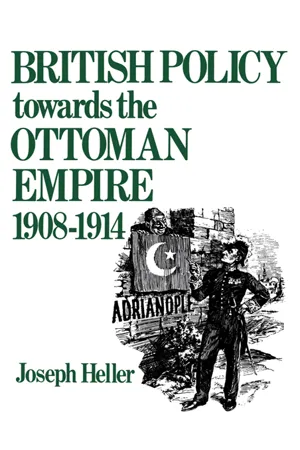
British Policy Towards the Ottoman Empire 1908-1914
About this book
First Published in 2004. Throughout the half-century between the Crimean War and the outbreak of the First World War, few countries confronted successive British governments with the complexity of problems posed by the Ottoman Empire. This study attempts to attain three main objectives. The first is an analysis of the growth and development of British policy at two levels: the Embassy and the Foreign Office. The second is an assessment of the influence of various embassies on decision-making in the Foreign Office. The third is an estimate of the influence of European and Imperial considerations upon the formulation of Britain's policy towards the Ottoman Empire.
Information
Subtopic
Middle Eastern HistoryIndex
History1
HOPES, PROMISES AND DOUBTS
The Embassy, the Foreign Office and the ‘Constitutional Movement’
The first report on the revolutionary events at Resna on 3 July 1908 was telegraphed from Constantinople on 8 July. It reached the Foreign Office on the same day, but was seen only the day after by the Eastern Department officials, the Permanent Under-Secretary, (Sir Charles Hardinge), and the Foreign Secretary himself, Sir Edward Grey.1 Not until 14 July, after more detailed reports had reached the Foreign Office, were the first important comments made. The significance of the uprising was fully grasped by the lower echelons of the Foreign Office,2 but was misunderstood by its head. Hardinge was entirely preoccupied with getting an agreement first with Russia and then with the Powers, and in mid-July did not even refer to the events in Macedonia in a private letter to Barclay, the Minister Plenipotentiary at Constantinople.3 The latter, too, underrated the importance of the new situation and as late as 18 July could still not tell whether the rising was likely ‘to fizzle out or spread’.4 By the end of the third week in July, the Foreign Office was beginning to realize that the progress made by the Young Turks had ‘a striking resemblance to revolution’.5 But in the Embassy at Constantinople only Fitzmaurice saw that the Constitutional movement would win the day.6
The crucial events of 23-4 July, when Abdul-Hamid abdicated his absolute power, resulted in a radical change of opinion. In Constantinople, the first, apart from Fitzmaurice, to be convinced of a Young Turk victory was Block. On 25 July he suggested that Hardinge inaugurate a new pro-Ottoman policy and support Said and Kiamil in their efforts to reform the country. Otherwise, he warned, the new movement might turn to the Germans.7 Something of the same feeling already prevailed in London. Consequently, and in view of the ‘marked improvement’ of the situation in Macedonia caused by the disappearance of the bands, the British Government on 27 July decided to suspend representations at the Porte for the creation of a mobile force.8 On the same day, Britain congratulated Abdul-Hamid and Said on the establishment of a constitutional regime. At the same time, the end of the old Turcophobe policy and the inauguration of a new attitude, cautious but sympathetic, was officially announced by Grey in Parliament:
If Turkey is going to improve the whole government of the country and ensure that the Mahomedans and Christians shall benefit equally by the improvement, then it is better that the Macedonian question should be settled by the Turks taking in hand and doing what for years we have been urging them to do, than by pressing partial reforms on reluctant, unwilling and obstructing authorities … of course we must await events; but at the present time I can only say this: Our own sympathy must be with those who are trying to introduce reforms, and I should be the last to prophesy that they will fail. If they succeed, then they must succeed by their own efforts, but our sympathy is with them … while not relaxing our watchfulness, while not becoming slack in our desire to do all in our power to promote improvement in Macedonia, we shall for the present preserve an expectant and sympathetic attitude.9
Grey’s views were not shared everywhere. Barclay, the British Minister, remained sceptical about the success of the Revolution;10 the Foreign Office was still confused. ‘Events of the last few days’, wrote Hardinge, ‘have been so unexpected that it is impossible to say what will be our next step as regards the Macedonian reform projects.’11 The old policy was only suspended and replaced by ‘an expectant attitude’ until it could be proved whether the bands had disappeared entirely or not. ‘If only this Young Turk party can consolidate itself and introduce a really good administration into the country, they will have been playing our game entirely, but perhaps not the game of other more interested Powers.’12 This was the real touchstone: a new policy was conditional on reforms being carried out by the Constitutional movement. The Foreign Office also hoped that the Revolution had caused a blow to German influence in Constantinople.13 Meanwhile, it was decided to suspend the scheme for the mobile force, to bring the activities of the gendarmerie to a minimum and to refuse to give any help to the officials of the old regime.14
It was a matter of coincidence that Sir Gerard Lowther, the new Ambassador, arrived just at the beginning of the new era. Subsequently, he was to be blamed for the worsening relations between Britain and the Ottoman Empire. But in fact, by the time of his arrival on 30 July, fear, doubt and anxiety were already considerable in the Foreign Office.
Hardinge had already appreciated the negative repercussions which the Revolution might produce in Egypt, India15 and the Balkan states, whilst Grey – although delighted with the enthusiastic popular reception accorded to Lowther16 – was not ready to promise much to the new regime. He was careful not to commit Britain in any way which could involve her in actual intervention on the Ottomans’ behalf. ‘Our diplomatic attitude will be benevolent, and our influence used to secure fair chance for them,’ was all he offered. Nevertheless, the trend of British policy was clear. Writing to Block, Hardinge promised:
Whatever we can do to help and encourage the Turks in their present attempt at the regeneration of the Turkish administration will most certainly be done by us. We are very anxious to make use of this opportunity to improve our relations with the Turks.… You may be quite sure that no external diversion on the part of Bulgaria or any other Balkan Power would be tolerated for one instant. I am quite convinced that the Russians, French and ourselves would do all we could to prevent such a development.17
The definite instruction which Grey conveyed to Lowther said that the Foreign Secretary’s statement of 27 July, made in Parliament and reported by The Times, might serve as a text for explaining the British attitude. ‘It is important that our attitude and views should become as clearly and widely known as possible.’18
Wider consideration further complicated the situation. Grey described the real dilemma for Britain: ‘The delicate point will presently be Russia – we cannot revert to the old policy of Lord Beaconsfield, we have now to be pro-Turkish without giving rise to any suspicion that we are anti-Russian.’19 Neither would it now be possible to maintain the tradition of intervention in Ottoman affairs. Grey himself detected quite early the true character of the Young Turks and the new regime. ‘The new Turkish Government are not likely to be in a hurry to put themselves in the hand of any foreign Power. There is a nationalist feeling in the new movement in Turkey which would resent this.’20 Thus, the tendency was to let the new regime alone. Both the Foreign Office and the Embassy thought that there was no necessity to despatch a warship to the Dardanelles,21 and did not demand the suppression of the predominant German influence at Constantinople as a condition for her change of policy.22 They were confident that the Revolution itself had been a blow to Germany since the latter identified herself with the Sultan; and the Foreign Office accepted Lowther’s opinion that it should postpone a project to introduce British naval and financial advisers as counterweights to the German General von der Goltz.23
The development of British policy towards the new regime was considerably helped when two other interested Powers, Russia and Austria, assured the Foreign Office that the Ottoman Empire would be able to devote itself to internal reform without the distraction of external interference. In mid-August, Izvolsky24 expressed Russia’s willingness to work ‘in full accord’ with Britain. On 12 August, Aehrenthal declared that Austria-Hungary would favour non-intervention and the preservation of the integrity of the Ottoman Empire.25 Since foreign intervention against the new regime seemed to be remote, in spite of the somewhat disquieting reports from Sofia,26 the Foreign Office continued to devote its attention to the more immediate and urgent question of the reform administration. In essence, the policy was not new. Grey merely advised that the Young Turks should not try to go too fast, but should place the government in the hands of ‘honest and capable’ men. Financial consolidation seemed the second most important point. The chief motive in Grey’s policy remained what it had always been: ‘Just as we used all our influence, when Turkish Government was bad, to press reforms from outside, so now if reforms are being developed from inside we shall use all our influence to prevent their being interfered with from outside.’ But he was not entirely altruistic. Grey also hoped that a consolidated Turkish regime would give British capital more openings – although he did insist that British firms should not impose onerous conditions.27 Similarly, Mallet, the Head of the Eastern Department, was upset when the new regime selected a French expert to rearrange their finances.28
Lowther was much more critical of the new regime. His scepticism was evident only one month after the Revolution. This coloured his official reports and was particularly apparent in his private letters, where he patronizingly referred to the Young Turks as ‘a collection of good-intentioned children’. He did not expect the Young Turks (whom he foresaw were about to assume official power) to start playing the dangerous game of nationalism, but from the very beginning he doubted their radical and liberal statements. ‘Just now the Committee are very anxious to obtain the applause of Europe and are constantly asking advice.…’29 The affinity of ideas between the newly arrived Ambassador and his knowledgeable Chief Dragoman, Fitzmaurice, was immediately clear. Fitzmaurice did have a better opinion of the Young Turks. (‘They have many of the requisites of successful national leaders – are impersonal and have a great sense of responsibility.’) But in view of the critical economic and social situation, he feared ‘a desperate internal struggle accompanied by disorders’ which would provoke Russian intervention. Fitzmaurice also warned that the Young Turks would raise the questions of Crete, Egypt, Macedonia, Bosnia, Aden, Lebanon, Cyprus, the special position of the British Residency at Baghdad and the ‘irregular’ status of Lynch’s Navigation Company in Mesopotamia. But despite these anxieties, he still thought that this moment, when Britain was the most favoured nation at Constantinople, provided a golden opportunity for checking the progress of the German-sponsored Baghdad Railway and establishing British economic control over Mesopotamia, particularly through Willcocks’ scheme for the irrigation of that area.30
Through Fitzmaurice, Lowther established his first contacts with the Young Turks. On 2 September 1908, he met with Mehmed Talaat and Dr Bahaeddin Shakir, the secretaries of the internal and external branches of the CUP. Lowther was impressed with their moderate ideas, and their realistic appraisal of future difficulties. They again professed their English orientation, and looked to the British Government for ‘approval and sympathy’.31 Lowther emphasized the importance of keeping Abdul-Hamid in his present position, but was careful not to exceed his instructions: ‘It was to be anticipated that if matters went smoothly under the new order of things, British money would seek investment in the country; and that the British Government and this Embassy would encourage only sound and reliable people.’32 In fact, Lowther was still suspicious and anxious. Thus, he reminded Grey of the national character of the Constitutional movement ‘with a consequent tendency to restrict the privileged position of foreigners’. Lynch’s steamers on the river Tigris might be regarded as an infringement of Ottoman sovereign rights. His demands that the Foreign Office hasten a loan for the new regime constituted more than a bona fide demonstration of goodwill, as there was a danger that the new regime might be driven into the arms of German financiers.33
Lowther’s pessimistic reports soon grew more pronounced. Noting the impatience of the Young Turks and their increasing suspicions of Abdul-Hamid, by mid-September he feared that the CUP might turn the Empire into a military dictatorship. He also doubted, as he had done continuously since his arrival, the possibility of reconciling Moslem predominance with constitutional government.34 Supplementary voices could al...
Table of contents
- Cover
- Halftitle
- Title
- Copyright
- Dedication
- Contents
- Preface
- Abbreviations
- Introduction
- 1 Hopes, Promises and Doubts: The Embassy, the Foreign Office and the ‘Constitutional Movement’
- 2 Between Crisis and Counter-Revolution (October 1908 – April 1909)
- 3 From Criticism to Opposition: British Policy and Interests from the Counter-Revolution to the Tripoli War (April 1909 – September 1911)
- 4 On the Eve of Catastrophe: Britain, the Tripoli War and the Formulation of the Balkan League (September 1911 – October 1912)
- 5 Catastrophe and Change: British Policy during the Balkan Wars (October 1912 – October 1913)
- 6 Mallet at Constantinople – The First Phase (October 1913 – July 1914)
- 7 The Last Phase: The Outbreak of War
- Conclusions
- List of Sources
- Notes
- Biographical Appendix
- Index
Trusted by 375,005 students
Access to over 1.5 million titles for a fair monthly price.
Study more efficiently using our study tools.
Frequently asked questions
Yes, you can cancel anytime from the Subscription tab in your account settings on the Perlego website. Your subscription will stay active until the end of your current billing period. Learn how to cancel your subscription
No, books cannot be downloaded as external files, such as PDFs, for use outside of Perlego. However, you can download books within the Perlego app for offline reading on mobile or tablet. Learn how to download books offline
Perlego offers two plans: Essential and Complete
- Essential is ideal for learners and professionals who enjoy exploring a wide range of subjects. Access the Essential Library with 800,000+ trusted titles and best-sellers across business, personal growth, and the humanities. Includes unlimited reading time and Standard Read Aloud voice.
- Complete: Perfect for advanced learners and researchers needing full, unrestricted access. Unlock 1.5M+ books across hundreds of subjects, including academic and specialized titles. The Complete Plan also includes advanced features like Premium Read Aloud and Research Assistant.
We are an online textbook subscription service, where you can get access to an entire online library for less than the price of a single book per month. With over 1.5 million books across 990+ topics, we’ve got you covered! Learn about our mission
Look out for the read-aloud symbol on your next book to see if you can listen to it. The read-aloud tool reads text aloud for you, highlighting the text as it is being read. You can pause it, speed it up and slow it down. Learn more about Read Aloud
Yes! You can use the Perlego app on both iOS and Android devices to read anytime, anywhere — even offline. Perfect for commutes or when you’re on the go.
Please note we cannot support devices running on iOS 13 and Android 7 or earlier. Learn more about using the app
Please note we cannot support devices running on iOS 13 and Android 7 or earlier. Learn more about using the app
Yes, you can access British Policy Towards the Ottoman Empire 1908-1914 by Joseph Heller in PDF and/or ePUB format, as well as other popular books in History & Middle Eastern History. We have over 1.5 million books available in our catalogue for you to explore.