- 320 pages
- English
- ePUB (mobile friendly)
- Available on iOS & Android
eBook - ePub
About this book
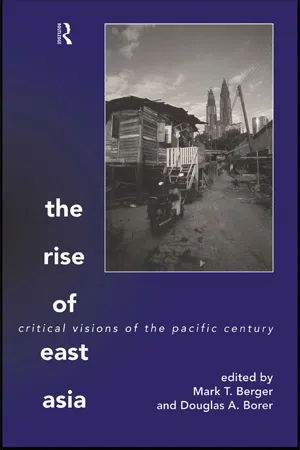
There is great interest in the Pacific Century and what its implications for the future will be. The rapid economic growth of East Asia was already setting the region apart from the rest of the world by the 1970s. By the 1980s the trend was seen to have spread southward to Thailand, Malaysia and Indonesia, while China's provinces had also become integral to the regional economic boom.
In this exciting new study many of the ideas and expectations associated with the Pacific Century are placed under critical scrutiny. The book includes studies of particular countries such as China, Japan, South Korea, Vietnam, Indonesia and Malaysia. There is analysis of economic and political trends in the region, the reasons behind its rise and its importance on a global scale.
The rise of East Asia represents an historic turning point with immense significance world-wide. This book will be of interest to anyone concerned about the new approaches to and the debate about the rise of east Asia and the coming of the Pacific Century.
Information
Part I
Asia-Pacific nations
1 The end of the miracle: Japanese politics in the post-Cold War era
Haruhiro Fukui and Shigeko N.Fukai*
INTRODUCTION: JAPANESE POLITICS IN THE POST-COLD WAR ERA
For three and a half decades, from the mid-1950s to the late 1980s, Japan enjoyed a double blessing: phenomenal economic growth and equally phenomenal political stability. To many observers, the two blessings were in fact causally connected: the economic miracle was, to an important extent, both a cause and a consequence of the political stability.1 The political stability was in turn due substantially to permanent rule by a single party, the Liberal Democratic Party (LDP), which ensured continuity and consistency in economic policy making and implementation. In other words, a domestic regime of hegemonic rule provided the Japanese for three and a half decades with generous amounts of key public goods such as political stability, personal safety and, above all, prosperity.
This felicitous combination attracted the attention and interest of not only scholars and journalists but also governments, especially in Asia. By the mid-1980s, it had spawned a whole new literature on the ‘developmental state’ and the ‘new capitalism’. In his influential and pioneering 1982 study of the modern Japanese political economy, Chalmers Johnson elaborated a model of a state that nurtures a highly capable elite bureaucracy and guides and directs the national economy vigorously but judiciously—by market-conforming means.2 In an article published two years later, Bruce Cumings named the model Bureaucratic-Authoritarian Industrializing Regime, or BAIR, and traced the route of its migration from pre-war imperialist Japan to its colonies, Taiwan and Korea.3
A BAIR is, by definition, a politically closed regime in the sense that participation in decision making on important political and economic issues is open only to members of the dominant group or groups.4 The fact of being closed, however, enables the regime to adapt rapidly and flexibly to changing domestic or international economic circumstances. It thus helps the regime to govern the market in such a way as to achieve its developmental goals by, as Wade suggests, effectively controlling and manipulating the ownership of farm land, the financial system, exchange and interest rates, prices, the import and export trade, and the acquisition and development of new technologies.5 Japan has been the model developmental state, or ‘Asian-style democracy’, as some euphemistically call it, not only for Taiwan and Korea but increasingly also for a number of other Asian nations.6 Prime Minister Mahathir Mohamad of Malaysia ‘looks east’ as intently and enthusiastically as the late President Park Chung Hee of South Korea.
However, Japan’s vaunted image and reputation as a strong and quintessential developmental state, spearheading a ‘new’ form of capitalism, was sullied by the early 1990s.7 Not only was its economy mired in a protracted recession, triggered by the burst of a speculative bubble at home and compounded by the soaring value of the yen abroad, but political stability guaranteed by continuous rule by an invincible conservative party was no longer the reliable marker of its politics. Intractable economic trouble began in early 1990 with a sudden collapse of stock prices. Political trouble had begun several months earlier, when the LDP suffered the worst electoral defeat in its history and, for the first time, lost the majority in the upper house, or House of Councillors, of the Japanese Parliament, or the Diet. Far more damaging to the stability of Japanese politics and government, as well as to the LDP’s position and role in them, were the results of the 1993 lower house election. For the first time, the LDP lost its majority in the House of Representatives, which is the larger and more powerful of the two chambers. This led to an end of the LDP’s thirty-eight-year-long rule and the formation of the first of a series of unstable coalition governments.8 All these events that took place in a rapid sequence in the early 1990s were unexpected and surprising. The most unexpected and surprising, however, was the party make-up of the coalition governments formed in the wake of the 1993 general election, particularly the third such government formed in the spring of 1995.
In the discussion that follows, we try to demonstrate that the dramatic developments in Japanese politics in the last few years of the 1980s and the first few years of the 1990s had deeper and more complex roots than casual observers realized. We point out that, in addition to a long and seemingly endless series of political scandals, an important change in Japanese economic and political culture triggered by the oil crisis of the early 1970s paved the way for the fall of the LDP’s hegemonic rule in the early 1990s. We document how that crisis led to a change in the attitude and behaviour, first, of the leadership of organized labour, and then of the leadership of organized business, and to the formation of a ‘neo-corporatist’ regime of tripartite cooptation and cooperation among the LDP government, big business and the main unions. The emergence of the neo-corporatist regime in turn paved the way for cooperation and coalition, first between the LDP and centrist parties and, eventually, between the LDP and the Socialists as well.
Paradoxically, however, Japanese politics became increasingly unstable even as the rapprochement between big business and the main unions and between the LDP and the major opposition parties progressed. This was due mainly to increases in the number of floating voters not attached to any particular party and of abstainers. These increases in turn reflected the growing disillusion and alienation among the Japanese electorate that resulted from the series of political scandals. They also resulted, however, from the apparent convergence among the parties on major policy issues, which, as we argue in the Conclusion, made elections irrelevant to the serious concerns of most voters.
PROXIMATE CAUSES OF THE ‘GREAT REVERSALS’9
The LDP suffered a disastrous defeat in the July 1993 lower house general election and, as a result, lost its legendary status as Japan’s permanent ruling party. The SDPJ suffered even greater losses, but these were not as surprising to most observers because it had been in opposition since 1955 when the two parties were founded. The LDP won 223 of the 511 lower house seats in the 1993 general election, compared to the 275 it had won in the previous general election of 1990, while the SDPJ won 70, compared to 136 in 1990. None of the three smaller parties which had been in existence since the 1960s—the DSP, the CGP, and the Japan Communist Party (JCP)—made significant gains or suffered significant losses.10 On the other hand, the three new parties founded by defectors from the LDP no more than fifteen months before the general election—the JNP, the JRP, and the NPH—won, respectively, 35, 55 and 13, or a total of 103 seats. Simple arithmetic thus suggests that the bulk of the LDP’s and SDPJ’s losses of, respectively, 52 and 66 seats went to the new parties. The same conclusion seems compelling when we look at the parties’ gains and losses in terms of actual numbers of votes. The LDP won about 7.3 million fewer votes than in 1990 and the SDPJ won about 6.3 million fewer than in 1990. The two parties thus lost about 13.6 million votes between them. On the other hand, the three new parties together collected just about 13 million votes. The commonsense conclusion that the new parties took both their votes and their seats from the LDP and SDPJ is in fact corroborated by survey data as well.11
Why did the LDP and SDPJ lose and the three new parties win so spectacularly? The answer seems simple: nearly one-third of the voters who had voted for LDP candidates and nearly two-thirds of those who had voted for SDPJ candidates in the 1990 elections were so unhappy with each party in 1993 that they defected to the new parties. Why were they so unhappy? They were unhappy and angry about the series of political scandals that had made one newspaper headline after another over a span of several years. A deeper search for the underlying causes of the voter disaffection suggests, however, a far more complex and ambiguous psychological state in contemporary Japanese society. For example, the unhappiness and alienation of many voters was not about any specific policy issue, such as the liberalization of agricultural imports, a proposed tax increase, greater contributions to international aid, that had been debated by some candidates.12 Nor were the disaffected voters particularly interested in a candidate’s party affiliation or legislative track record. Incumbency was not as significant an asset for candidates in the 1993 election as in previous elections.13 Widespread malaise generated by the exposure of pervasive political corruption and compounded by a prolonged recession thus appears to have led to the rejection of the political status quo in general and of both the ruling and the major opposition parties in particular.
This state of public sentiment explains, at least partly, the results of the 1995 upper house election as well: a key partner in the ruling coalition, the SDPJ, suffered another devastating defeat, while the newly formed major opposition party, the New Frontier Party (Shinshinto), made substantial gains, especially where proportional representation applied.14 Judging by the record low voter turnout (44.5 per cent, compared with the previous low of 50.7 per cent in 1992), however, it seems sensible to regard the new party’s advance as a sign of voters’ rejection of the ruling coalition, rather than as a sign of their positive approval of the opposition. As Charles Maier suggests, similar trends can be seen in North America and Europe but in Japan the feeling of anticlimax following the collapse of the Soviet Union and international communism was a far less important factor than disillusion caused by domestic problems, such as the series of political scandals and the protracted recession.15
Incidentally, the year 1995 was memorable for the Japanese for several other events that singly and collectively undermined their self-image as a people living in a uniquely peaceful and safe society. They had long been used to, and proud of, this self-image, and willing to tolerate the bureaucratic red tape and government regulations that went with it. In early 1995, however, a disastrous earthquake hit Kobe, a major city and hub of maritime transportation in western Japan, claiming well over 5000 lives and exposing the Japanese government’s inability to cope effectively with a national crisis, as well as revealing the shoddy construction of public highways and port facilities. This was followed by a lethal sarin gas attack on Tokyo’s subway system and the shooting in broad daylight of the top official of the National Police Agency. Both events, which were blamed on a fanatical new religious group called Aum Shinrikyo (Supreme Truth), further shook the Japanese sense of personal security and confidence in their own society and government. So did media reports of the proliferation of guns and gang violence. These events were seen by many as symptomatic of widespread social malaise and frustration, and as evidence of the potential for even greater violence.16 Nor did Japan appear to be an isolated case but part of an increasingly unstable and tormented world in the last decade of the twentieth century.17
How and why the post-1993 coalition governments took the form they did are considerably more complex and difficult questions than how and why the LDP and the SDPJ lost the 1993 general election to the new parties. For example, an Asahi shinbun telephone poll conducted in the wake of the election found the majority of the respondents (56 per cent) to be anticipating the formation of a coalition between the LDP and one other party or more, while only a third of the respondents (33 per cent) expected a coalition government without the LDP to be formed.18 What followed, however, was the formation of a coalition government led by the JNP leader, Morihiro Hosokawa, which not only did not include the LDP as a coalition partner but was openly anti-LDP. Given the results of the general election reviewed above, however, this development was not particularly surprising. In fact, the news of the event was received with little surprise by the media. The nation’s press reported the event under remarkably bland titles such as ‘Prime Minister Hosokawa has arrived’.19
Proximate causes provide similarly plausible explanations for the subsequent comings and goings of the post-1993 governments. The Hosokawa government lasted for only nine months before it resigned in April 1994. The timing of Hosokawa’s decision to resign and his announcement of that decision were precipitous and caught many observers by surprise, but the decision itself was perfectly understandable. He had been accused of borrowing a large sum of money (¥100 million) from a scandal-tainted parcel carrier company, Sagawa Kyubin, under suspicious circumstances, and of involvement in dubious stock transactions in his father-in-law’s name.20 His resignation thus had little to do with any policy issue. Hosokawa had claimed and won premiership ostensibly to stamp out political corruption and ‘money politics’, but now found himself accused of the same kind of practices. A scion of an old aristocratic family to whom politics was probably no more than an honourable service to society, if not a diversion, he called it a day when the job became much too serious, personal and unpleasant.21
Hosokawa was succeeded by Tsutomu Hata, the leader of the largest coalition partner, the JRP. However, on the day he was elected by the Diet, the creation of a new coalition which excluded the SDPJ was reported by the media. The SDPJ, which had not even been informed of, much less consulted about, the planned coalition, felt itself to be the victim of a plot by its conservative partners to punish it for its left-wing beliefs, and quickly defected from the existing government coalition.22 Such a plot may have existed, but the timing of its disclosure by the media was clearly not what its members wanted. The SDPJ’s defection made Hata’s new cabinet a minority government at its birth, and the subsequent failure of the coalition leaders’ frantic efforts to lure the party back into the government doomed it to a predictably short life.
The Hata government thus lasted for only two months and was replaced in June 1994 by the third coalition cabinet since the great elec...
Table of contents
- Cover Page
- The Rise of East Asia
- Title Page
- Copyright Page
- Figure and Tables
- Contributors
- Editors’ Preface and Acknowledgements
- Introduction: The rise of East Asia: Critical visions of the Pacific Century
- Part I: Asia-Pacific nations
- Part II: Asia-Pacific patterns
- Conclusion: The coming of the Pacific Century: the Cold War and after in the Asia-Pacific
Trusted by 375,005 students
Access to over 1.5 million titles for a fair monthly price.
Study more efficiently using our study tools.
Frequently asked questions
Yes, you can cancel anytime from the Subscription tab in your account settings on the Perlego website. Your subscription will stay active until the end of your current billing period. Learn how to cancel your subscription
No, books cannot be downloaded as external files, such as PDFs, for use outside of Perlego. However, you can download books within the Perlego app for offline reading on mobile or tablet. Learn how to download books offline
Perlego offers two plans: Essential and Complete
- Essential is ideal for learners and professionals who enjoy exploring a wide range of subjects. Access the Essential Library with 800,000+ trusted titles and best-sellers across business, personal growth, and the humanities. Includes unlimited reading time and Standard Read Aloud voice.
- Complete: Perfect for advanced learners and researchers needing full, unrestricted access. Unlock 1.5M+ books across hundreds of subjects, including academic and specialized titles. The Complete Plan also includes advanced features like Premium Read Aloud and Research Assistant.
We are an online textbook subscription service, where you can get access to an entire online library for less than the price of a single book per month. With over 1.5 million books across 990+ topics, we’ve got you covered! Learn about our mission
Look out for the read-aloud symbol on your next book to see if you can listen to it. The read-aloud tool reads text aloud for you, highlighting the text as it is being read. You can pause it, speed it up and slow it down. Learn more about Read Aloud
Yes! You can use the Perlego app on both iOS and Android devices to read anytime, anywhere — even offline. Perfect for commutes or when you’re on the go.
Please note we cannot support devices running on iOS 13 and Android 7 or earlier. Learn more about using the app
Please note we cannot support devices running on iOS 13 and Android 7 or earlier. Learn more about using the app
Yes, you can access The Rise of East Asia by Mark Berger,Douglas Borer in PDF and/or ePUB format, as well as other popular books in Politics & International Relations & Economic History. We have over 1.5 million books available in our catalogue for you to explore.