This unique and authoritative guide describes more than 400 important Chinese symbols, explaining their esoteric meanings and connections. Their use and development in Chinese literature and in Chinese customs and attitudes to life are traced lucidly and precisely.
`An ideal reference book to help one learn and explore further, while simultaneously giving greater insight into many other aspects of Chinese life ... the most authoritative guide to Chinese symbolism available to the general reader today ... a well-researched, informative and entertaining guide to the treasure trove of Chinese symbols.' - South China Morning Post
eBook - ePub
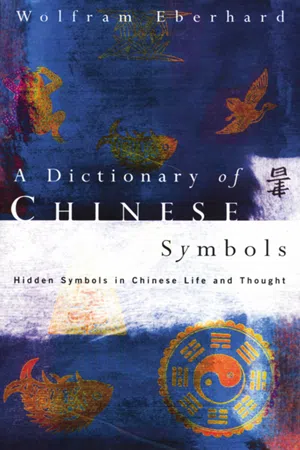
Dictionary of Chinese Symbols
Hidden Symbols in Chinese Life and Thought
- 336 pages
- English
- ePUB (mobile friendly)
- Available on iOS & Android
eBook - ePub
About this book
Information
A
Amber
hu-po
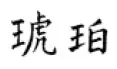
As far back as the Middle Ages, the Chinese knew that amber was ancient pine resin and that the remains of insects could sometimes be found in it. Amber was imported from what is now Burma, and from parts of Central Asia. It symbolised ‘courage’, and its Chinese name hu-po means ‘tiger soul’, the → tiger being known as a courageous animal. In early times, it was believed that at death the tiger’s spirit entered the earth and became amber.
Amulet
hufu
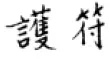
Amulets and talismans are referred to in the oldest Chinese texts. All sorts of materials were used to fashion them; in later times, however, they were made principally from paper, on which a message to the evil → spirits was written, adjuring them not to harm the bearer of the amulet. Since this message was addressed not to men but to spirits, it was written in ‘ghost script’, a form of writing whose characters bear a certain similarity to ordinary Chinese characters, but which is fully accessible only to Taoist adepts. Some Taoists claim that a handwritten amulet warding off fire can be understood by the spirits in the Western world as well, as one and the same ‘ghost script’ is uniformly used and understood all over the world. The script is in fact very old. The work known as Bao-po ze by Go Hung (AD 281-361) contains a dictionary of it.
The ancient Chinese regarded the → calendar as enormously influential and, in practice, indispensable; so the paper of a calendar that had served its turn was often used as an amulet. For example, old calendars were hung up over pigsties, or they were burned and the ashes mixed into the swill as a tried and proven specific against diseases.
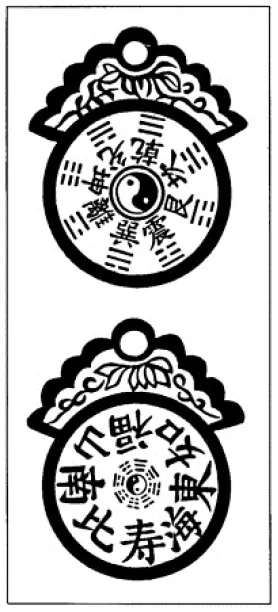
An amulet bearing the eight trigrams and the all-purpose benediction‘(May you have) good fortune like the Eastern Ocean and longlife like the mountain of the South!’
Ancestral Tablet
zu

The memorial tablet is a small wooden board, often lacquered; it is about 10–20 cm broad and at least twice as high. On it are inscribed the name and often the title of the deceased, whose soul, it is popularly believed, lingers on the tablet, especially during sacrifices when it has been ‘revived’ by means of a little chicken blood. In well-to-do families the tablet is placed in a special temple dedicated to the ancestors in which all the members of the clan are assembled together. Poor families make do with a small table placed against the north wall of the living room and surrounded by incense burners and other objects. The tablets are arranged according to position in the family hierarchy; and the tablet in memory of a man is usually flanked by that of his principal wife. Homage is paid to ancestors on certain days of the year, and people turn to them for help and advice. Family pride in its ancestral line can be measured by the number of memorial tablets displayed.
In the case of a → married daughter, her memorial tablet after death will be placed next to that of her husband if he has pre-deceased her. However, a tablet referring to an unmarried daughter cannot be placed among those belonging to her own family. In such cases there are two possibilities: a so-called ‘nominal marriage’ (ming hun) can be arranged - i.e. asking a family whose son has died before marriage to agree to a retrospective marriage with the dead girl; alternatively, a living man can be asked to marry her. He is then, in a certain sense, a widower and can take another daughter of the family to wife. In these circumstances, the normal wedding gifts for the bride’s family are dispensed with - on the contrary, the bridegroom is financially rewarded for his help in a difficult situation.
There was a third possibility: the tablet could be placed in an area specially designated for this purpose in a Buddhist temple, a procedure involving considerable financial outlay. In the People’s Republic of China the ancestor cult in temples has been vetoed, and it is being discouraged in private dwellings. Politically, this is a question of strengthening state solidarity vis-à-vis family solidarity.
Angler
yu-fu
When the first → Emperor of the Zhou Dynasty (c. 1050 BC) was looking around for a wise counsellor, he noticed, so the legend has it, an old man dressed in very simple clothes fishing on a river bank. This was Jiang Ze-ya (also known as Jiang Tai-gung) and it is in this form that he is always represented. The Emperor-to-be ‘fished’ the old man in: that is to say, he made him his chief strategist in his fight against the decadent Shang Dynasty. The story is told in the novel Feng-shen yanyi, which appeared in the early 17th century.
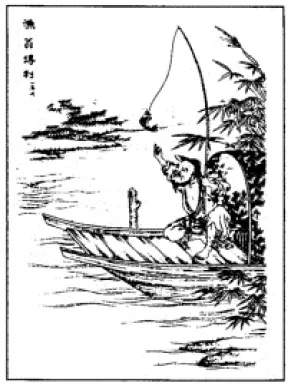
A stroke of luck for the angler
Animals
shou

The Chinese divided animals up into five classes, each of which had its representative: the feathered creatures were represented by the → phoenix, the furry creatures by the → unicorn, naked creatures by →man, scaly creatures by the →dragon, and creatures with shells by the → tortoise.
When a woman was granted an audience at court, she wore a skirt embellished with a design showing the qi-lin (the unicorn) receiving the obeisance of the other classes of animal - though man himself was absent from the group.
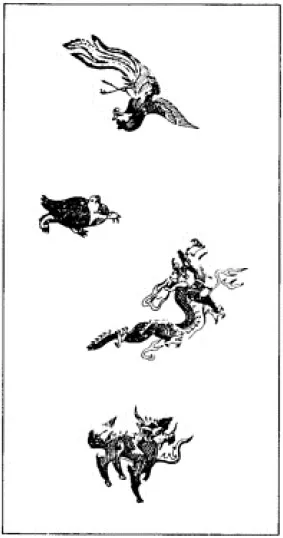
Phoenix, dragon, unicorn and tortoise, the representatives of their animal kinds; they are also symbols of the four directions
Five or six kinds of domestic animal were distinguished - horse, ox, sheep, pig, dog and hen (see separate entries). All of these were regarded as edible, though horse-flesh was only eaten on ceremonial occasions.
The five noxious creatures are the → snake, the → centipede, the scorpion, the lizard or → gecko and the → toad. On the 5th day of the 5th month, magical means were invoked to rid human settlements of these creatures. → Zhong-kui is the god mainly charged with operations against them, and he is helped by the → cock.
Ant
ma-yi
The second component of the Chinese word for ‘ant’ – yi – is phonetically close to the word yi meaning ‘virtue’ (the words differ only in tone), and this is probably the reason why the ant figures as a symbol of right conduct and of patriotism. It also symbolises self-interest.
In the Shanghai hinterland, the village broker with a finger in every business deal is called an ‘ant’, a reference no doubt to his unfailing attention to his own interests. In general, however, the ant plays no great part in Chinese symbolism.
Ao
Ao

The Ao is usually said to be an enormous sea turtle, though another tradition describes it as a giant fish. Once upon a time, so it is said, the goddess → Nü-gua repaired one of the four pillars which bear the earth with one of the turtle’s legs. Again, it was widely believed that the earth itself rested on the back of the huge turtle. There was a long-lasting belief among the Chinese that they could make the ground they stood on firmer and more secure (i.e. against earthquakes) if they fashioned → tortoises out of → stone, and placed heavy slabs on their backs. In this way, it was believed, heaven and earth were more securely bound to each other.
The Ao-shan, i.e. the Ao mountain, lies in the ‘Islands of the Blessed’, the paradise → islands in the Eastern Ocean. It was the practice from the 12th century onwards to mark the → New Year Feast by building large figures consisting of lanterns and models, representing the Ao mountain.
The man who came f...
Table of contents
- Cover
- Half Title
- Full Title
- Copyright
- Table of Contents
- Introduction: The Symbolic Language of the Chinese
- Dictionary of Chinese Symbols
- Bibliography
Trusted by 375,005 students
Access to over 1.5 million titles for a fair monthly price.
Study more efficiently using our study tools.
Frequently asked questions
Yes, you can cancel anytime from the Subscription tab in your account settings on the Perlego website. Your subscription will stay active until the end of your current billing period. Learn how to cancel your subscription
No, books cannot be downloaded as external files, such as PDFs, for use outside of Perlego. However, you can download books within the Perlego app for offline reading on mobile or tablet. Learn how to download books offline
Perlego offers two plans: Essential and Complete
- Essential is ideal for learners and professionals who enjoy exploring a wide range of subjects. Access the Essential Library with 800,000+ trusted titles and best-sellers across business, personal growth, and the humanities. Includes unlimited reading time and Standard Read Aloud voice.
- Complete: Perfect for advanced learners and researchers needing full, unrestricted access. Unlock 1.5M+ books across hundreds of subjects, including academic and specialized titles. The Complete Plan also includes advanced features like Premium Read Aloud and Research Assistant.
We are an online textbook subscription service, where you can get access to an entire online library for less than the price of a single book per month. With over 1.5 million books across 990+ topics, we’ve got you covered! Learn about our mission
Look out for the read-aloud symbol on your next book to see if you can listen to it. The read-aloud tool reads text aloud for you, highlighting the text as it is being read. You can pause it, speed it up and slow it down. Learn more about Read Aloud
Yes! You can use the Perlego app on both iOS and Android devices to read anytime, anywhere — even offline. Perfect for commutes or when you’re on the go.
Please note we cannot support devices running on iOS 13 and Android 7 or earlier. Learn more about using the app
Please note we cannot support devices running on iOS 13 and Android 7 or earlier. Learn more about using the app
Yes, you can access Dictionary of Chinese Symbols by Wolfram Eberhard in PDF and/or ePUB format, as well as other popular books in Languages & Linguistics & Regional Studies. We have over 1.5 million books available in our catalogue for you to explore.