eBook - ePub
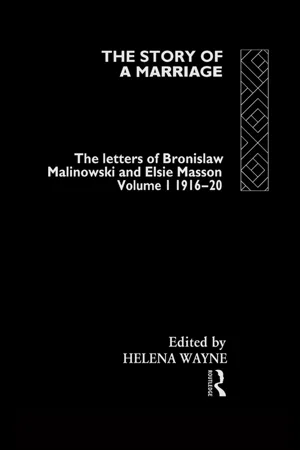
The Story of a Marriage
The letters of Bronislaw Malinowski and Elsie Masson. Vol I 1916-20
- 216 pages
- English
- ePUB (mobile friendly)
- Available on iOS & Android
eBook - ePub
The Story of a Marriage
The letters of Bronislaw Malinowski and Elsie Masson. Vol I 1916-20
About this book
Much has been written about the work of Bronislaw Malinowski but little is available about his personal life and thoughts. These letters, available for the first time, were written by him and Elsie Masson from 1916 to her death in 1935. They chronoicle their meeting and subsequent extraordinary marriage in a highly accessible and revealing way, also telling the story of his remarkable, courageous and largely unknown wife and personalise Malinowski, not just as a teacher and scientist, but as a husband, father and friend. There is a tremendous variety in the correspondence. The Malinowskis lived in half a dozen countries and visited many more and their gypsy lifestyle, his brilliant successes in his professional life, the tragedy of her illness, as well as their continuing love story are all recorded. The letters bring in luminaries such as Sir James Frazer, and Malinowski's students, many of whom went on to become famous anthropologists themselves. There are also fascinating glimpses of attitudes and day-to-day life in the twenties and thirties, including the rise of Nazism and Fascism. Volume I presents the letters written between 1916 and the beginning of 1920 in Australia and New Guinea. They start with a retrospective diary letter from Elsie Masson to Bronislaw Malinowski and detail their first meeting and eventual falling in love. Malinowski describes his third, and final, time of fieldwork in New Guinea, in the Trobriand Islands, 1917-1918. He then returns to Australia where, despite opposition from Elsie's parents, they marry and then spend a year there. At this time they both succumb to the Spanish 'flu epidemic but, having recovered, then move to England.
Information
The Story of a Marriage Volume I 1916–20
Bronislaw Malinowski is known internationally as one of the founders of social anthropology, as the creator of modern fieldwork, as a great writer and an inspiring teacher. Until now little has been known about his personal life and thoughts. This book reveals for the first time his marriage and domestic life, and clarifies his relationships with colleagues, with his students and with a wide spectrum of friends. The letters in The Story of a Marriage were written by Malinowski and his wife, Elsie Masson, from 1916 to her death in 1935. They chronicle their meeting and their subsequent extraordinary marriage, showing Malinowski in a new light, not just as a teacher and scholar, but as husband, father and friend. His wife, so far largely unknown, is shown as a humorous, courageous and talented woman.
Volume I covers the letters written in Australia and New Guinea, from their first meeting in 1916 to the beginning of 1920 when they leave for Europe. It starts with a retrospective diary letter from Elsie to Bronislaw recording their first meeting and eventual falling in love. Malinowski’s letters describe his third and final field trip in New Guinea, the Trobriand Islands, 1917–18. He then returns to Australia where they marry and spend a year before moving to Europe in 1920.
Volume II begins with their arrival in England in April 1920 and details their lives together as he achieves success and international fame, until her death in 1935.
The Malinowskis lived in half-a-dozen countries and visited many more, and the letters record their wandering life. They bring in leading figures such as Sir James Frazer, and Malinowski’s students, many of whom went on to become famous anthropologists themselves. There are also fascinating glimpses of attitudes and day-to-day life in the twenties and thirties, including the rise of Nazism and Fascism. The letters will be of immense interest to students and teachers of anthropology, history and cultural studies; they will also have a strong appeal for the general reader.
Helena Wayne was born in the South Tirol, northern Italy, the youngest of the three daughters of Bronislaw Malinowski and Elsie Masson. She has researched at length in her father’s papers and has interviewed relations, friends and former students, building up a unique body of knowledge about her parents. She has been a reporter for Life magazine, book editor, and television producer for the BBC.

Elsie Rosaline Masson, 1890–1935
Illustrations
Map of the Trobriand Islands
Figure 3.1 Malinowski working in his tent in the Trobriand Islands
Figure 3.2 Fragment of letter, with sketch
Figure 4.1 Fragment of letter, with sketch
Figure 4.2 Children in Omar akana, Trobriand Islands, showing Malinowski one of their games
Figure 4.3 Fragment of letter, with sketch
Figure 4.4 Józefa Malinowska, Bronio’s mother
Figure 4.5 Elsie on the roof of Melbourne Hospital, 1918
Figure 4.6 Fragment of letter, with sketch
Figure 5.1 Elsie and Bronio with friends, 1919
Editor’s foreword
These two volumes of letters between my parents, the anthropologist Bronislaw Malinowski, nicknamed Bronio, pronounced ‘Bronnyo’, and his wife Elsie Masson, begin at the time of their first meeting in Australia in 1916 and continue until a few weeks before her early death in 1935. The couple were often separated during those nineteen years and thus one can follow their early acquaintance and falling in love, and much of the period of sixteen years from their marriage in 1919 to her death, through the correspondence.
The first volume, which includes his second period of fieldwork in the Trobriand Islands, ends with their departure from Melbourne a year after their wedding, and the second volume takes up their story as they reach Europe and his professional life and for a time their personal lives take wing. Then, as he achieved brilliant success and international fame, her illness, her tragedy, overtook her and she had gradually to retreat from action and involvement.
It was perhaps inevitable that Bronio’s letters should diminish in length and number in the busy-ness of his life; nevertheless he was a faithful correspondent with one outstanding exception when, late in his first visit to the USA in 1926, he was caught up by American hospitality in California and developed total agraphia.
A few groups of his letters have unfortunately been lost, the later ones certainly because the invalid Elsie was no longer in control of her posses-sions. Her long and loving letters continued beyond the days when she could use her eyes and hands, and when she could hardly sign the letters she dictated.
The letters were well-travelled. They were written in Australia and New Guinea, in the Canary Islands, the USA, Mexico, southern and eastern Africa, in England, Scotland, Italy, France, Poland, Germany, Austria, Czechoslovakia and Switzerland. It is a wonder that so many have survived the displacements as well as the years.
For several years the letters found a home in London. At some time after Elsie’s death Bronio put them together, where necessary dating them and numbering them with the coloured pencils he liked to use. He kept them with his other papers either at his office at the London School of Economics or at the family house near Primrose Hill in north London.
In the autumn of 1938 Malinowski made what was intended to be a year’s visit, a sabbatical break, to the USA. War broke out in 1939 just as he was about to return to England, and on the advice of the Director of the LSE he decided to stay in the United States and accepted a teaching post at Yale University: he then arranged for many of his books and papers to be sent to him from London.
He died suddenly in 1942. His second wife, Valetta Swann, whom he had married in 1940, moved from the USA to Mexico taking with her his available papers and later receiving more from London. Most of this mass of material travelled again when Valetta returned it to join the newly-formed Malinowski archive at the LSE.
Some of Malinowski’s papers nevertheless remained in Mexico City, and it was among those that I found my parents’ letters when I went there after Valetta’s death. These papers journeyed with me back to England again, with their ultimate destination the Malinowski archive at the British Library of Political and Economic Science.
There are too many letters for all of them to be published here. I have left out those that are more or less repetitions of others or too concerned with domestic minutiae, but none from the Trobriand area. I have chosen those that are the most significant about the large and small events of their daily lives, about Bronio’s work, about the characteristics and Weltanschauung of the two people themselves; and those most evocative of time and place, from the earliest days of their meeting in Melbourne to Elsie’s last days in a village in the Austrian alps.
One thing must be noted. When writing his letters from New Guinea, Malinowski used a word that is now considered taboo, ‘nigger’ and its variant ‘niggs’. In those days of course the current view of racism, the idea that it is evil, hardly existed and though not a ‘drawing room’ word even then, ‘nigger’ was widely used, certainly carelessly used by the white traders who were Bronio’s companions in the Trobriands. The word and the idea are offensive to us now but to eliminate it would have been a falsification and a distortion of a world nearly eighty years behind us.
Acknowledgements
I have received help from many sides and would particularly like to thank Mr Martin Foley for leading me to these precious letters in Mexico City; my husband Donald Wayne who acted as éminence grise during my lengthy work; Professor Sir Raymond Firth and Professor Michael Young for their interest and encouragement and the latter also for technical help with a number of footnotes; and Mrs Andrea Barrett for her invaluable secretarial help. I also remember the selfless kindness of my late uncle and aunt, Sir Walter and Lady (Marnie) Bassett, in Australia.

Map of the Trobriand Islands, from Argonauts of the Western Pacific, first published 1992
Introduction
The meeting of Bronislaw Kasper Malinowski and Elsie Rosaline Masson was an unlikely one, their eventual marriage even more so. He, born and bred in Poland, and she, born in Australia of Scottish parents, came from very different worlds; but they had an important common thread in their lives, their academic, cultured milieus. They also shared traits of character. Both were highly sensitive and imaginative, both were romantics though not sentimentalists and both were rebels against certain aspects of the status quo. They were passionate people but Elsie was anchored in a greater common sense.
Bronio was an only child, born in Cracow on 7 April 1884 to Józefa (Lacka) and Lucjan Malinowski, a distinguished linguist and ethnographer, Professor of Slavonic Philology at Cracow University. Both parents came from the ‘small’ nobility or landed gentry though much of the land had been lost. Poland did not exist then as a state, divided as it was between the Russian, German and Austrian Empires; in Bronio’s day the Austrian regime had been liberalized, and intellectual and artistic life could flourish in Austrian Galicia, of which Cracow was the capital.
Bronio was a delicate child, often away from his school to be tutored at home. His father died when Bronio was 14 and his mother’s influence and that of her family, uncles, aunts and cousins to Bronio, was strong.
The young Malinowski travelled a great deal, often with his mother, partly at doctors’ orders, and these journeys were formative. Within Europe he felt a special love for Italy and added Italian to his Polish, German and French. Mother and son went further afield, to Mediterranean islands and northern Africa, to Madeira and to the Canary Islands where he learnt Spanish. His schooling had already grounded him in Latin and Greek.
From childhood on Bronio had spent holidays in the town of Zakopane and the Tatra mountains in which it lies, south of Cracow. As he grew older he had a circle of friends there of great importance to him, a lively group of young men sharing interests in the arts, literature, the intellect and relationships with women.
At 18 he went to Cracow University, studying first physics and mathematics and then psychology and philosophy. He was awarded his doctorate with the highest honours in the Austrian Empire, sub auspiciis imperatoris, and then went for three terms to Leipzig University where his father had received his degree. Here Bronio studied economics and Völker-psychologie. In 1910, when he was 26, he came to a crucial decision, to take up a new field, anthropology, ethnology, that was a bringing-together and an extension of some of his previous work. Also crucial was his decision to pursue his new studies in England and he chose to go to the London School of Economics, where he worked chiefly under the aegis of C.G.Seligman. He had planned to stay for a year but eventually stayed four, though making long visits home to Poland. He mastered spoken and written English quickly.
Elsie was more than six years younger than Bronio. She was born in Melbourne on 29 September 1890. She had an elder brother Irvine and a sister very little older, her great companion Marnie. Her parents, Mary (Struthers) and David Orme Masson, respectively from Aberdeen and Edinburgh, had left for Australia soon after their marriage in 1886, Masson to take up the Chair of Chemistry at Melbourne University. The Masson and Struthers families produced many academics in sciences and the arts, and there were two aunts who were writers.
Elsie and Marnie were taught by governesses at home, Elsie having a brief taste of school once. Their brother however had regular schooling and went on to university. The Massons were not practising believers and Elsie had no formal religious education, in contrast to Bronio who had been brought up in the devout Polish Roman Catholicism. Elsie rejected revealed religion all her life, while Bronio lapsed completely from his early beliefs but retained perhaps a nostalgia for faith. He described himself sometimes as a humanist and as a reluctant agnostic.
Elsie had a happy settled childhood, growing up to become part of a large circle of friends. There were dances, parties, theatricals and picnics in the bush. She began to write stories and poetry with her good friend Mim Weigall. When they were 16 and 17 she and Marnie had the adventure of half a year in Europe with their mother, seeing relations in Scotland, then visiting Paris, studying music in Leipzig and art in Florence. The young Elsie knew French, German and Italian to a greater or lesser degree.
Another adventure came her way in 1912, when she went to the Northern Territory, newly joined to the Australian Commonwealth, to spend a year au pair with the Administrator John Gilruth and his family in Darwin. She wrote newspaper articles and long letters home describing life in Australia’s frontier, and these were collected into a book published in England by Macmillan in 1915, An Untamed Territory.
Bronio’s first book in English had been published, also in London, two years before that. The Family Among the Australian Aborigines was of course based on a wide reading o...
Table of contents
- Cover Page
- Title Page
- Copyright Page
- The Story of a Marriage Volume I 1916–20
- Illustrations
- Editor’s Foreword
- Acknowledgements
- Introduction
- Chronology
- Chapter 1
- Chapter 2
- Chapter 3
- Chapter 4
- Chapter 5
- Notes
Trusted by 375,005 students
Access to over 1.5 million titles for a fair monthly price.
Study more efficiently using our study tools.
Frequently asked questions
Yes, you can cancel anytime from the Subscription tab in your account settings on the Perlego website. Your subscription will stay active until the end of your current billing period. Learn how to cancel your subscription
No, books cannot be downloaded as external files, such as PDFs, for use outside of Perlego. However, you can download books within the Perlego app for offline reading on mobile or tablet. Learn how to download books offline
Perlego offers two plans: Essential and Complete
- Essential is ideal for learners and professionals who enjoy exploring a wide range of subjects. Access the Essential Library with 800,000+ trusted titles and best-sellers across business, personal growth, and the humanities. Includes unlimited reading time and Standard Read Aloud voice.
- Complete: Perfect for advanced learners and researchers needing full, unrestricted access. Unlock 1.5M+ books across hundreds of subjects, including academic and specialized titles. The Complete Plan also includes advanced features like Premium Read Aloud and Research Assistant.
We are an online textbook subscription service, where you can get access to an entire online library for less than the price of a single book per month. With over 1.5 million books across 990+ topics, we’ve got you covered! Learn about our mission
Look out for the read-aloud symbol on your next book to see if you can listen to it. The read-aloud tool reads text aloud for you, highlighting the text as it is being read. You can pause it, speed it up and slow it down. Learn more about Read Aloud
Yes! You can use the Perlego app on both iOS and Android devices to read anytime, anywhere — even offline. Perfect for commutes or when you’re on the go.
Please note we cannot support devices running on iOS 13 and Android 7 or earlier. Learn more about using the app
Please note we cannot support devices running on iOS 13 and Android 7 or earlier. Learn more about using the app
Yes, you can access The Story of a Marriage by Helena Wayne in PDF and/or ePUB format, as well as other popular books in Scienze sociali & Biografie nell'ambito delle scienze sociali. We have over 1.5 million books available in our catalogue for you to explore.