- 680 pages
- English
- ePUB (mobile friendly)
- Available on iOS & Android
eBook - ePub
Building Adaptation
About this book
As existing buildings age, nearly half of all construction activity in Britain is related to maintenance, refurbishment and conversions. Building adaptation is an activity that continues to make a significant contribution to the workload of the construction industry. Given its importance to sustainable construction, the proportion of adaptation works in relation to new build is likely to remain substantial for the foreseeable future, especially in the developed parts of the world.
Building Adaptation, Second Edition is intended as a primer on the physical changes that can affect older properties. It demonstrates the general principles, techniques, and processes needed when existing buildings must undergo alteration, conversion, extension, improvement, or refurbishment.
The publication of the first edition of Building Adaptation reflected the upsurge in refurbishment work. The book quickly established itself as one of the core texts for building surveying students and others on undergraduate and postgraduate built environment courses.
This new edition continues to provide a comprehensive introduction to all the key issues relating to the adaptation of buildings. It deals with any work to a building over and above maintenance to change its capacity, function or performance.
Information
1
Introduction
Overview
This chapter outlines the principles of building adaptation. It describes the nature and scale of as well as the reasons for the alteration, conversion, extension and refurbishment of properties. Adaptation is compared with maintenance, the other main branch of building performance management. The advantages and disadvantages of adapting buildings are examined. In this chapter the issues of obsolescence, redundancy, and vacant buildings are also addressed.
What is Adaptation?
Definitions
‘Adaptation’ is derived from the Latin ad (to) and aptare (fit). In the context of this book it is taken to include any work to a building over and above maintenance to change its capacity, function or performance (i.e. any intervention to adjust, reuse or upgrade a building to suit new conditions or requirements). As regards existing buildings adaptation has traditionally come to have a narrower meaning that suggests mainly some form of change of use. The term has also been commonly used to describe improvement work such as adaptations to buildings for use by disabled or elderly people. In relation to this book, though, and as suggested above, it has a much broader connotation.
There are many other different terms that are used to describe interventions to a building that go beyond maintenance. Words such as ‘refurbishment’ or ‘rehabilitation’ and ‘renovation’ or ‘restoration’ are occasionally taken as being synonymous with one another, even by some in the construction industry (see Glossary). For example, Markus (1979) noted that ‘in the world of building the terms “rehabilitation”, “conversion”, “remodelling”, “restoration”, “reinstatement” and so forth are unhappily confused’.
‘Refurbishment’, though, has gained widespread use in the UK as the most popular term to describe a wide range of adaptation work. The article ‘Keeping up appearances’ in the Building magazine supplement Building Homes, 25 November 1994, for instance, demonstrates this point. It described major alterations and improvements to ‘a typical rundown Victorian terrace house in the throes of a conventional refurbishment’. The excellent series of regular features entitled ‘Refurbishment’ in the Architects Journal during the second half of the 1990s seems to reinforce this view. The articles in that series dealt with conversions, extensions and upgrades of significant buildings, as well as ‘refurbishment’ as defined in this work.
In one of the Energy Efficiency Office’s Best Practice Programme publications (GIR 32, 1995), four types of ‘refurbishment’ were identified: major repair, acquisition and rehabilitation, conversion, and re-improvement. Including extensions, these comprise most of the adaptation work featured in this book.
Another contemporary example illustrates this broad use of the word ‘refurbishment’. The writer recently encountered in the west side of Edinburgh a developer’s signboard on the front wall of a redundant listed printing works that was being converted into flats. The sign read ‘Coming Soon … A Refurbishment of this Historic Warehouse to Provide 1, 2 and 3 Bed Apartments’.
Occasionally some ‘building adaptation’ terms are used together. Certain construction companies, for example, advertise their services as ‘specializing in renovating and refurbishing old homes’. Other contractors use the expression ‘extensions and renovations’ to indicate the range of works they undertake.
However, there is a technical as well as a semantic difference between these and other related general terms in building adaptation. ‘Refurbishment’ comes from the words ‘re’, to do again, and ‘furbish’, to polish or rub up. Thus to refurbish something is to give it a facelift or a refit to enhance its appearance and function. In the context of a building it primarily involves extensive maintenance and repairs as well as improvements to bring it up to a modern standard. At a basic level refurbishment implies that the work involved is mainly superficial or cosmetic. It usually refers to upgrading the aesthetic and functional performance of the building. At the other extreme, though, refurbishment might include a lateral extension to the main part of the property (see Chapter 5) as well as major improvements to its fabric and services (see Chapter 9). The latter type of refurbishment is sometimes colloquially called ‘giving a building a revamp or makeover’ or ‘revamping a building’.
Rehabilitation, on the other hand, because of its obvious relevance to the word ‘habitation’, is usually restricted to housing schemes. Like refurbishment, rehabilitation may include an element of modernization as well as some extension work. Still, unlike refurbishment it may comprise major structural alterations to the existing building as well (see Chapter 7).
Words such as ‘recycling’, ‘remodelling’ or ‘renewal’ are also sometimes used to describe major adaptations. ‘Remodelling’, for example, is commonly employed in the USA as an all-encompassing expression for these works. Such terms, whilst descriptive in their own way, only serve to blur the distinctions between the various interventions that can be done to existing buildings.
Moreover, in relation to building conservation, general terms such as refurbishment, rehabilitation, renovation and restoration lack precise technical meaning (BS 7913, 1998). As suggested above, ‘restoration’, is normally restricted to major adaptation work to dilapidated, derelict or ruinous residential or public buildings. In the writer’s experience its use is very rare in the context of commercial properties. In addition, technically ‘renovation’ can occur to residential as well as commercial buildings but usually infers to less substantial works than ‘restoration’.
Despite the absence of any universally agreed definition, however, ‘building adaptation’ is used in this book as an all-embracing term. In the author’s view it is the one that best describes the full range of works to a property over and above maintenance.
Significance of Building Adaptation and Maintenance
The importance of refurbishment/adaptation and maintenance in the UK can be gauged by its contribution to the output of the construction industry. Table 1.1 shows that this sector accounts for almost half of the UK industry’s output. This is because of the extent and age of its existing stocks of buildings, the vast majority of which were built in the 20th century. Dilapidation, deficiencies in performance, sustainability of buildings are just some of the drivers that have stimulated and maintained the growth in building refurbishment and maintenance.
Table 1.1 Value of the building sector in the UK (Goodier and Gibb, 2004)
| Sector | Value (£bn) | % |
New build (excluding civil engineering) | 53.3 | 54 |
Construction refurbishment and repair | 45.0 | 46 |
Total UK construction | 98.3 | 100 |
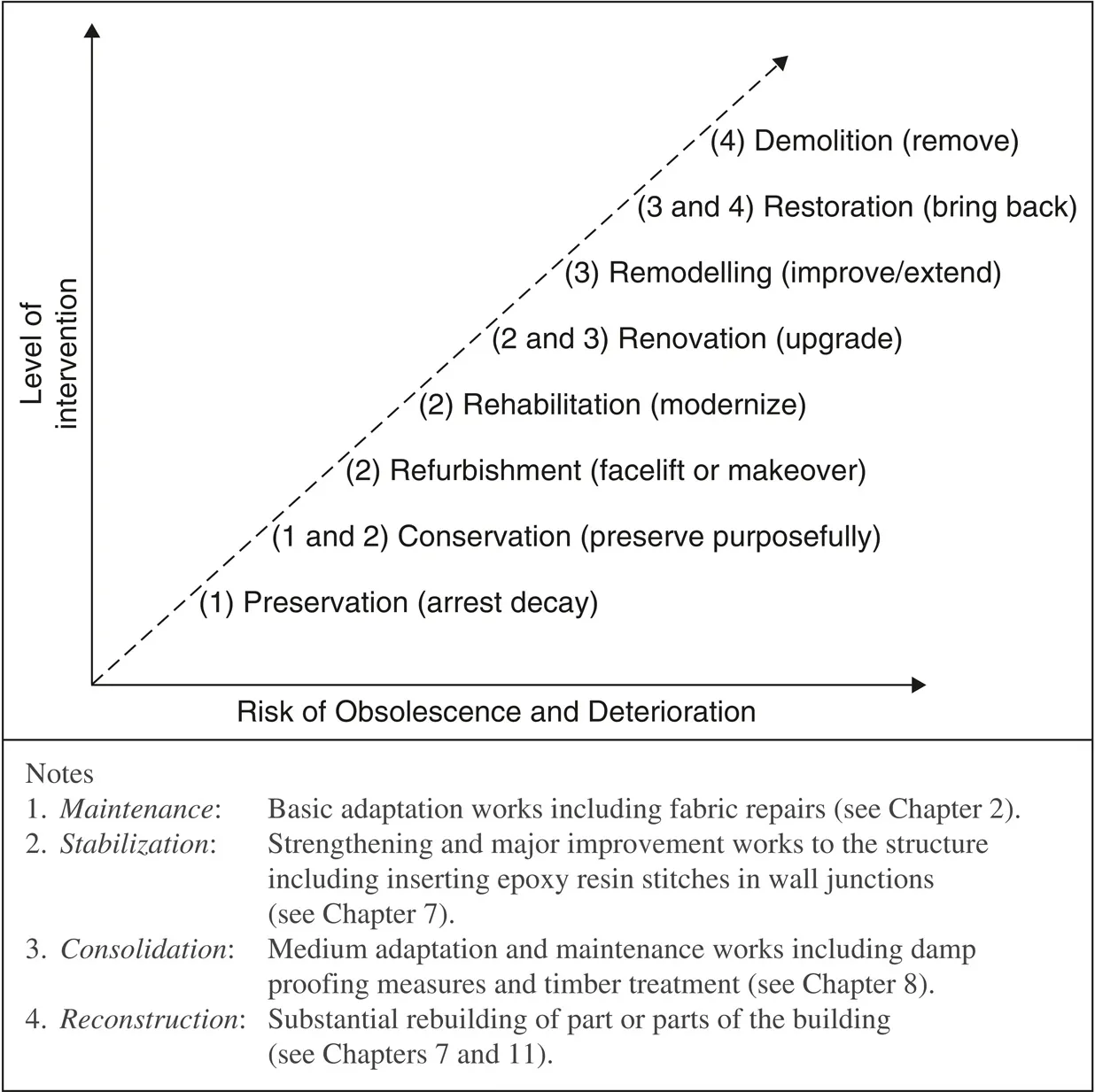
Figure 1.1 The range of interventions
Range of Adaptation Options
As suggested in the above section the scope of adaptation works is wide and depends on the extent and purpose of the change proposed to the building. Figure 1.1 shows that they can range from basic preservation works at one end of the spectrum to almost complete reconstruction at the other (see also Figures 1.8 and 3.2, respectively for the three main branches of adaptation and for increasing intervention). In between these two extremes, in approximate ascending order are interventions such as refurbishment, rehabilitation, remodelling, renovation, retrofitting, and restoration. The Glossary at the end of the book gives brief definitions of these and other related terms.
The differences between the various terms for adaptation options relate to both the extent and the nature of the change and intervention they describe. Table 1.2 highlights the scale of adaptation options.
Table 1.2 Scale of adaptation options and degree of change

Levels of Commercial Adaptation
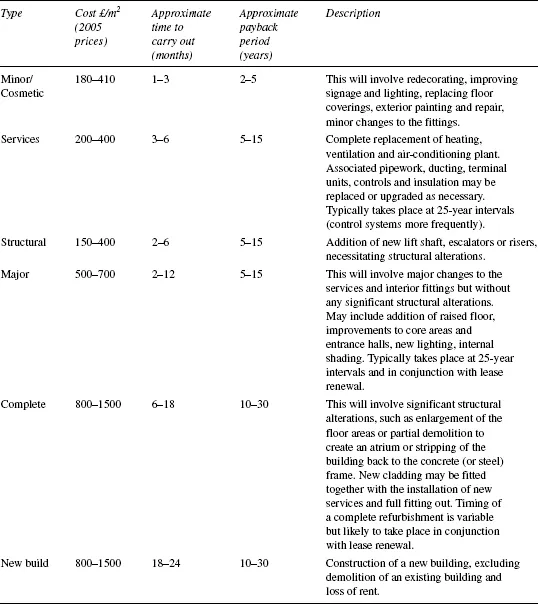
As seen in the above section the scope of adaptation works is wide and depends on the extent and purpose of the change proposed to the building. More specifically Table 1.3 shows the various levels of refurbishment for commercial premises, which are particularly influenced by market and lease considerations.
Timing and Cost of Typical Adaptation Projects
The duration and cost of an adaptation project depends, as with new-build work, on a variety of factors. The size, quality, complexity and location of the work will all influence the time it takes to complete the scheme as well as determine the level of expenditure required.
Table 1.3 Typical levels of commercial refurbishment (Based on Martin and Gold, 1999)
Another factor that influences when and how adaptation is undertaken is the phasing of the work. This is addressed in a little more detail later in the chapter.
The lists in Tables 1.4–1.6, respectively give an approximate indication of the time-scale and costs involved for typical range of small/medium/large-size adaptation schemes. They are based on typical projects but the lists are neither exhaustive nor precise and so should be used with care. (See also the list in Table 11.4 comparing the procurement options of various sizes of adaptation work.)
Table 1.4 Estimated time-scales and costs of typical small-scale adaptation schemes

Adaptability Criteria
Adaptability is obviously a key attribute of adaptation. It can be defined as the capacity of a building to absorb minor and major change (Grammenos and Russell, 1997). The five criteria of adaptability are:
- Convertibility: Allowing for changes in use (economically, legally, technically).
- Dismantlability: Capable of being demolished safely, efficiently and speedily – in part or in whole.
- Disaggregatability: Materials and components from any dismantled building should be as reusable or reprocessable (i.e. recyclable) as possible.
- Expandability: Allowing for increases in volume or capacity (the latter can be achieved by inserting a...
Table of contents
- Cover Page
- Half Title Page
- Dedication
- Title Page
- Copyright Page
- Contents
- List of Figures
- List of Tables
- Preface to 2nd edition
- Preface to 1st edition
- Disclaimer
- Acknowledgements
- 1 Introduction
- 2 Feasibility
- 3 Principles of Converting Buildings
- 4 Adaptive Reuses
- 5 Lateral extensions
- 6 Vertical Extensions
- 7 Structural alterations
- 8 Principles of refurbishment
- 9 Further aspects of refurbishment
- 10 Sustainable adaptation
- 11 Implementation
- Appendix A: Checklist for assessment of habitability
- Appendix B: Key aspects of performance
- Appendix C: Table of suitable sizes of pre-cast (pc) concrete lintels for various spans and loadings (from Richard Lees Ltd catalogue, c. 1995)
- Appendix D: Typical notes and specification column in a drawing for a small extension scheme
- Appendix E: Building control checklist
- Appendix F: Typical specimen maintenance schedules
- Appendix G: Normalized performance index (NPI) calculation form
- Appendix H: House extensions
- Appendix I: Office scorer refurbishment/redevelopment evaluation form
- Glossary
- Bibliography
- Index
Trusted by 375,005 students
Access to over 1.5 million titles for a fair monthly price.
Study more efficiently using our study tools.
Frequently asked questions
Yes, you can cancel anytime from the Subscription tab in your account settings on the Perlego website. Your subscription will stay active until the end of your current billing period. Learn how to cancel your subscription
No, books cannot be downloaded as external files, such as PDFs, for use outside of Perlego. However, you can download books within the Perlego app for offline reading on mobile or tablet. Learn how to download books offline
Perlego offers two plans: Essential and Complete
- Essential is ideal for learners and professionals who enjoy exploring a wide range of subjects. Access the Essential Library with 800,000+ trusted titles and best-sellers across business, personal growth, and the humanities. Includes unlimited reading time and Standard Read Aloud voice.
- Complete: Perfect for advanced learners and researchers needing full, unrestricted access. Unlock 1.5M+ books across hundreds of subjects, including academic and specialized titles. The Complete Plan also includes advanced features like Premium Read Aloud and Research Assistant.
We are an online textbook subscription service, where you can get access to an entire online library for less than the price of a single book per month. With over 1.5 million books across 990+ topics, we’ve got you covered! Learn about our mission
Look out for the read-aloud symbol on your next book to see if you can listen to it. The read-aloud tool reads text aloud for you, highlighting the text as it is being read. You can pause it, speed it up and slow it down. Learn more about Read Aloud
Yes! You can use the Perlego app on both iOS and Android devices to read anytime, anywhere — even offline. Perfect for commutes or when you’re on the go.
Please note we cannot support devices running on iOS 13 and Android 7 or earlier. Learn more about using the app
Please note we cannot support devices running on iOS 13 and Android 7 or earlier. Learn more about using the app
Yes, you can access Building Adaptation by James Douglas in PDF and/or ePUB format, as well as other popular books in Architecture & Architecture General. We have over 1.5 million books available in our catalogue for you to explore.