- 264 pages
- English
- ePUB (mobile friendly)
- Available on iOS & Android
eBook - ePub
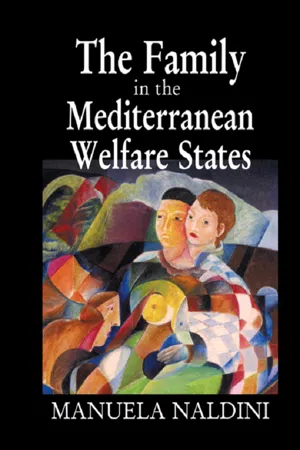
The Family in the Mediterranean Welfare States
About this book
This work analyses in a historical and comparative perspective the relationship between the family and the welfare state in two Mediterranean countries: Italy and Spain. Two aims form the focus of the book. Firstly, to open the black box of the family in welfare state analysis, introducing a focus on inter-generational and kin relations. Secondly, to explain why the southern welfare states have offered very low support to families with children by taking into account several factors: the legacy of fascism, the role of the Church, and the specific role played by leftist parties in defining family policy as labour policy.
Information
PART ONE ANALYSING FAMILIES AND THE WELFARE STATE
Chapter 1 Welfare State and Family Models
DOI: 10.4324/9780203009468-3
Theoretical Orientations
The theoretical core of this book draws primarily on the literature on comparative welfare states and gender studies. This chapter is divided into four main sections. The first section provides some initial definitions and investigates the relationship between the family and the state. The second provides a historical analysis of when and why research on the sociology of the family and the welfare state converged. In the third section I explore the main traditions of comparative welfare state research, focusing particularly on two new strands of research: the gendered welfare state and the Mediterranean welfare state model. Finally, the fourth section illustrates the theoretical perspective in which this book is placed.
Problems of Definition
Some key concepts in this book are ‘family’, ‘state’, ‘social policy’ and ‘welfare state’. The first two are particularly problematic. ‘Family’ and ‘state’ cannot be seen as unitary concepts with a single meaning or reference point. There have been different family forms in the past and in modern society; moreover, the concept of ‘family’ overlaps with concepts such as household, kinship, marriage and parenthood. The concept of family itself has different meanings in different countries, and in some countries may have a broader meaning which is not clearly delimited in the language or daily life of the people. In Italy and Spain, for instance, the single term la famigliaAa familia can refer both to individual households and to kinship networks. Different values and ideas also exist about what families should be like, and what kind of living arrangements are acceptable and merit the term ‘family’. The phrase ‘the family’ is polysemic and thus avoided in this work, while alternative terms such as family, families and/or family/kinship networks are used (Finch, 1989). ‘State’ is also a concept that incorporates many different meanings. The state can be broadly defined as a set of institutions and/or organizations (i.e. central and local governments, courts, police and so on).
Neither does social policy have a single meaning, and perhaps given that this term refers to a great number of public policies that vary across countries and over time, it is more appropriate to use the term ‘social policies’. Social policies can be seen as an assemblage of public interventions that have social purposes and effects, including the distribution of life chances, well-being and the quality of life, as well as social consequences of other policies. This definition of social policies clearly inspires Marshall’s definition, where
Social policy is not a technical term with an exact meaning … it is taken to refer to the policy of governments with regard to the action having a direct impact on the welfare of citizens, by providing them with service and income. The central core consists of social insurance, the health and welfare services, and housing policy.(quoted in Titmuss, 1974: 30)
From this perspective the meaning of the term ‘social policy’ does not differ greatly from that of ‘welfare state’. According to Flora and Heidenheimer, ‘welfare and state are among the most ambiguously employed terms in contemporary English political vocabulary’ (1981a: 5). Even today, the concept underlying the term ‘welfare state’ has hardly been defined once and for all (Ferrera, 1996). It is difficult to define because the concept is related to modernization processes and to basic development problems, and it should be interpreted as a response to the demand for socio-economic equality and security. From this point of view
There are three basic means by which the welfare state pursues its goals: the direct payment of cash benefits, the direct provision of services in kind, and the indirect extension of benefits through tax deductions and credits … The objectives and instruments … do not define the historical core of the welfare state. It has become usual to identify the beginning of the modern welfare state with the innovation of social insurance.(Flora and Heidenheimer, 1981b: 25–7)
From another perspective, the welfare state has been conceptualized as a state committed to modifying the play of social or market forces in order to achieve greater equality (Ruggie, 1984). Recently, Ferrera has tried to summarize the existing suggestions into a new definition of the term welfare state. She argues that the welfare state can be defined as ‘an aggregation of public interventions related to modernisation processes, which provides protection under the form of assistance, assurance and social security, introducing specific social rights in the case of pre-defined events as well as duties of financial contribution’ (Ferrera, 1996: 49).
With regard to families, while policies act on them, policies in their turn are also affected by the formation and behaviour of families themselves (Fox Harding, 1996). This means looking at the twin interaction between the two elements of the analysis: policies and families.
The Relationship between the Family and the State: A Theoretical Perspective
The relationship between the state and the family has always been crucial for understanding the material and symbolic organization of families. The fundamental aspect of this relationship is the institutional dimension of the family’, the fact that the family is one of the main institutions which provides for social reproduction and social control in society. The institutional dimension of the family is the real object of state intervention and it is with-in this relation that we experience the different organizational forms of what we label ‘family’. From an analytical perspective, the institutional dimension of the family is assumed to be a metaphor for the opposing dichotomy between the public and the private spheres. The nexus between public and private exists only in terms of this relationship. As a consequence, the concept of private does not have life of its own without that of public. Thus, the modern family exists only within defined institutional expectations of the society and as a consequence of the state (Saraceno, 1984).
The relationship between the family and the welfare state in the area of social reproduction is where interference between the public and the private spheres is strong.1 The state – by its welfare state structures – has been by no means neutral with regard to the family. A range of measures, from transfer payments to welfare provisions, have been grounded on certain presuppositions about family functioning and have attempted to create, strengthen or modify the appropriate conditions.
In Moroney’s words, the development of the welfare state during this century has been based on:
A set of implicit and explicit assumptions concerning the responsibility which families assume, or are excepted to assume, for their members and the condition under which this responsibility must either be shared with or taken over by society through its public or voluntary organisations.(Moroney, 1976: 5)
The historiography of welfare states has tended to focus almost exclusively on the role of the state and/or on the nexus between the state and the market, neglecting the importance of other relations. As Lewis suggests, it is more adequate to see modern states as always having had a ‘mixed economy of welfare’, in which the state, the voluntary sector, the family and the market have played different roles at different points in time. Although the mixed economy of welfare has taken different forms in different European countries, the family has always been the main provider of welfare in every country (Lewis, 1993). Paci (1987) has also noted that the major challenge to comparative work on the history of welfare regimes is to chart and explain the changing boundaries between the various elements in the ‘mixed economy’.
From this point of view the issue of family contribution, particularly the contribution of women to the welfare state and to social protection, underlines the importance of considering private issues in the design of public protection measures. It highlights the need to take into account not only what happens with respect to access to work and to work’s accompanying protection systems, but also what happens in family life and the social protection that it provides (Martin, 1996). This means that family issues should no longer be treated as sectoral issues, but rather in terms of family policy or interventions undertaken by the state or other social partners for their support.
The balance of responsibilities between the family and the state in the provision of social welfare is a key issue in social policy analysis. The boundary between public and private spheres has been redrawn, over time, at the level of prescription as found in certain laws and social policies. One way of looking at state policies about the family is that these are in effect concerned with drawing the boundaries between state and family and defining the proper role of each. It should be added that the process of drawing the boundaries between state and family responsibilities is part of an on-going process and is a contested arena (Finch, 1989).
Thus, not only must the division of labour between different institutions be taken into account in social policy analysis, but also the gender division of labour and the forms of interdependence between men and women and between parents and children within families (Saraceno, 1994; Sainsbury, 1994b). As a consequence, cross-national variation between welfare states (e.g. Esping-Andersen’s work2) and in family patterns cannot be understood without looking at the ways in which welfare state policies have conceptualized paid and unpaid work.
The Convergence of Research on the Sociology of the Family and Welfare State Studies
This section illustrates the fruitful intersection of work from sociology on the family with studies on the welfare state. An overview of the existing literature leads to the conclusion that sociologists of the family were the first to pay attention to the relationship between social policy and the family. It was only with the awareness of the limits of welfare state growth that scholars on the welfare state began to re-evaluate the family in their analyses of welfare state functioning.
The Sociology of the Family and Interest in the Welfare State
In the area of sociology of the family, there are two very different approaches to the study of the interrelationship between the family and the welfare state in the European context:
- The feminist approach, namely, gender studies and studies on caring work.3
- The approach that conceived the development of the welfare state as an example of excessive state intrusion into the family’s private sphere.
Since the 1970s gender studies and research on caring work have begun to underline the importance of studying the relationship between women, the family, and the welfare state. The authors who adopt this approach conceive of the family as an institution reacting to state intervention as well as influencing other social institutions. This means that the family cannot be seen merely as a dependent’ variable. Instead it should be conceived as a complex institution, composed of different, and sometimes conflicting, individuals with different needs, interests and perspectives. This perspective also emphasizes that the family changes its forms and functions across social, historical, economic and cultural contexts.
From the 1970s onwards, feminist analyses of the family and the welfare state have focused on the social control exercised over women by various public bodies for the organization of reproduction (Pitch, 1983). In particular, studies of how welfare states organize social reproduction describe the relationship between women and the welfare state in terms of both ‘patriarchy’ (e.g. Eisenstein, 1979) and ‘partnership’ (e.g. Siim, 1987). Mcintosh (1978), amongst others, argues that state policies contribute to the reproduction of gender inequalities and of ‘patriarchy’. She approaches the question from the standpoin...
Table of contents
- Cover Page
- Half Title Page
- Title Page
- Copyright Page
- Contents
- List of Figures and Tables
- Foreword by Chiara Saraceno
- Preface
- Acknowledgements
- List of Abbreviations and Acronyms
- Introduction
- PART ONE: ANALYSING FAMILIES AND THE WELFARE STATE
- 1. Welfare State and Family Models
- 2. State Policies Towards the Family
- PART TWO: ORIGINS OF STATE POLICIES TOWARDS THE FAMILY IN THE AUTHORITARIAN PERIOD
- Introduction: DEFINING FASCIST-ERA FAMILY MODELS
- 3. The Italian Case
- 4. The Spanish Case
- PART THREE: THE DEMOCRATIC PERIOD: A FAMILY/KINSHIP SOLIDARITY MODEL
- Introduction: THE WEAKENING OF THE MALE BREADWINNER
- 5. The Political and Legal Context
- 6. Family Changes and Family Solidarity
- 7. Social Policy and Social Services for the Family
- 8. The Cost of Children in Policy-Making Processes
- Conclusion
- Appendices
- Reference
- Index
Trusted by 375,005 students
Access to over 1.5 million titles for a fair monthly price.
Study more efficiently using our study tools.
Frequently asked questions
Yes, you can cancel anytime from the Subscription tab in your account settings on the Perlego website. Your subscription will stay active until the end of your current billing period. Learn how to cancel your subscription
No, books cannot be downloaded as external files, such as PDFs, for use outside of Perlego. However, you can download books within the Perlego app for offline reading on mobile or tablet. Learn how to download books offline
Perlego offers two plans: Essential and Complete
- Essential is ideal for learners and professionals who enjoy exploring a wide range of subjects. Access the Essential Library with 800,000+ trusted titles and best-sellers across business, personal growth, and the humanities. Includes unlimited reading time and Standard Read Aloud voice.
- Complete: Perfect for advanced learners and researchers needing full, unrestricted access. Unlock 1.5M+ books across hundreds of subjects, including academic and specialized titles. The Complete Plan also includes advanced features like Premium Read Aloud and Research Assistant.
We are an online textbook subscription service, where you can get access to an entire online library for less than the price of a single book per month. With over 1.5 million books across 990+ topics, we’ve got you covered! Learn about our mission
Look out for the read-aloud symbol on your next book to see if you can listen to it. The read-aloud tool reads text aloud for you, highlighting the text as it is being read. You can pause it, speed it up and slow it down. Learn more about Read Aloud
Yes! You can use the Perlego app on both iOS and Android devices to read anytime, anywhere — even offline. Perfect for commutes or when you’re on the go.
Please note we cannot support devices running on iOS 13 and Android 7 or earlier. Learn more about using the app
Please note we cannot support devices running on iOS 13 and Android 7 or earlier. Learn more about using the app
Yes, you can access The Family in the Mediterranean Welfare States by Manuela Naldini in PDF and/or ePUB format, as well as other popular books in Politics & International Relations & European Politics. We have over 1.5 million books available in our catalogue for you to explore.